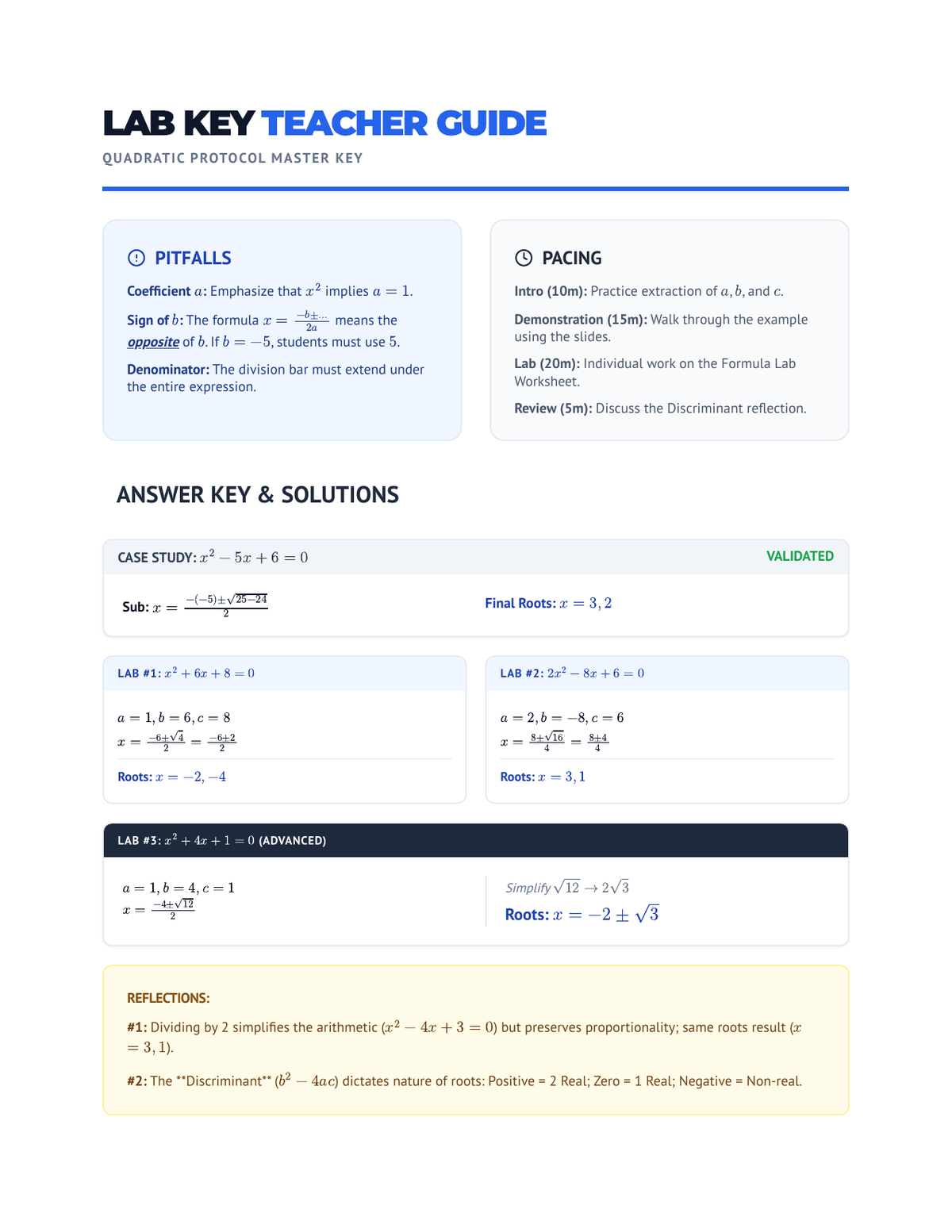
An answer key for the 'Extraction Lab Worksheet' with detailed solutions and error analysis explanations.
A comprehensive teacher resource containing teaching strategies, common student misconceptions, a suggested pacing guide, and a detailed answer key for the Formula Lab worksheet.
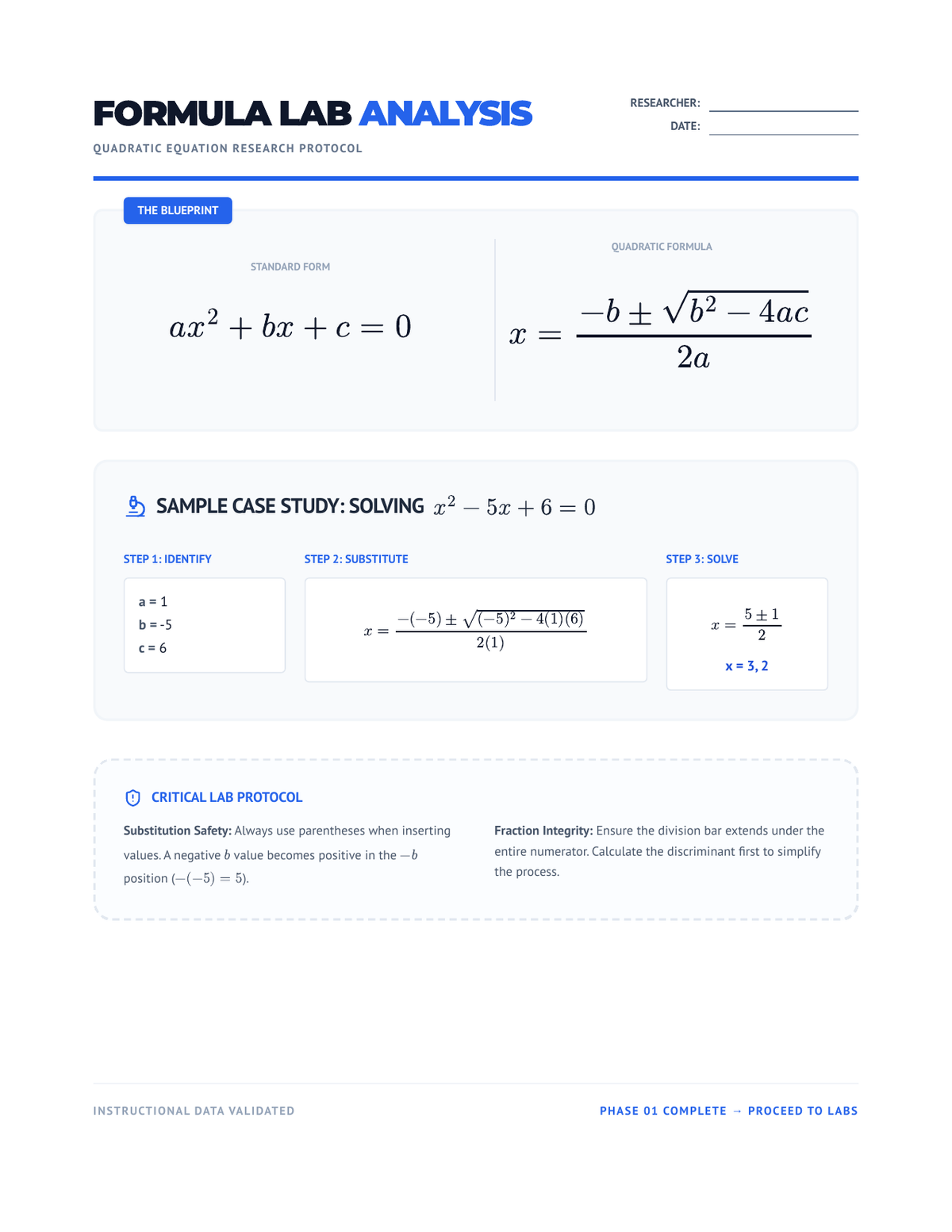
A student-facing worksheet designed as a laboratory report. It includes a guided breakdown of the x² - 5x + 6 = 0 example and three independent practice problems ranging from simple roots to irrational roots.
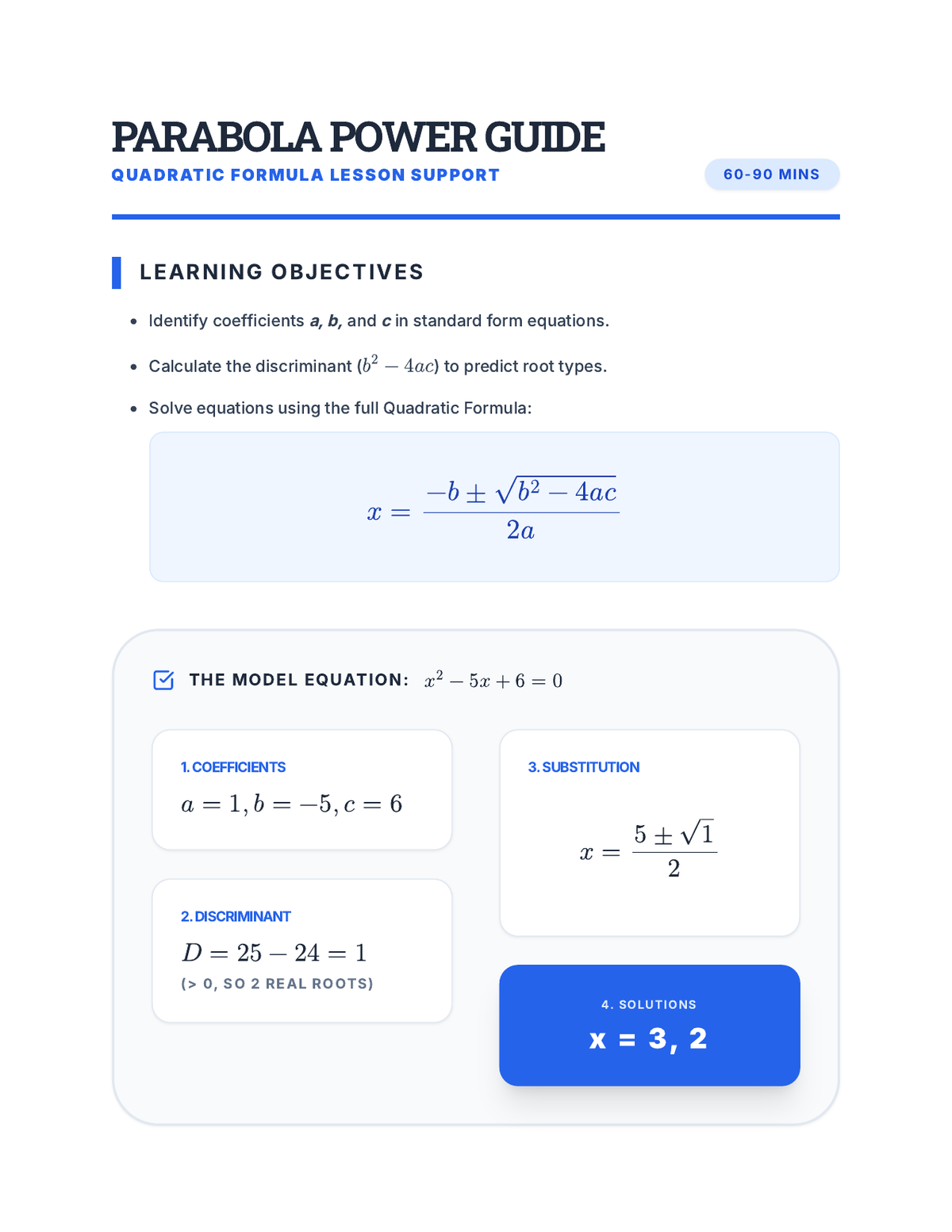
A visually engaging slide deck that breaks down the quadratic formula using a 'Parabola Lab' theme. Includes standard form definitions, the core formula, and a detailed walkthrough of solving x² - 5x + 6 = 0.
A comprehensive teacher guide for the Parabola Power lesson, including pacing, learning objectives, discussion prompts, and common student misconceptions.
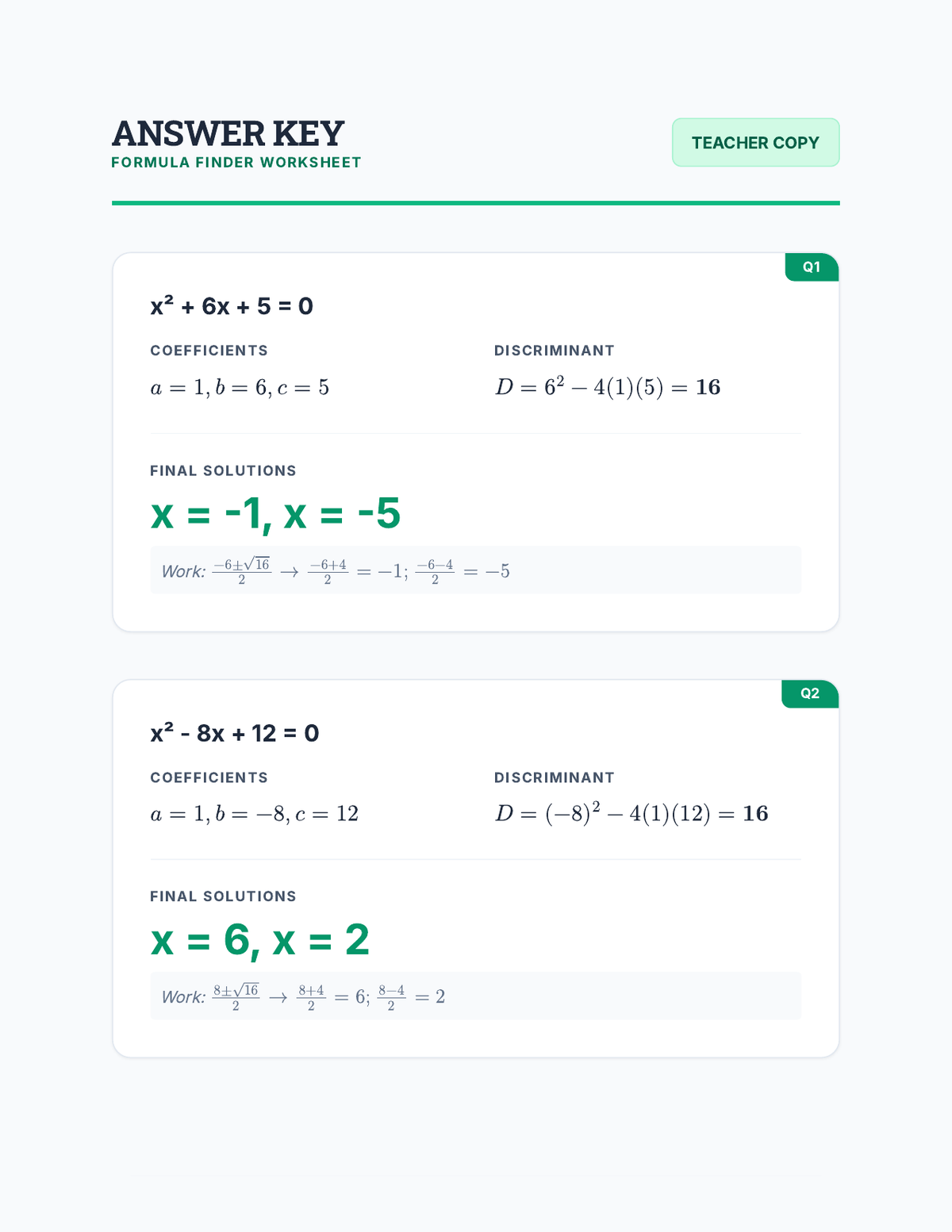
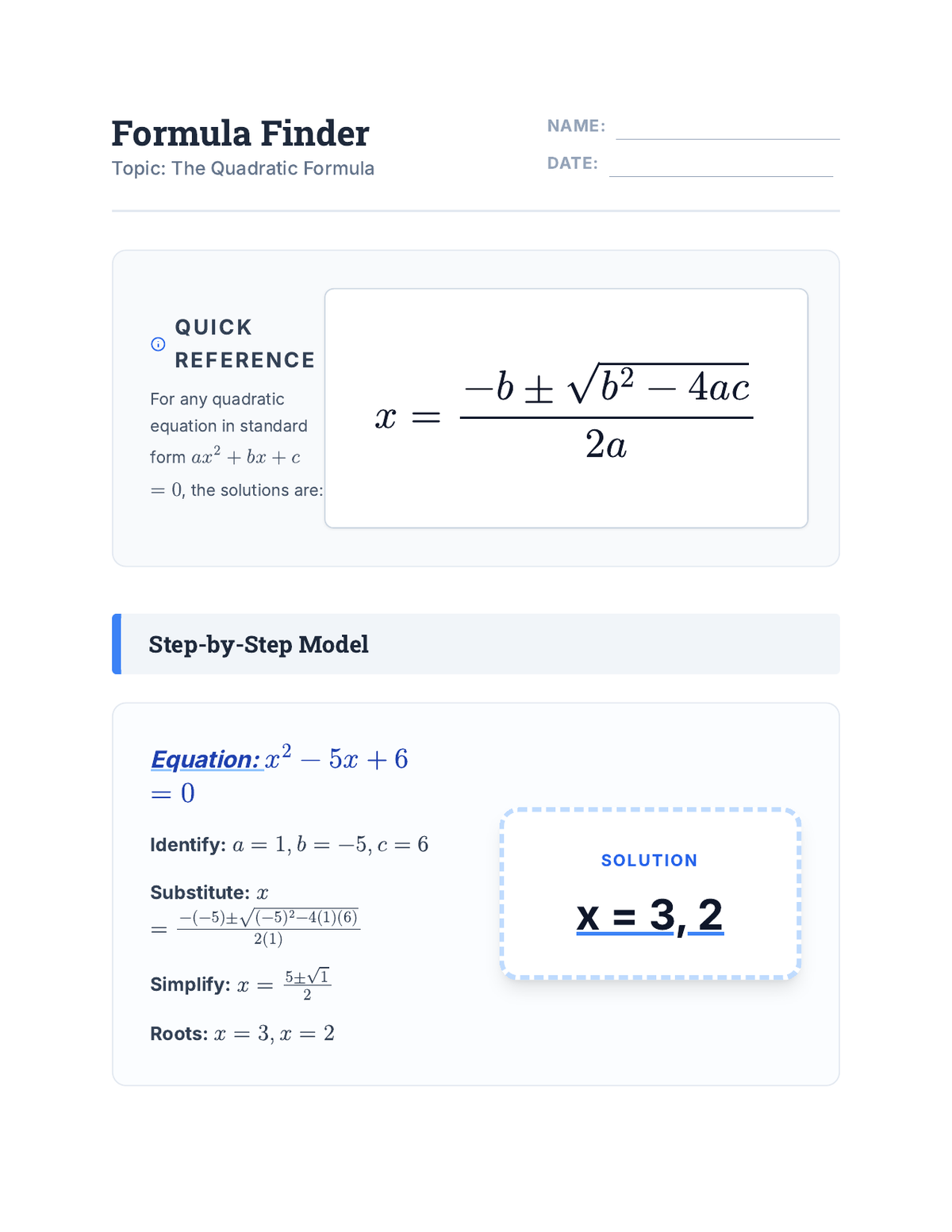
A detailed answer key for the Formula Finder worksheet, including discriminant calculations and step-by-step solutions.
A student worksheet featuring a formula reference, a guided step-by-step example, and practice problems of increasing complexity.
A visual slide deck introducing the quadratic formula, the discriminant, and a step-by-step solved example for class instruction.
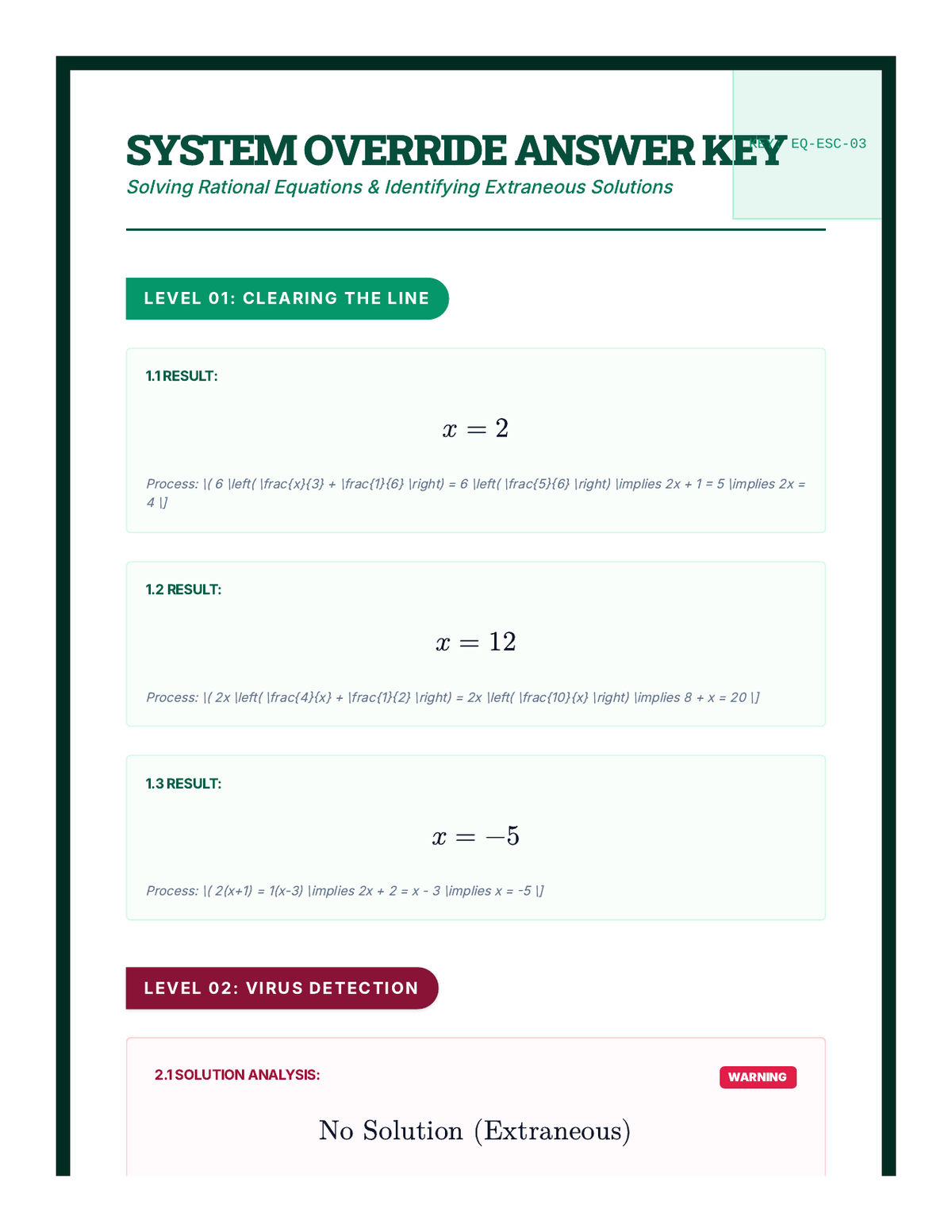
An answer key for the 'System Override Worksheet' providing step-by-step solutions for solving rational equations and identifying extraneous solutions.
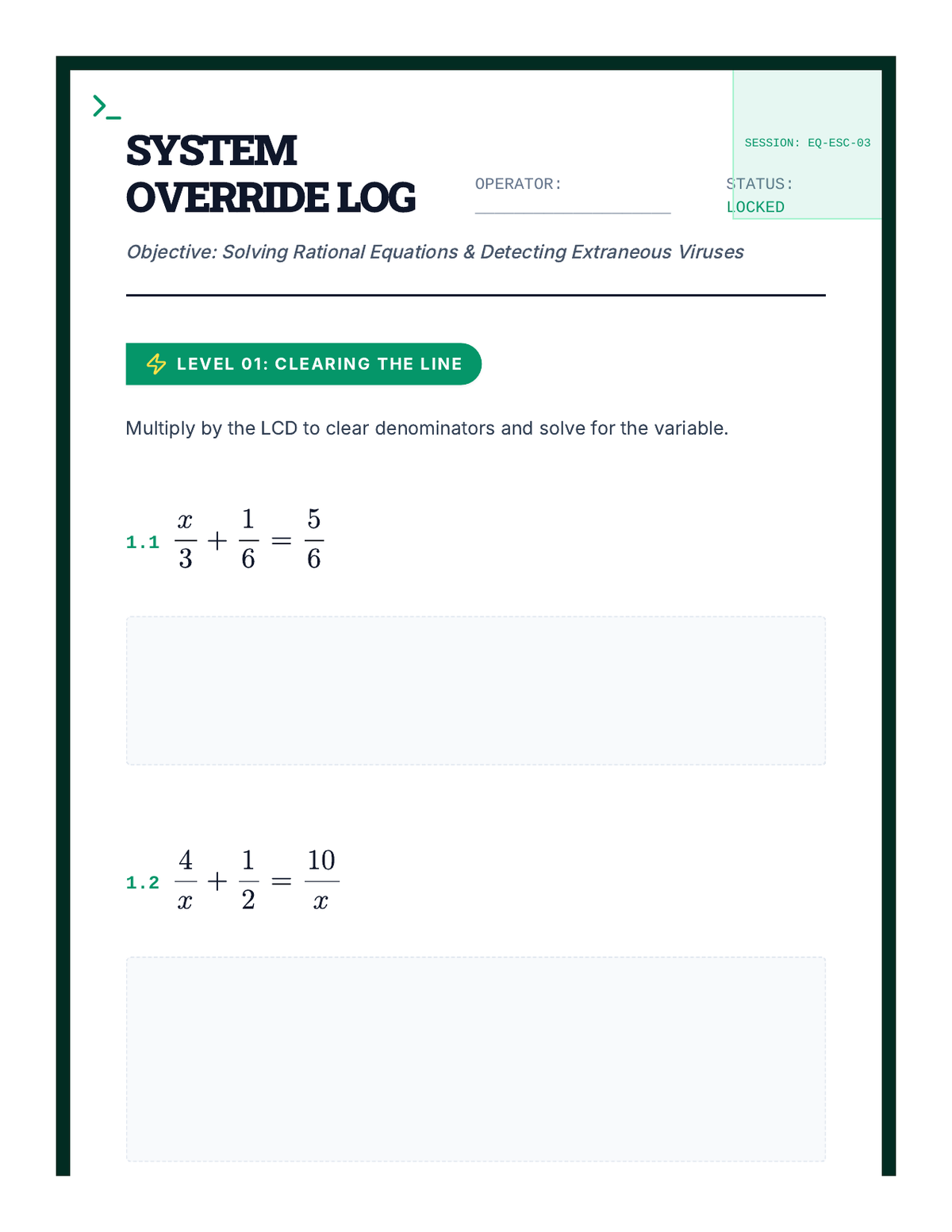
A digital 'escape room' themed worksheet for practicing solving rational equations, including a focus on extraneous solutions and work-rate word problems.
An 'escape room' themed slide deck for solving rational equations. It covers the strategy of multiplying by the LCD to clear denominators, identifying extraneous solutions, and modeling work-rate problems with a digital, system-override aesthetic.
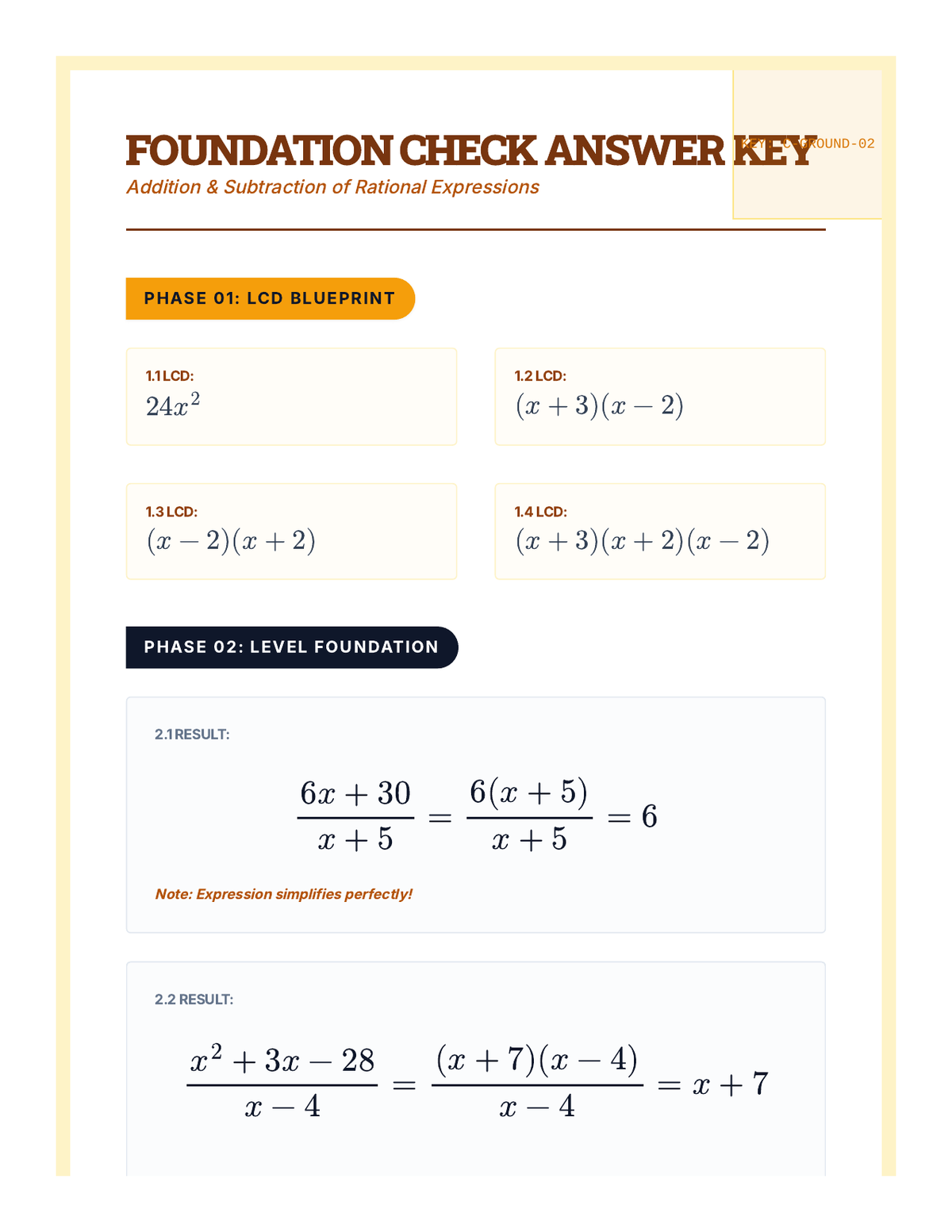
Detailed answer key for the Foundation Check Worksheet, providing step-by-step solutions and explanations for LCD construction and common errors.
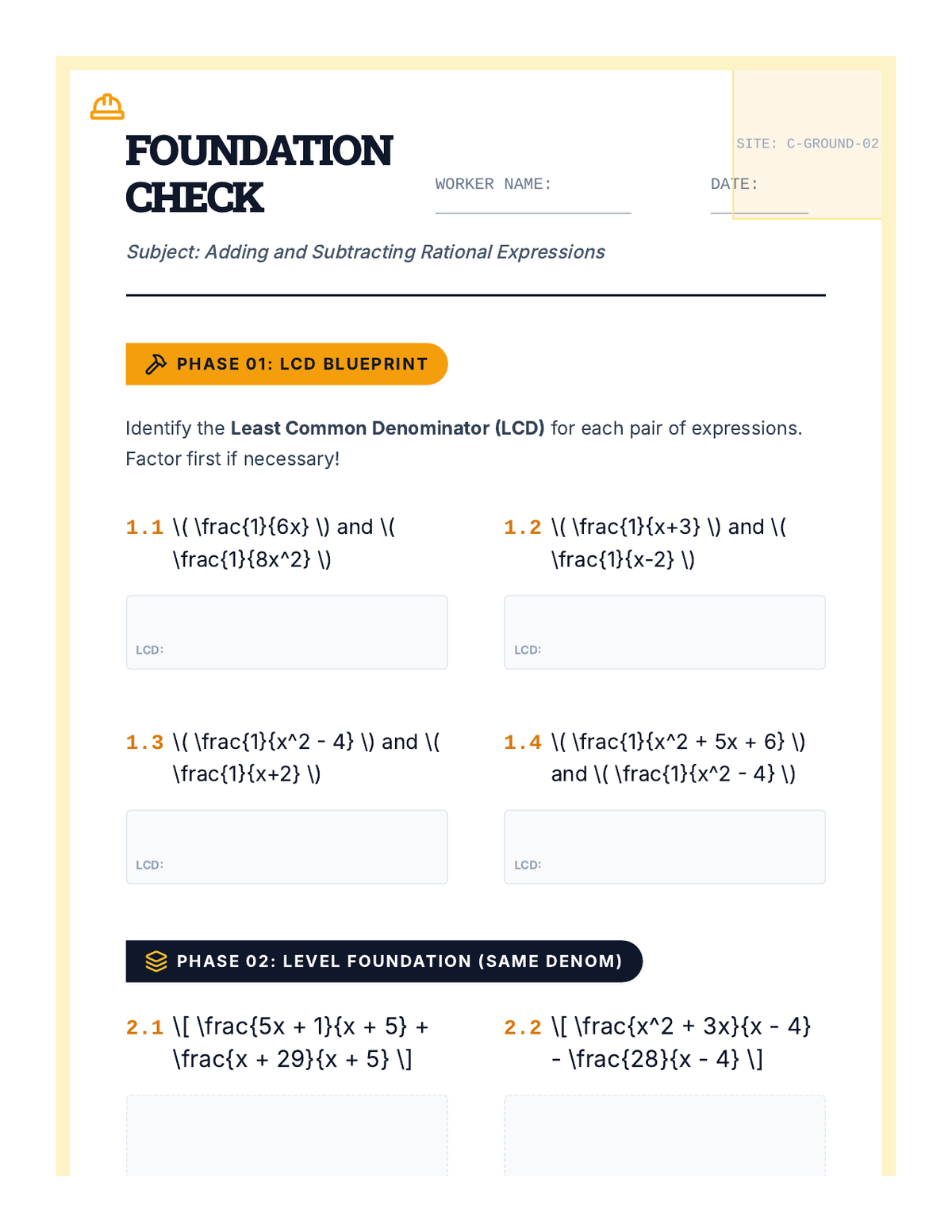
A construction-themed worksheet for practicing addition and subtraction of rational expressions, including LCD identification and a specific section on distributing negative signs.
An engaging slide deck titled 'Common Ground' for Lesson 1.2 on adding and subtracting rational expressions. It features a construction/foundation theme, emphasizing the importance of common denominators (LCD) and the 'subtraction trap' of distributing signs.
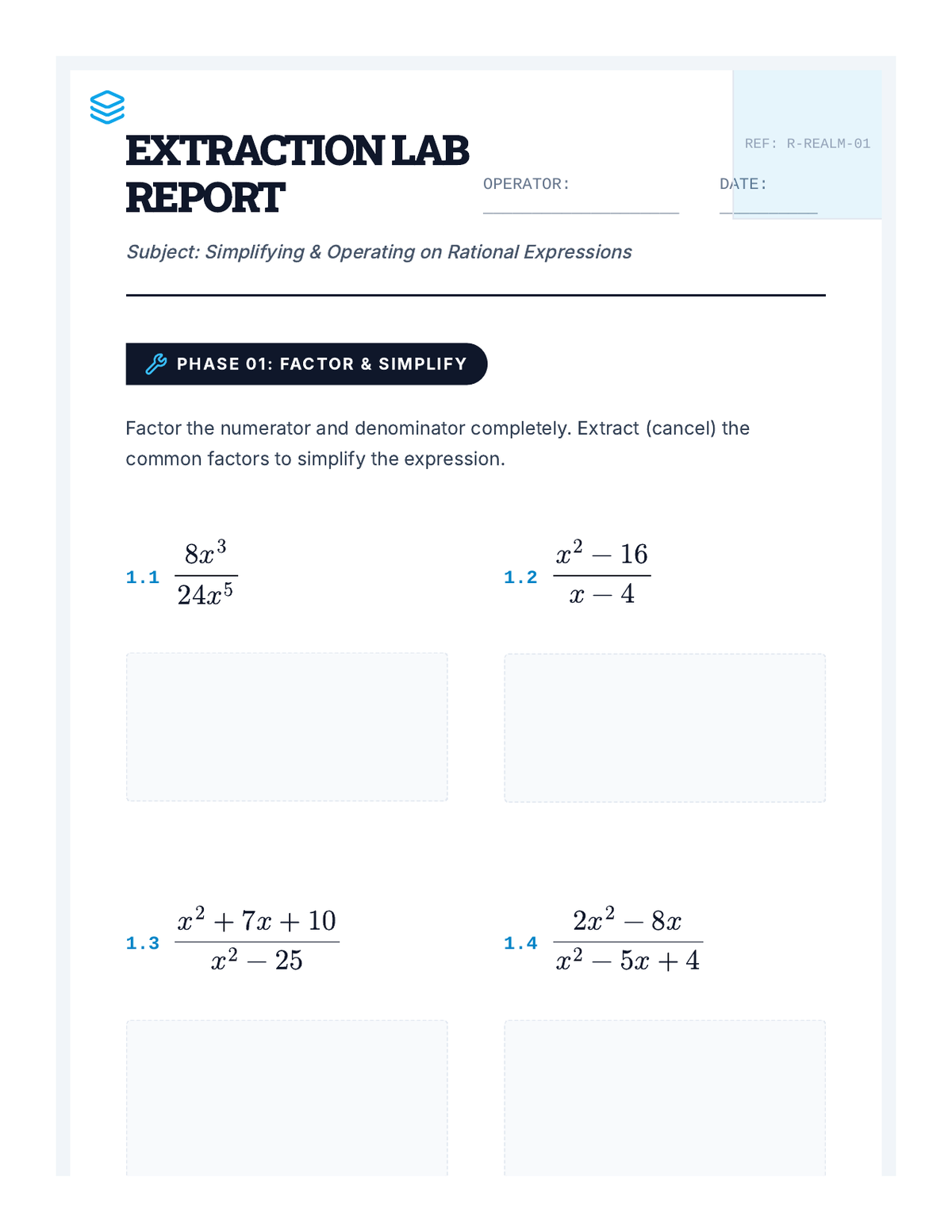
A technical 'Lab Report' worksheet for students to practice simplifying, multiplying, and dividing rational expressions. It includes a specific section for error analysis to help students avoid common 'illegal' mathematical maneuvers.
An engaging slide deck titled 'Expression Extraction' designed for an Algebra 1 lesson on rational expressions. It features a technical 'blueprint' aesthetic and covers simplifying, multiplying, and dividing with a strong emphasis on factoring and avoiding common errors. Updated with larger font sizes for better visibility.
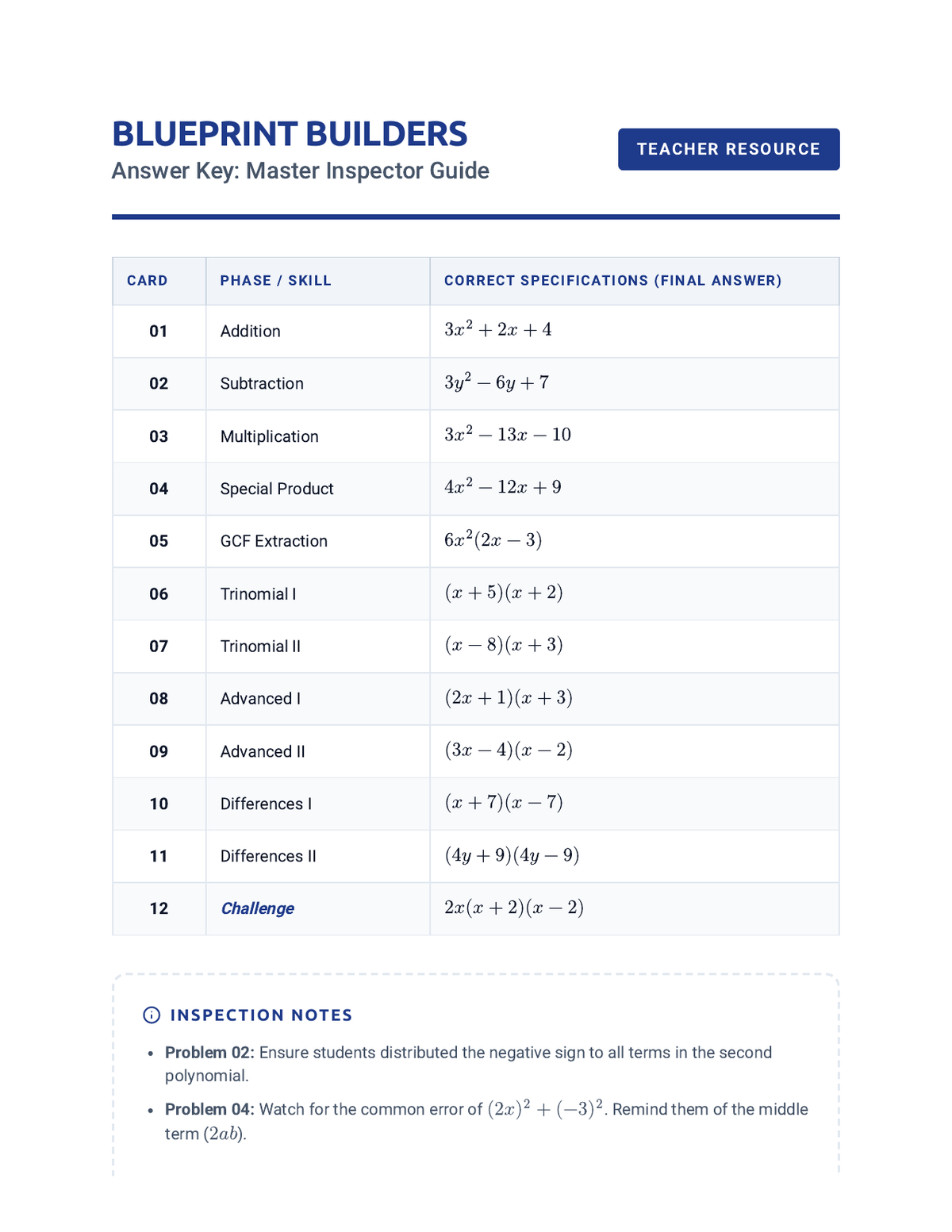
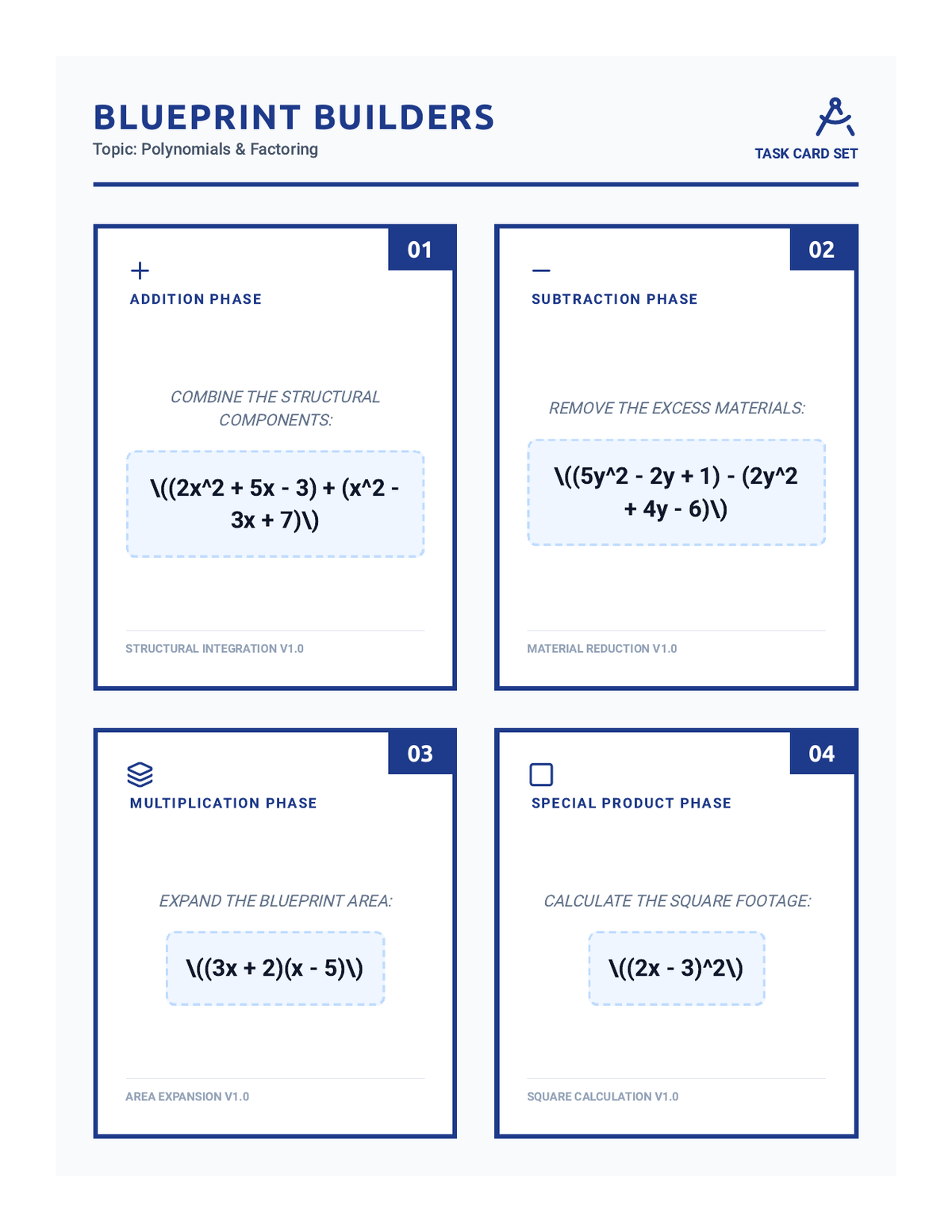
A comprehensive teacher answer key for the Blueprint Builders task cards, including final answers and common student misconception notes.
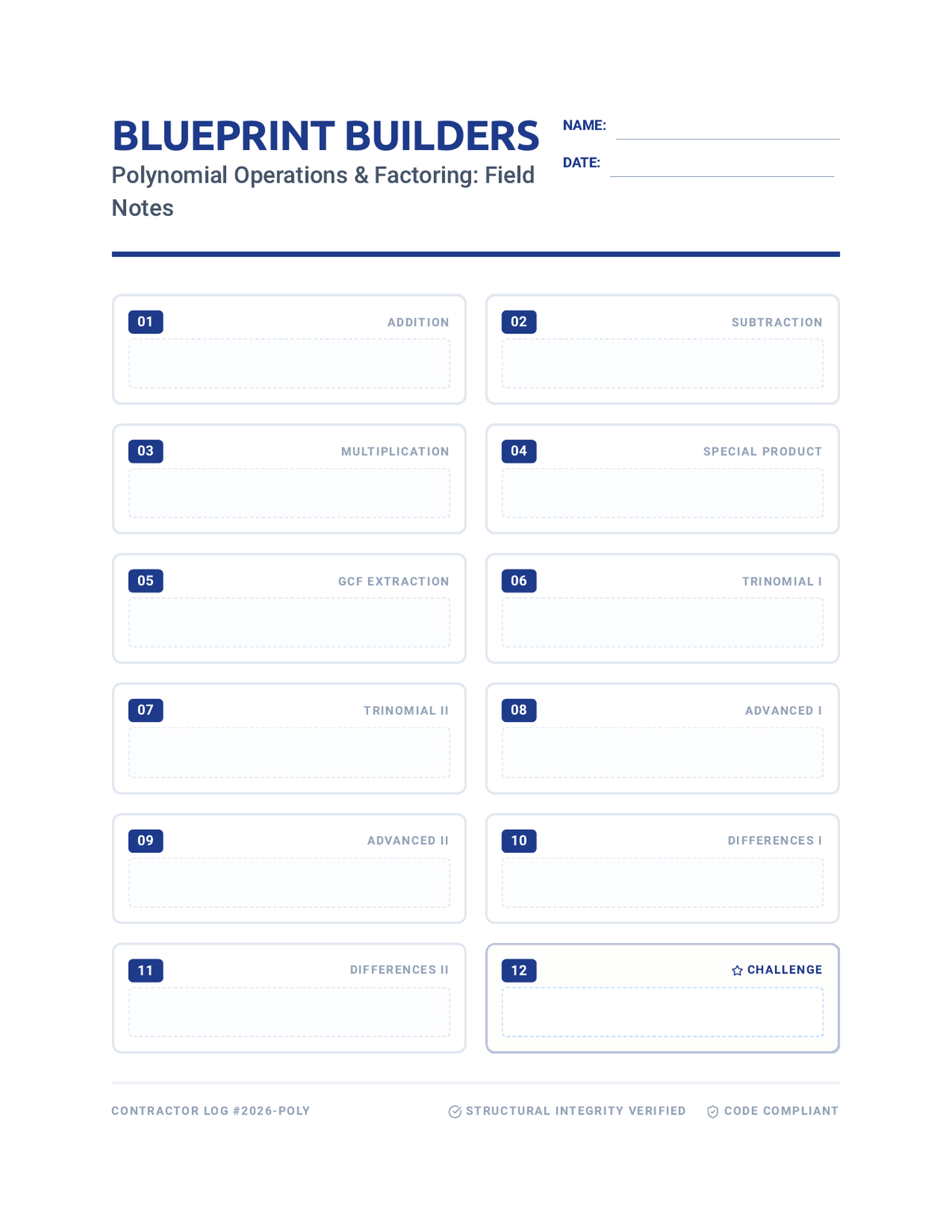
A student recording sheet for the Blueprint Builders task cards, providing organized spaces for work and final answers for all 12 problems.
A set of 12 architectural-themed task cards for Algebra 1, covering polynomial operations and factoring techniques. Each card features a unique construction-related task and specific math problem.
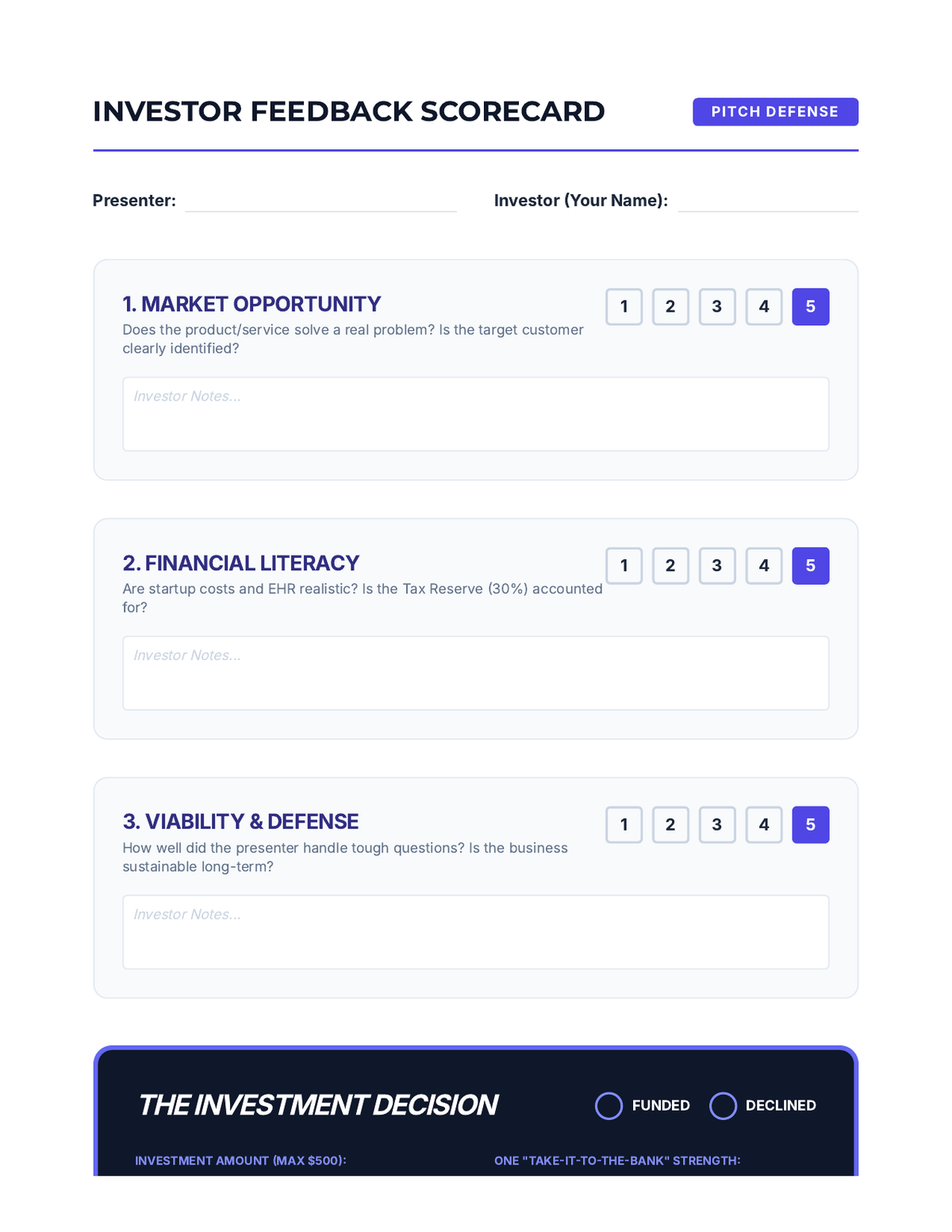
Student peer-assessment scorecard for the Lesson 5 capstone pitch, used by "investors" to evaluate market opportunity, financial literacy, and business viability.
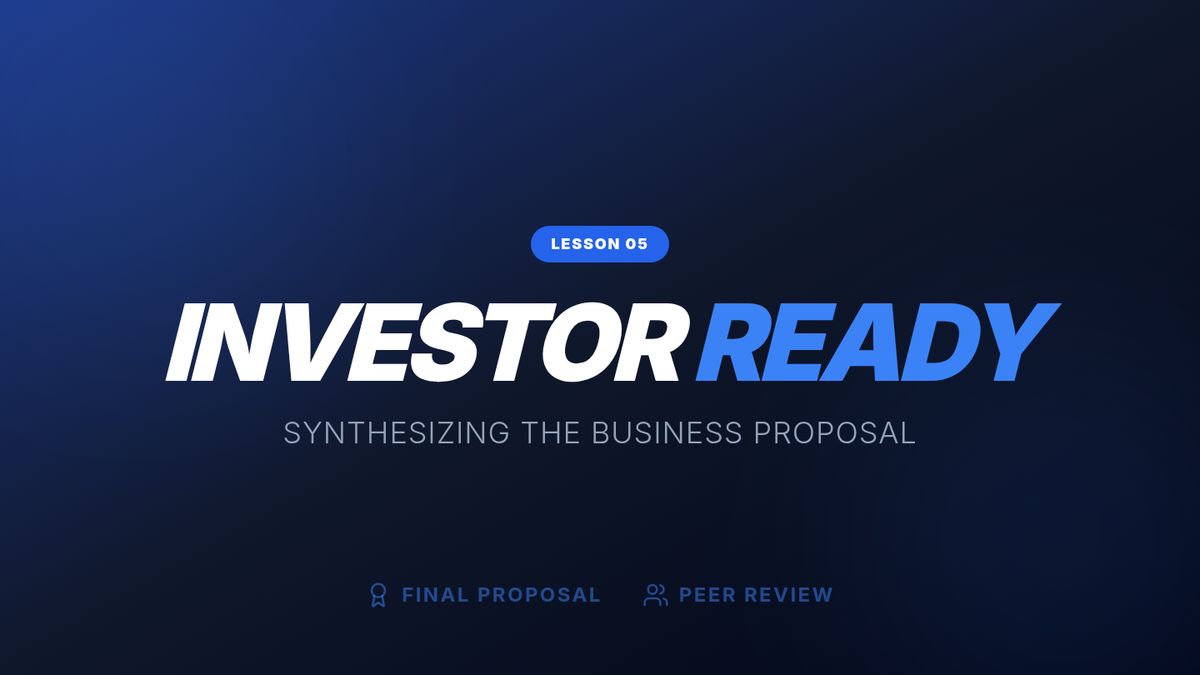
Presentation slides for Lesson 5, framing the "Shark Tank" style pitch day, defining the investor role, and providing tough Q&A prompts for the viability defense.
Visual presentation for Lesson 4: understanding 1099 taxes, self-employment tax obligations, and the power of business deductions.
Visual presentation for Lesson 3: calculating effective hourly rate, understanding non-billable labor, and evaluating opportunity cost in the gig economy.
Visual presentation for Lesson 2: calculating startup costs, distinguishing between one-time and recurring overhead, and understanding the break-even point.
Visual presentation for Lesson 1: identifying marketable skills, introduction to the gig economy, and the SWOT analysis framework for side hustles.
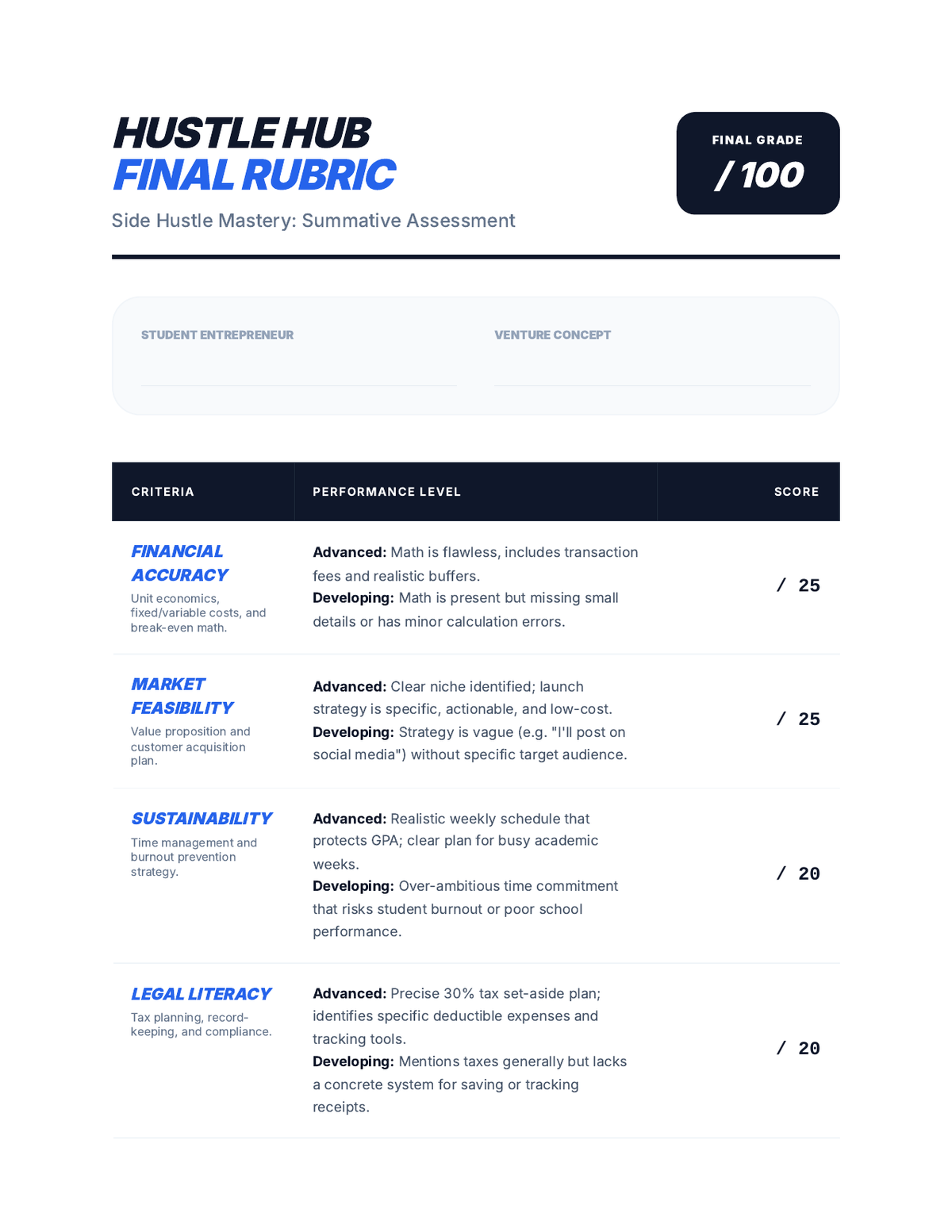
A professional 1-page grading rubric for the final business proposal assessment, covering financial accuracy, feasibility, sustainability, legal literacy, and refinement.
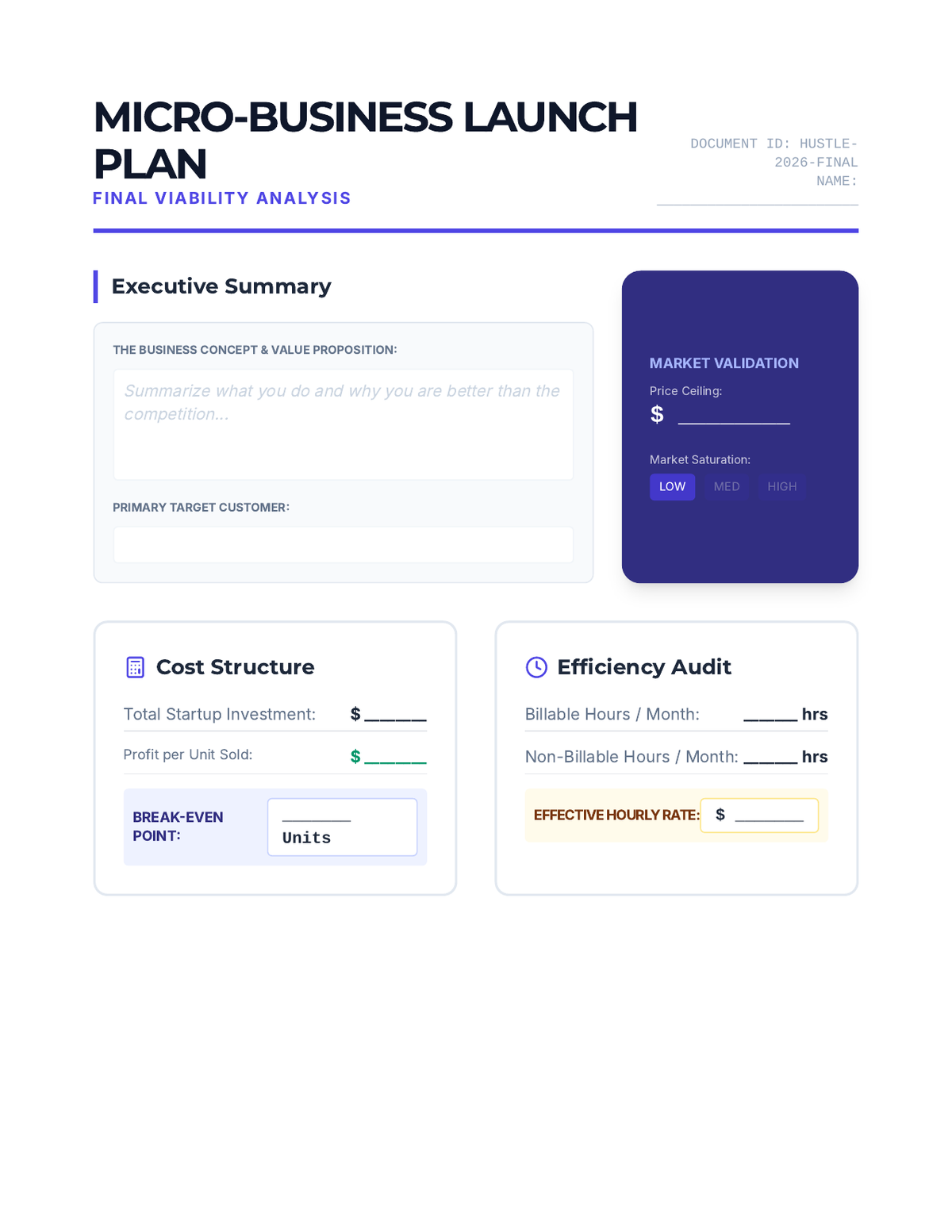
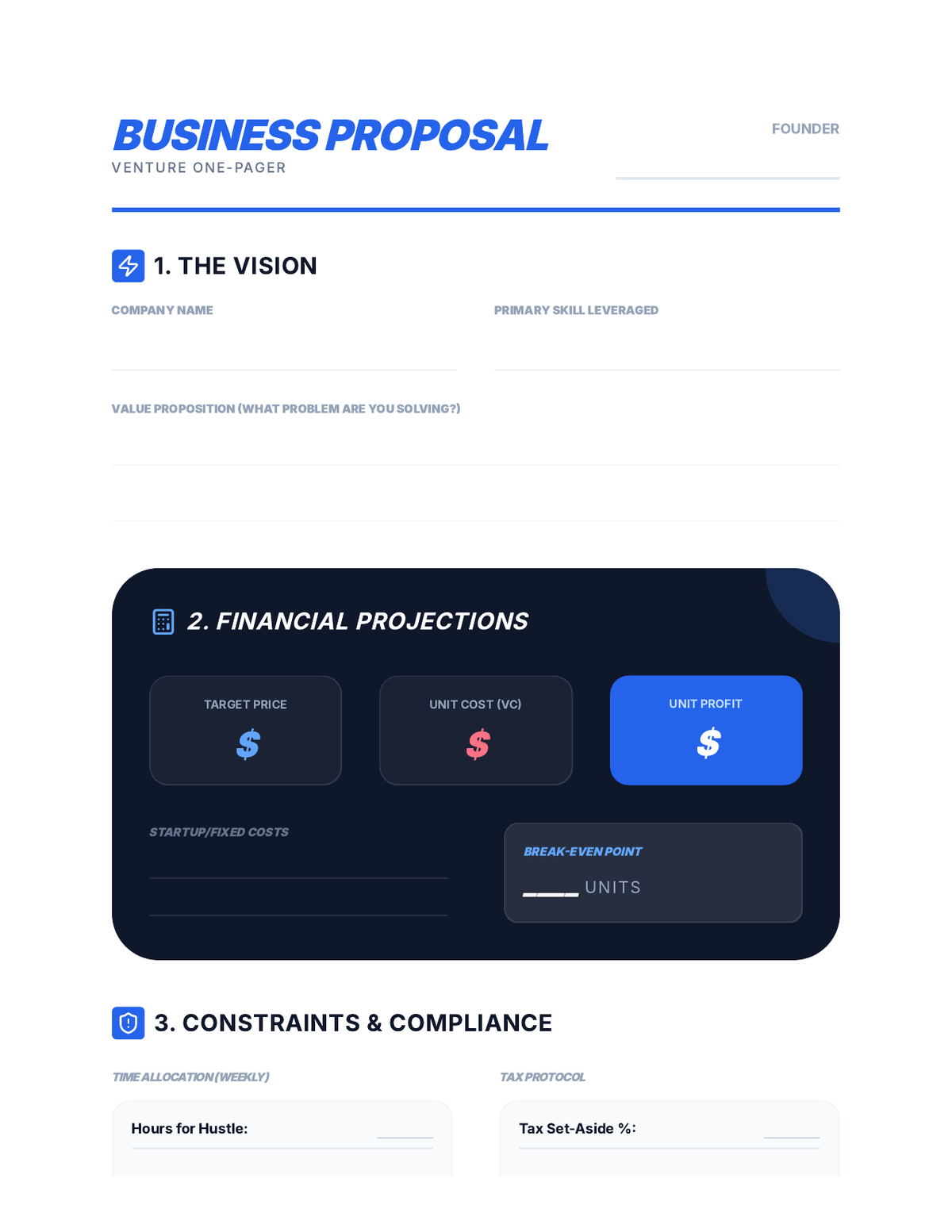
Capstone student document for Lesson 5: a comprehensive one-page business plan synthesizing financial, market, and time-management data for their side hustle concept.
A 2-page student worksheet for the final lesson. Students use this template to develop a professional one-page business proposal and participate in a peer-review session.
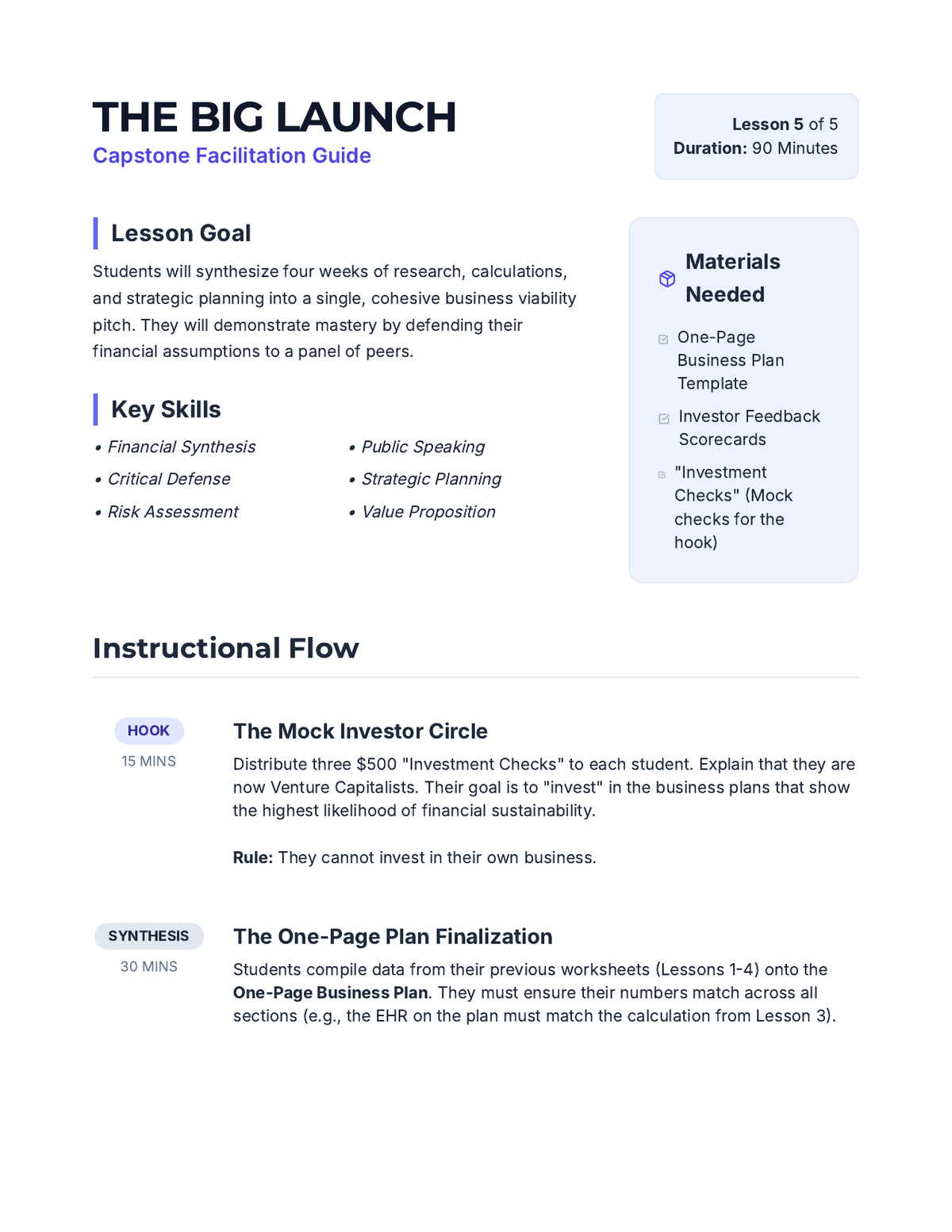
Teacher facilitation guide for Lesson 5, including the mock investor hook, pitch defense instructions, and final debrief prompts.
A 5-slide visual presentation for Lesson 5, introducing the one-page business proposal and guiding the final pitch and peer-review session.
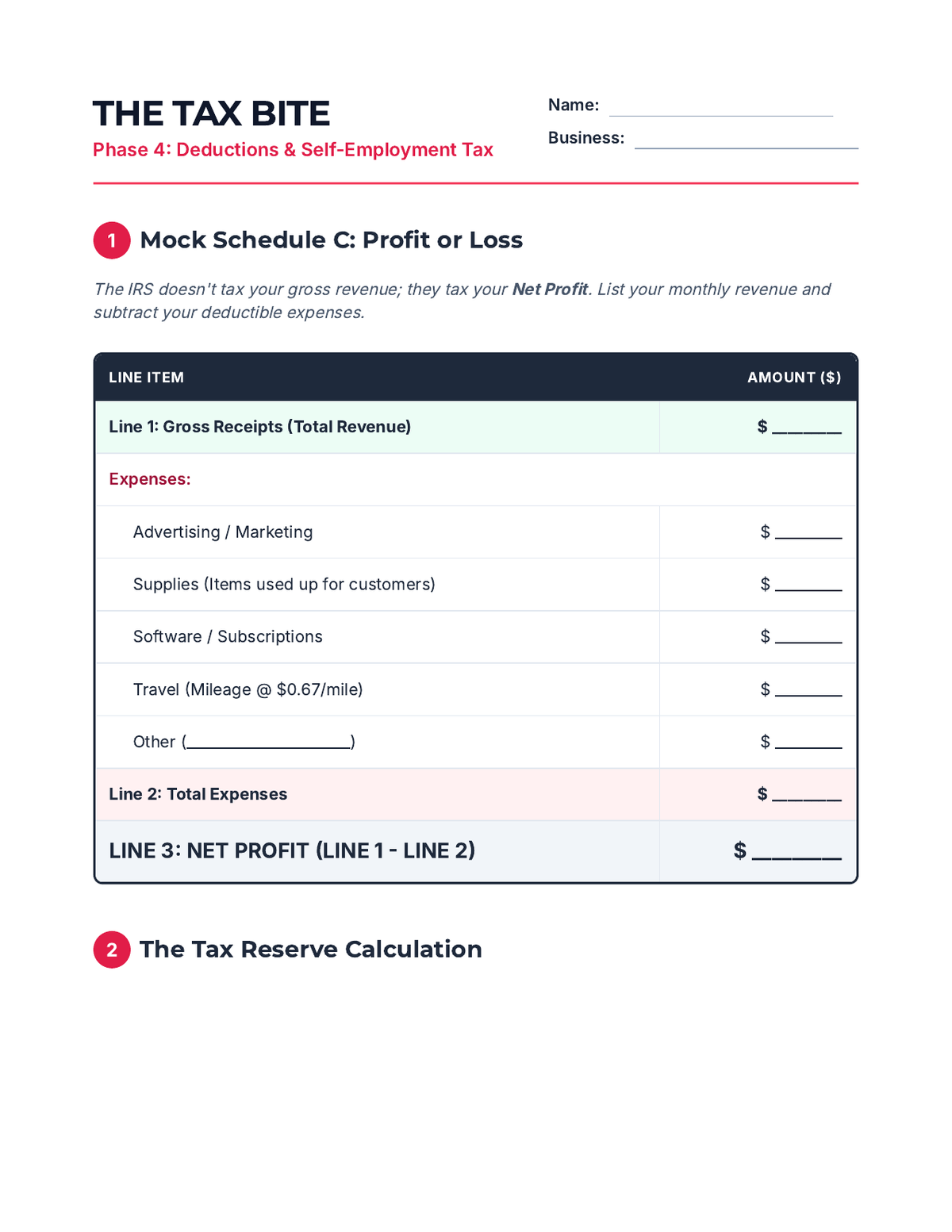
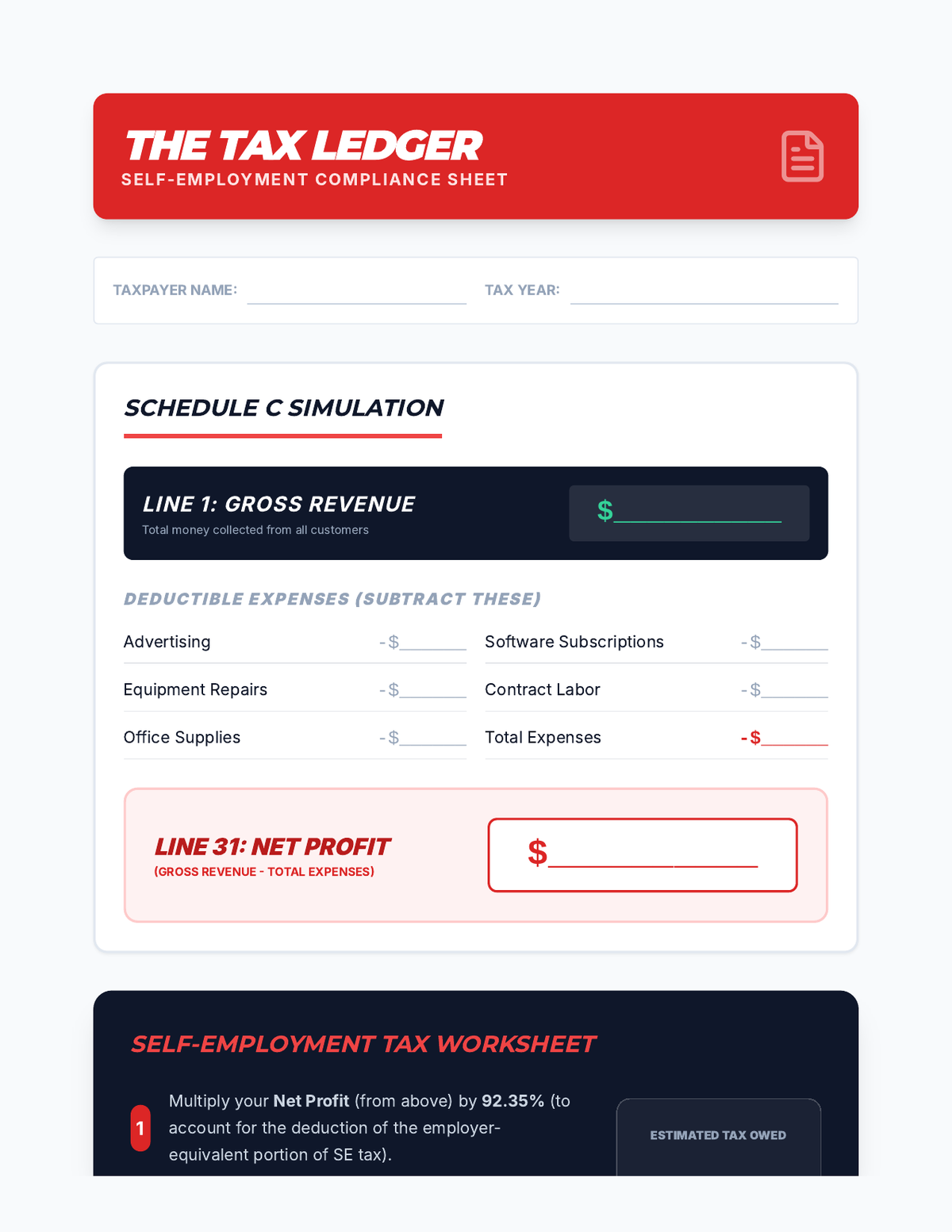
Student worksheet for Lesson 4, featuring a simplified mock Schedule C for calculating net profit and a tax reserve calculator to estimate actual take-home pay.
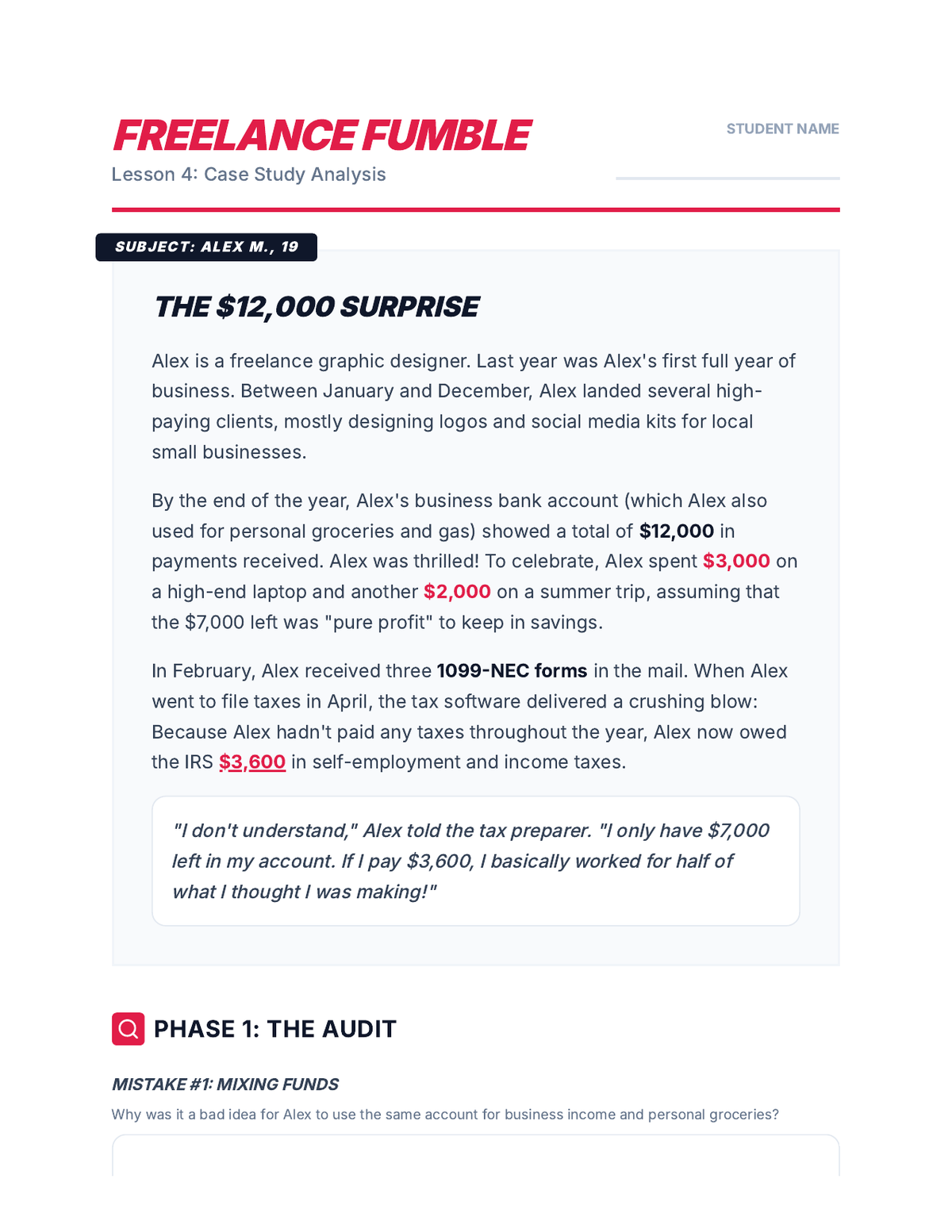
A 2-page case study for Lesson 4 analyzing the financial mistakes of a freelance graphic designer. It includes a narrative, mistake identification, and a student-specific tax planning section.
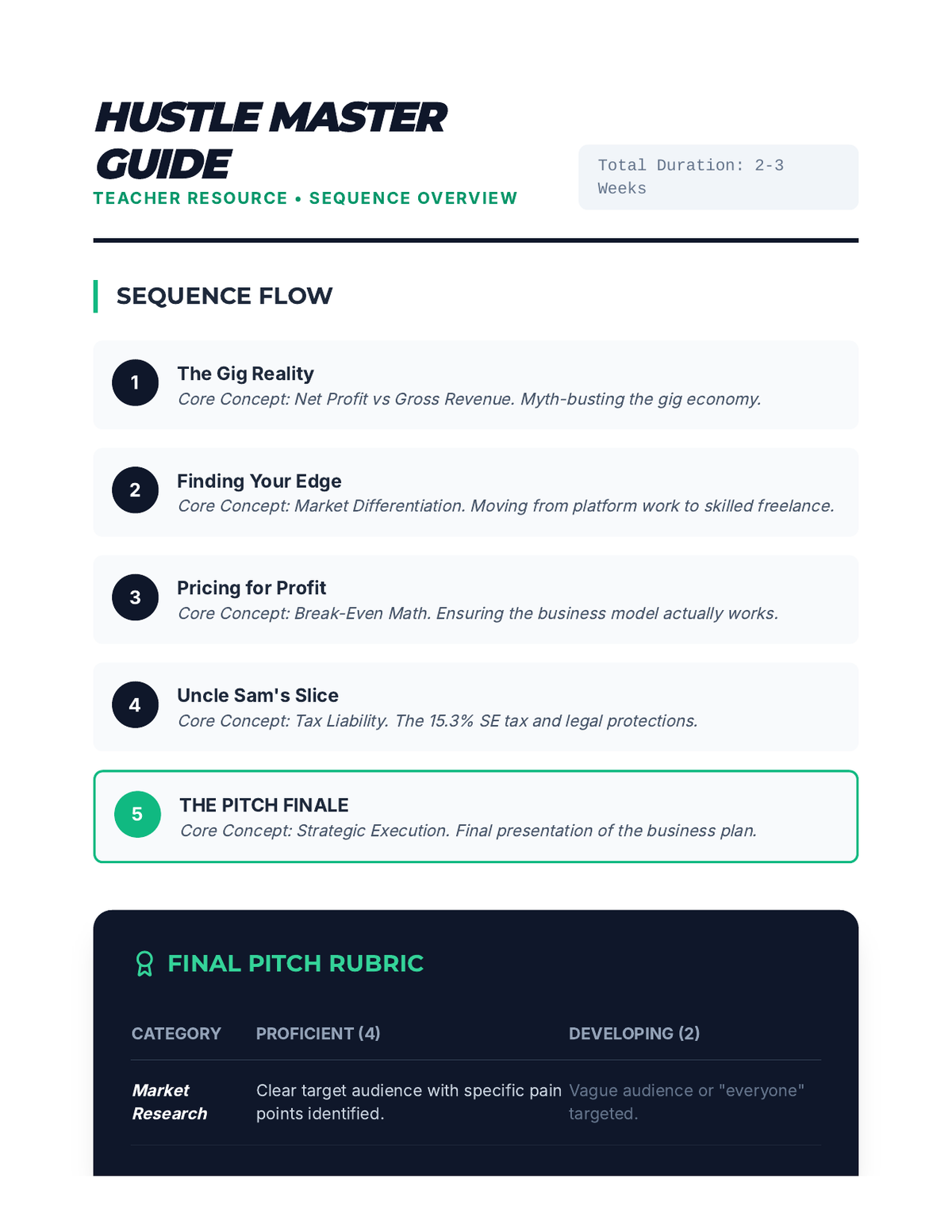
High-level teacher guide for the entire Side Hustle Mastery sequence, including a sequence map, final project rubric, and instructional tips.
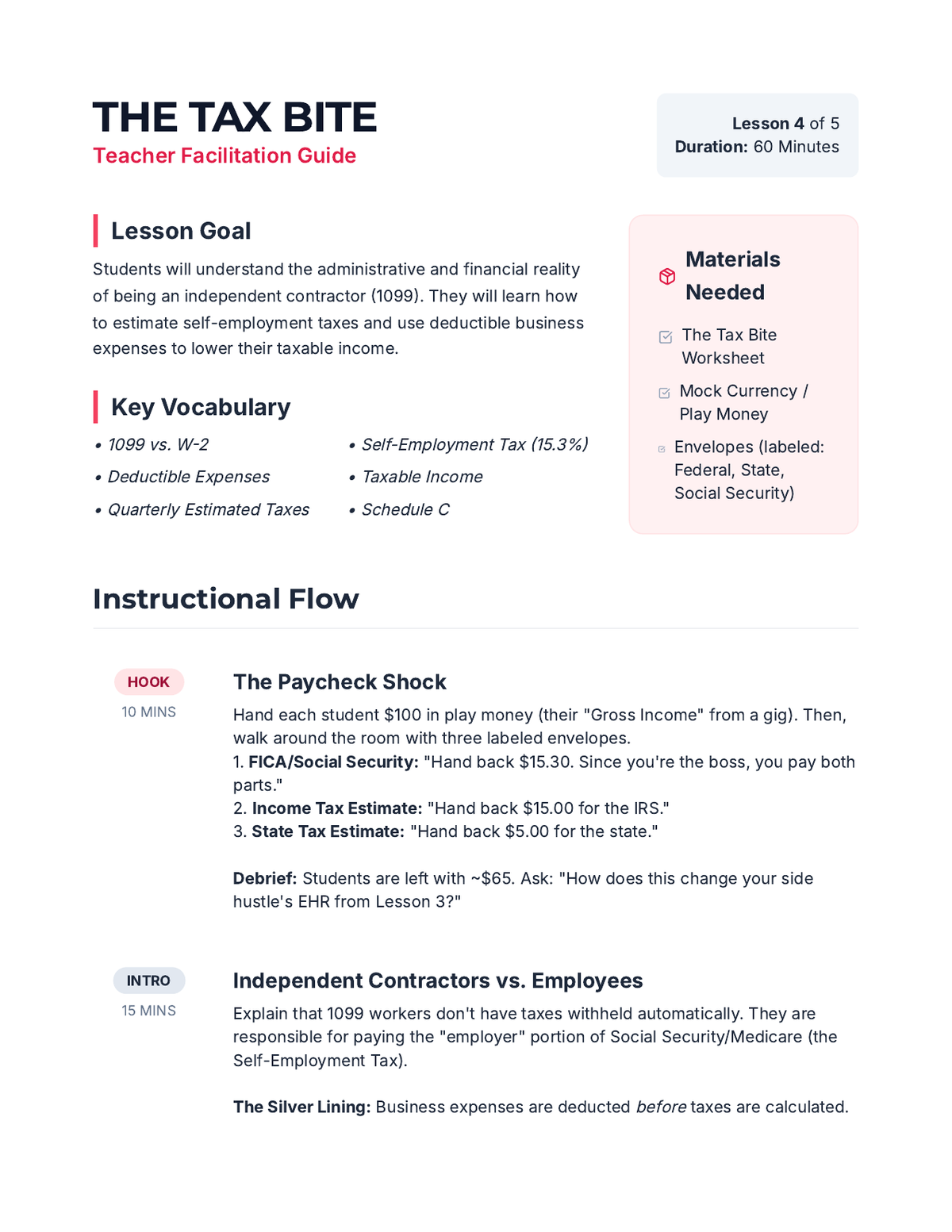
Teacher facilitation guide for Lesson 4, focusing on 1099 taxes, self-employment tax, and the concept of deductible business expenses.
A 5-slide visual presentation for Lesson 4, focusing on the tax and legal realities of being self-employed.
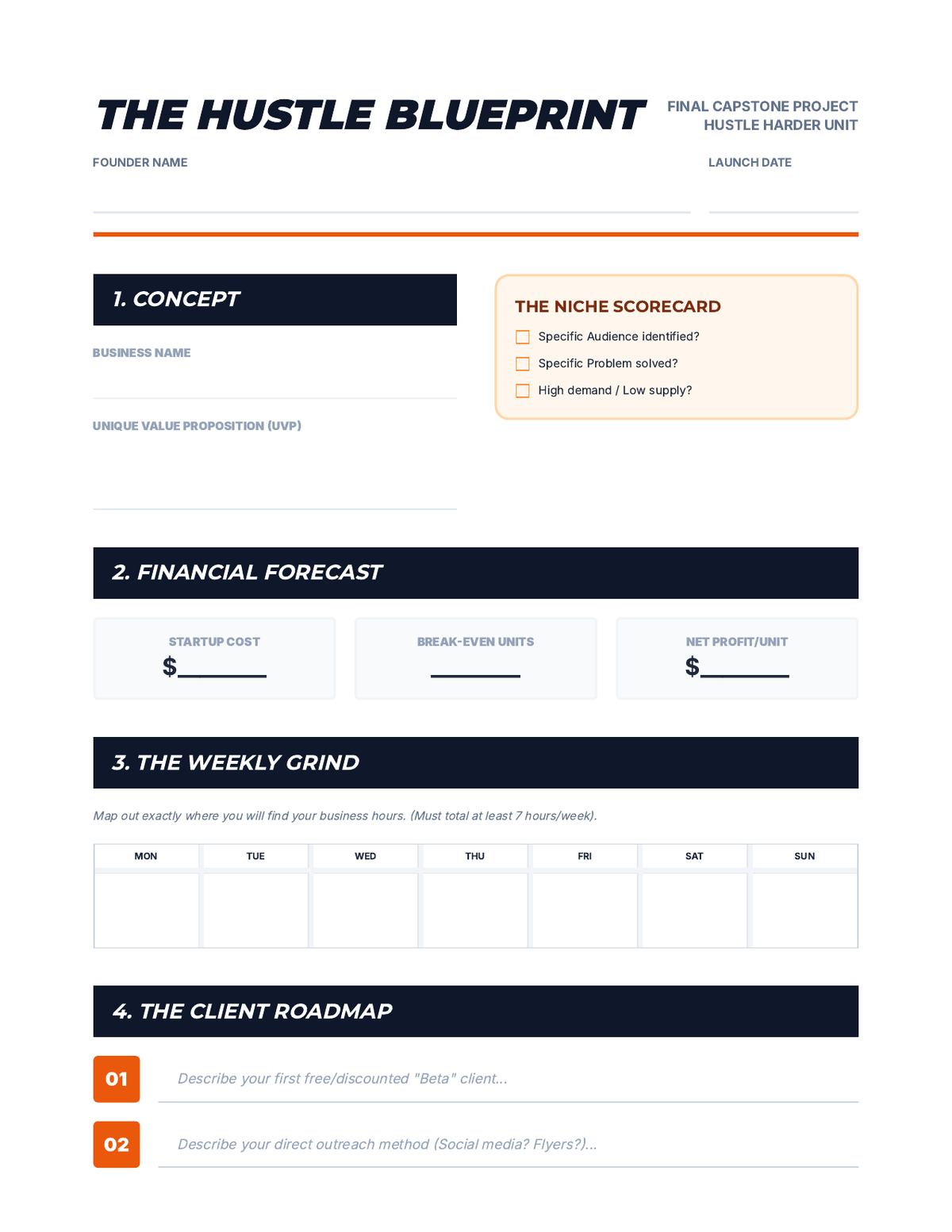
Final project document (Capstone) where students synthesize their business concept, financial forecast, weekly schedule, and client acquisition strategy.
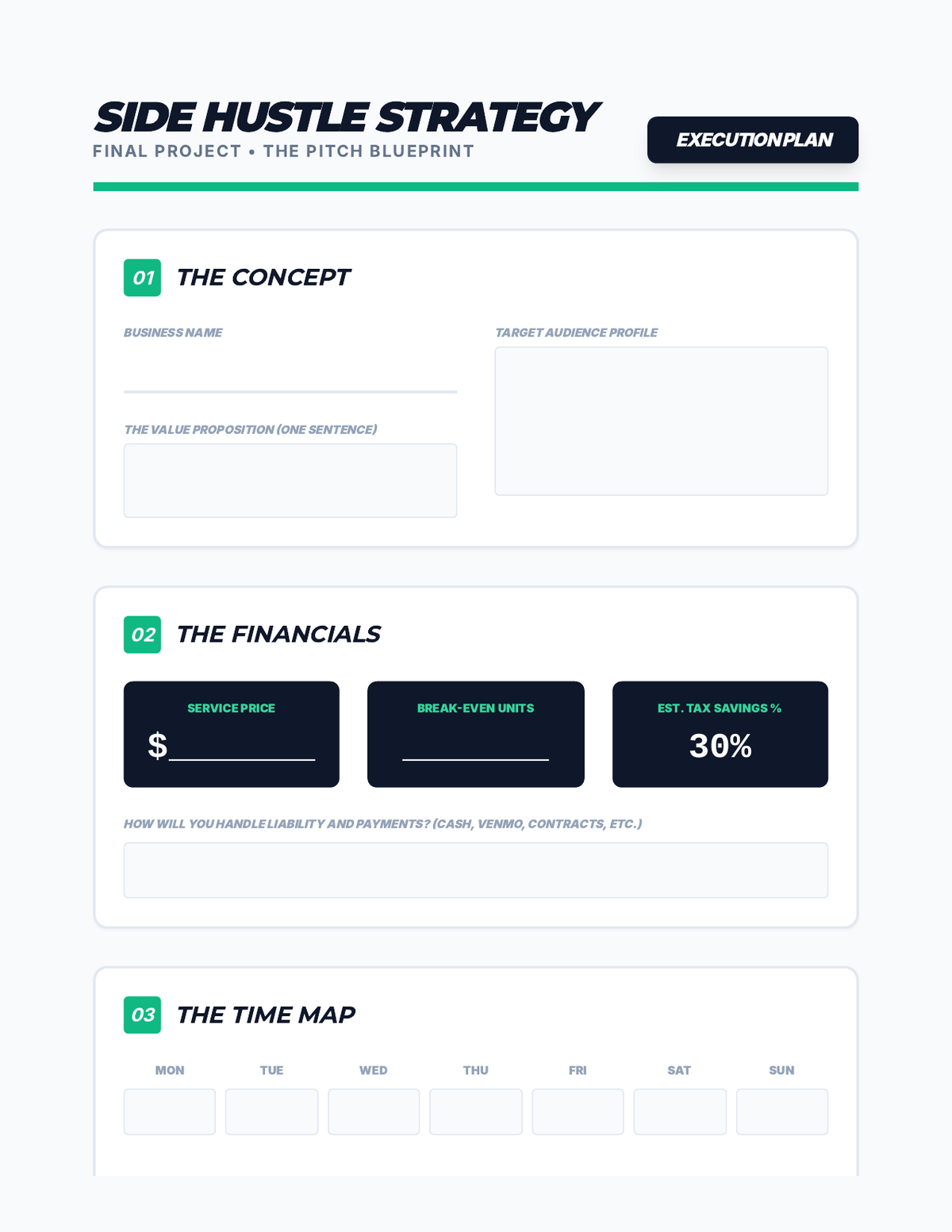
The capstone project document for the sequence, requiring students to synthesize all previous lessons into a final Side Hustle Strategy Plan and Pitch.
Slide deck on time management (time-blocking), efficiency auditing, and low-cost client acquisition strategies.
Presentation for Lesson 5, focusing on time management, opportunity cost, the stages of business growth, and preparation for the final Pitch Deck presentation.
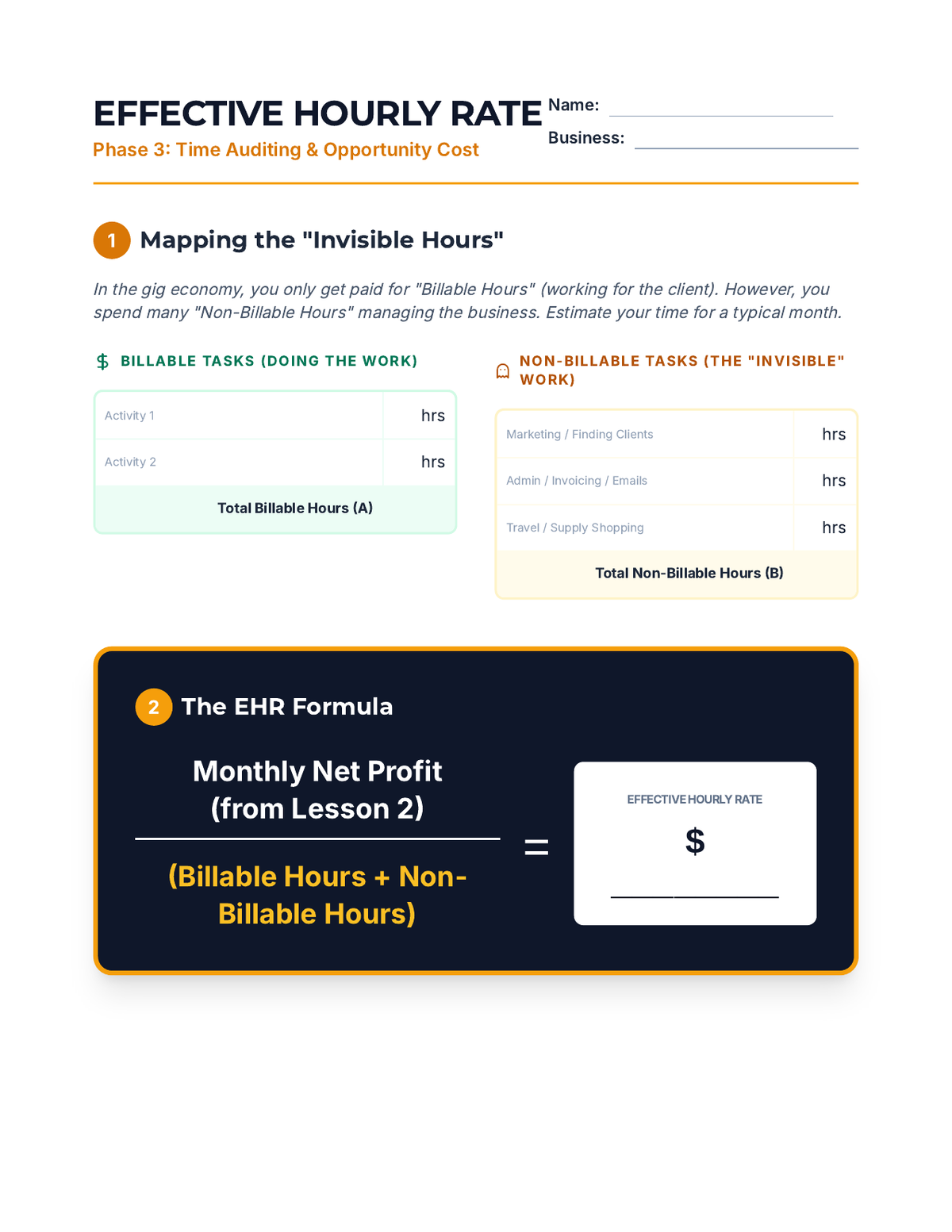
Student worksheet for Lesson 3, featuring an effective hourly rate calculator and an opportunity cost comparison grid between gig work and traditional employment.
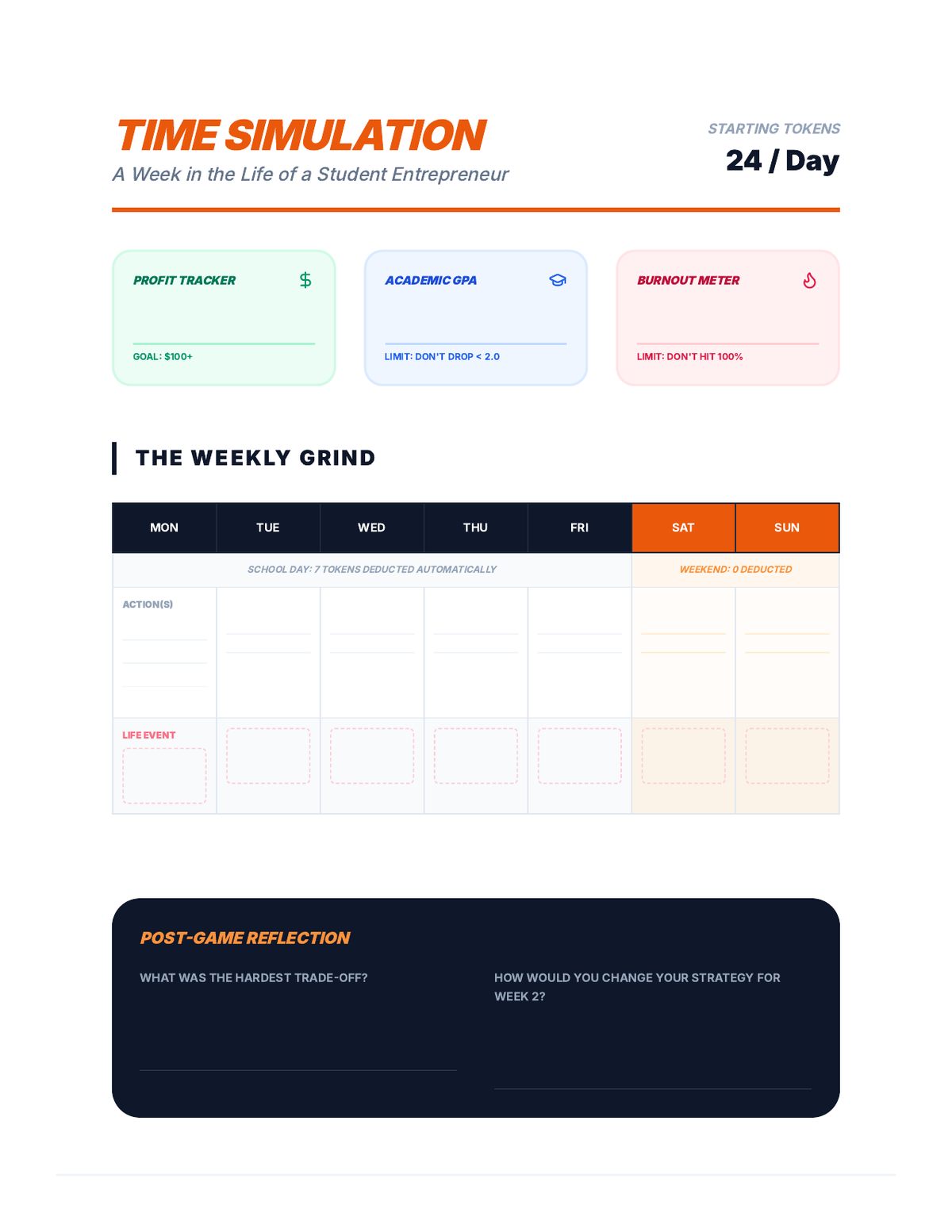
A 2-page simulation kit for Lesson 3. Includes a weekly dashboard to track time, profit, GPA, and burnout, alongside a menu of business actions and random life events.
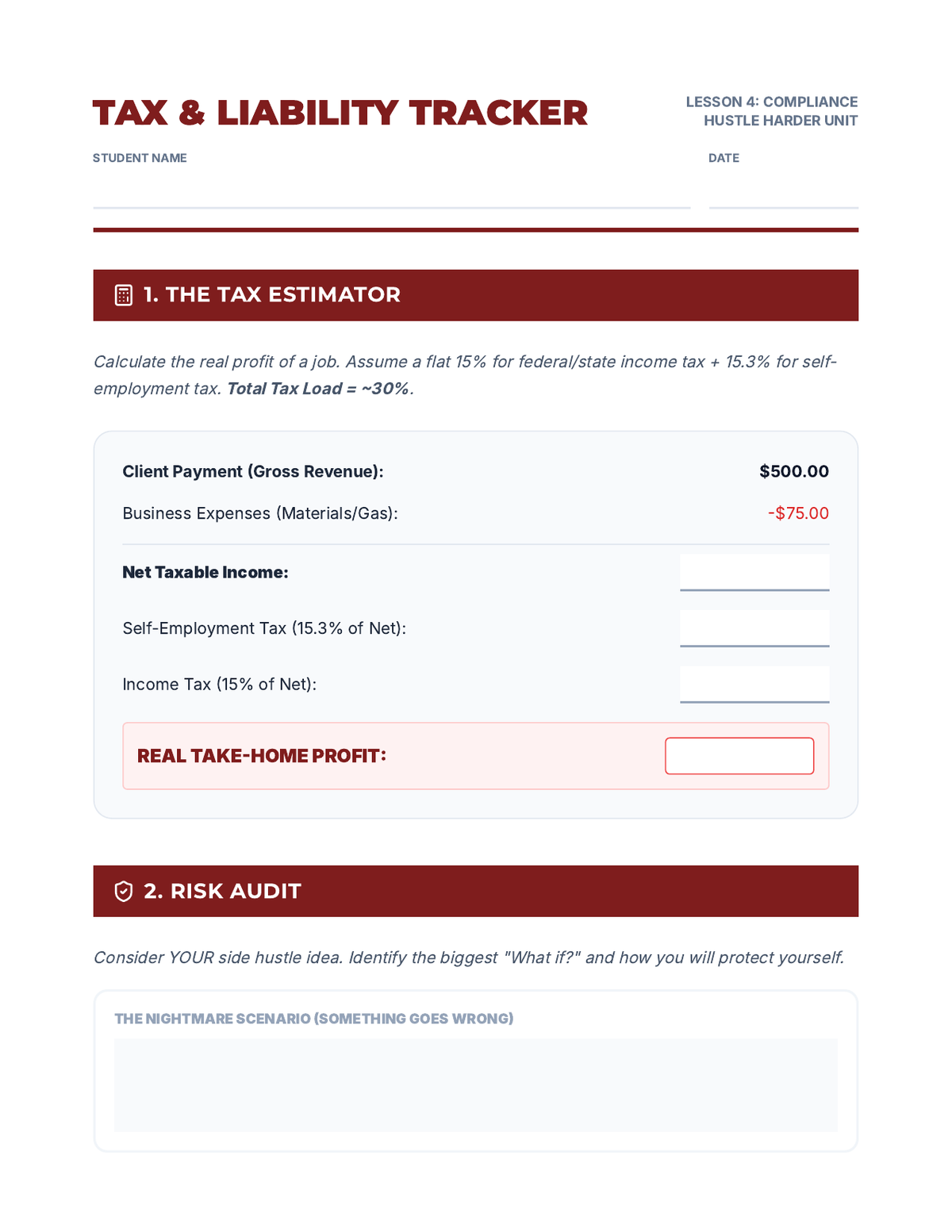
Math-based worksheet for tax estimation (30% total load) and risk audit for side hustles.
Worksheet for Lesson 4, designed as a simplified Schedule C form to help students calculate net profit and estimate self-employment taxes.
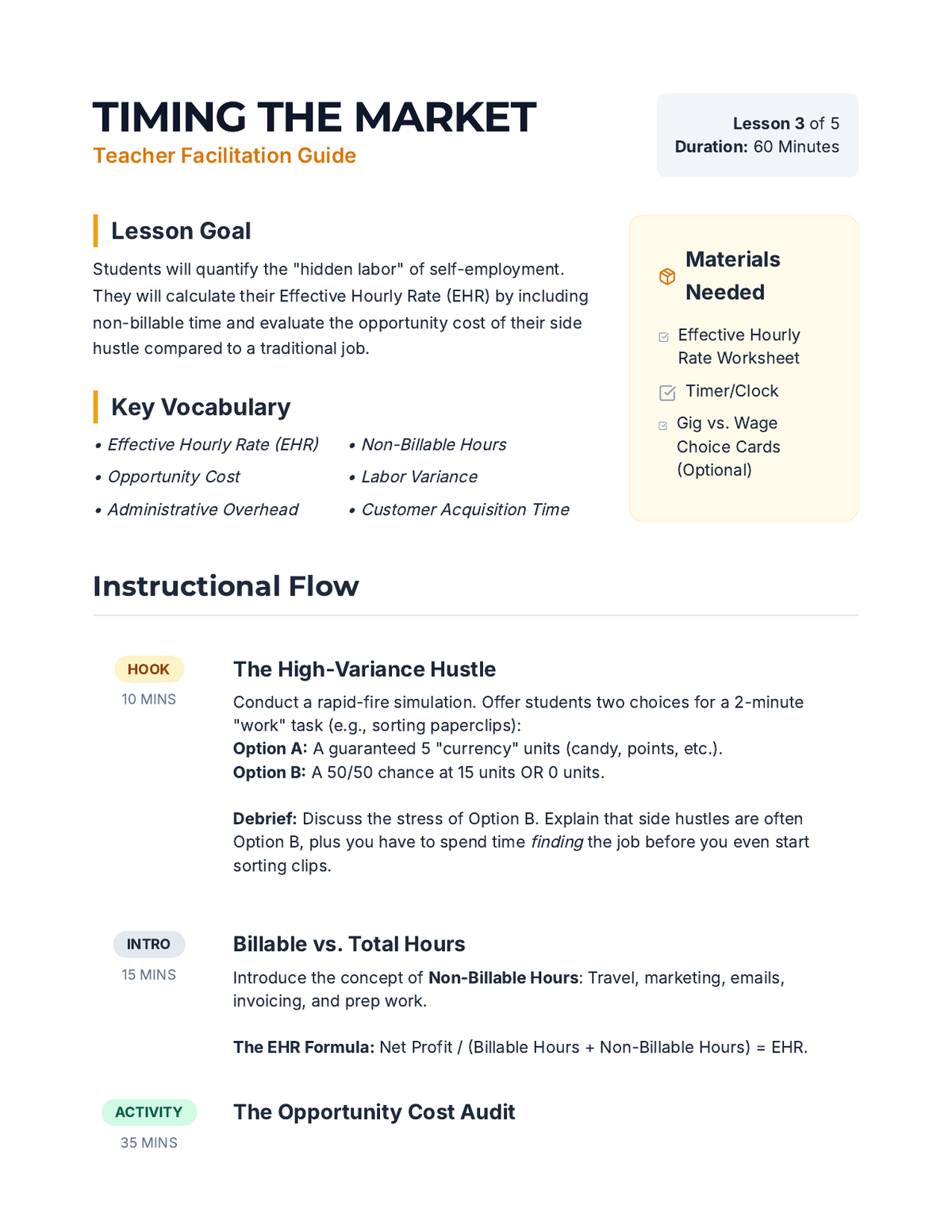
Teacher facilitation guide for Lesson 3, focusing on effective hourly rate calculations and the concept of opportunity cost in the gig economy.
Slide deck covering self-employment taxes (15.3% FICA), 1099 vs. W-2 differences, and business liability/contracts.
Presentation for Lesson 4, covering the critical aspects of self-employment taxes (the 15.3% trap), tax deductions, and legal considerations like liability and contracts.
A 5-slide visual presentation for Lesson 3, focusing on time management, opportunity cost, and the "real" hourly wage for student entrepreneurs.
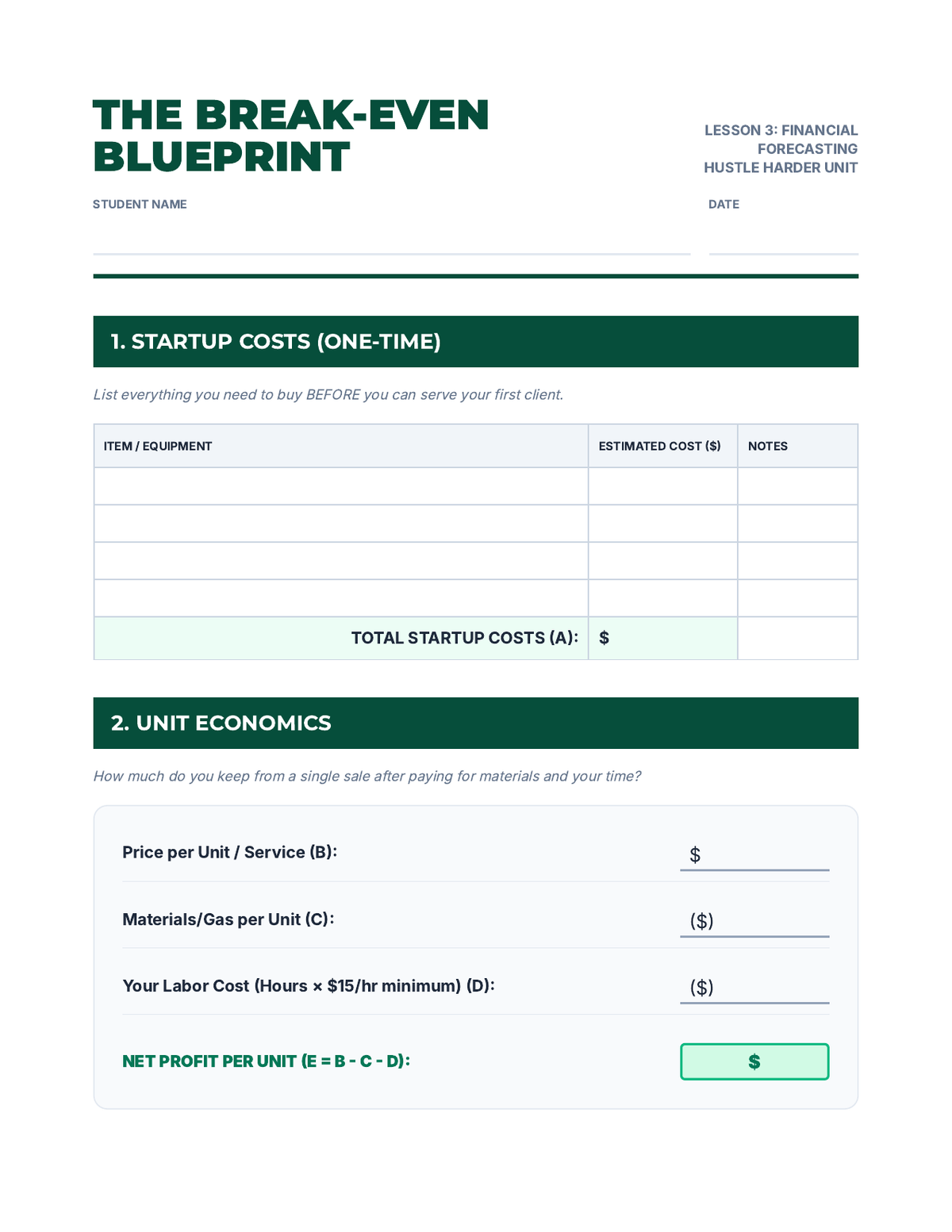
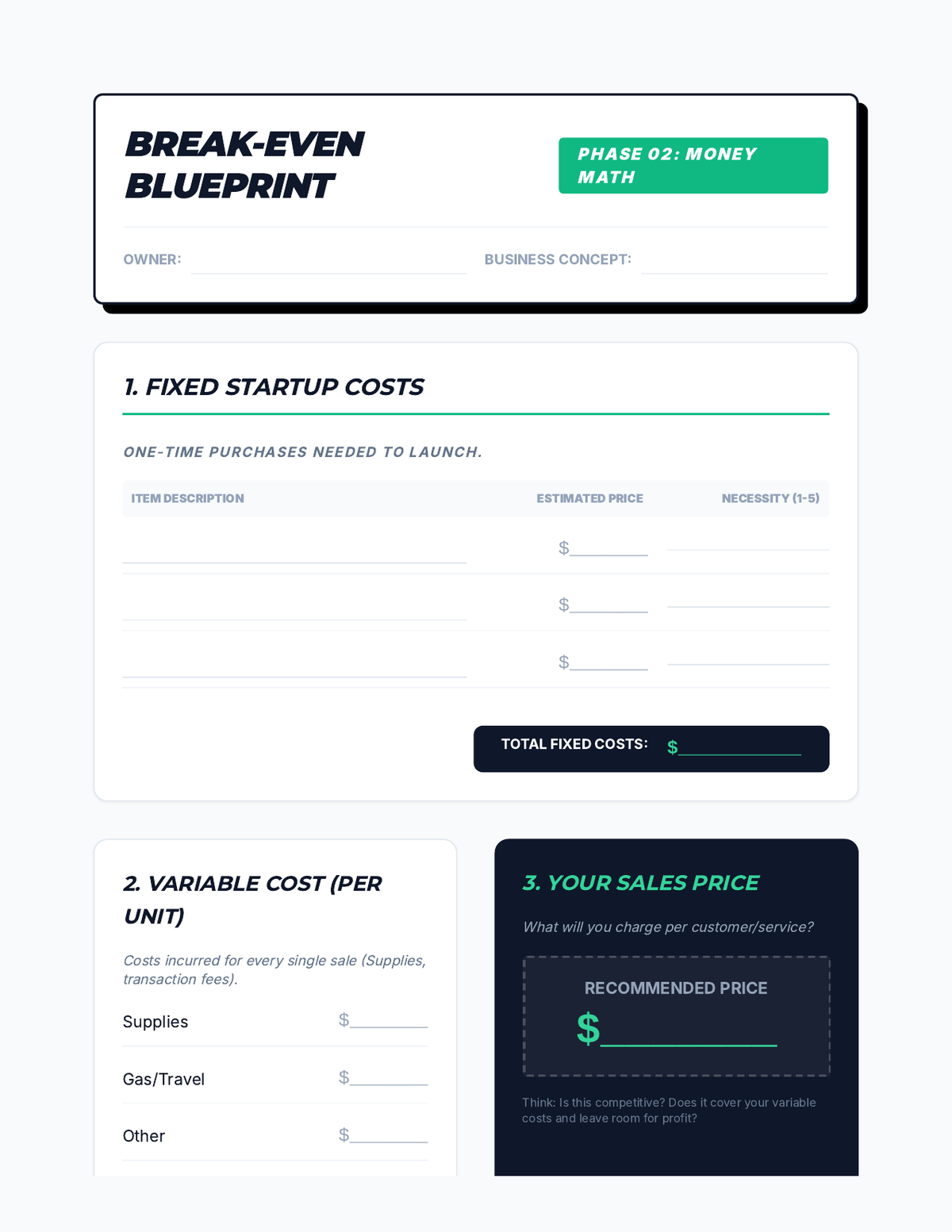
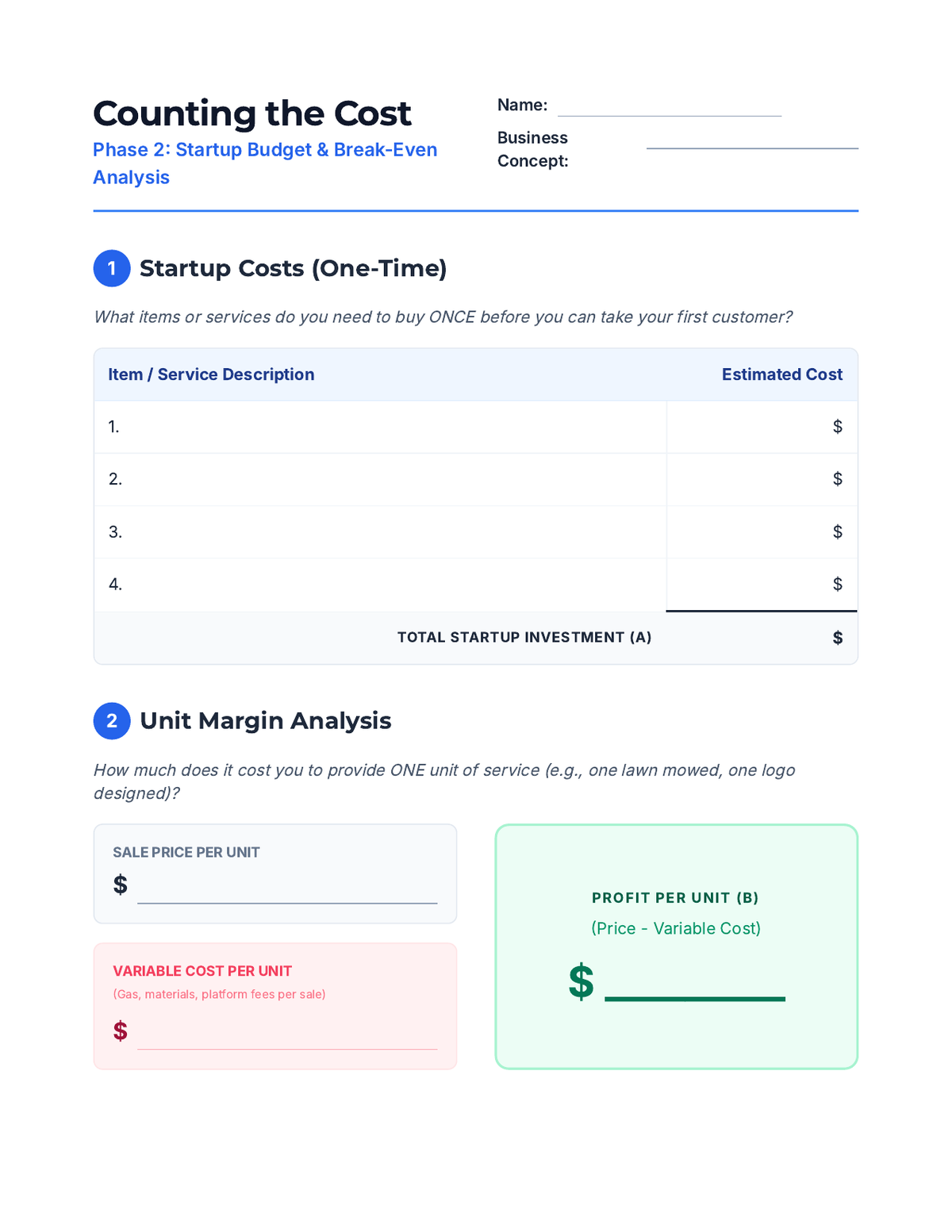
Calculation-based worksheet for startup costs, unit economics, and break-even analysis.
Worksheet for Lesson 3, guiding students through the calculation of startup costs, variable costs per unit, and determining their break-even point.
Student worksheet for Lesson 2, featuring startup cost tables, unit margin analysis, and a break-even point calculator.
Slide deck explaining startup costs, fixed vs. variable expenses, and the break-even formula.