A grading resource for teachers with sample answers and scoring criteria for the Llama Field Guide worksheet.
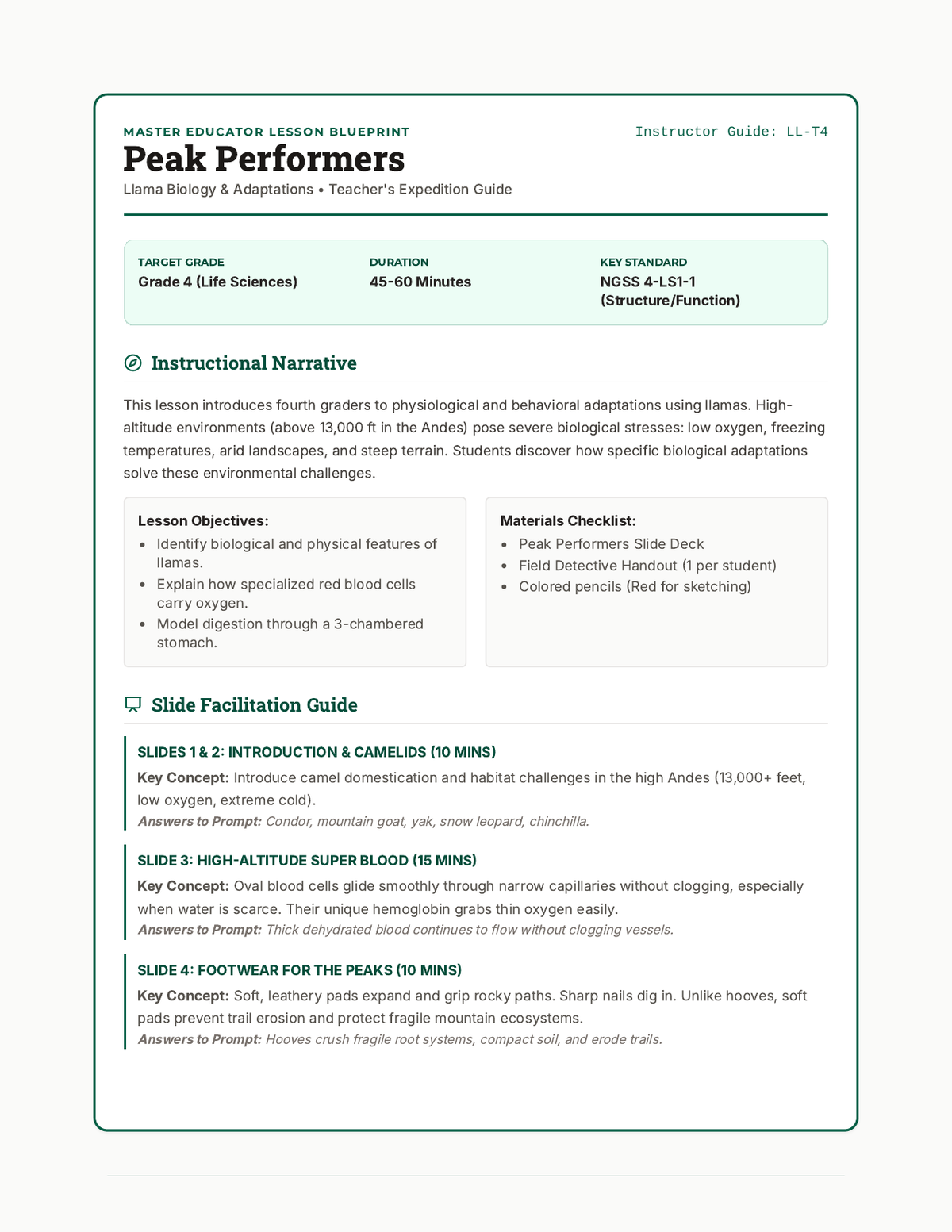
A comprehensive instructional script, discussion prompts, background knowledge summary, and answer key for delivering the Peak Performers lesson.
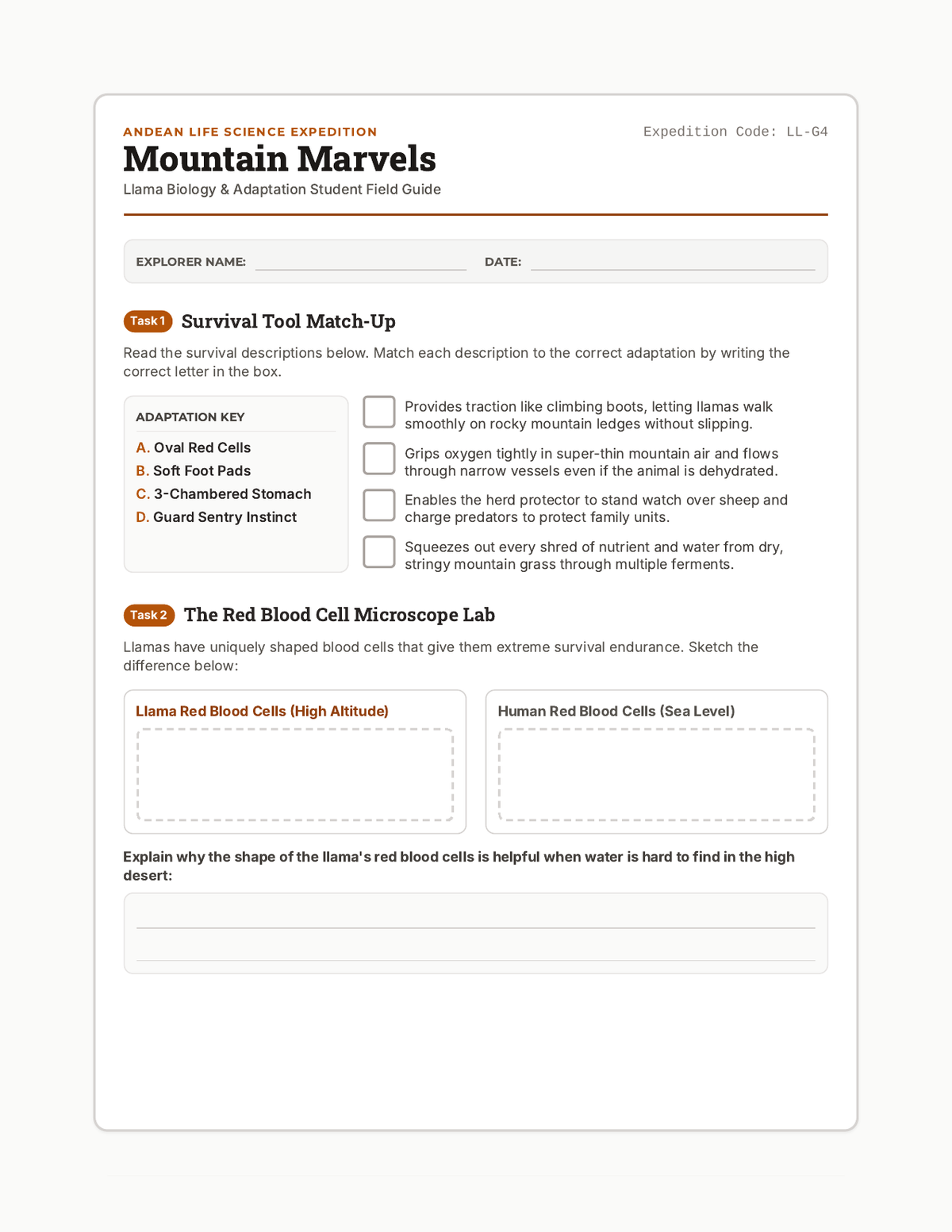
A 2-page student field guide worksheet featuring matching activities, blood cell sketch sections, sorting activities for the multi-chambered stomach, and scenario-based defense questions.
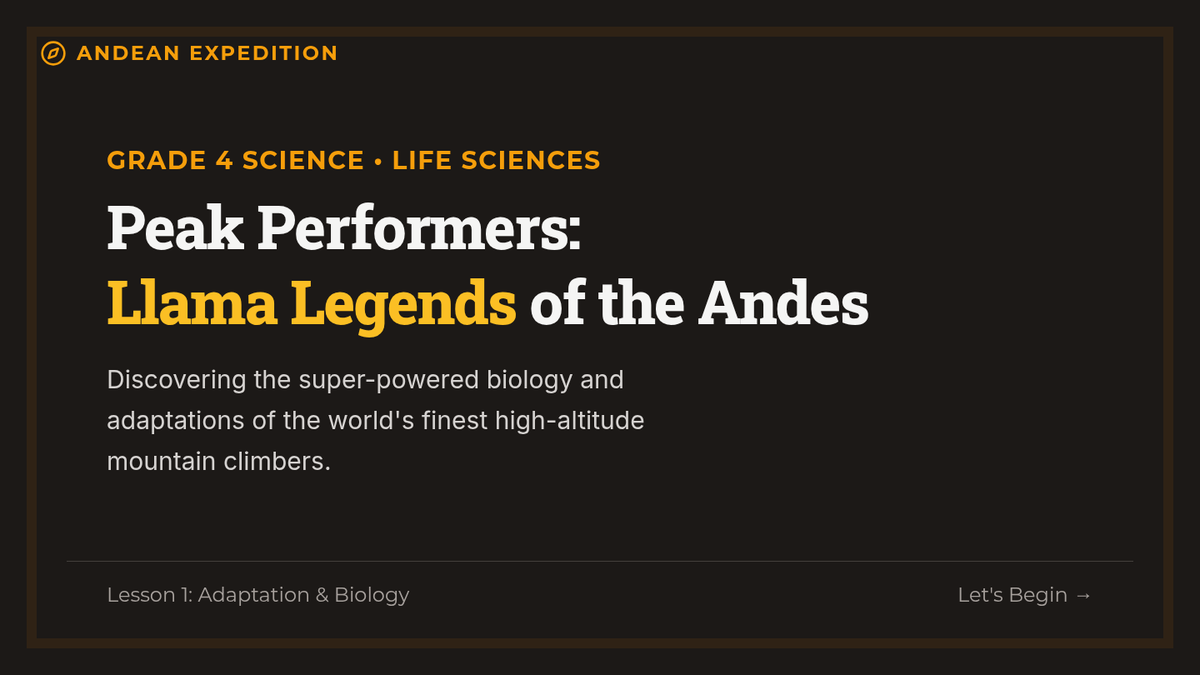
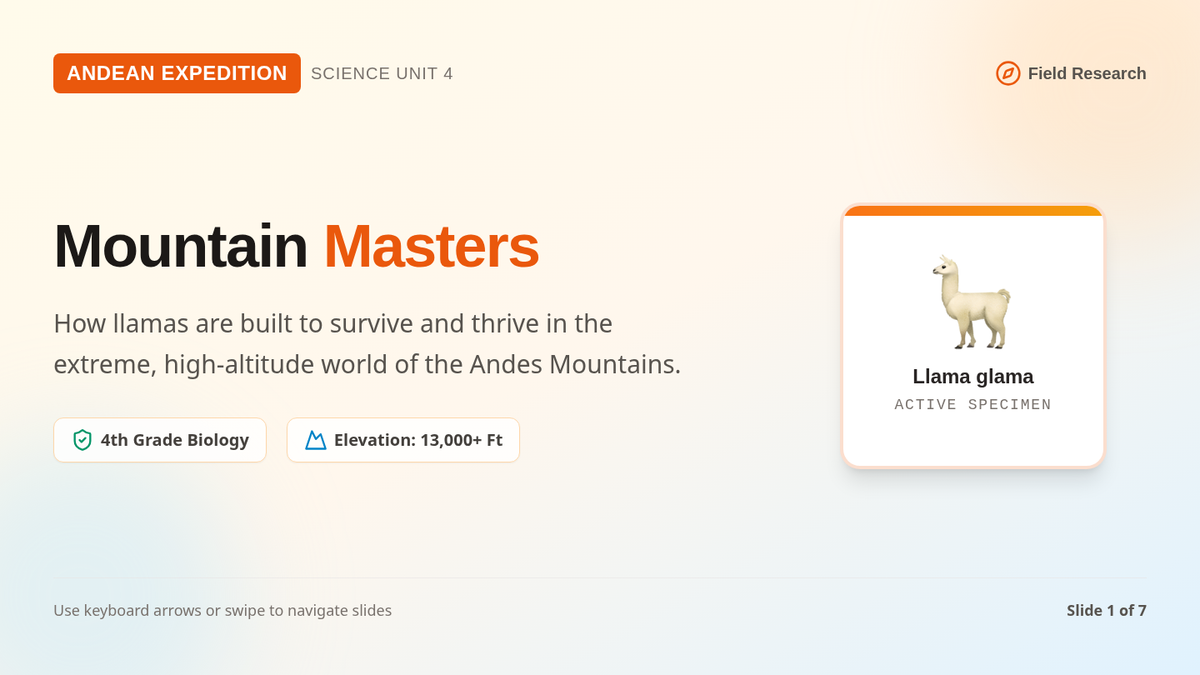
A 7-slide interactive presentation exploring llama biology, high-altitude blood adaptations, specialized foot structures, unique digestive systems, and social defensive strategies tailored for 4th graders.
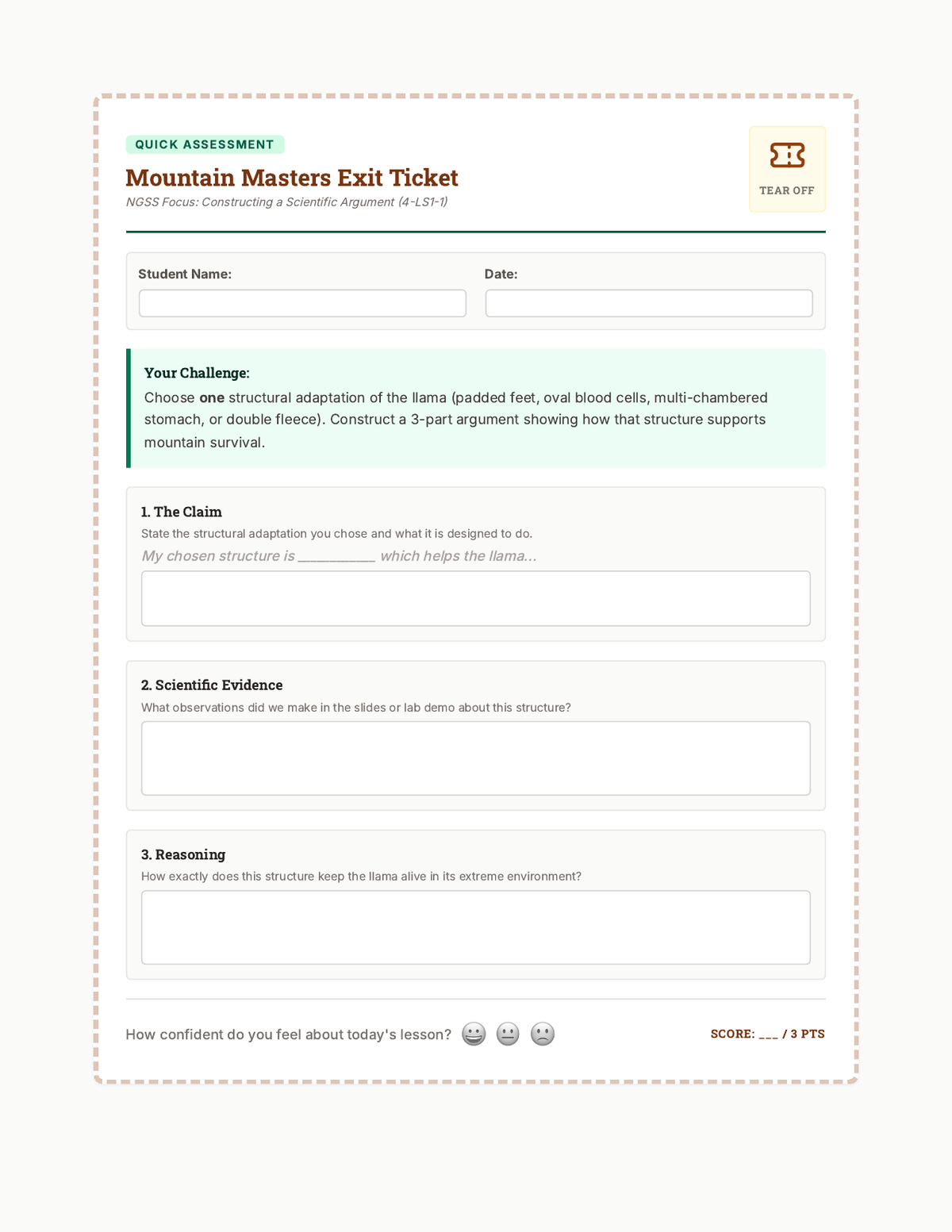
A student-facing quick assessment exit ticket for the Mountain Masters lesson, structured to support NGSS 4-LS1-1 scientific argumentation with claims, evidence, and reasoning.
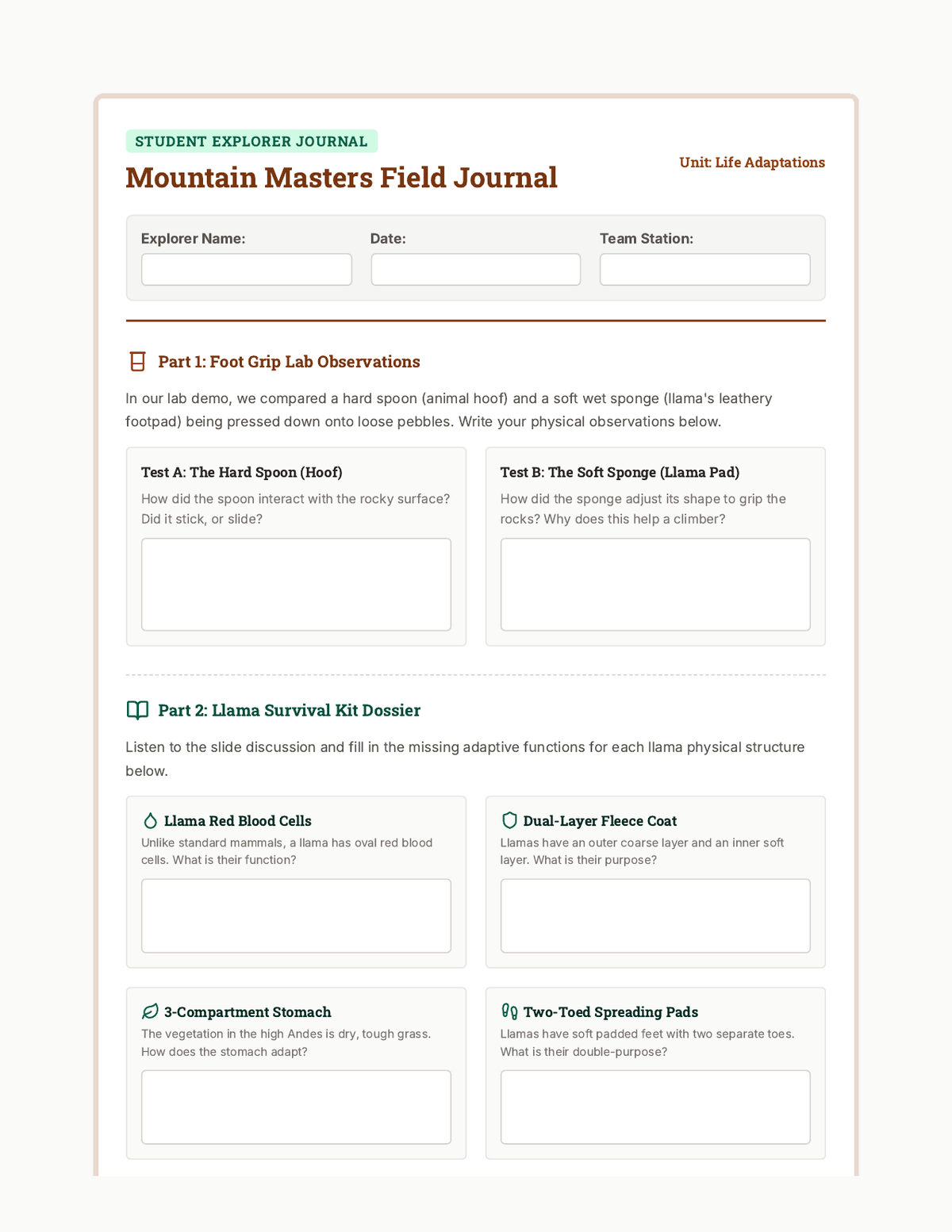
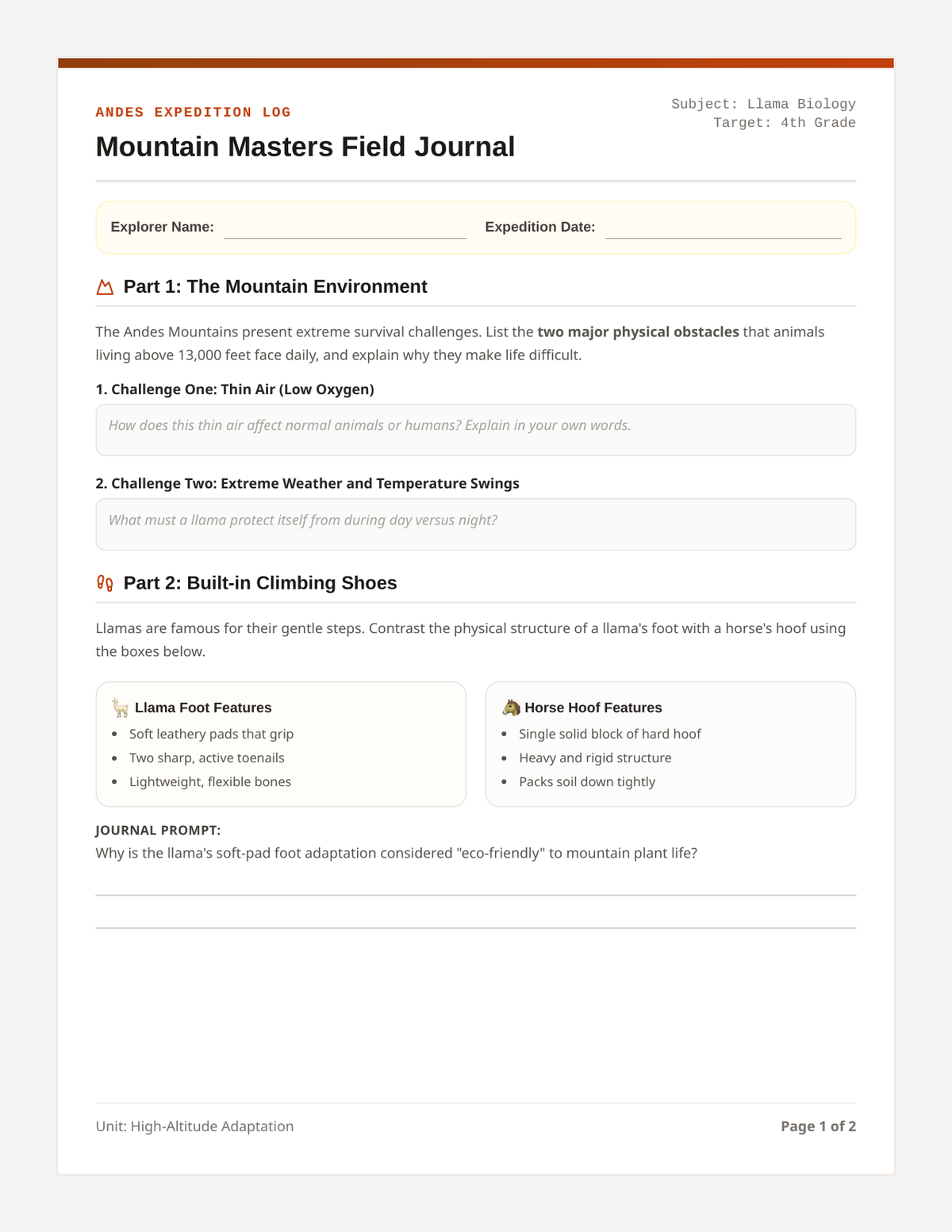
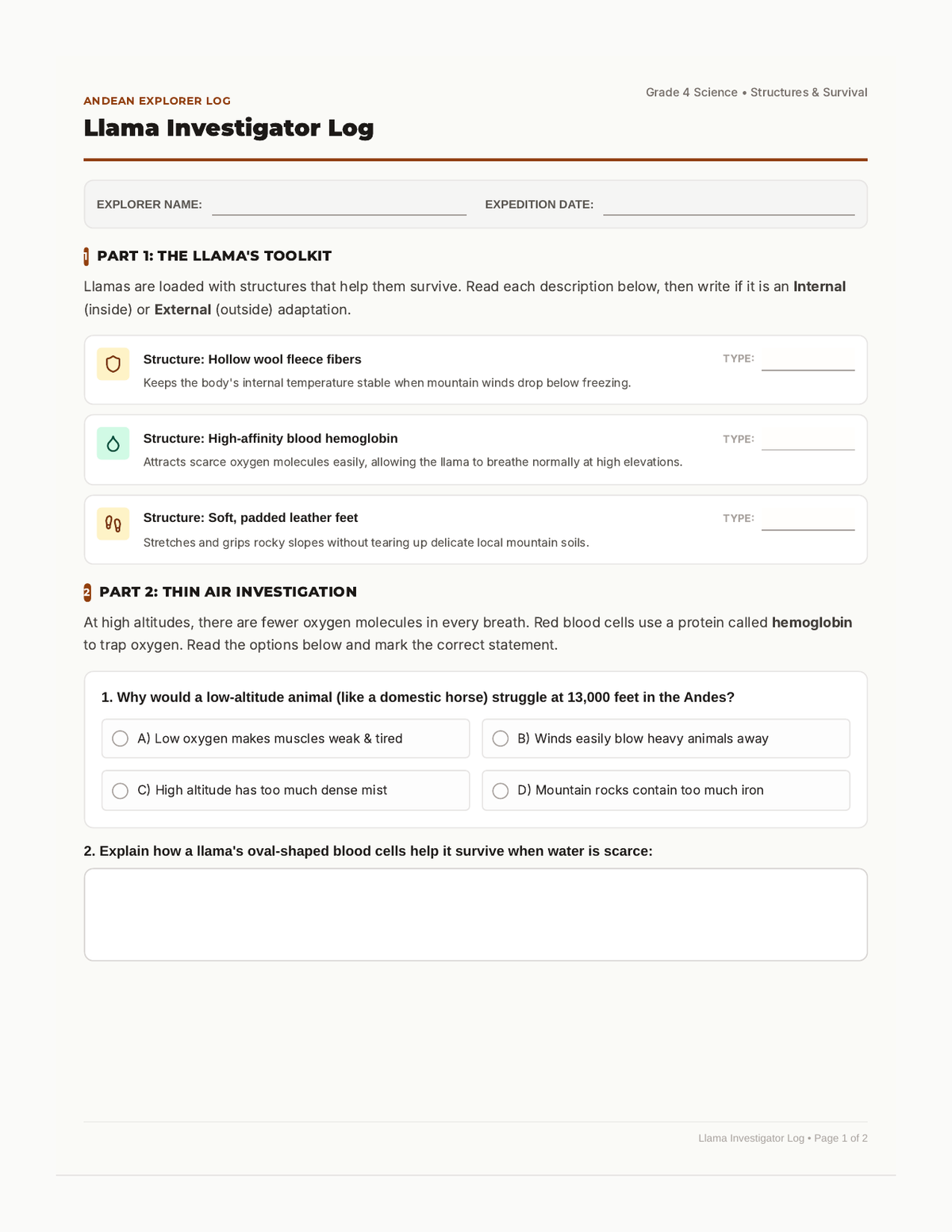
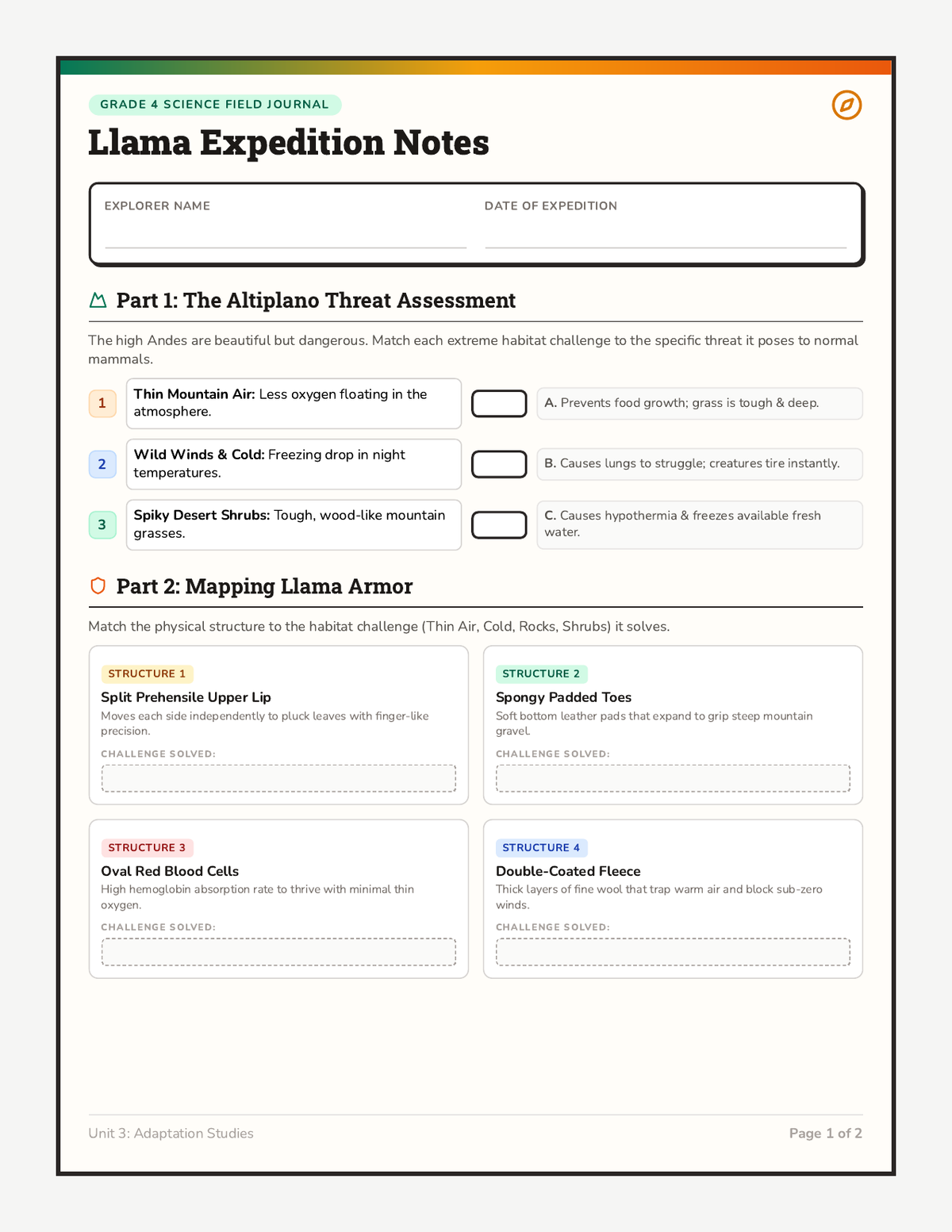
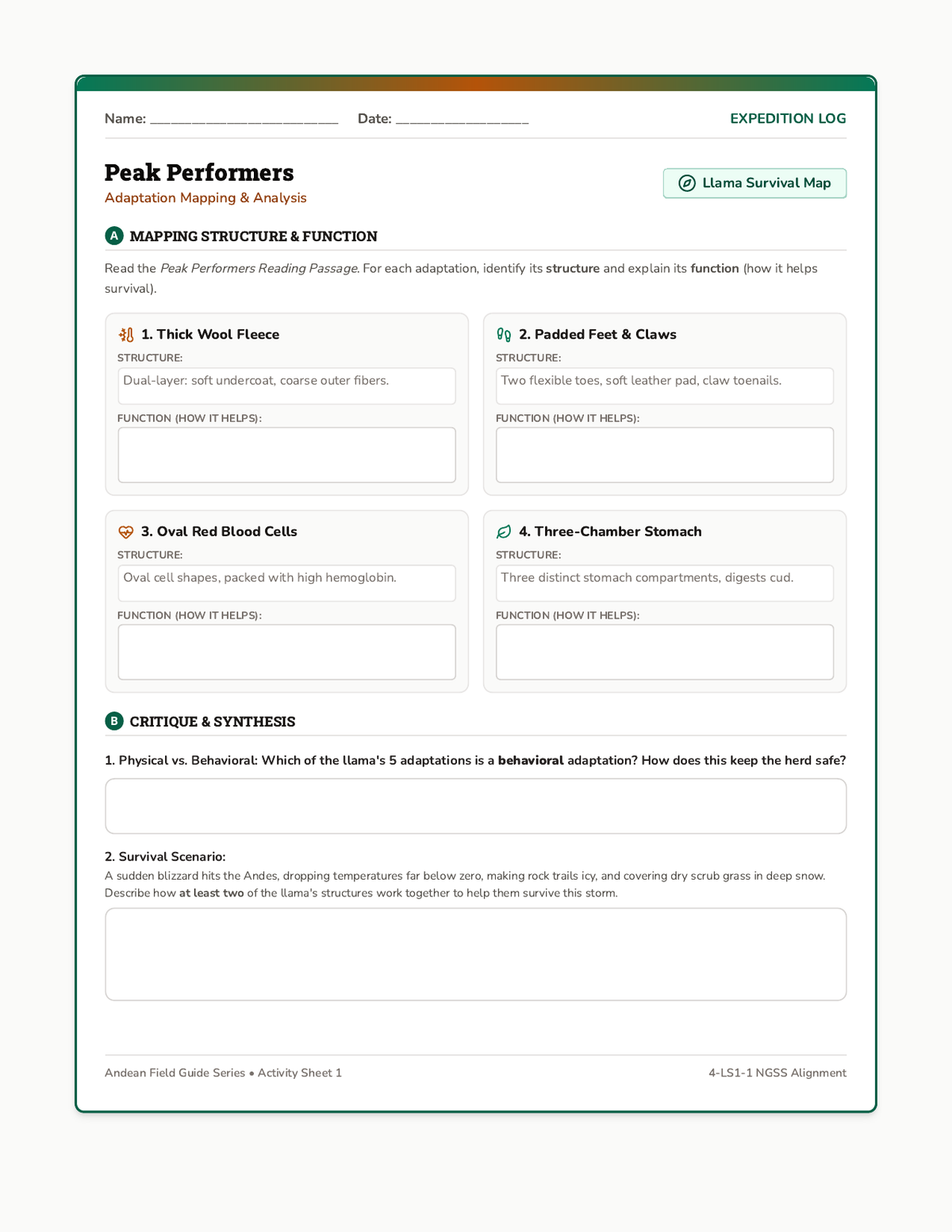
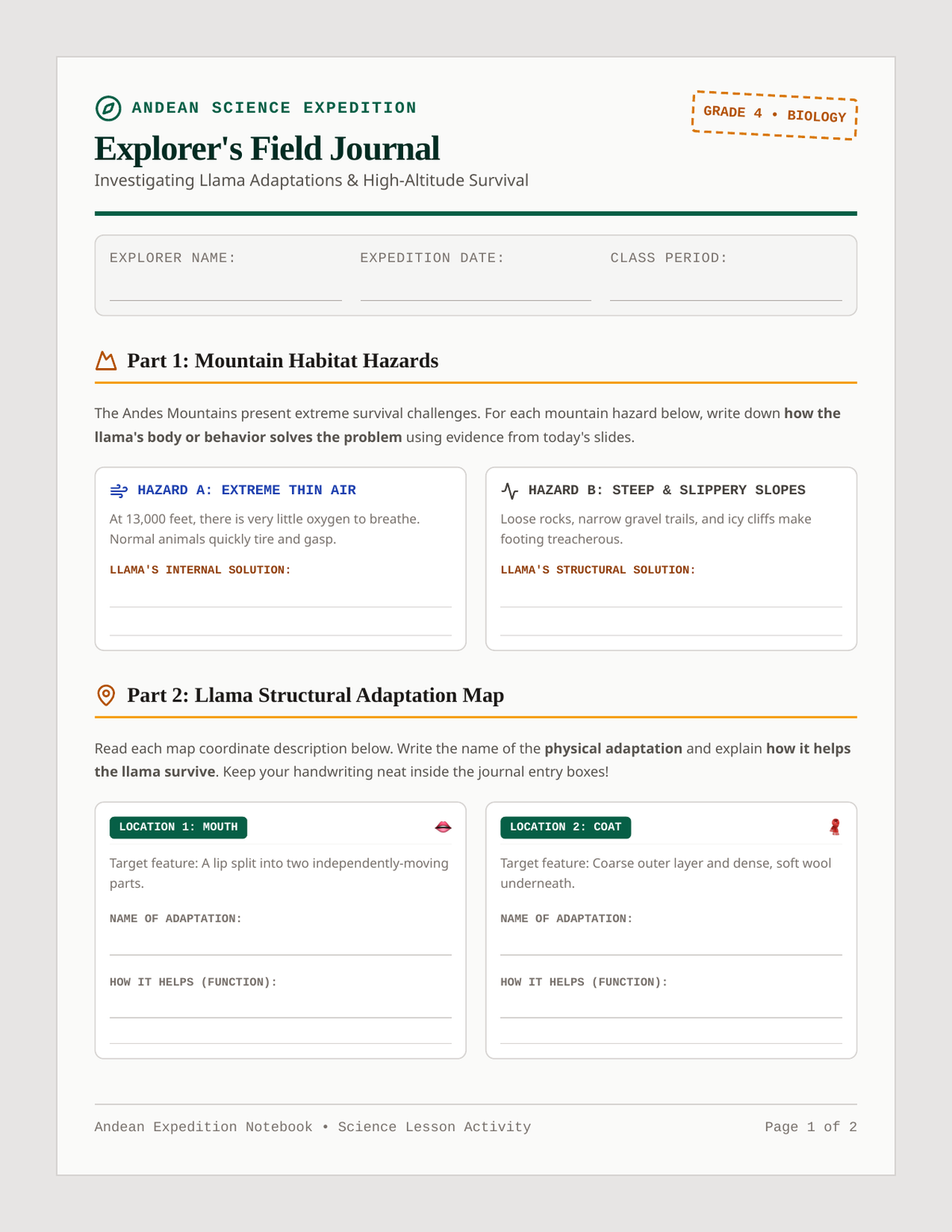
A student-facing field journal worksheet designed for 4th-grade science, matching the lessons on Andean adaptations. Includes visual structured prompt boxes, structured lab notes areas, and critical-thinking questions about structure and function.
An instructional slide deck (6 slides) for presentation during the lesson, styled with bold text (all size 24px and above) and clear, visually clean representations of physical adaptations and the camelid family.
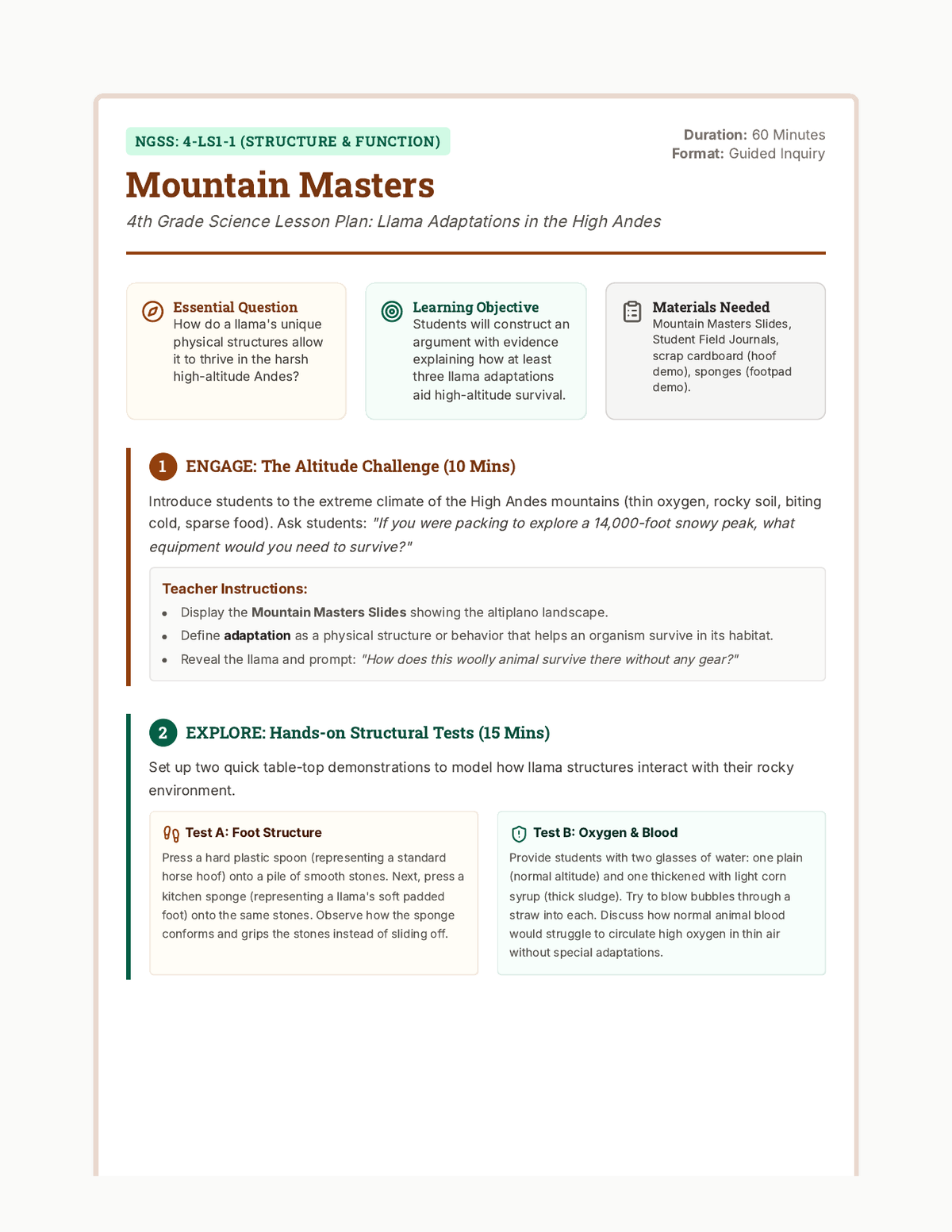
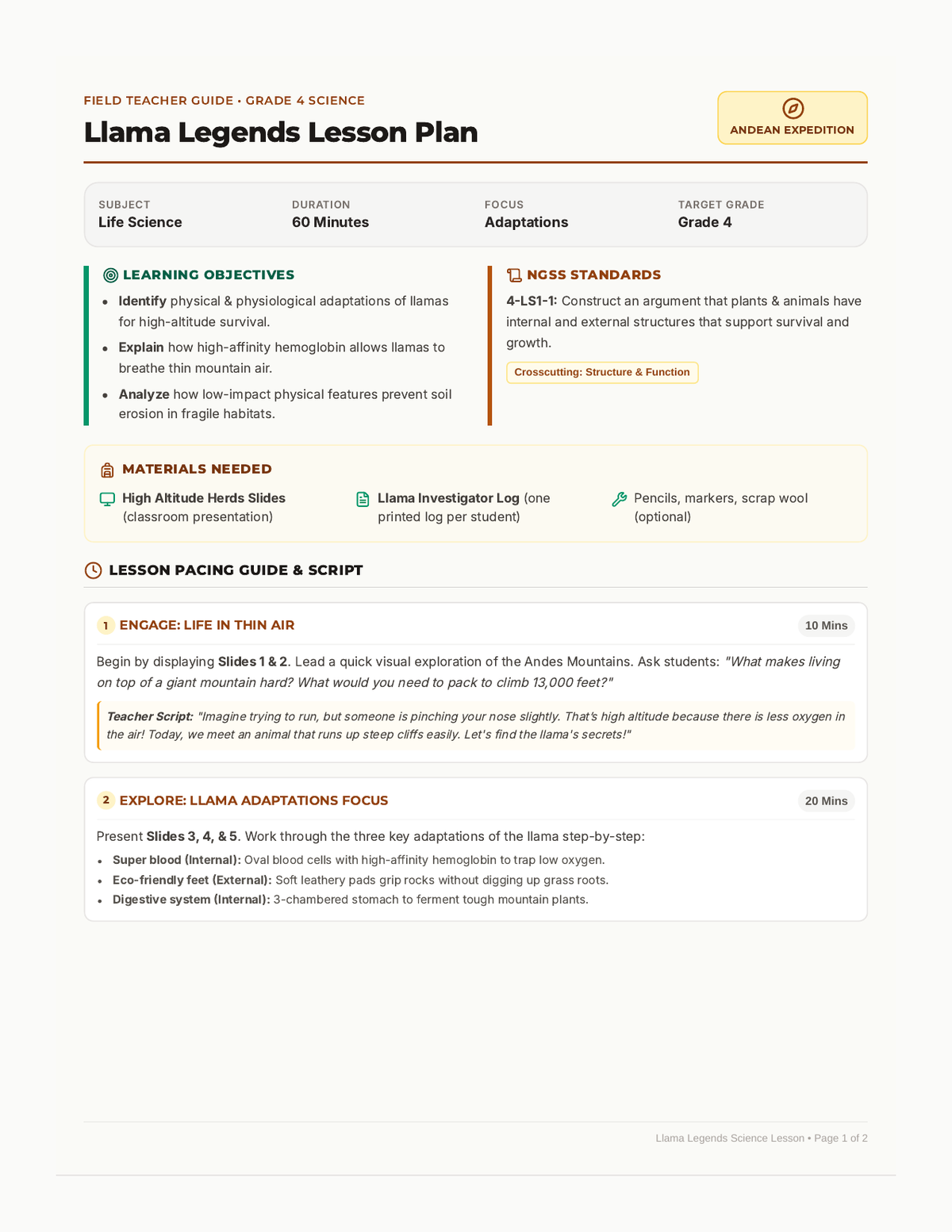
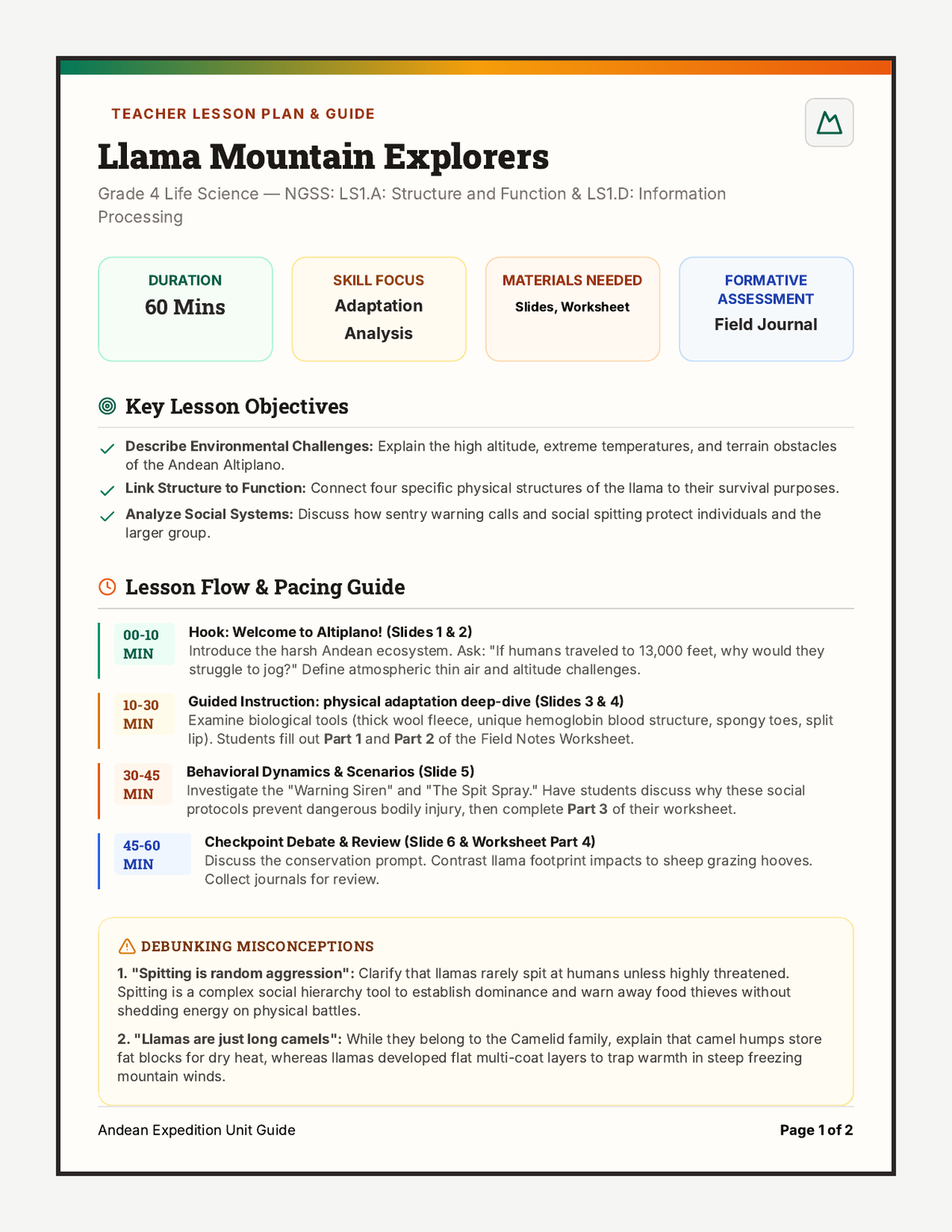
A comprehensive 60-minute lesson plan for teaching 4th-grade students about physical adaptations, centering on the unique structural features of llamas in the Andes. Includes step-by-step 5E sequence instructions, scaffolding tips, and hands-on demonstrations.
A printable 2-page explorer's field journal worksheet designed to accompany the llama adaptations lesson. It features visual diagram sketching sections, open-ended biological analysis prompts, and a true/false check.
An engaging 16:9 presentation exploring the unique physical and biological adaptations of llamas in the Andes Mountains. It features structured layouts, vibrant thematic colors, large readable text, and interactive check questions for 4th-grade students.
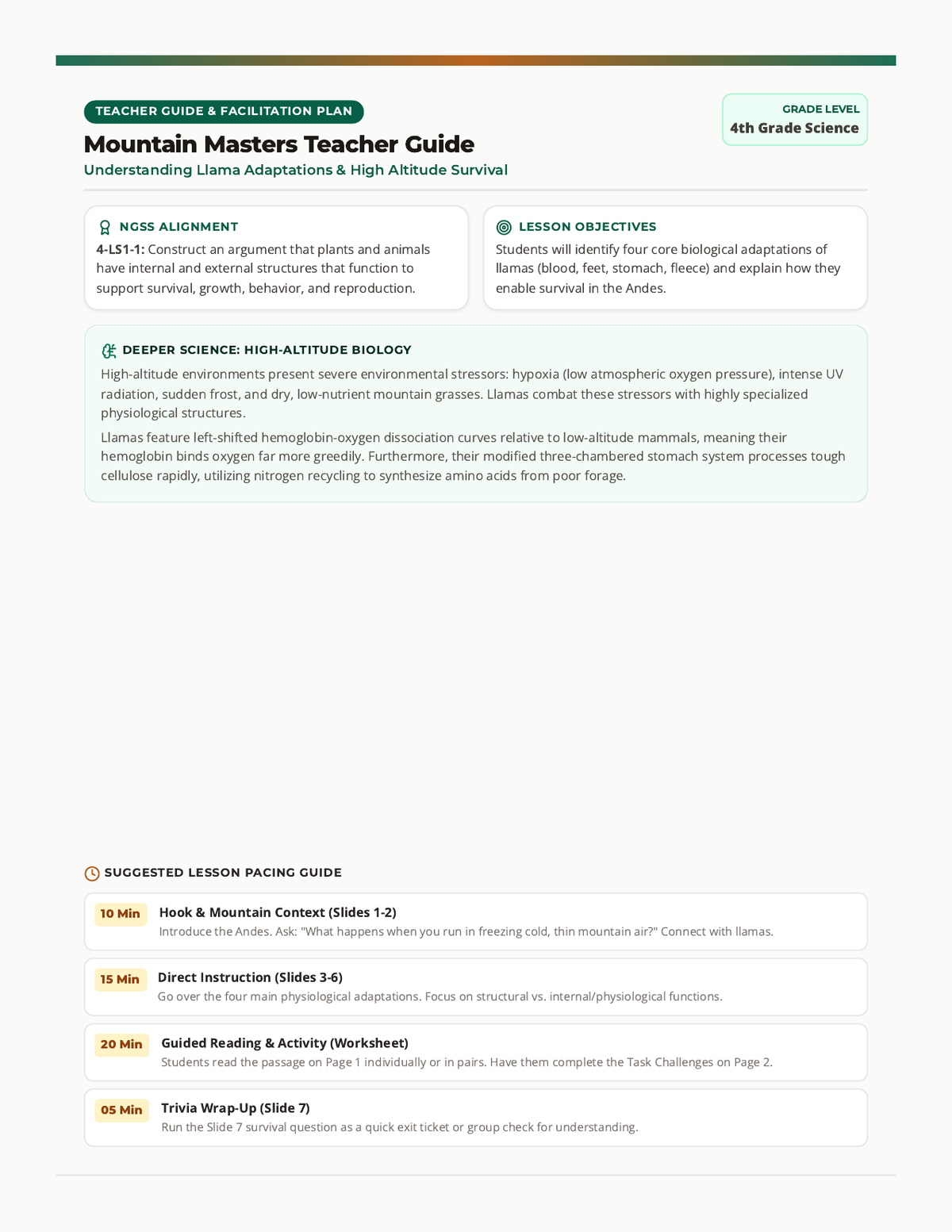
A comprehensive 2-page teacher guide providing standards alignment (NGSS 4-LS1-1), background information on high-altitude hypoxia and digestion, pacing suggestions, and an answer key for the student reading worksheet.
An engaging 7-slide presentation deck structured to visually walk students through the extreme environment of the Andes Mountains and the key physiological adaptations of llamas. Includes a closing survival challenge.
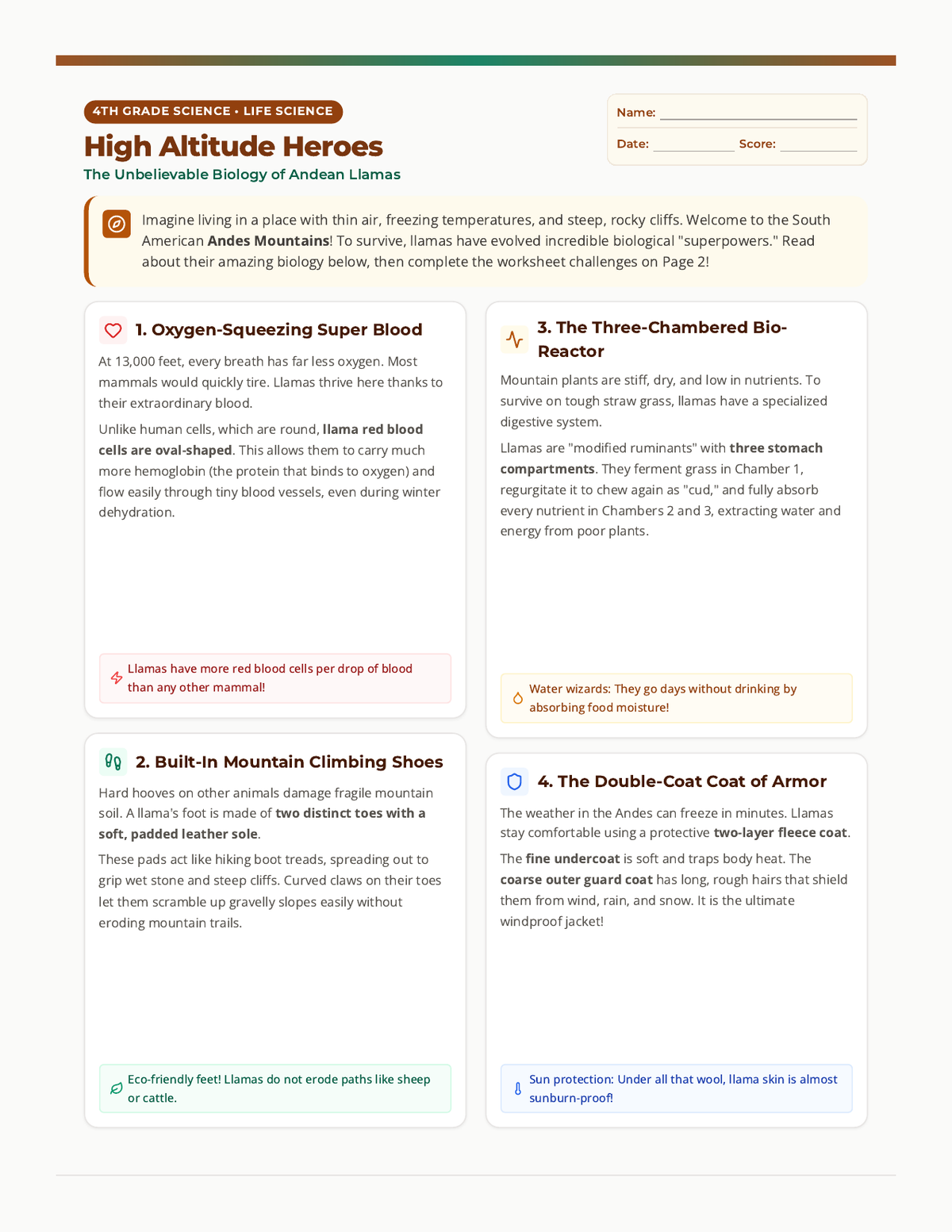
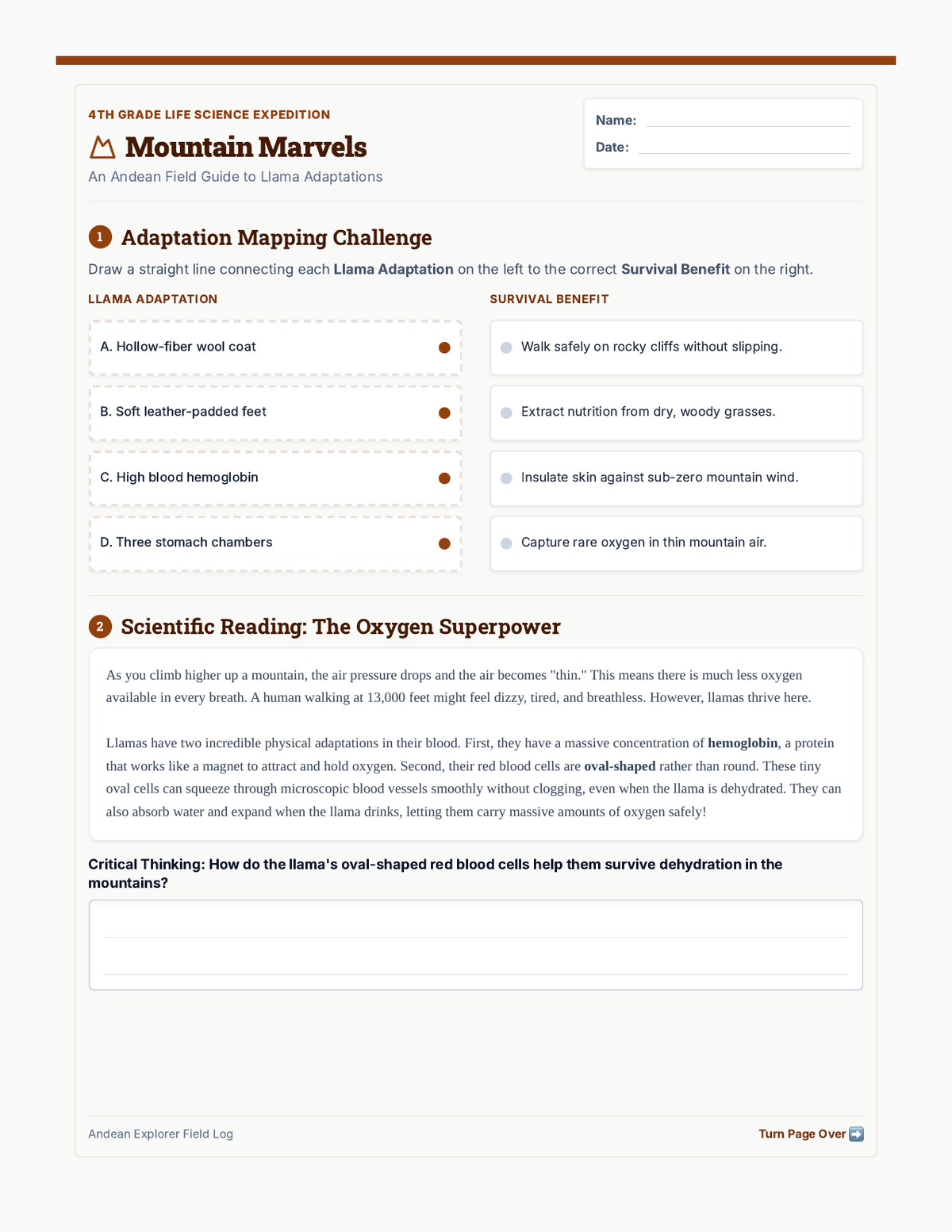
An interactive science reading worksheet for 4th graders on llamas' biological adaptations to the Andes. Features a reading passage covering blood, feet, stomach, and fur, and an activities page with matching, true/false, and a scenario-based writing prompt.
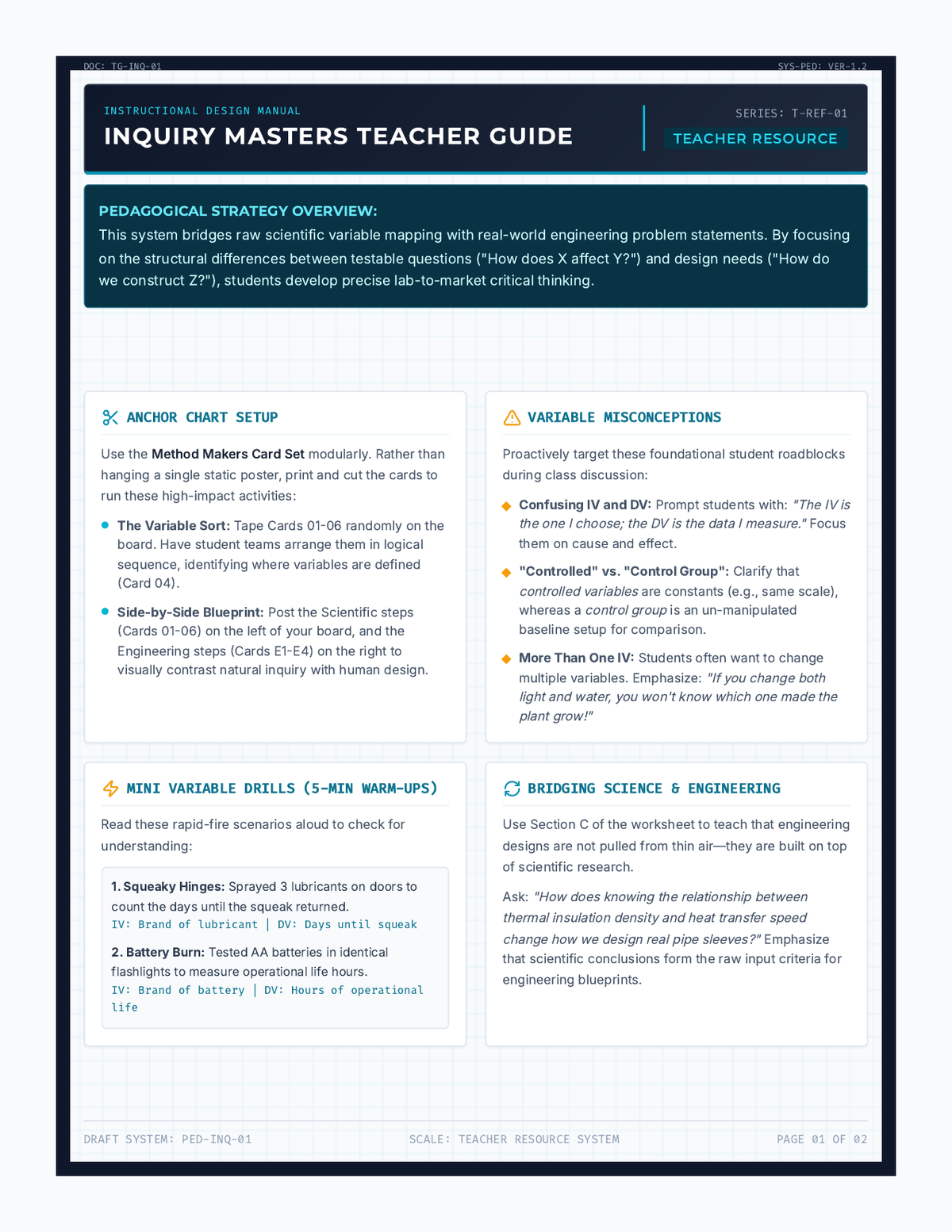
An instructional guide detailing how to build the anchor chart with students, interactive sorting games with the cards, key misconceptions on variables, and a quick-reference answer key for the worksheets.
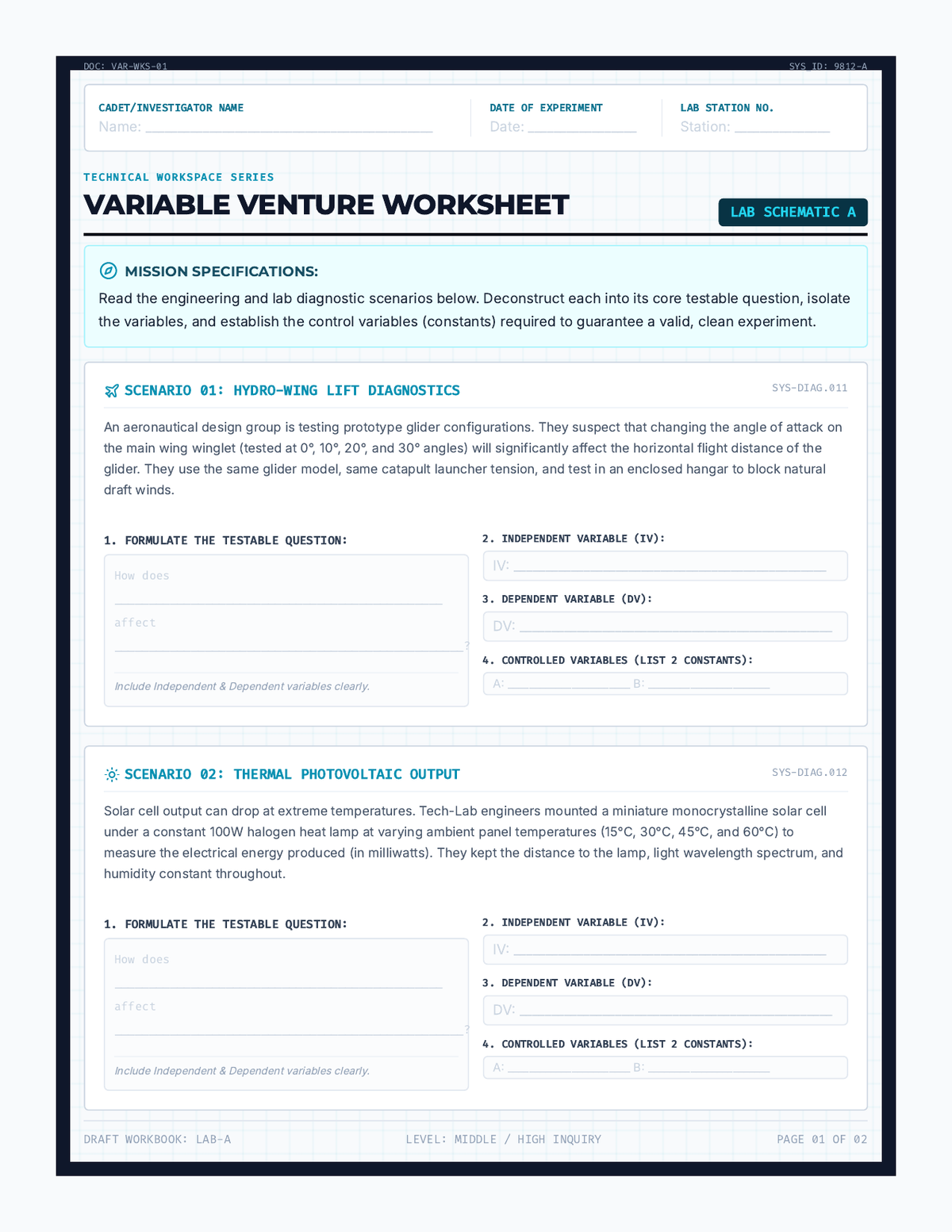
An interactive student workbook matching the retro blueprint drafting aesthetic. Students practice identifying independent, dependent, and controlled variables in laboratory scenarios, formulate their own testable questions, and retrofit a scientific inquiry into an engineering design solution.
A 3-page set of printable, modular classroom anchor cards in a retro blueprint drafting aesthetic. Pages 1 and 2 cover the steps of the Scientific Method with an intense focus on variables and testable questions, while Page 3 introduces the comparative steps of the Engineering Design Process.
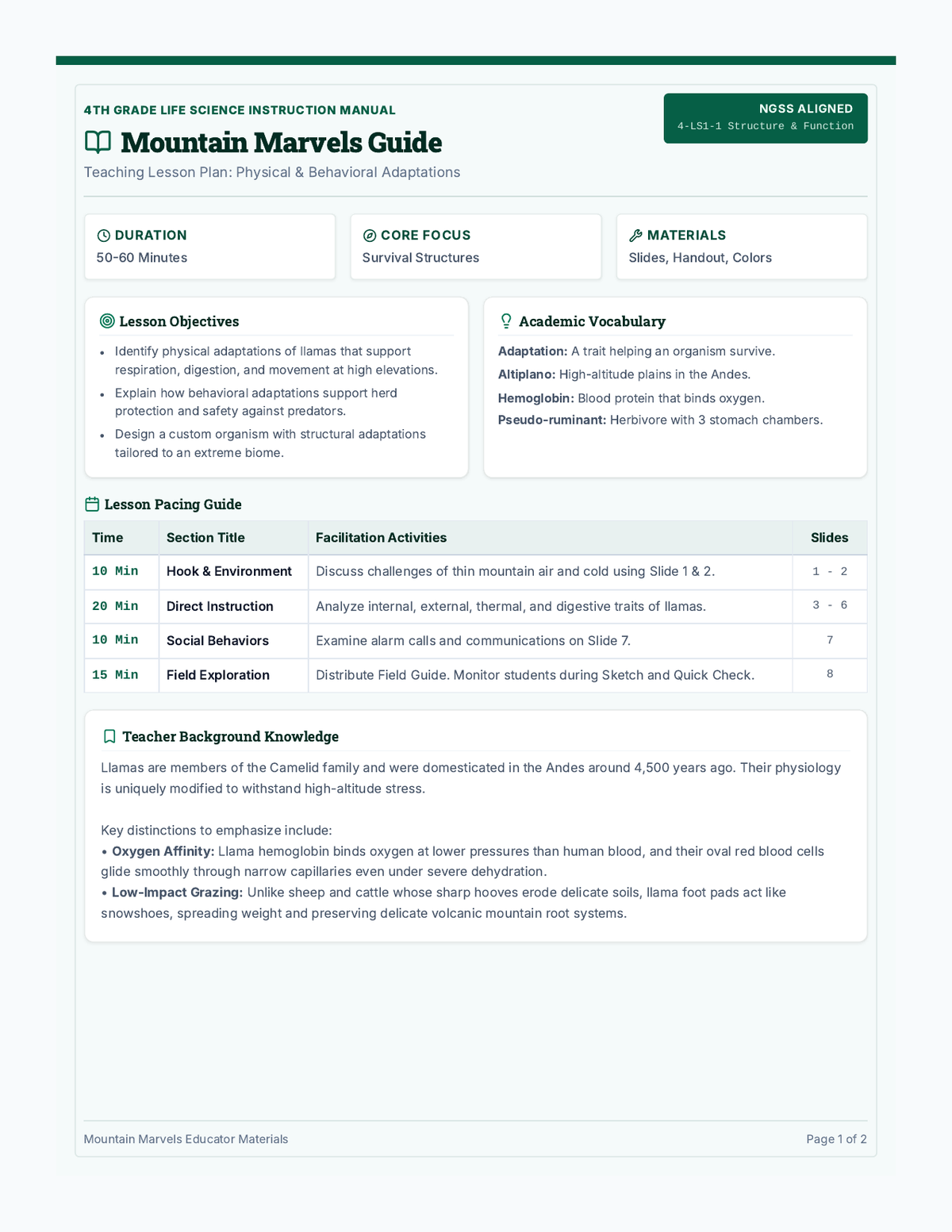
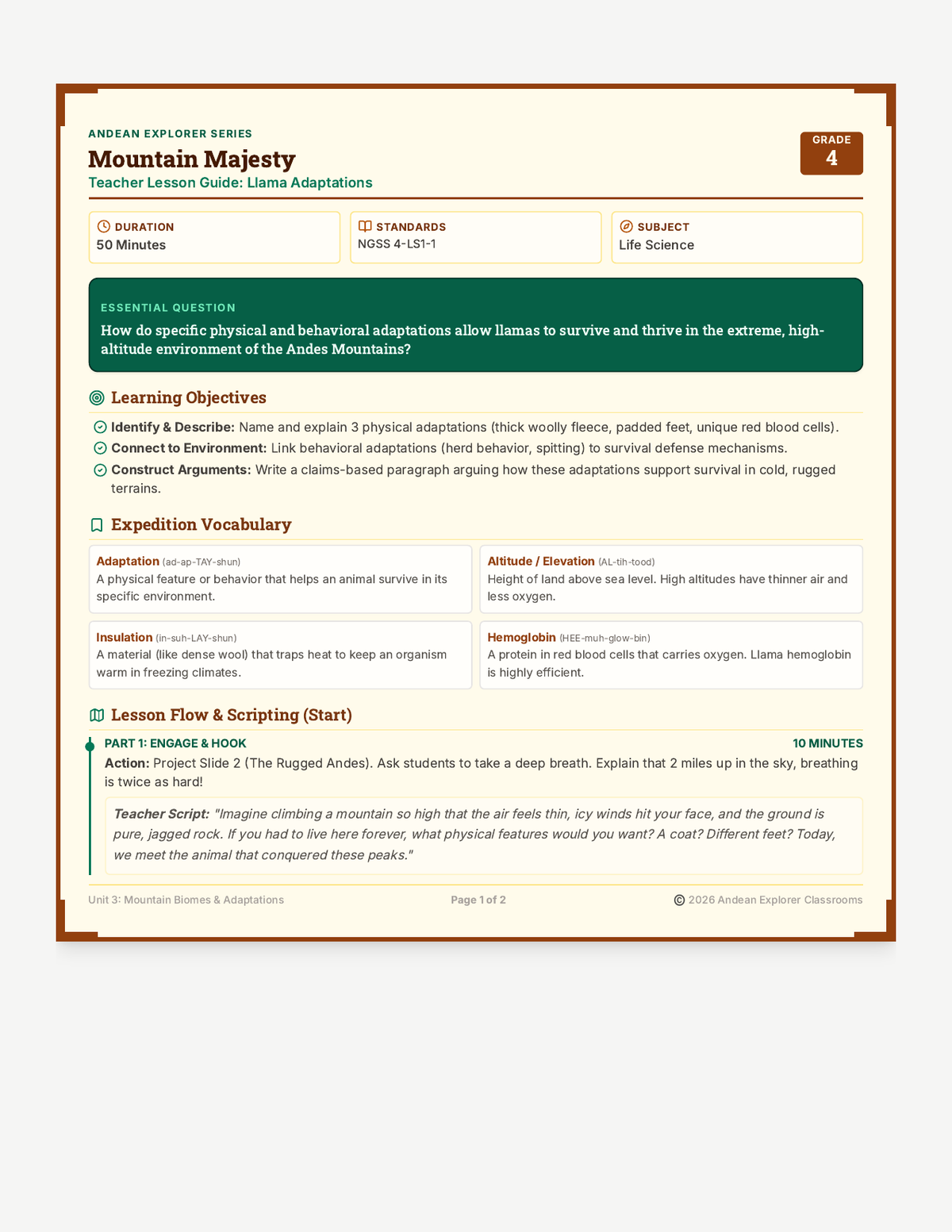
A comprehensive teacher guide for the llama adaptations lesson, including lesson objectives, standard alignments (NGSS), a recommended pacing guide, key vocabulary, common misconceptions, slide facilitation prompts, and a student guide answer key.
A beautifully laid out, 2-page print-ready companion journal worksheet for 4th graders. Features interactive anatomy diagram labeling, matching exercises, and wide writing lines with light white backgrounds to allow students to demonstrate their understanding of llama adaptations.
A visually stunning, high-contrast presentation slide deck designed for a 4th-grade science lesson about llama biology and high-altitude adaptations in the Andes Mountains. Uses giant fonts, generous spacing, and custom-styled comparison visuals to ensure visibility and clarity.
A comprehensive, 2-page teacher's guide matching the lesson theme, featuring NGSS alignment, pacing instructions, vocabulary lists, slide-by-slide facilitation scripts, student differentiation suggestions, and a complete worksheet answer key.
A student worksheet designed as an explorer's field guide, including adaptation matching, a scientific reading comprehension section about oxygen blood cells, a design lab to create a 'Super Llama' in various extreme biomes, and multiple-choice questions.
An interactive slide presentation introducing the structural and behavioral adaptations of llamas, including high-altitude blood adaptations, cushioned foot structures, thermal fleece properties, pseudo-ruminant digestion, and herd communication behaviors.
A comprehensive 2-page student worksheet for Grade 4 science. It guides students to analyze and classify llama adaptations, answer conceptual questions about oxygen and hemoglobin, construct a structured scientific argument, and assess environmental impact on soil erosion.
A modern 6-slide deck for instructional use. Highlights the climate, altitude, and three key adaptations of the llama using bright typography (Poppins & Montserrat), custom text colors, and visual structuring. Text sizes meet the strict 24px minimum.
A detailed 2-page teacher's guide and lesson plan for introducing llama adaptations to 4th-grade students. It aligns with NGSS 4-LS1-1, and features structured lesson pacing, classroom scripts, check-for-understanding guides, and differentiation strategies.
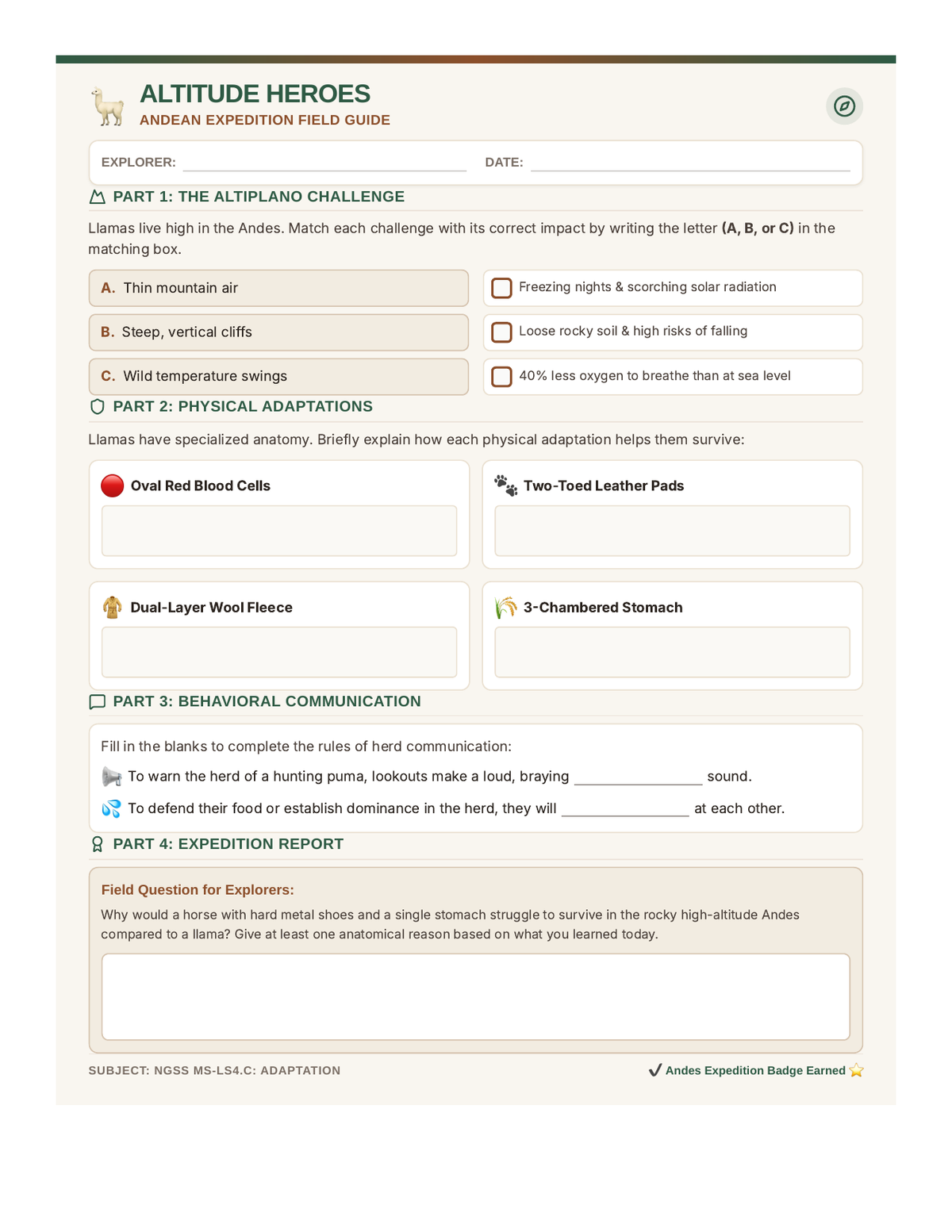
A printable companion explorer's notebook worksheet for 4th-grade students to complete while watching the Altitude Heroes presentation. Features interactive matching, fill-in-the-blank behavioral rules, physical adaptation definitions, and a critical thinking comparison prompt.
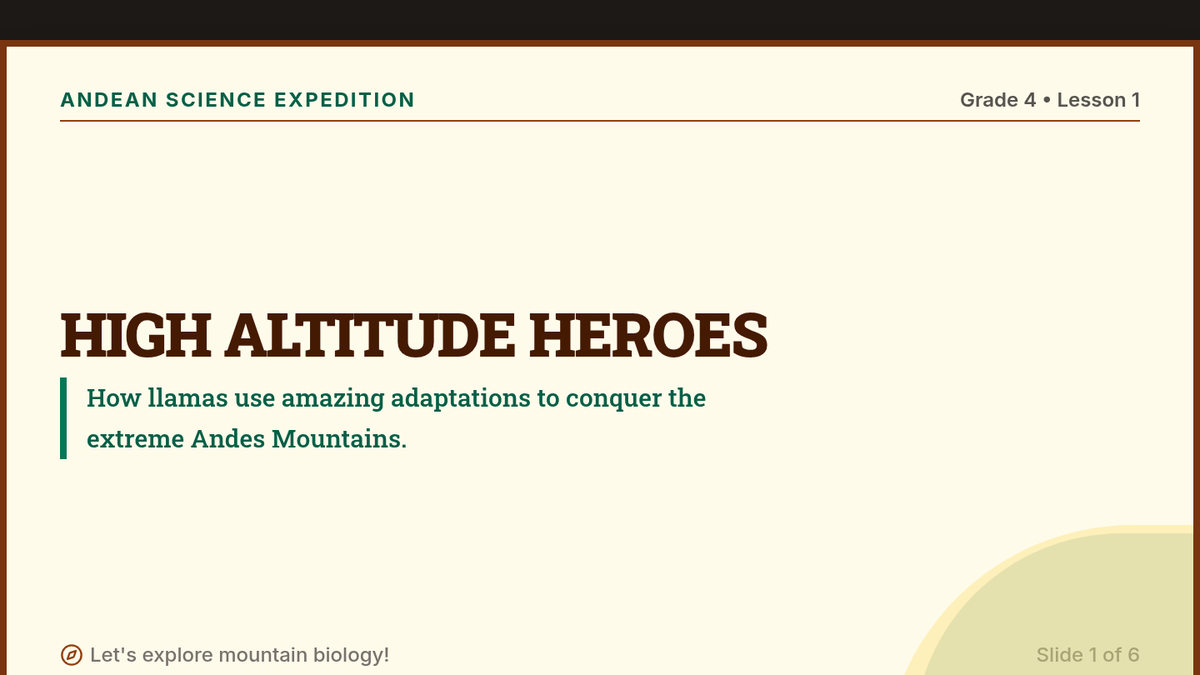
Highly visual presentation slides for teaching 4th-grade students about the unique physical and behavioral adaptations of llamas in the Andes Mountains. Uses mountain-themed colors and clean slide-by-side structures with large text (minimum 24px).
A comprehensive facilitation script and master pacing resource for teachers. Details lesson delivery times, common 4th-grade student misconceptions, and provides a full visual answer key for all sections of the student field notes worksheet.
A highly visual, print-ready, 2-page student worksheet styled as an Explorer Field Journal. Includes match questions, diagrammatic structure mapping, behavioral scenario analyses, and custom empty white-lined student answer writing areas.
An engaging set of 6 high-visibility presentation slides for a 4th-grade science lesson on llama adaptations and habitats. The slides use a warm 'Andean Field Guide' color palette with large readable fonts (>= 24px) to highlight altitude challenges, physical structures, and behavioral strategies.
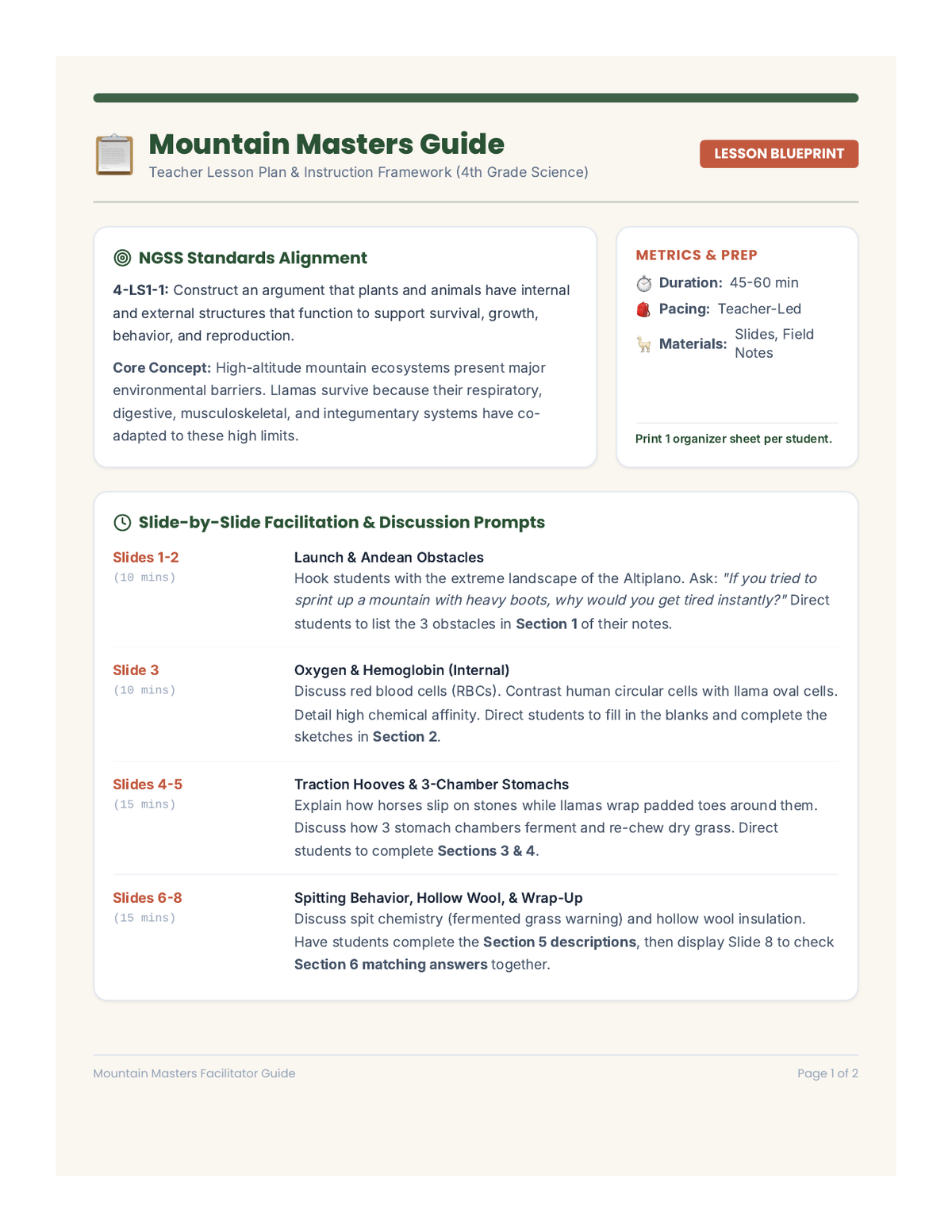
A teacher facilitation guide and answer key matching the Mountain Masters lessons. Features an NGSS lesson blueprint, slide-by-slide pacing and discussion tips, and detailed answers for the student field notes.
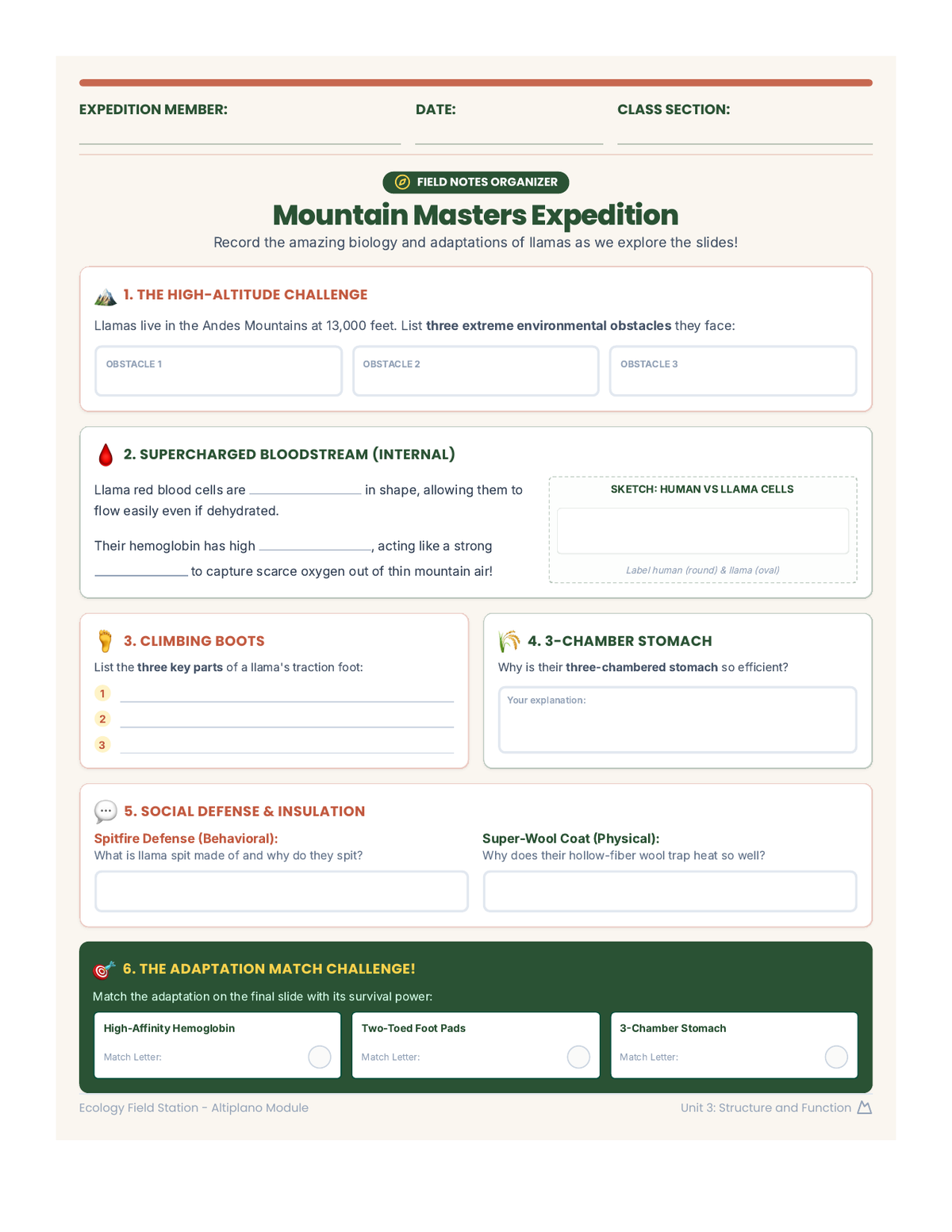
A printable note-taking organizer and field guide for 4th graders to complete as they watch the Mountain Masters slides. Includes blank spaces for environmental observations, bloodstream anatomy drawings, hoof and digestive biology explanations, and a matching review activity.
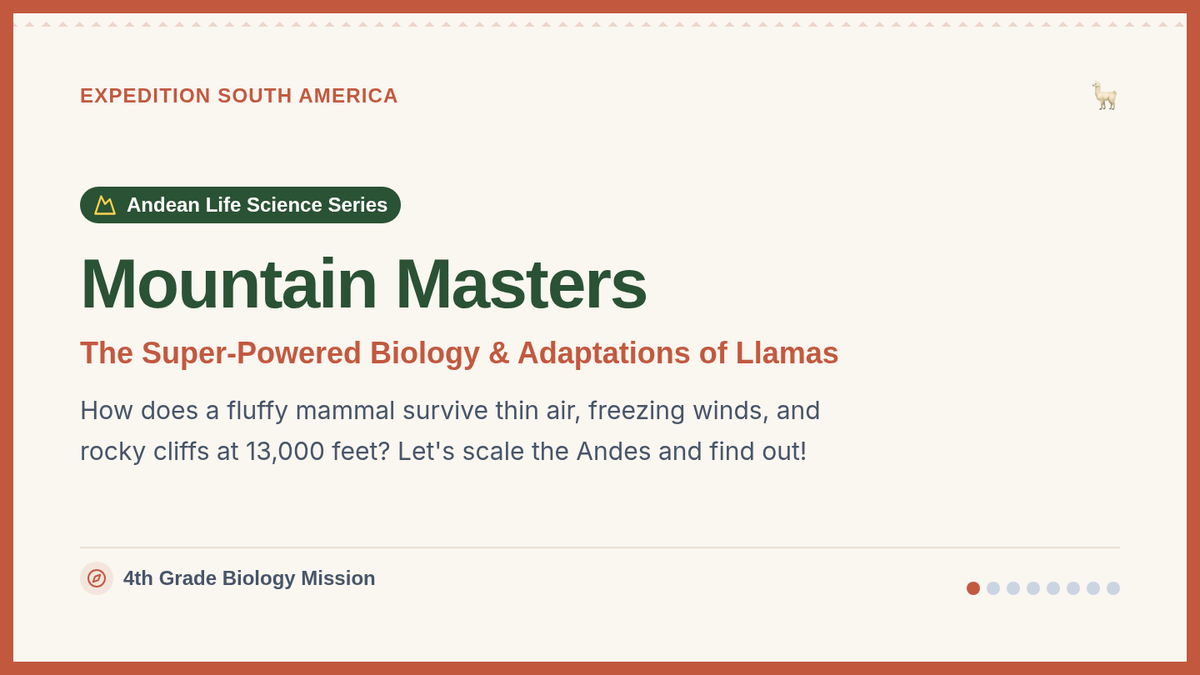
An interactive classroom slideshow designed for 4th graders exploring llama biology and adaptations. Features large, readable text, clear biological explanations, and graphic layouts detailing Andean altitude, blood biology, anatomy, digestion, wool, and behavioral traits.
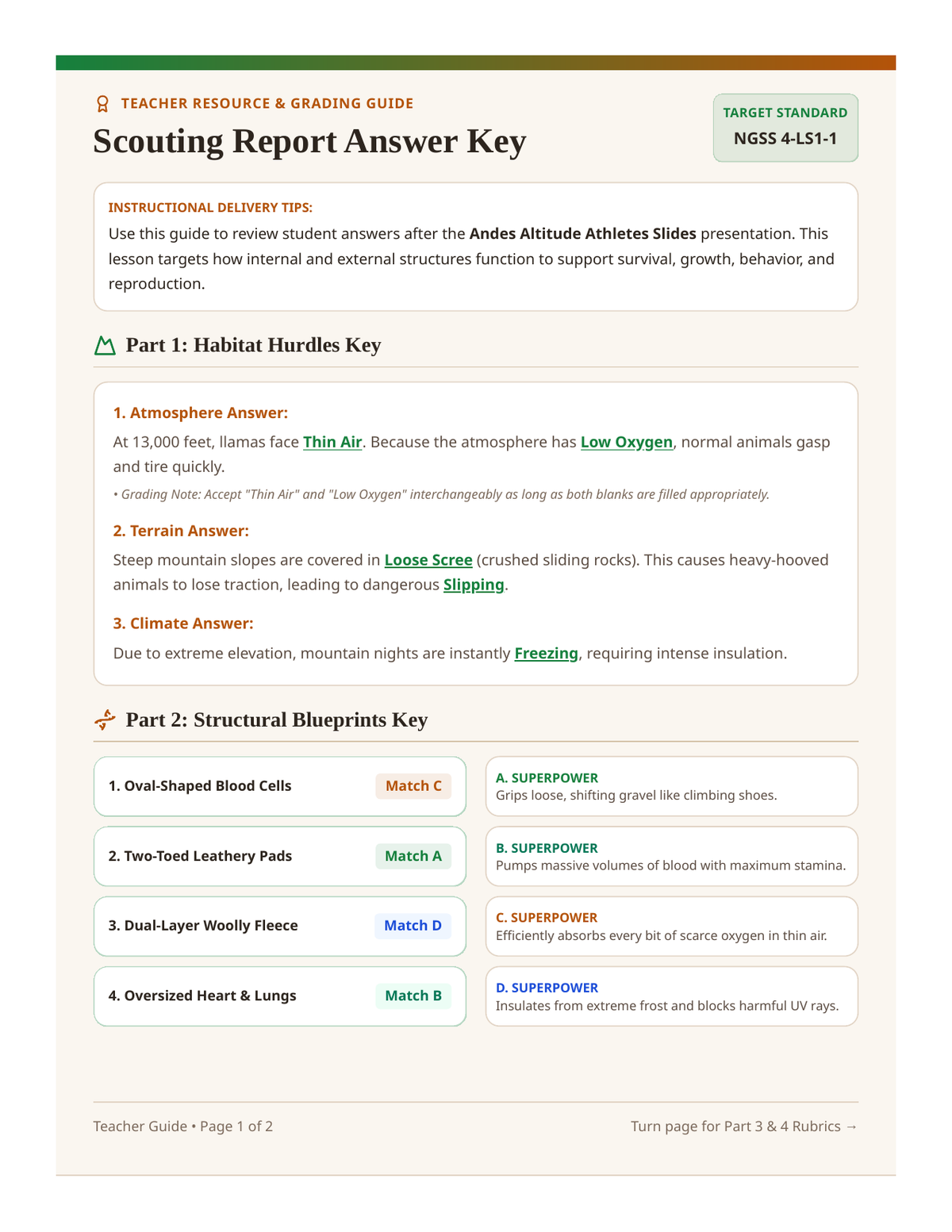
A 2-page print-ready teacher answer key and assessment rubric. Provides complete solutions for the habitat hurdles matching activity, behavioral essay analysis, and a grading guide for the biomimicry challenge.
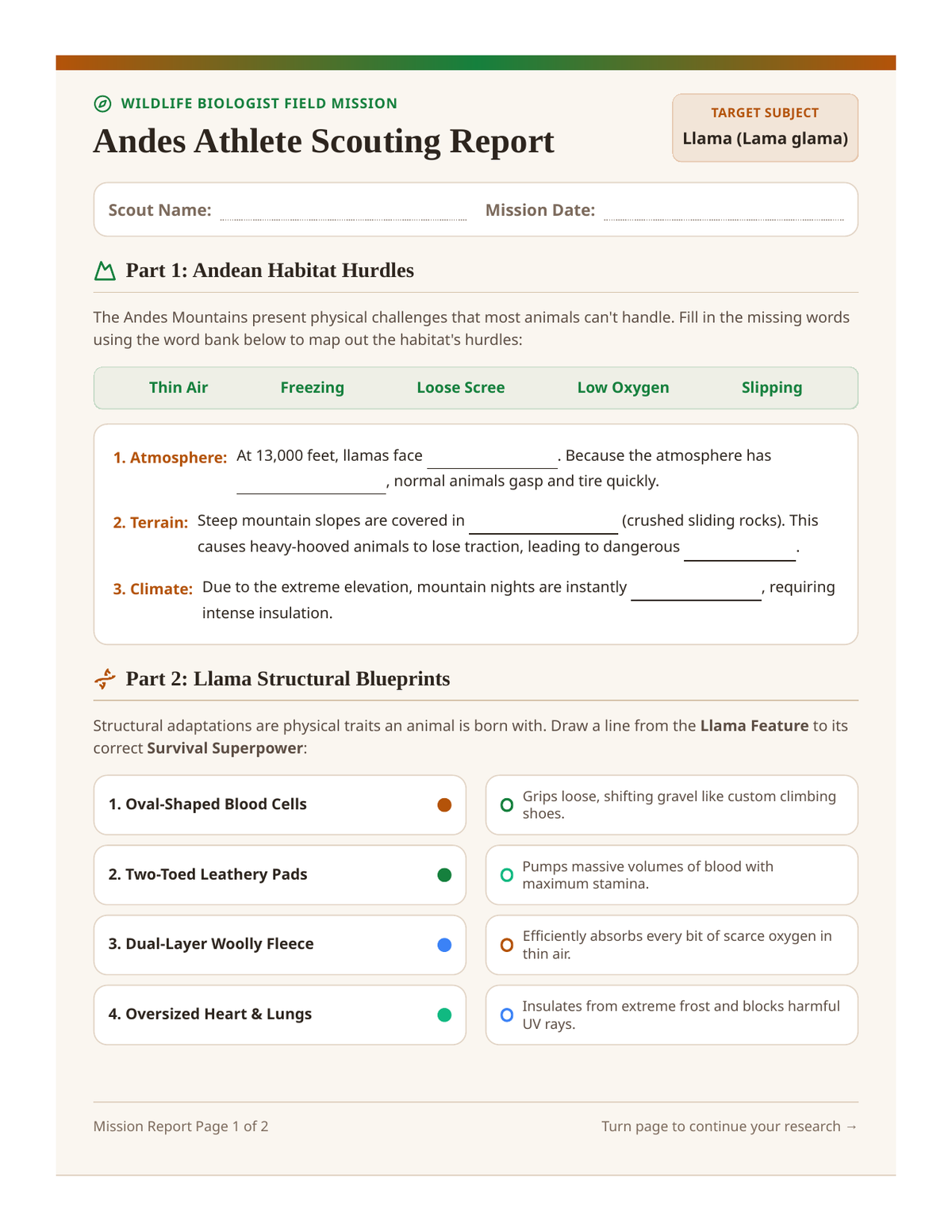
A 2-page print-ready student expedition report focused on the adaptations of the llama. Features multiple-choice habitat obstacles, a matching guide for structural adaptations, open-ended analysis of defense behavior, and a creative bio-inspired hiking gear engineering challenge.
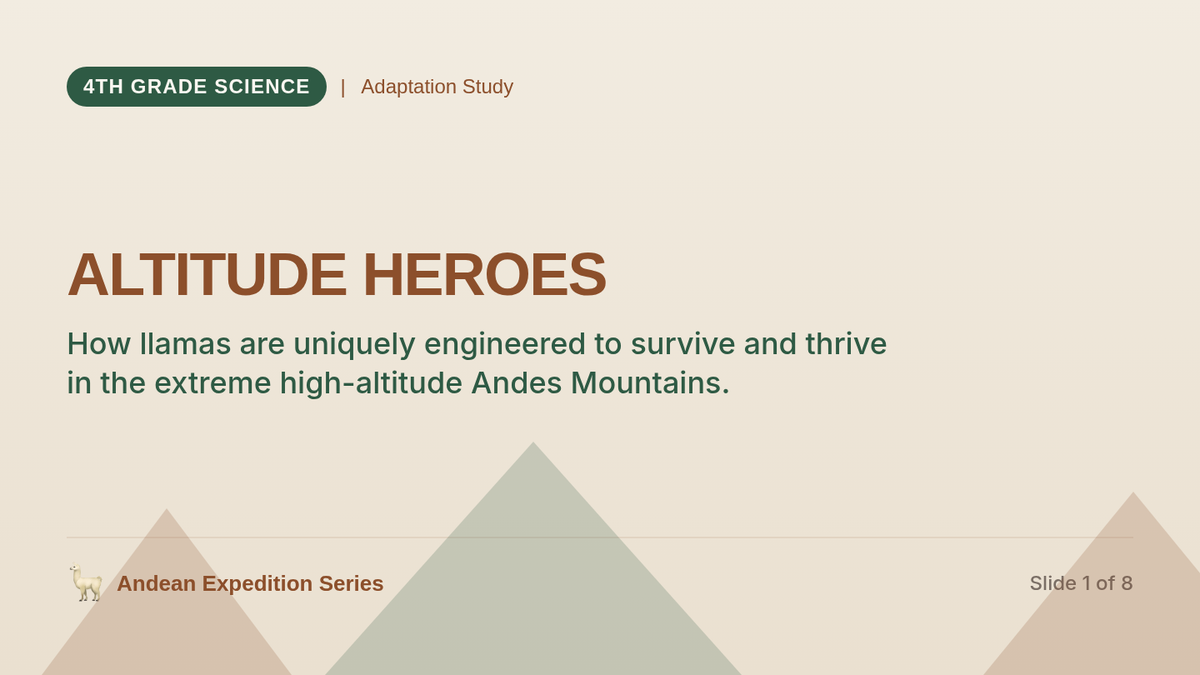
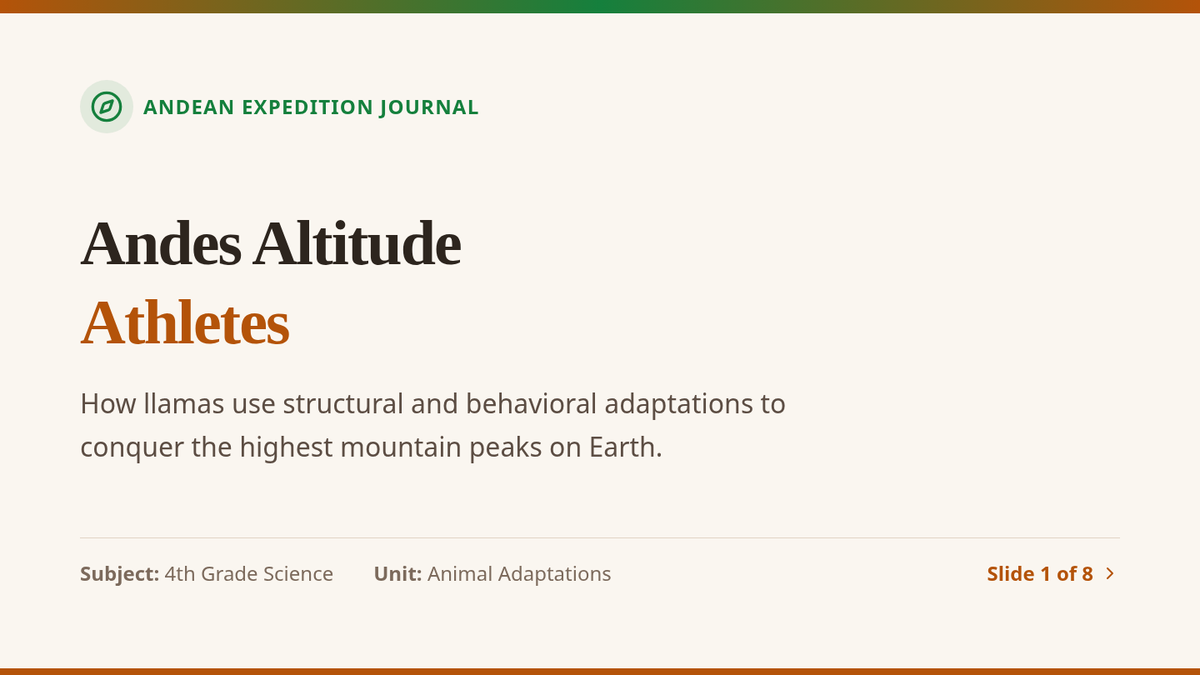
A vibrant, highly structured 8-slide classroom presentation with high-contrast text and warm mountain-themed colors. Features structural and behavioral adaptations of llamas (e.g., blood cells, soft footpads, insulating wool, herd communication, and spitting behavior) designed specifically for 4th-grade science standards.
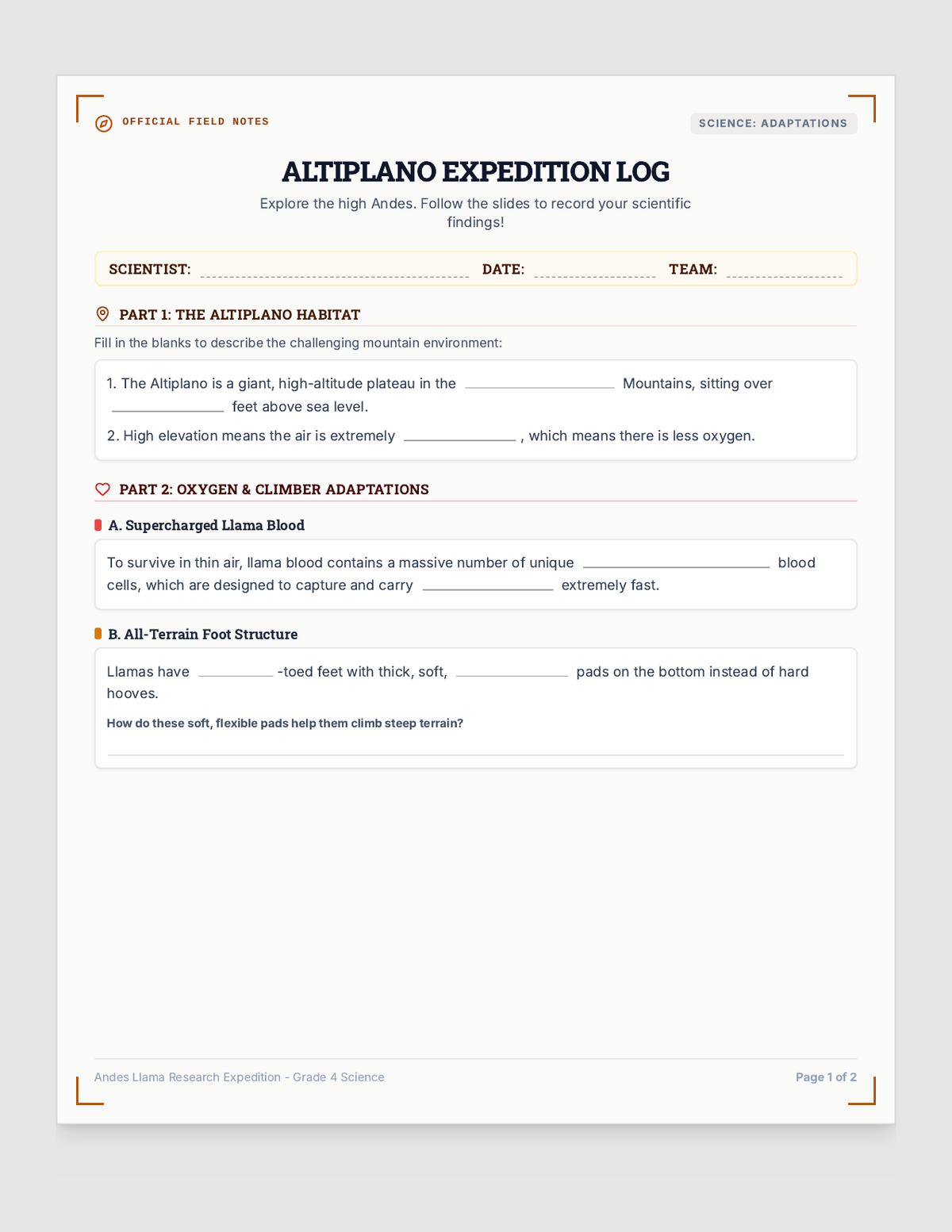
A printable 2-page guided notes worksheet designed as an expedition scientist's notebook for 4th-grade students to complete during the Altiplano Expedition slides. Features clean writing lines, fill-in-the-blank logs, and a fun field-sketching challenge.
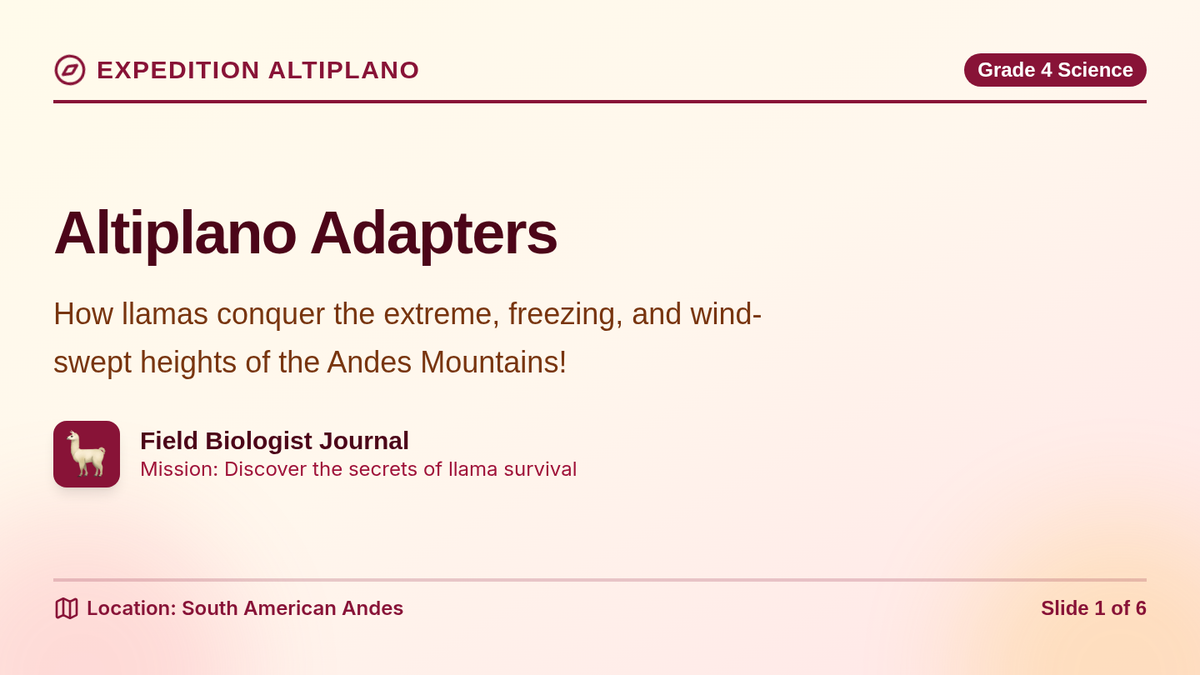
An engaging 16:9 presentation slide deck that guides 4th graders through the rugged Andes Mountains environment (the Altiplano) and explains the incredible physical and behavioral adaptations of llamas. Includes beautiful visual layouts, clear icons, and student discussion prompts.
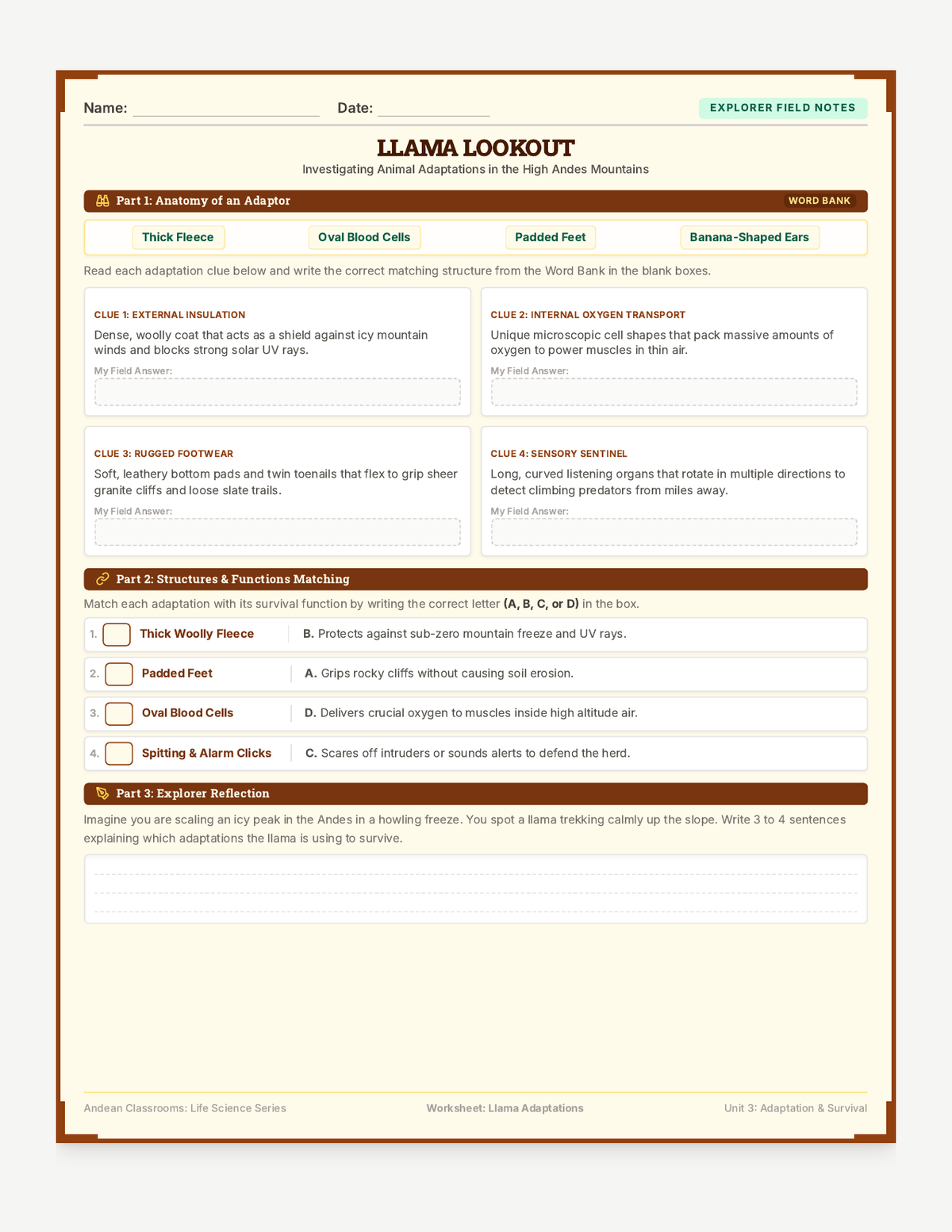
A student-facing activity sheet featuring a llama anatomy diagram for labeling adaptations, matching questions, and a short-answer writing prompt about survival.
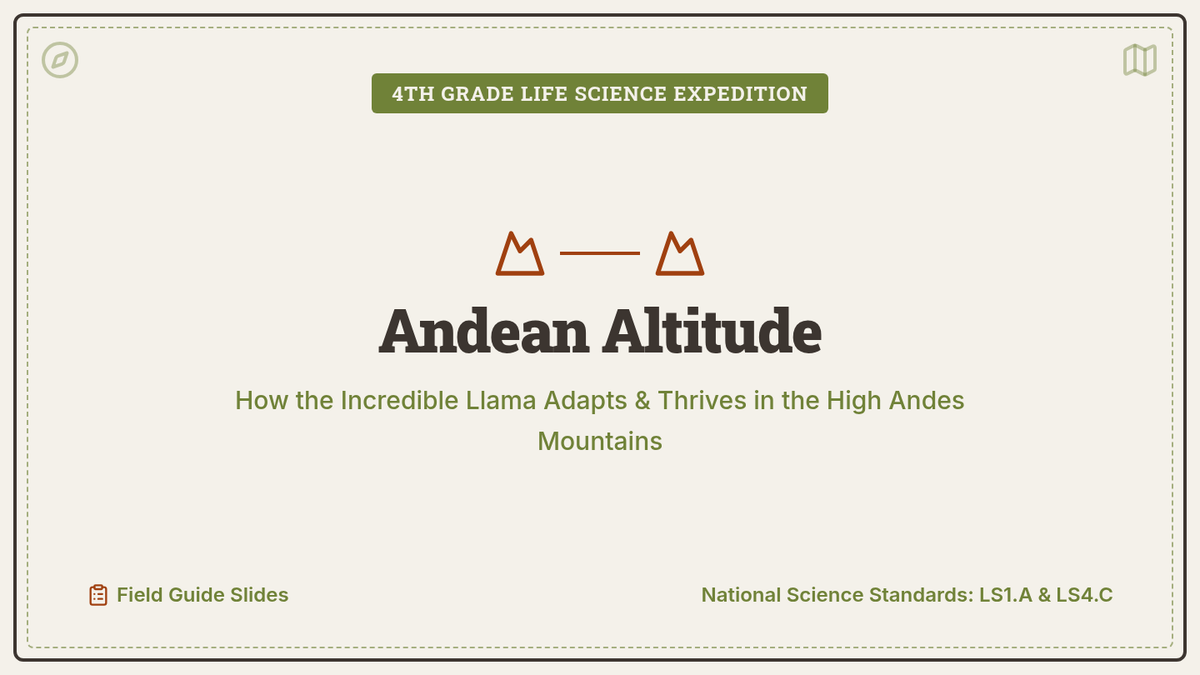
An engaging 6-slide presentation with strict minimum 24px text covering the Andes environment, llama physical adaptations (thick fleece, special blood, padded feet), and behavioral adaptations.
A comprehensive teacher guide for leading a life-science lesson on llama adaptations, complete with lesson pacing, scripting, key vocabulary, and an assessment rubric.
A highly visual student worksheet to accompany the Peak Performers reading passage. Features a structured graphic organizer mapping the four main physiological llama adaptations and two higher-order synthesis and real-world scenario questions.
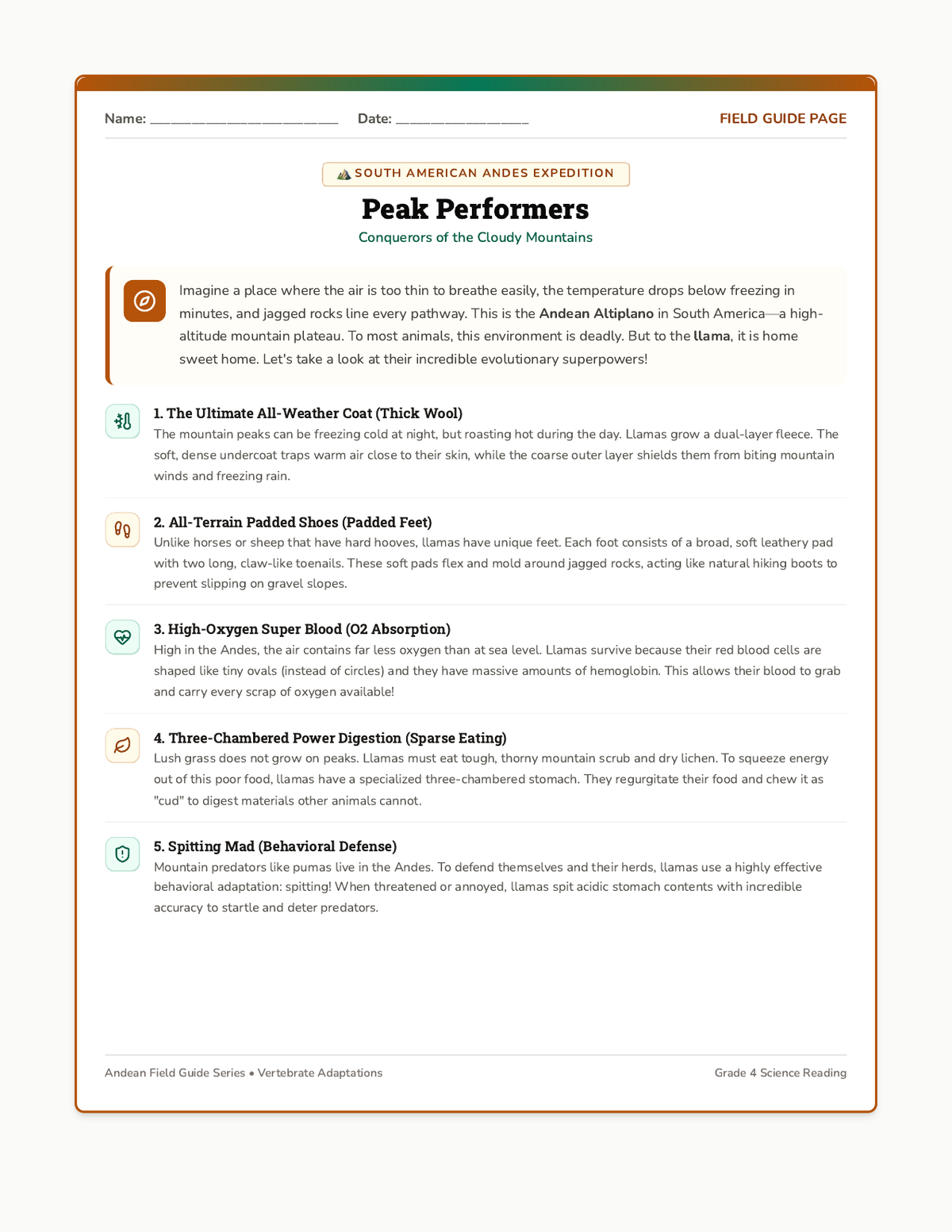
An engaging, field-guide-style reading passage about llamas tailored for 4th-grade students. It details 5 vital adaptations—thick wool, padded feet, oval red blood cells, a three-chambered stomach, and spitting behavior—with beautiful layouts and intuitive headers.
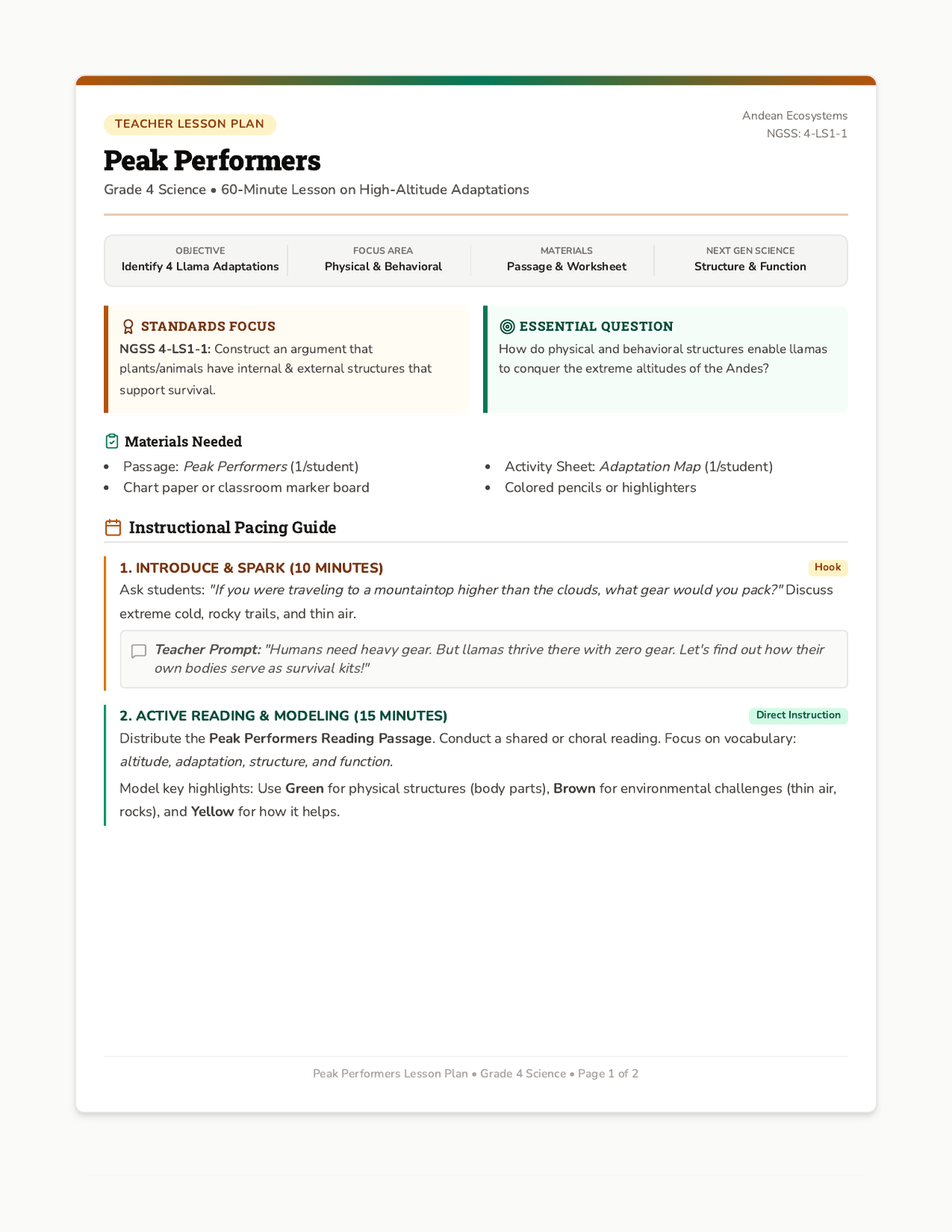
A comprehensive, 2-page teacher lesson plan for a 4th-grade science lesson on llama adaptations. Built around the NGSS 4-LS1-1 standard, it includes a clear pacing guide, check-for-understanding questions, and targeted differentiation strategies for varying student needs.
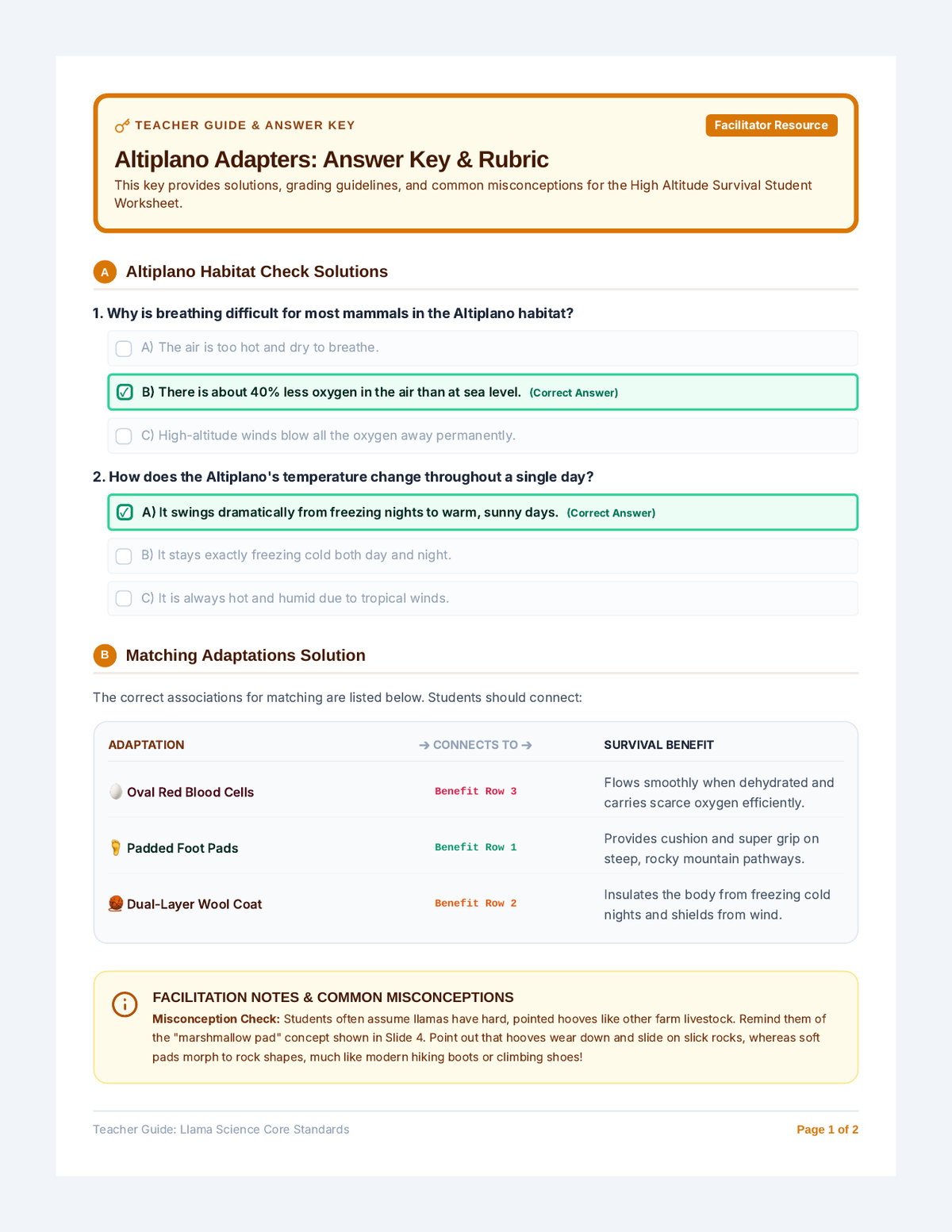
A comprehensive 2-page print-ready teacher answer key and assessment guide for the Altiplano Adapters lesson. It includes highlighted solutions for multiple choice questions, matching keys, sketching checklists, a written student exemplar response, and an objective grading rubric.
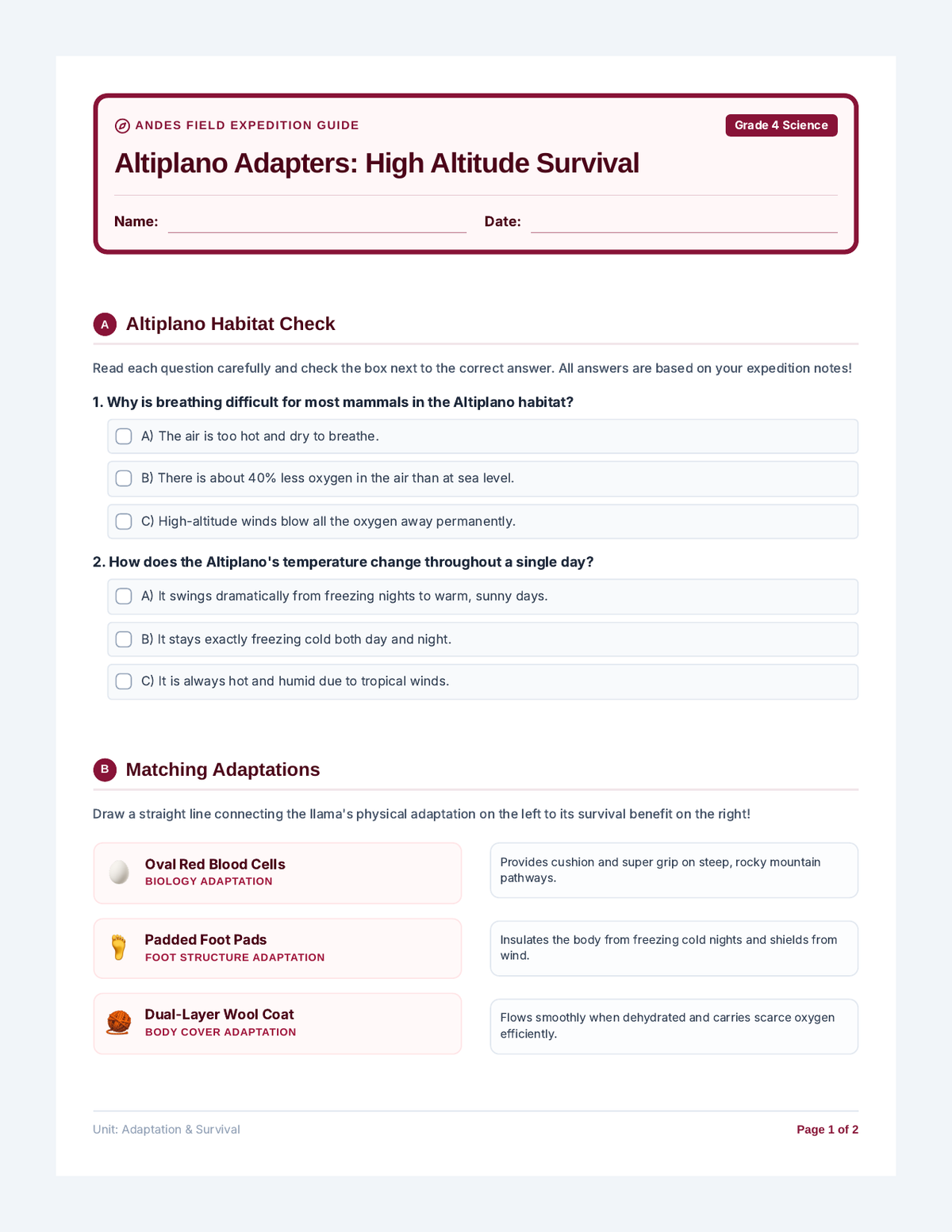
A 2-page print-ready student worksheet designed for 4th-grade science lessons. It features an Altiplano habitat multiple choice check, matching of key adaptations, a field biologist sketching lab for feet and blood cells, and a written explanation section for high-altitude survival.
A visually rich, highly readable 6-slide presentation deck designed for 4th-grade science lessons. It introduces the Altiplano habitat and outlines three essential physical adaptations of llamas (oval red blood cells, marshmallow feet, and dual-layer wool coats) with giant text (minimum 24px) and clear comparison visuals.
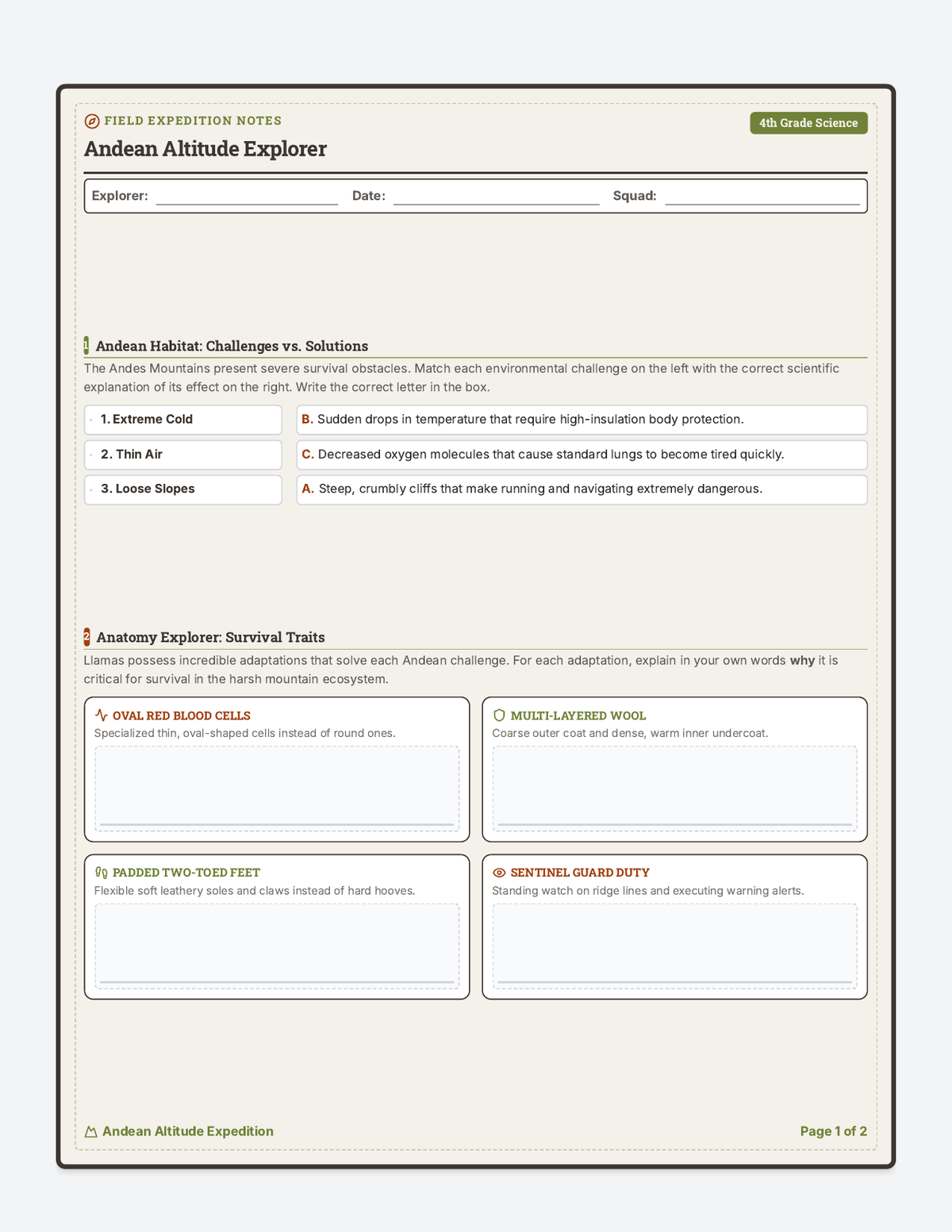
Expedition Field Notes student worksheet. Contains visual matching of ecosystem challenges, short-response prompts analyzing llama physiological adaptations, and real-world scenario challenges with handwriting lines. Explicitly styled for 720x960 layout.
Interactive instruction slides that explore the harsh Andean ecosystem and the incredible physical and behavioral adaptations of llamas (including oval red blood cells, padded toes, and spitting defenses). Explicitly sized for 1440x810 slides.
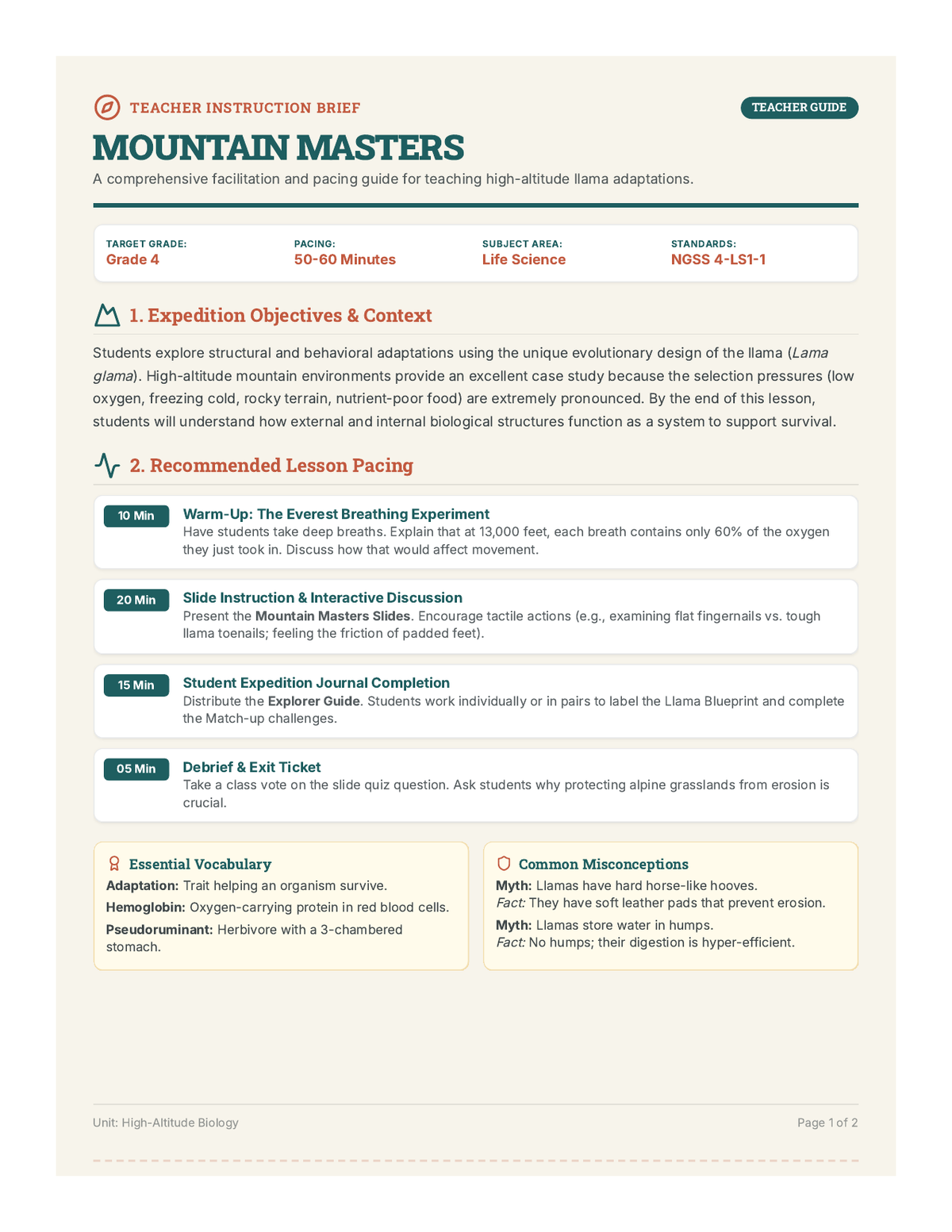
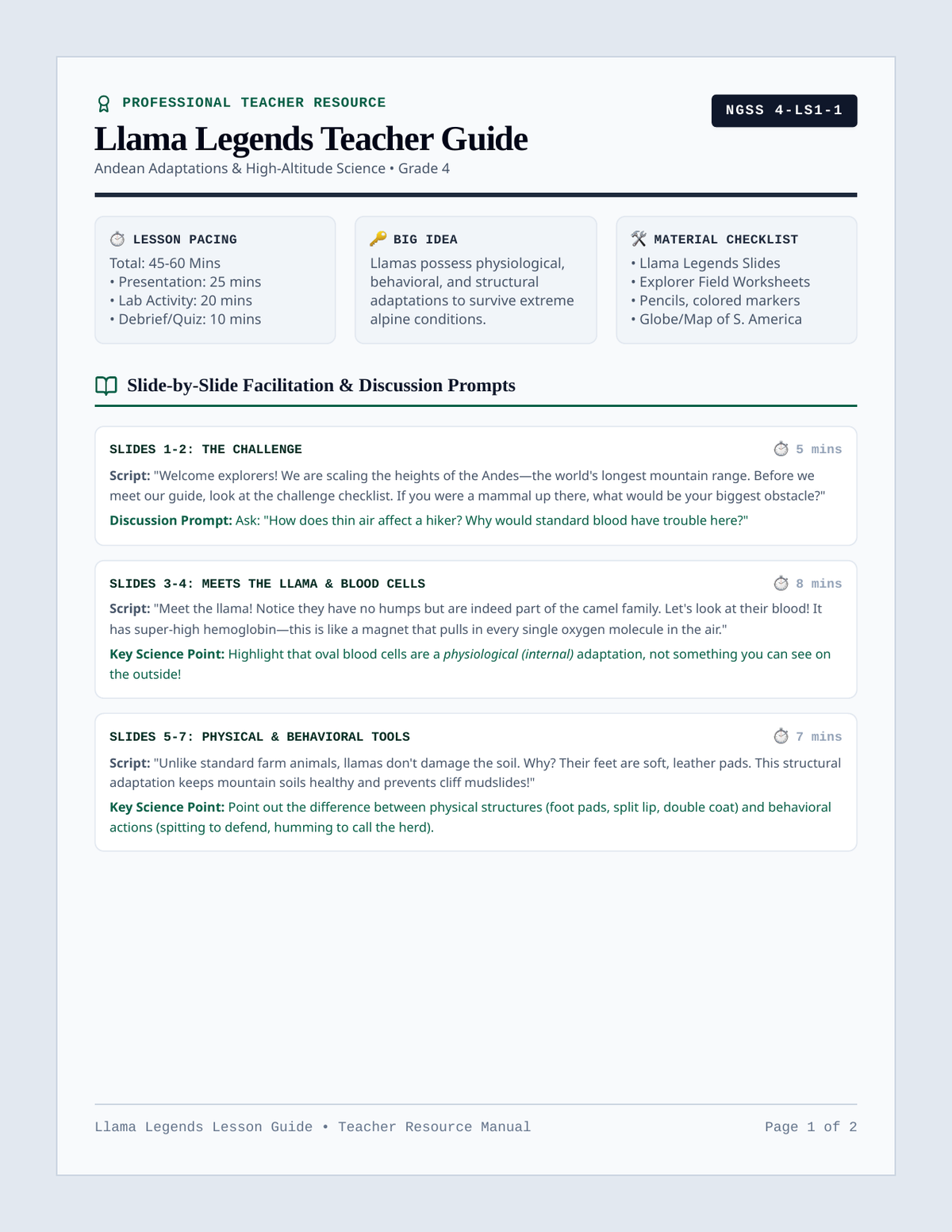
A comprehensive teacher preparation and facilitation guide outlining lesson plans, discussion prompts, student misconceptions, and differentiation strategies for the Llama Legends lesson.
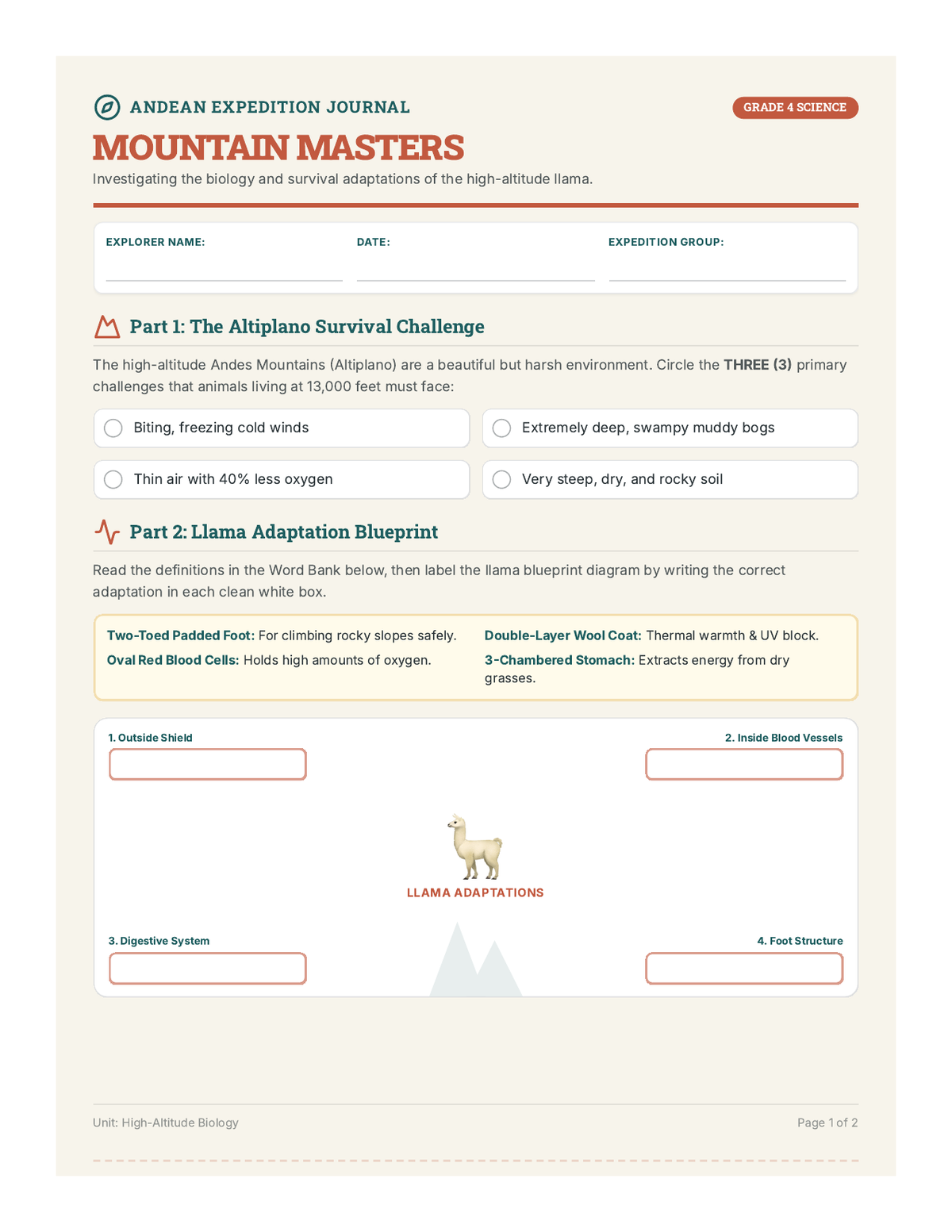
A student-facing printable worksheet styled as an explorer's field notebook, allowing students to sketch, label, and analyze llama adaptations and habitat.