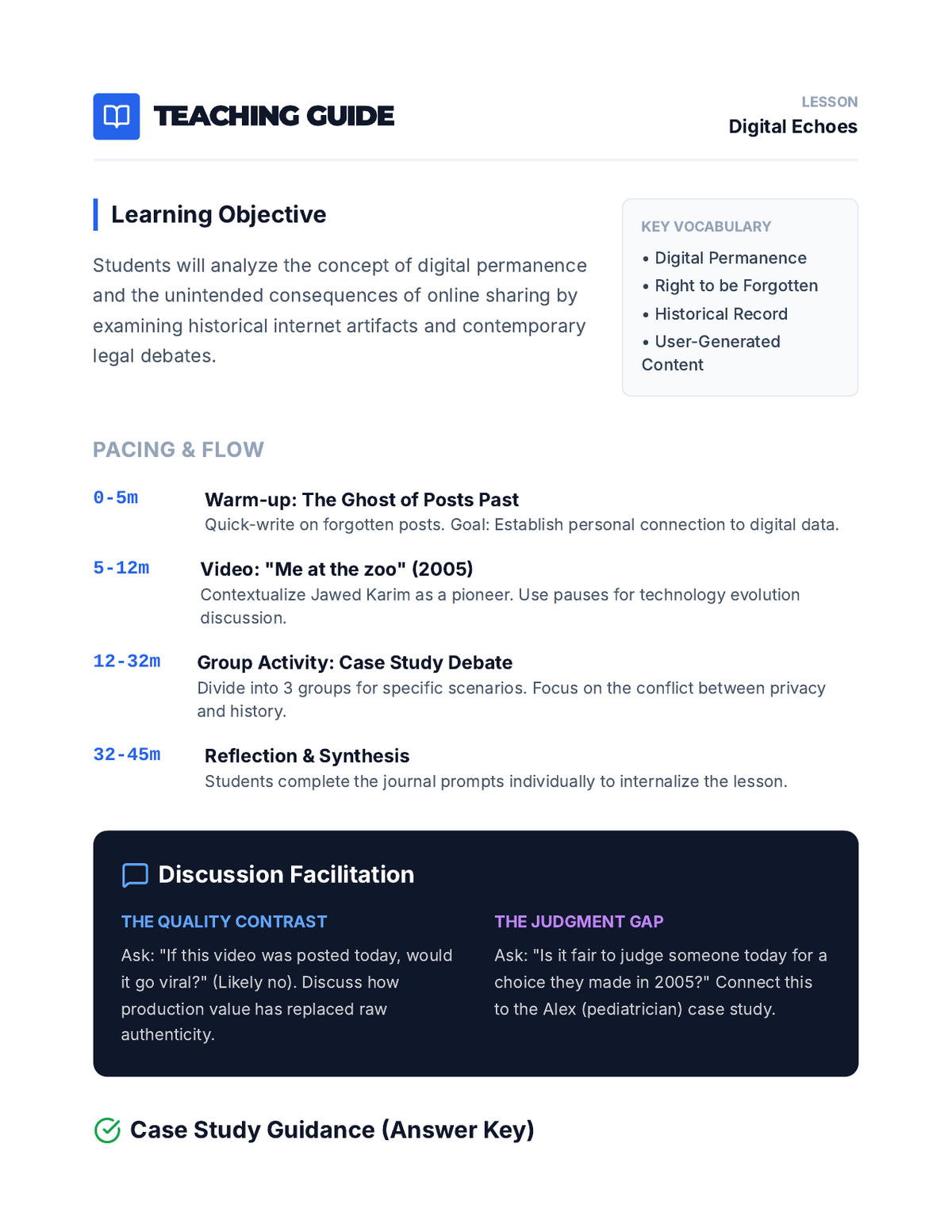
A comprehensive facilitator's guide for leading a 45-minute workshop on digital footprints, including pacing, discussion prompts, and instructional sequences.
A teacher guide and answer key for the climate bias warm-up, including facilitation strategies, timing breakdowns, and exemplar student responses.

1/12
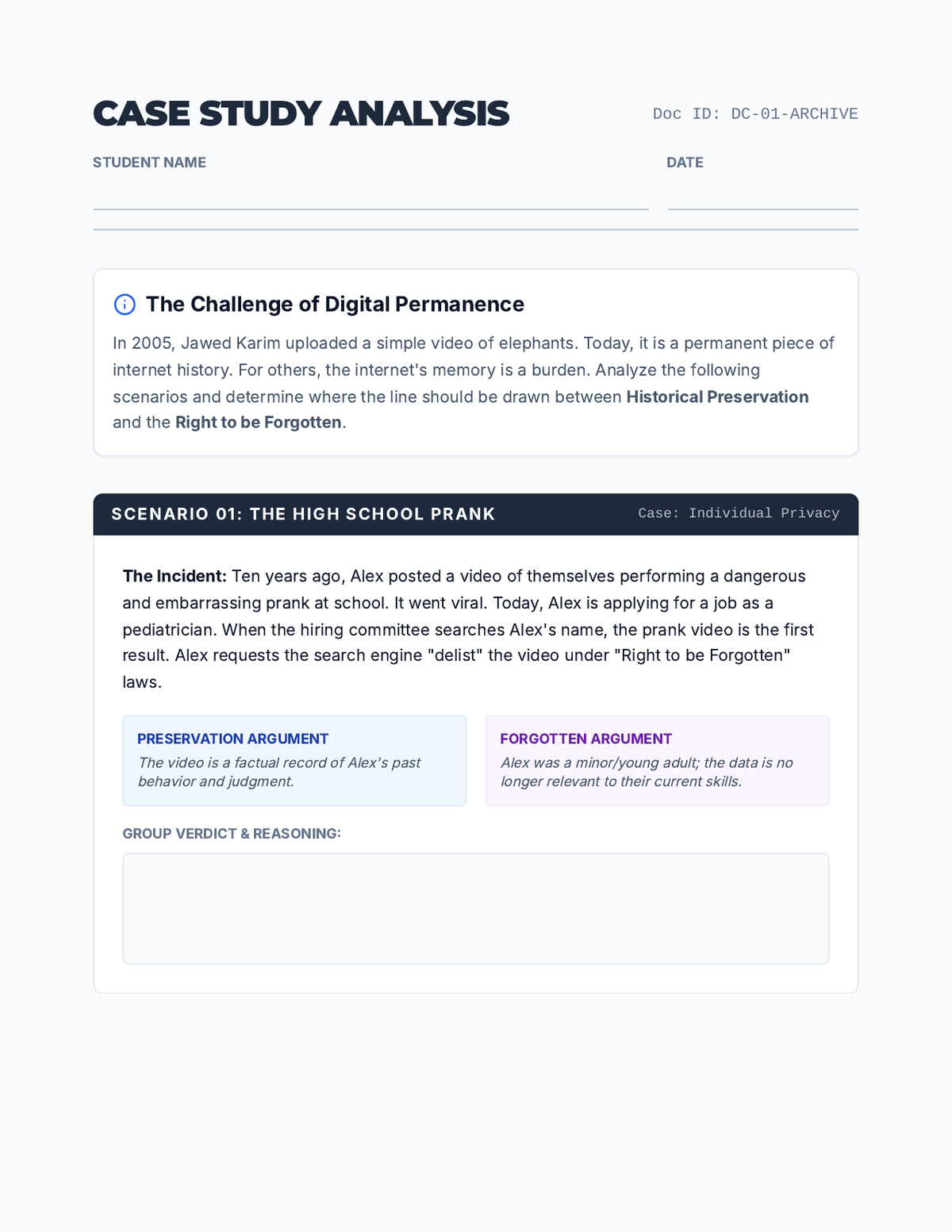
A structured student worksheet featuring three distinct case studies on digital permanence, encouraging debate between individual privacy and historical preservation. Includes space for group verdicts and a summary 'permanence scale' activity.
1/16
Final facilitation guide for Session 6. Provides instructions for synthesizing the 6-week program, helping students select their best tools, and planning for long-term maintenance of skills.
1/13
A set of three printable exit tickets per page for the 'Pixel Pioneers' lesson, asking students to reflect on the modern viability of the first YouTube video.
Visual presentation for Session 3, focusing on distress tolerance techniques for high-intensity situations using the TIPP skills framework.
Visual presentation for Session 2, introducing the 'Window of Tolerance' and teaching proactive regulation tools like 5-4-3-2-1 grounding and controlled breathing.
A student reference and practice sheet for Session 2. It provides clear, visual instructions for Square Breathing and 5-4-3-2-1 Grounding, along with a simple 'regulation plan' for students to complete.
A set of 6 printable discussion cards for middle school students to analyze the "Me at the zoo" video. Each card features a specific timestamp or concept, focusing on social norms, technology evolution, and presentation styles.
Teacher-facing facilitation guide for Session 3. Focuses on teaching TIPP skills for crisis regulation and helping students identify environmental supports (like cold water access) within the school.
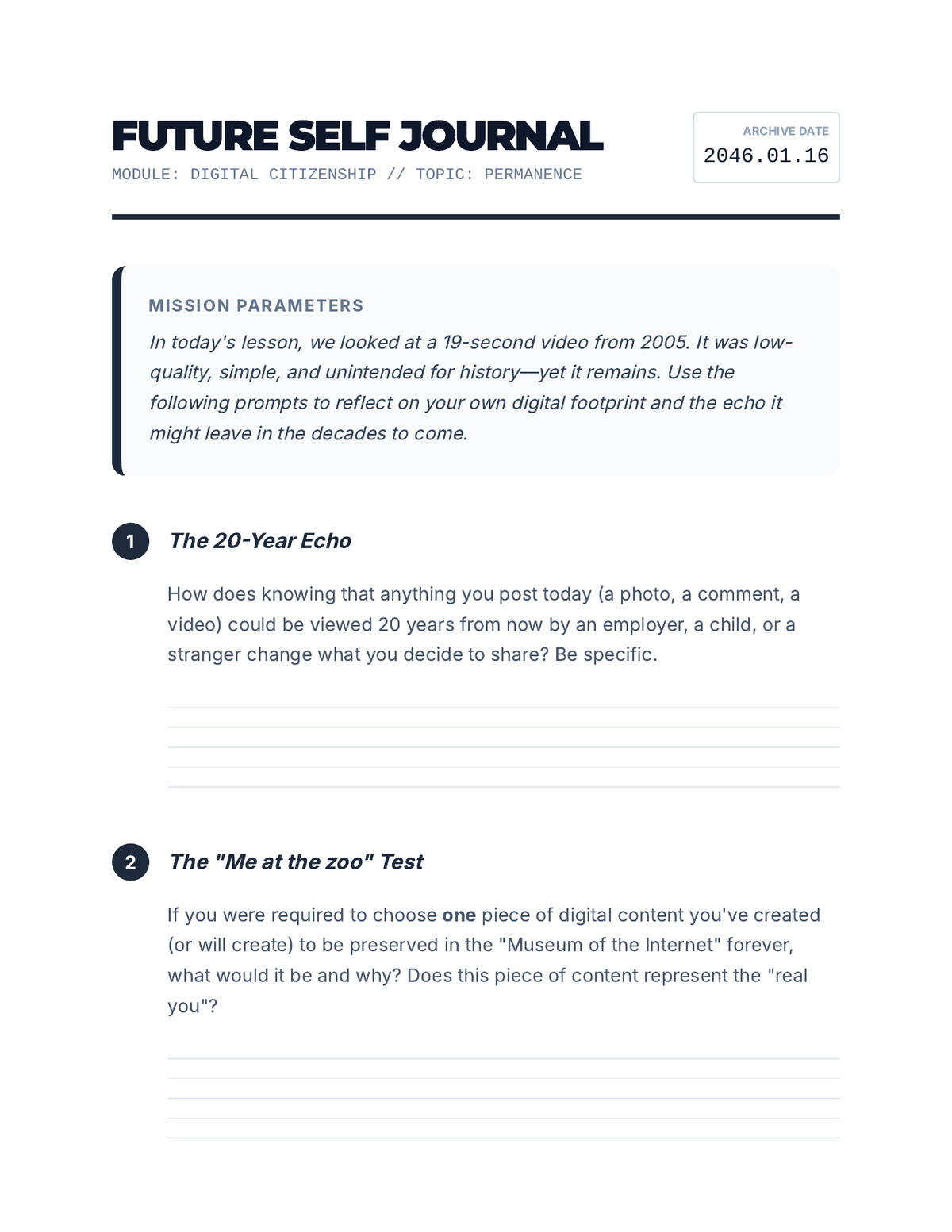
A critical reflection journal for undergraduate students to deconstruct their perception of authenticity, comparing early Web 2.0 aesthetics to the modern creator economy.
A visual warm-up activity featuring two 'mystery' patterns with missing elements. Designed to spark discussion about identifying and justifying pattern rules.
Introductory slide deck for Session 1, establishing the 'Inner Compass' theme. It explains the purpose of the intervention and teaches students how to recognize physiological signals of emotions using the 'Emotions as Data' framework.
Visual presentation for Session 5, focusing on assertive communication (I-statements) and the concept of healthy boundaries in relationships.
Culminating slide deck for Session 6, summarizing the key skills from the intervention and guiding students through the creation of their personalized 'Resilience Toolkit.'
A comprehensive teacher's guide for the Zoo Talk lesson, detailing the objective, materials, time breakdown, and the 'Jawed' three-part speaking structure.
A culminating student worksheet that synthesizes all skills learned throughout the 6-week intervention into a single, comprehensive 'Resilience Toolkit' for future reference.
Comprehensive lesson plan for Lesson 1: Can You Feel the Beat? including instructional steps, objectives, and differentiation strategies.
Printable discussion cards with deep-dive questions about authenticity, monetization, and social media performance for small group seminars.
A ledger recording activity where students fill in transaction details and calculate a running balance based on Charlie's weekly activity.
A worksheet for students to identify repeating units and extend AB, AAB, and ABB shape patterns. Includes a creative section for students to design their own AAB pattern.