Buddy Builders Teacher Guide
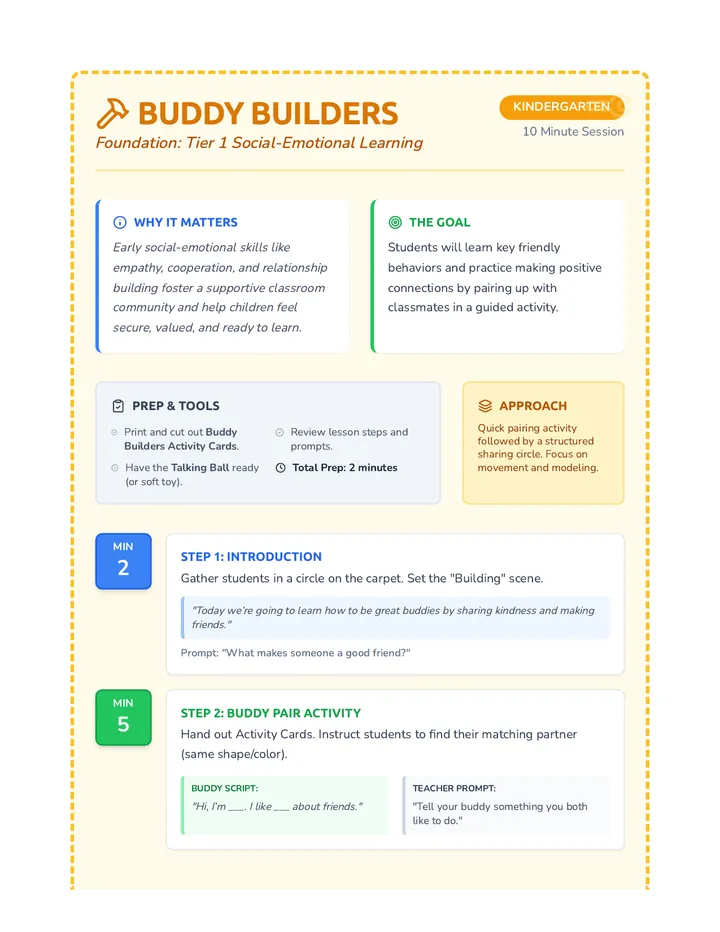
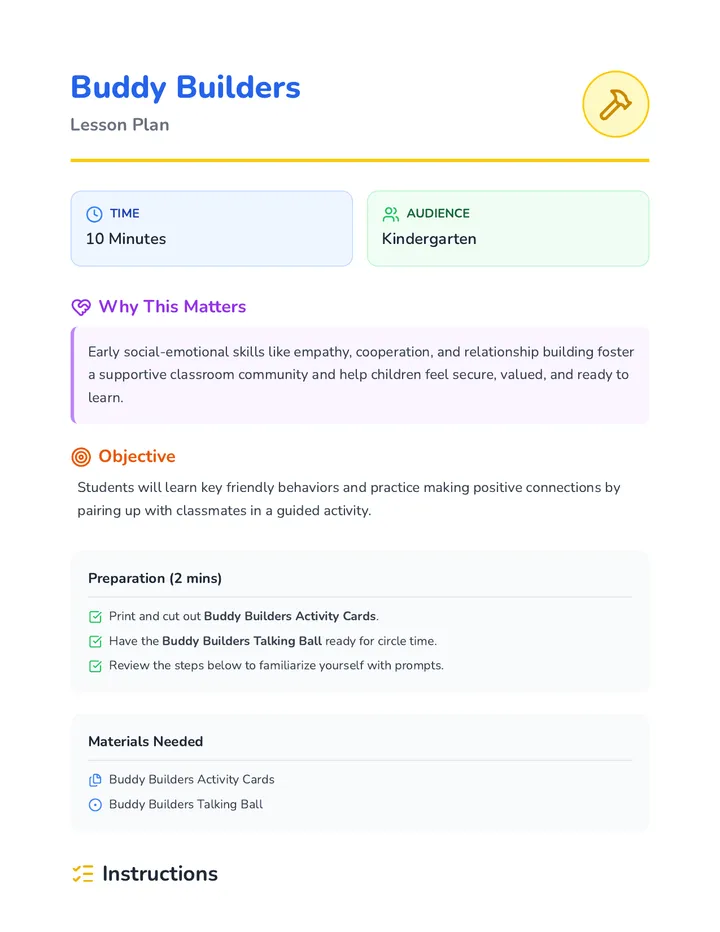
Buddy Builders
Teacher Lesson Plan
Level: Kindergarten
Time
10 Minutes
Objective
Students will learn key friendly behaviors and practice making positive connections by pairing up with classmates in a guided activity.
Materials
- Buddy Match Cards
- Talking Ball Prompts
- A soft ball (for the activity)
Preparation
- Print and cut out Buddy Match Cards.
- Prepare the Talking Ball with the printed prompts.
- Review prompts to familiarize yourself with steps.
1 Introduction (2 min)
Gather students in a circle on the carpet. Set the tone for a fun, collaborative session.
"Today we’re going to learn how to be great buddies by sharing kindness and making friends."
Discussion Question:
“What makes someone a good friend?” (Collect 2-3 responses).
2 Buddy Pair Activity (5 min)
- Hand each child one Buddy Match Card.
- Instruct students to find the classmate with the matching shape and color.
- Once paired, guide them through a greeting:
Prompt:
“Hi, I’m [Name]. I like [Kindness/Sharing/Playing] about friends.”
Circulate and help pairs who might be struggling to find their match or start the conversation.
3 Sharing & Reflection (3 min)
Reconvene in the circle. Introduce the Talking Ball.
- Pass the ball; the holder shares one kind thing their partner did or said.
- Celebrate specific examples (e.g., sharing a card, using manners).
Closing:
“Well done, buddies! Remember to use these skills every day.”
Buddy Builders Activity Guide
Buddy Builders Activity
Facilitation Guide
Activity Overview
This interactive experience uses a physical matching component to remove the stress of "finding a partner" while scaffolding positive social interactions. Students move from a 1-on-1 greeting to a group reflection.
1
Distribute & Match
Give one Buddy Match Card to each child. Instruct students to walk around the room silently (or with "mouse feet") to find the classmate holding the card that matches their own shape and color.
2