A play-based lesson designed to help young students identify and understand a wide range of emotions through interactive games and visual aids.
An introductory lesson exploring the continuous movement of water on Earth, focusing on the key stages of the water cycle.
The final stage of the EDP where students test their designs, gather data, and iterate for improvement.
Students learn about materials, constraints, and building techniques as they move into the 'Plan' and 'Create' stages.
Focuses on the 'Define' and 'Imagine' stages of the EDP through a real-world problem-solving scenario.
Students are introduced to the five stages of the Engineering Design Process and apply them to a simple 'Paper Tower' challenge.
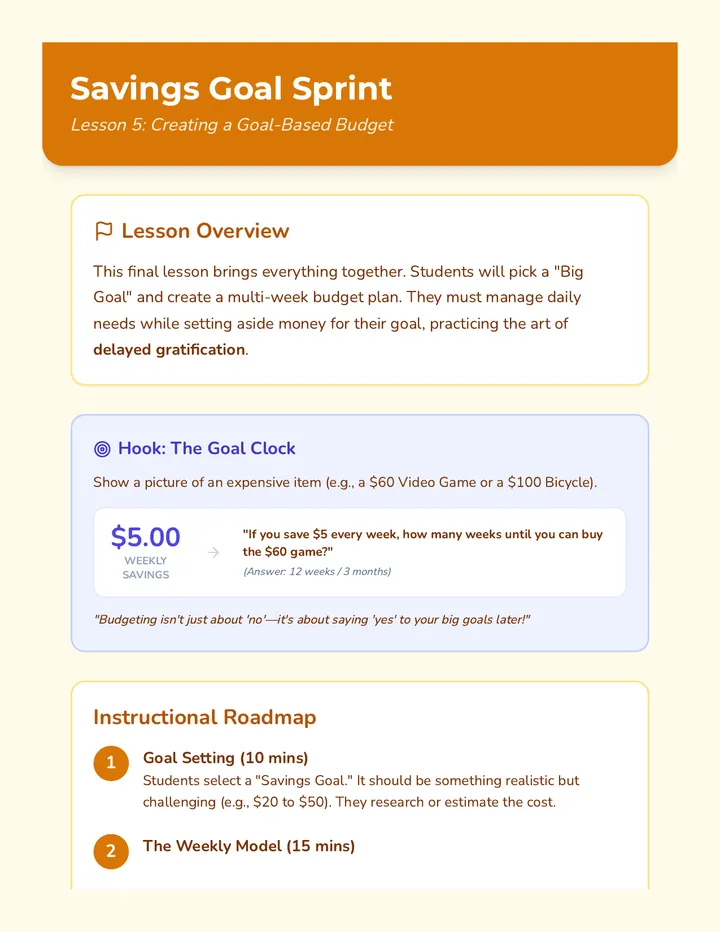
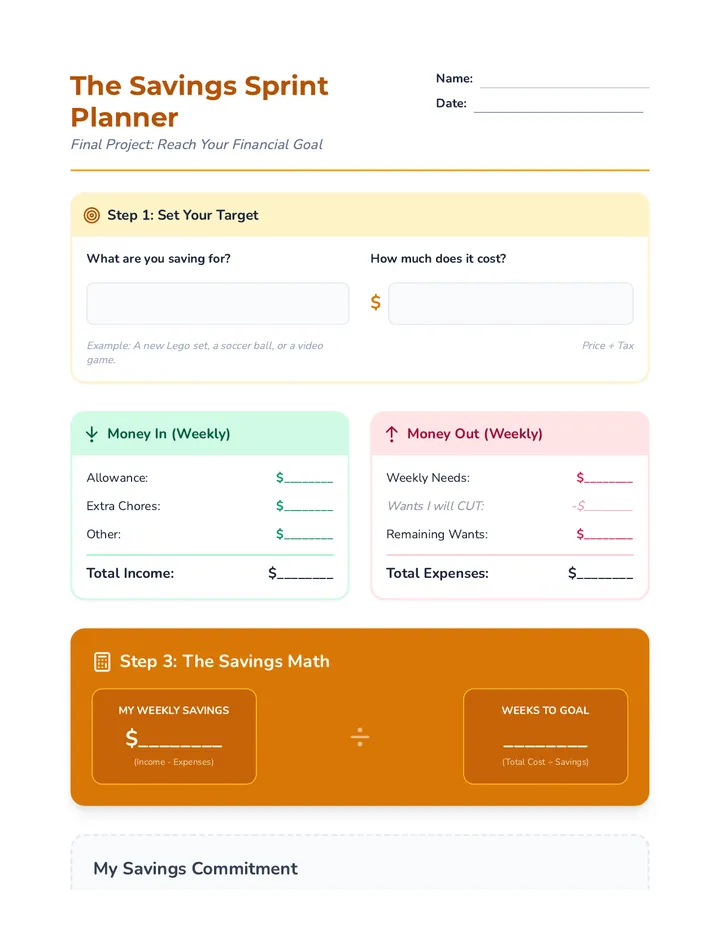
A culminating project where students create a budget to reach a specific savings goal while managing weekly expenses.
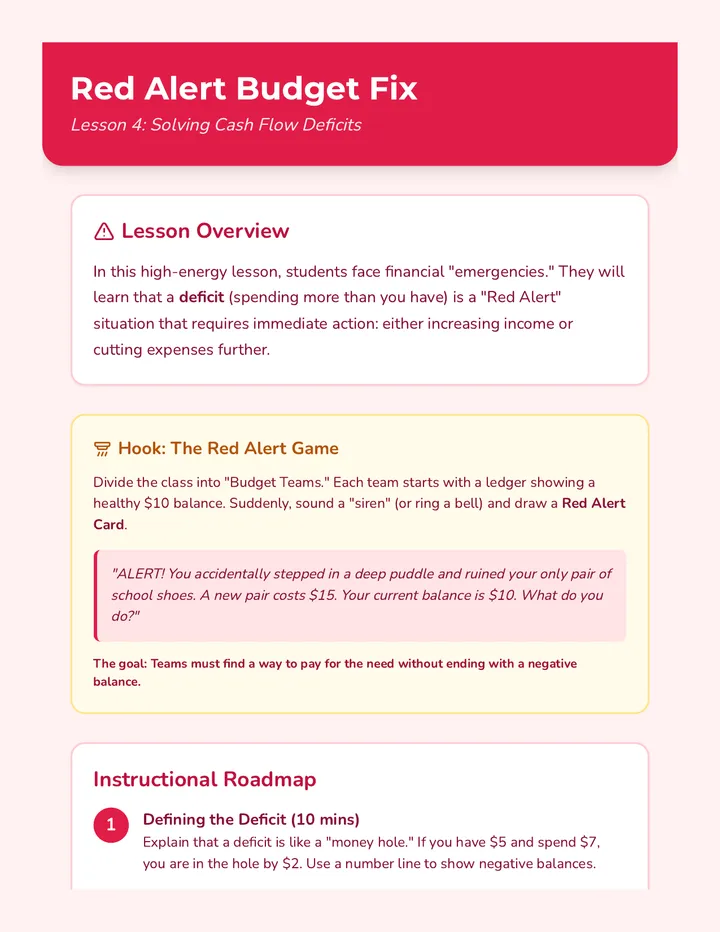
Challenges students to solve budget emergencies and navigate financial deficits using problem-solving strategies.
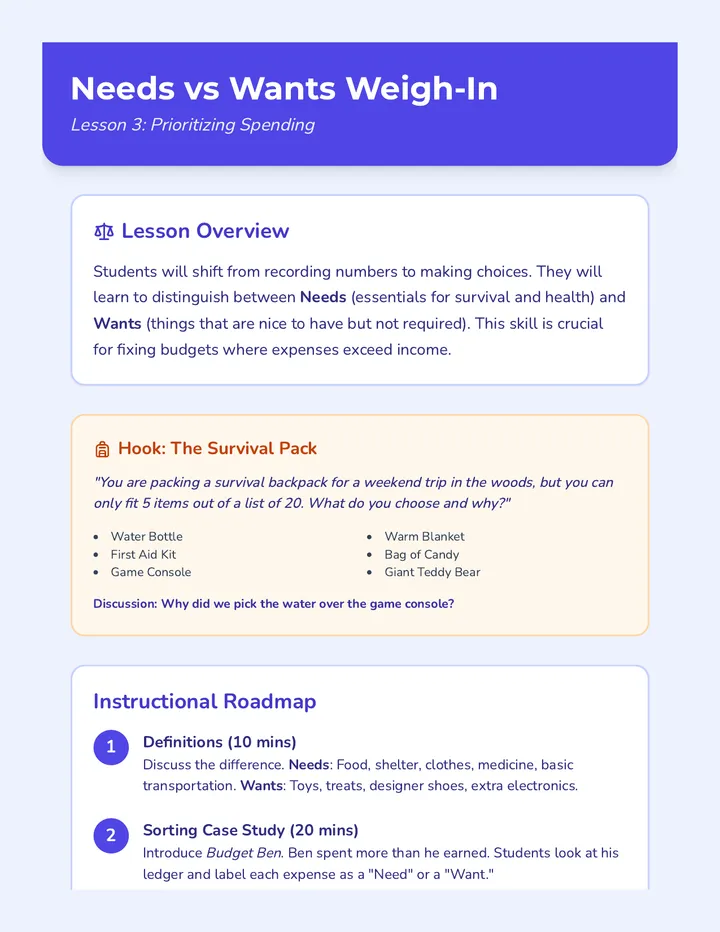
Focuses on financial decision-making by distinguishing essential needs from discretionary wants to fix a deficit.
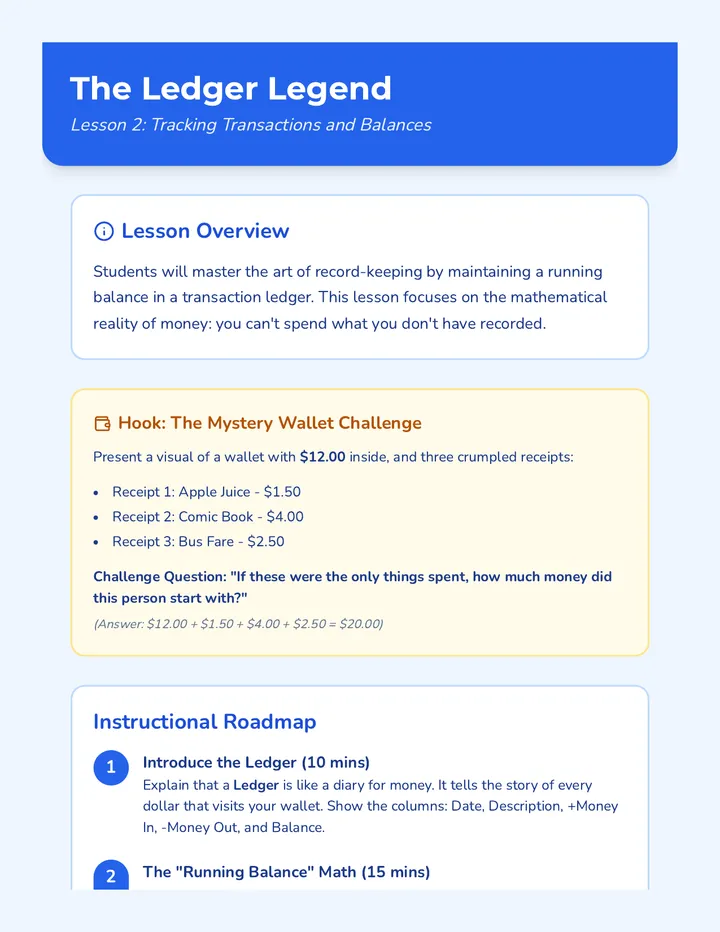
Teaches students how to record transactions and maintain a running balance using a simple ledger.
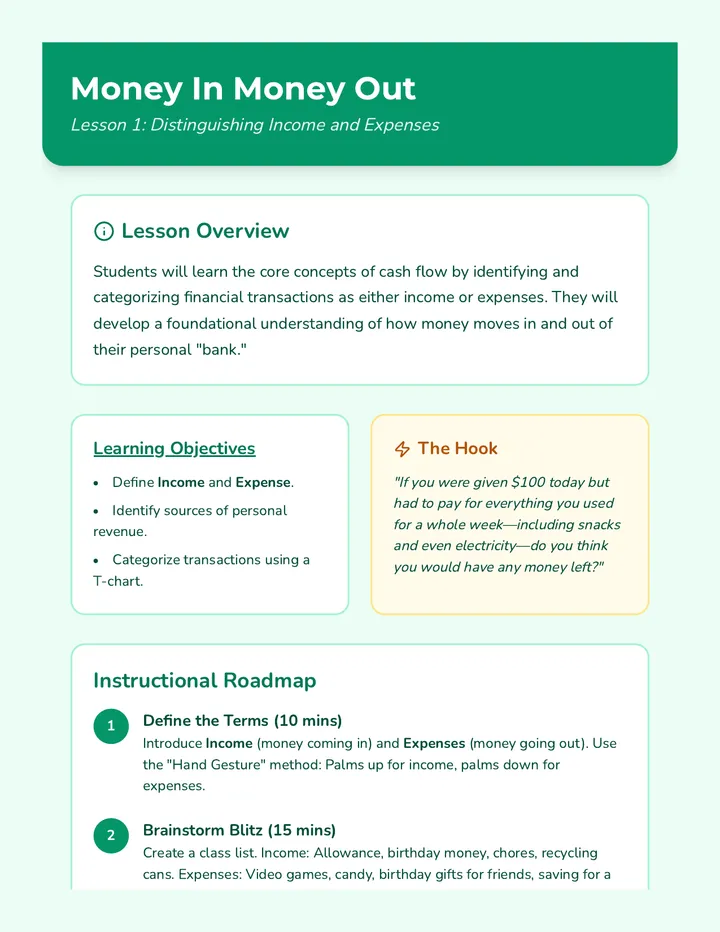
Introduces income and expenses through categorization and brainstorming, ending with a personal T-chart.
A fun, introductory lesson for early learners to practice descriptive language through the lens of animals, inspired by the first-ever YouTube video. Students identify animal features and use a simple sentence frame to share their observations.
A fun, interactive lesson for Pre-K to 1st Grade focusing on identifying animals and using descriptive language to describe their unique physical features. Students will watch the first-ever YouTube video and practice their observation skills through 'I Spy' and drawing activities.
A 30-minute introductory music lesson for Kindergarteners to explore and demonstrate a steady beat using body percussion and movement.
A Kindergarten to 2nd Grade lesson exploring the first YouTube video ever made, focusing on observation skills, animal characteristics, and the evolution of digital content. Students will identify key details about elephants and create their own drawings based on the video's descriptions.
A Kindergarten-2nd Grade lesson where students learn to make simple animal observations by watching the first-ever YouTube video and creating their own 'Zoo Vlog' drawing and description.
A Kindergarten-2nd grade lesson focused on using descriptive adjectives to observe animals, using the historic first YouTube video as a starting point for vocabulary expansion.
A Kindergarten to 2nd-grade lesson on observation and descriptive language using the historic 'Me at the zoo' video. Students will practice using the word 'long' to describe elephant trunks through drawing and writing activities.
A Kindergarten to 2nd Grade lesson where students practice observation and descriptive language by watching the first-ever YouTube video and drawing an elephant.
A lesson for elementary students exploring the permanence of the internet through the first-ever YouTube video, 'Me at the zoo', teaching the concept of a digital footprint.
A Kindergarten to 2nd-grade lesson where students observe elephants, learn about their trunks, and practice observation skills using the historic 'Me at the zoo' video.
A quick 10-minute kindergarten lesson focused on developing social skills, empathy, and cooperation through guided peer interaction and positive reinforcement.
A quick 10-minute interactive lesson for kindergarteners to practice positive social interactions, empathy, and cooperation through guided pairing and sharing activities.
A fun, interactive lesson for Pre-K to 1st grade focusing on identifying animal features and using descriptive language, inspired by the first-ever YouTube video.
In this 10-minute kindergarten lesson, students will learn to build positive relationships with peers through a fun, interactive activity. This lesson is crucial for developing early social skills, empathy, and cooperation in young learners.
A Kindergarten - 1st Grade lesson focused on observational speaking skills using the 'Me at the zoo' video. Students practice identifying animal characteristics and using sentence frames to report on what they see.
A K-2 lesson focused on observing animals and using descriptive vocabulary, featuring the video 'Me at the zoo'.
A Pre-K to 2nd-grade lesson on elephant characteristics using the first YouTube video "Me at the zoo". Students observe, draw, and describe elephants.
A K-2 lesson focused on developing observation skills by watching a short video about elephants, drawing key features, and practicing descriptive vocabulary.
A set of visual tools to help students navigate daily classroom transitions and routines with independence.
A Pre-K to 1st Grade lesson on listening and observing, featuring the 'Me at the zoo' video to teach about elephants and descriptive language.
A Pre-K to 1st grade lesson focused on observing elephants and their distinctive trunks, utilizing the 'Me at the zoo' video as a stimulus for listening and art.
A 20-minute morning meeting designed to help 2nd graders identify and practice appropriate classroom voice levels through interactive discussion and visual aids.
A descriptive writing workshop where students rewrite the script of the first YouTube video to include sensory details and precise adjectives.
A K-1 lesson on making observations and using descriptive size words, featuring the first-ever YouTube video 'Me at the zoo'.
A listening comprehension and preposition focus lesson for ESL/ELL students using the 'Me at the zoo' video.
A simple science observation lesson for Pre-K to 1st grade students focusing on describing animal features, observing a video, and drawing.
A lesson for 1st-3rd graders focusing on observation skills and descriptive adjectives, using the 'Me at the zoo' video as a primary source for analysis and imitation.
A K-2 lesson on making simple animal observations using descriptive words, featuring the 'Me at the zoo' video. Students act as zoo reporters to practice using sentence frames.
A hands-on 1st-grade math lesson where students explore lines of symmetry in nature, letters, and art through video analysis and a fold-painting activity.
A 2nd-grade math lesson where students identify U.S. coins and calculate their total value through video instruction and a hands-on coin rubbing activity.