A lesson for elementary students exploring the permanence of the internet through the first-ever YouTube video, 'Me at the zoo', teaching the concept of a digital footprint.
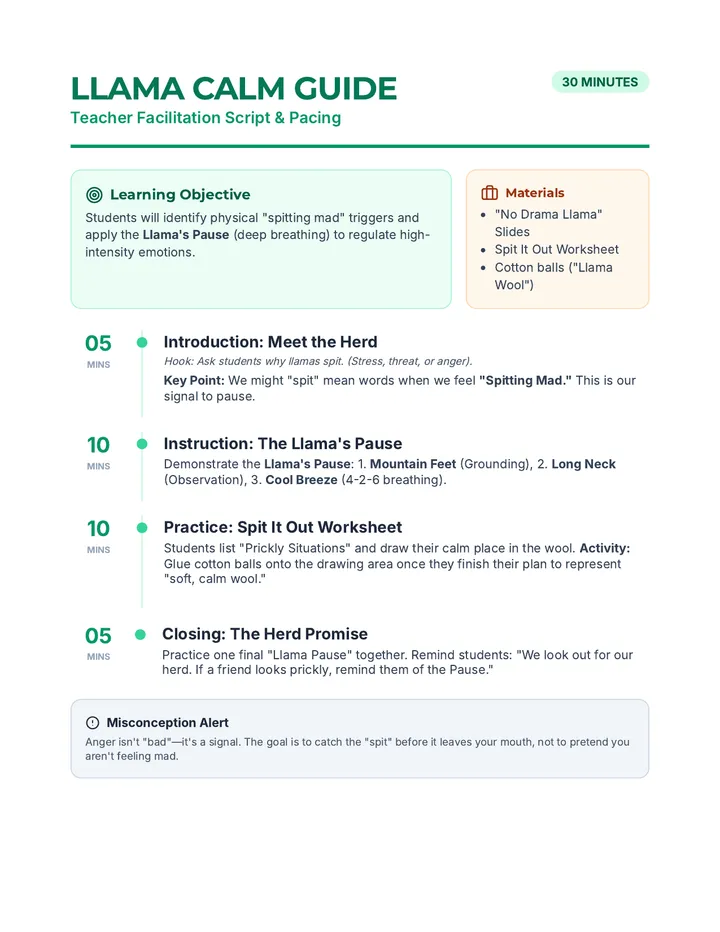
A heart-warming lesson exploring the positive character traits of llamas, such as social harmony, alertness, and gentleness, through interactive discussion and creative reflection.
An introductory lesson exploring the continuous movement of water on Earth, focusing on the key stages of the water cycle.
The final stage of the EDP where students test their designs, gather data, and iterate for improvement.
Students learn about materials, constraints, and building techniques as they move into the 'Plan' and 'Create' stages.
Focuses on the 'Define' and 'Imagine' stages of the EDP through a real-world problem-solving scenario.
Students are introduced to the five stages of the Engineering Design Process and apply them to a simple 'Paper Tower' challenge.
Students reflect on their financial choices, identify spending leaks, and create a revised budget for future stability.
Students calculate their final monthly totals, identifying surpluses or deficits and visualizing their spending patterns.
Students navigate weeks three and four of the simulation, encountering unexpected costs and learning to prioritize needs over wants.
A simulation of the first two weeks of a month where students make spending decisions for a fictional character and record them in real-time.
Students define income and expenses and practice the foundational skill of recording transactions in a ledger to maintain a running balance.
Students create a balanced spending plan to reach a specific savings goal while managing essential costs.
Students analyze financial scenarios to identify budget deficits and 'budget busters' that cause overspending.
Students learn to maintain a transaction ledger by recording income, expenses, and calculating a running balance.
Students differentiate between essential expenses and discretionary spending to prioritize financial health.
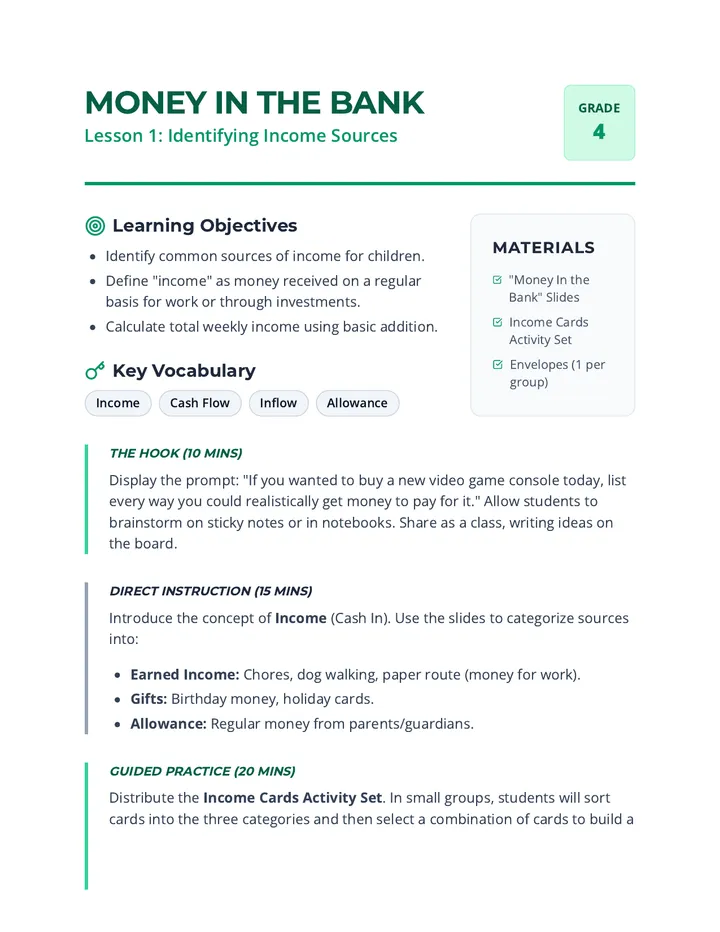
Students brainstorm and categorize different ways to earn money, establishing the 'Cash In' side of the financial equation.
Students apply their skills to create a forward-looking plan with a specific savings goal. They learn the 'pay yourself first' principle by intentionally allocating money for savings before spending on non-essentials.
Students face a deficit scenario caused by an unexpected expense. They must analyze their spending to identify 'wants' that can be cut to balance the budget and return to a positive balance.
Students learn the mechanical skill of tracking money by maintaining a simple transaction log. They practice data entry and basic arithmetic to keep a running balance of a fictional account.
Students analyze potential purchases to determine which items are essential (needs) and which are optional (wants). Through a limited-budget simulation, they practice making difficult spending decisions.
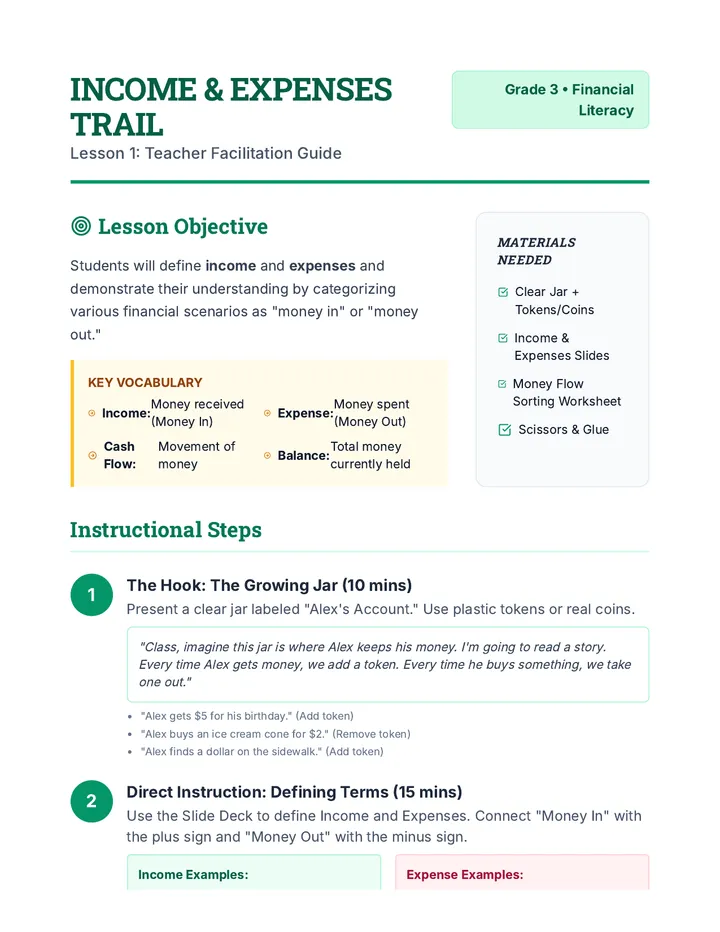
Students are introduced to the core concepts of money flow by sorting various financial scenarios into 'money in' (income) and 'money out' (expenses). This foundational lesson ensures students can correctly identify the direction of cash flow.
Students synthesize their learning to create a forward-looking cash flow plan that balances expenses while hitting a specific savings goal.
Through a 'Life Happens' simulation, students practice adjusting their spending and making trade-offs between needs and wants.
Students analyze pre-filled ledgers to identify deficits and 'spending leaks', acting as budget doctors to fix financial health.
Students master the skill of recording transactions in a financial ledger, ensuring accuracy in calculating a running balance.
Students differentiate between income and expenses and learn to categorize fixed and variable spending using a 'Mystery Wallet' simulation.
Final financial reflection. Students balance their ledgers, evaluate their spending choices, and celebrate their savings successes or identify areas for improvement.
Mid-month data analysis. Students review their spending trends and forecast their future balance to ensure they stay on track for their big savings goal.
Navigating financial curveballs. Students adjust their budgets to account for unexpected costs like library fines or gifts while maintaining their savings goals.
Exploration of fixed vs. variable expenses. Students categorize potential purchases as needs or wants and record their first week of planned spending.
Introduction to income and expenses. Students set up their personal transaction ledgers and record their starting balances for the four-week simulation.
A culminating project where students create a budget to reach a specific savings goal while managing weekly expenses.
Challenges students to solve budget emergencies and navigate financial deficits using problem-solving strategies.
Focuses on financial decision-making by distinguishing essential needs from discretionary wants to fix a deficit.
Teaches students how to record transactions and maintain a running balance using a simple ledger.
Introduces income and expenses through categorization and brainstorming, ending with a personal T-chart.
Lesson for studio export and print testing
A fun, introductory lesson for early learners to practice descriptive language through the lens of animals, inspired by the first-ever YouTube video. Students identify animal features and use a simple sentence frame to share their observations.
A media arts and oral communication lesson where students analyze the first YouTube video and create their own 19-second observational scripts.
A science and observation lesson for elementary students focused on distinguishing between objective facts (observations) and subjective opinions (interpretations) using the first-ever YouTube video as a case study.
A Kindergarten to 2nd Grade lesson exploring the first YouTube video ever made, focusing on observation skills, animal characteristics, and the evolution of digital content. Students will identify key details about elephants and create their own drawings based on the video's descriptions.
A play-based lesson designed to help young students identify and understand a wide range of emotions through interactive games and visual aids.
Students learn the foundations of impromptu speaking and user-generated content by analyzing the first-ever YouTube video and performing their own '20-Second Reporter' segment using a simple three-part structure.
A Kindergarten-2nd Grade lesson where students learn to make simple animal observations by watching the first-ever YouTube video and creating their own 'Zoo Vlog' drawing and description.
A lesson focusing on distinguishing between factual observations and opinions using the first YouTube video, 'Me at the zoo'. Students analyze dialogue and imagery to understand how word choice influences information.
A Kindergarten-2nd grade lesson focused on using descriptive adjectives to observe animals, using the historic first YouTube video as a starting point for vocabulary expansion.
A Kindergarten to 2nd Grade lesson where students practice observation and descriptive language by watching the first-ever YouTube video and drawing an elephant.
A Kindergarten to 2nd-grade lesson where students observe elephants, learn about their trunks, and practice observation skills using the historic 'Me at the zoo' video.