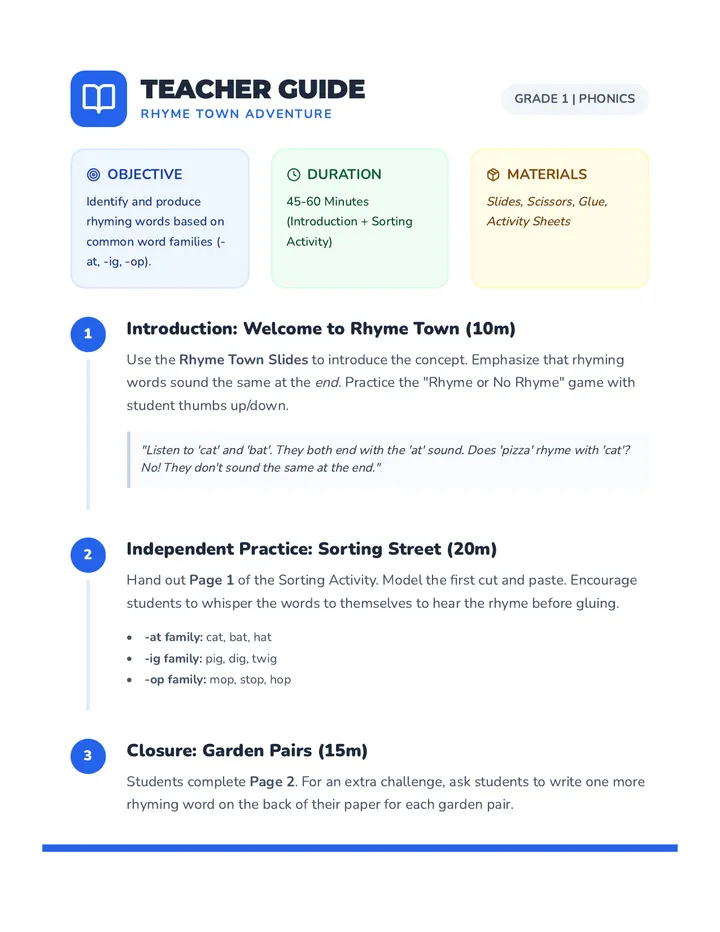
Zoo Explorer Teacher Guide
Zoo Explorer
Teacher Guide
Grades
K - 2
Learning Objective
Students will use descriptive adjectives to observe and describe animals. They will transition from using vague, general vocabulary (like "cool" or "really") to more specific, sensory-based descriptive words.
Materials Needed
- Zoo Explorer Slides
- Field Sketch Worksheet
- Adjectives Anchor Chart
- Crayons / Markers
Lesson Pacing
5 MIN
Warm-Up: Animal Whispers
Ask students to think of their favorite animal. Invite them to share the animal name and exactly one word to describe it. Record a few on the board.
"If a tiger is your favorite, is it 'fast', 'scary', or 'orange'?"
5 MIN
Viewing: Me at the Zoo
Watch the historic first YouTube video. Note the date (2005) and how simple it is. Ask students to listen specifically for the words the man uses to describe the elephants.
Key Discussion Prompts:
- "What animal does he see?" (Elephants)
- "What words did he use?" ('Cool', 'Really really really long')
- "Does 'cool' tell us what they look like? How could he be more specific?"
20 MIN
Activity: Field Sketch
Distribute the Field Sketch Worksheet. As a class, refer to the Adjectives Anchor Chart to brainstorm "Explorer Words" for elephants (gray, wrinkled, heavy, gigantic).
Task 1: Draw
Focus on the 'really long' trunk and the 'gigantic' body.
Task 2: Label
Choose 3 adjectives to label the sketch. Help younger students with spelling or provide a word bank.
5 MIN
Closure: Gallery Walk
Students share their drawings and read one of their new descriptive words aloud. Encourage them to explain why they chose that word.
Explorer Tips
Vocabulary Extension
If students finish early, ask them to find an adjective for a specific part (e.g., "floppy" ears or "stomp" feet).
Differentiation
For Kindergarten, focus on colors and sizes. For 2nd Grade, encourage more abstract texture words like "weathered" or "parched".