Variable Venture Worksheet
DOC: VAR-WKS-01
SYS_ID: 9812-A
CADET/INVESTIGATOR NAME Name: _____________________________________________
DATE OF EXPERIMENT Date: _________________
LAB STATION NO. Station: _______________
Technical Workspace Series
Variable Venture Worksheet
LAB SCHEMATIC A
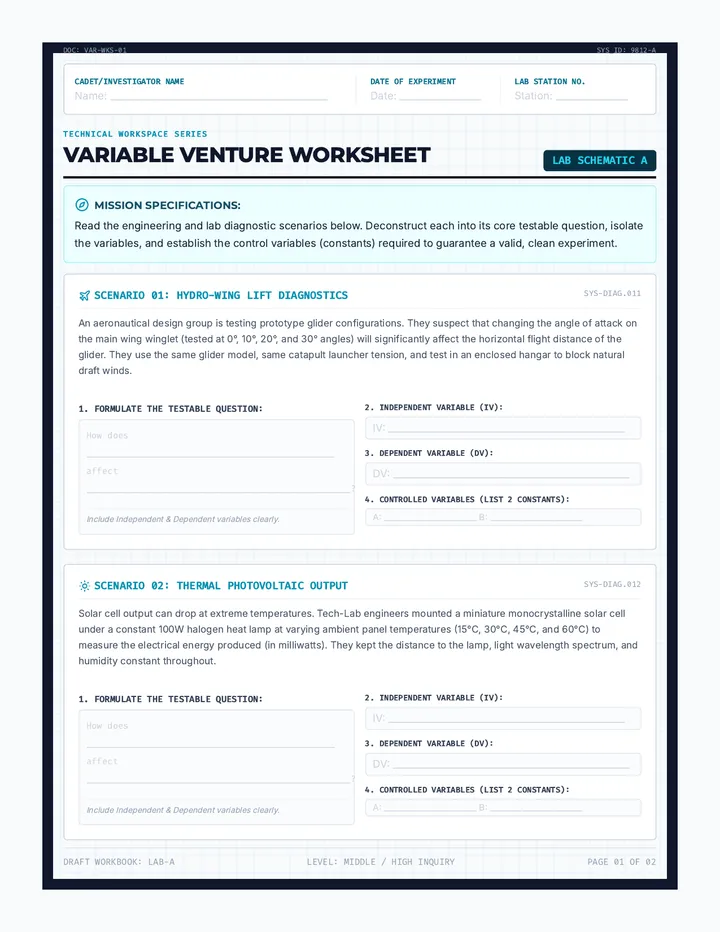
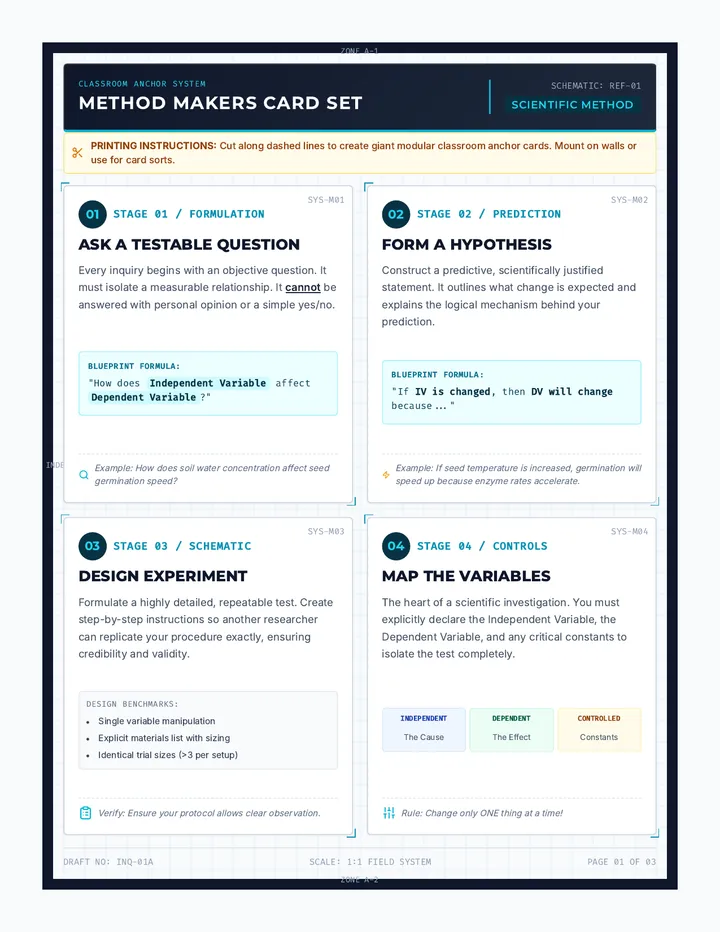
MISSION SPECIFICATIONS: Read the engineering and lab diagnostic scenarios below. Deconstruct each into its core testable question, isolate the variables, and establish the control variables (constants) required to guarantee a valid, clean experiment.
SCENARIO 01: Hydro-Wing Lift Diagnostics SYS-DIAG.011
An aeronautical design group is testing prototype glider configurations. They suspect that changing the angle of attack on the main wing winglet (tested at 0°, 10°, 20°, and 30° angles) will significantly affect the horizontal flight distance of the glider. They use the same glider model, same catapult launcher tension, and test in an enclosed hangar to block natural draft winds.
1. Formulate the Testable Question:
How does _______________________________________________
affect __________________________________________________?
Include Independent & Dependent variables clearly.
2. Independent Variable (IV):
IV: _________________________________________________
3. Dependent Variable (DV):
DV: _________________________________________________
4. Controlled Variables (List 2 Constants):
A: _______________________ B: _______________________
SCENARIO 02: Thermal Photovoltaic Output SYS-DIAG.012
Solar cell output can drop at extreme temperatures. Tech-Lab engineers mounted a miniature monocrystalline solar cell under a constant 100W halogen heat lamp at varying ambient panel temperatures (15°C, 30°C, 45°C, and 60°C) to measure the electrical energy produced (in milliwatts). They kept the distance to the lamp, light wavelength spectrum, and humidity constant throughout.
1. Formulate the Testable Question:
How does _______________________________________________
affect __________________________________________________?
Include Independent & Dependent variables clearly.
2. Independent Variable (IV):
IV: _________________________________________________
3. Dependent Variable (DV):
DV: _________________________________________________
4. Controlled Variables (List 2 Constants):
A: _______________________ B: _______________________
DRAFT WORKBOOK: LAB-A LEVEL: MIDDLE / HIGH INQUIRY PAGE 01 OF 02
DOC: VAR-WKS-02
SYS_ID: 9812-B
INVESTIGATOR: ________________________ DATE: _______________
Technical Workspace Series
The Engineering Retrofit
RETROFIT LOOP
SECTION B: Draft Your Own Scientific Schematic SYS-DRAFT.021
Raw Observation: Iron nails seem to rust exceptionally fast when exposed to warm saltwater baths compared to cold freshwater baths.
1. Formulate a highly specific Testable Question to isolate this observation:
How does __________________________________________________________________________________?
2. Identify Independent Variable (IV):
_________________________________________________
3. Identify Dependent Variable (DV):
_________________________________________________
4. List three crucial Controlled Variables (Constants) to secure this physical test:
1: ______________________
2: ______________________
3: ______________________
SECTION C: Retrofitting - Science to Engineering Shift SYS-RETRO.022
Observe how we convert a scientific inquiry into an engineering design task. Scientific Question: "How does the density of wrapping insulation affect heat loss in a copper pipe?" We can retrofit this into an engineering challenge: Create a protective sleeve for plumbing under freezing sub-zero conditions.
1. DESIGN CRITERIA (Goal):
Create a custom physical sleeve that keeps a 20cm pipe above freezing for at least 120 minutes.
2. CONSTRAINTS (Limits):
- Max thickness: 2.5 cm
- Materials budget: $10.00
- No active electrical heating element allowed.
3. PROTOTYPE DESIGN & MATERIAL DRAFT:
Write or diagram your physical prototype solution here. Label what materials you will use to slow thermal transfer:
GRID CALIBRATION SCALE: NONE VERSION 1.0
How did your scientific knowledge of "heat loss factors" inform your engineering prototype design? Explain:
__________________________________________________________________________________________________
DRAFT WORKBOOK: LAB-B LEVEL: MIDDLE / HIGH INQUIRY PAGE 02 OF 02