Llama Ranch Reckoning Lesson Plan
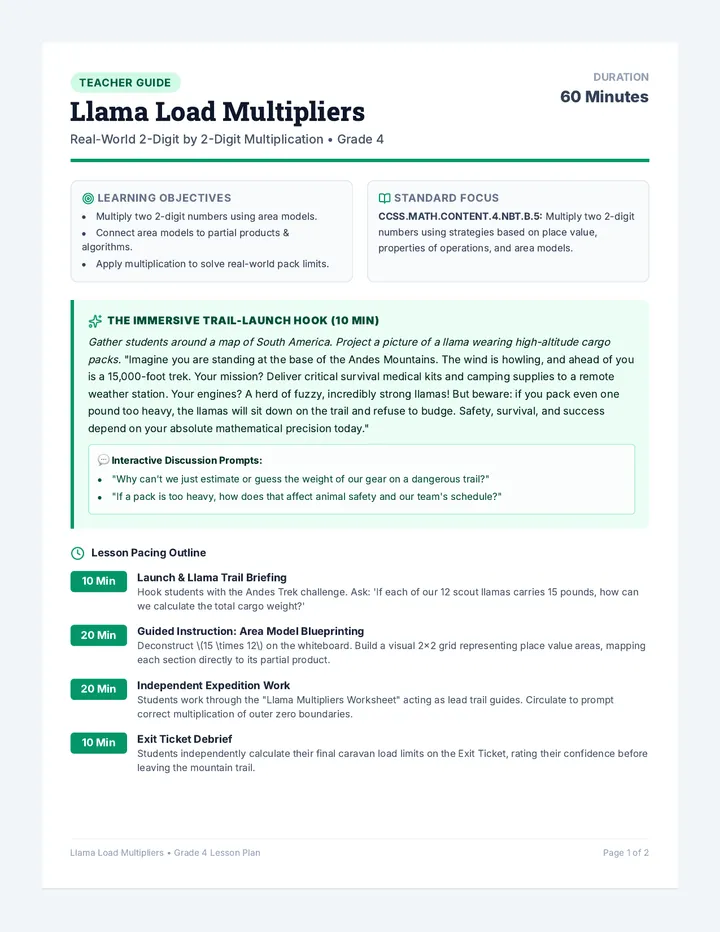
Grade 4 Math Lesson Plan
Llama Ranch Reckoning
60 Minutes
Learning Objectives
- Multiply a 2-digit number by a 2-digit number using place value strategies (Area Model) and standard algorithms.
- Apply multi-digit multiplication to solve real-world animal husbandry scenarios.
- Justify math choices by explaining how partial products are calculated.
Standards Met
CCSS.MATH.CONTENT.4.NBT.B.5: Multiply a whole number of up to four digits by a one-digit whole number, and multiply two two-digit numbers, using equations, rectangular arrays, and/or area models.
Required Materials
-
Llama Ranch Reckoning Slides
-
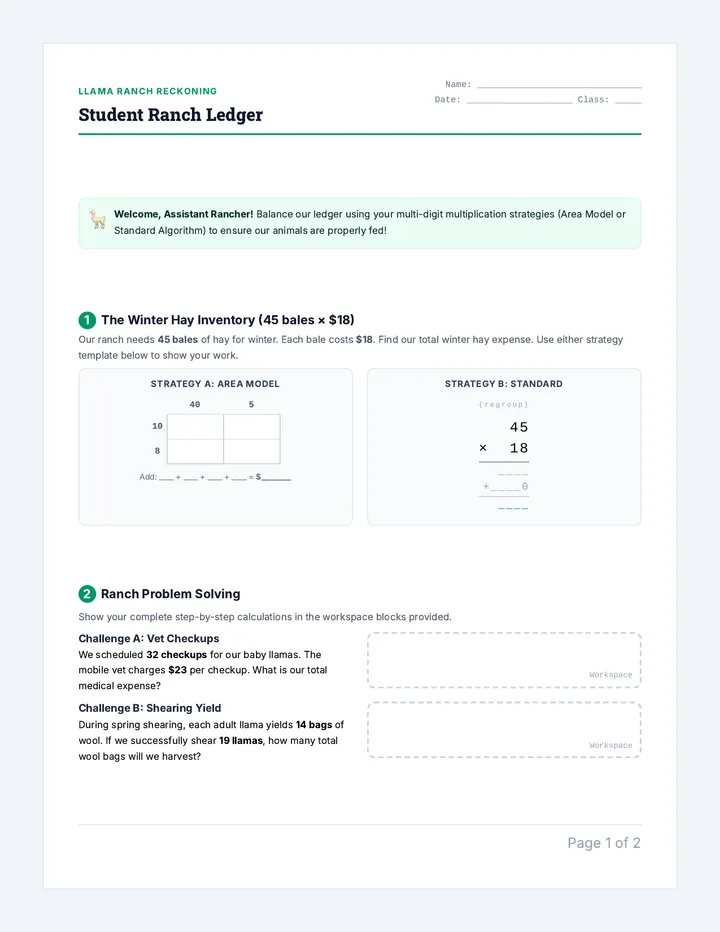
Llama Ranch Reckoning Worksheet
-
Scratch paper or dry-erase boards
-
Colored pencils (helpful for Area Model)
Pacing Outline
10
Hook & Concept Review
Introduce llamas, discuss food consumption, review single-digit multiplication.
0-10 min
20
Direct Instruction & Modelling
Show Area Model & Standard Algorithm with 24 × 13 using the slides.
10-30 min
20
Partner & Independent Practice
Complete the scenarios and computational challenges on the student worksheet.
30-50 min
10
Review & Close
Review solutions together, address misconceptions, collect exit tickets.
50-60 min
Page 1 of 2
Instructional Delivery
Teaching Guidelines
Section 2
1 Hook & Background (10 mins)
Start by asking: "Have you ever seen a llama? What do you think they eat?" Share that llamas are hardy herding animals that eat grass and hay. Explain that ranchers must calculate large food deliveries to prevent their herds from going hungry. Show Slide 2 to introduce Paco, Luna, and Tito.
2 Direct Instruction (20 mins)
Project Slide 3 to present the scenario: 24 llamas eating 13 lbs of hay per day. Highlight that standard single-digit multiplication won't work alone. Use Slide 4 to demonstrate the Area Model. Walk through expanding 24 to (20 + 4) and 13 to (10 + 3). Follow up with Slide 5 to show how the standard algorithm corresponds with the partial products from the Area Model.
3 Guided & Partner Practice (20 mins)
Hand out the Llama Ranch Reckoning Worksheet. Guide the class in setting up the "Monthly Expenses" scenario on the board (45 bales × $18). Have them work with a partner to complete Section 1 of the worksheet. Circulate the room to catch common errors such as improper place-value alignment when using the standard algorithm.
4 Class Discussion & Reflection (10 mins)
Call on students to present their solutions. Ask: "Which method did you prefer, and why?" Reiterate that both models are mathematically sound and are just different ways to track our place value. Have them submit the completed worksheet as their ticket-out-the-door.
Common Pitfalls
- Forgetting the placeholder zero in row 2 of the Standard Algorithm.
- Adding the regrouped digits before multiplying rather than after.
- Incorrectly adding partial products.
Differentiation
- Scaffolding: Use grid-paper overlays to align digits correctly. Provide pre-drawn area models.
- Extension: Calculate herd water requirements or annual costs over a 12-month period.
Page 2 of 2