Concept C Practice Slides
Test Preparation 30-Minute Masterclass
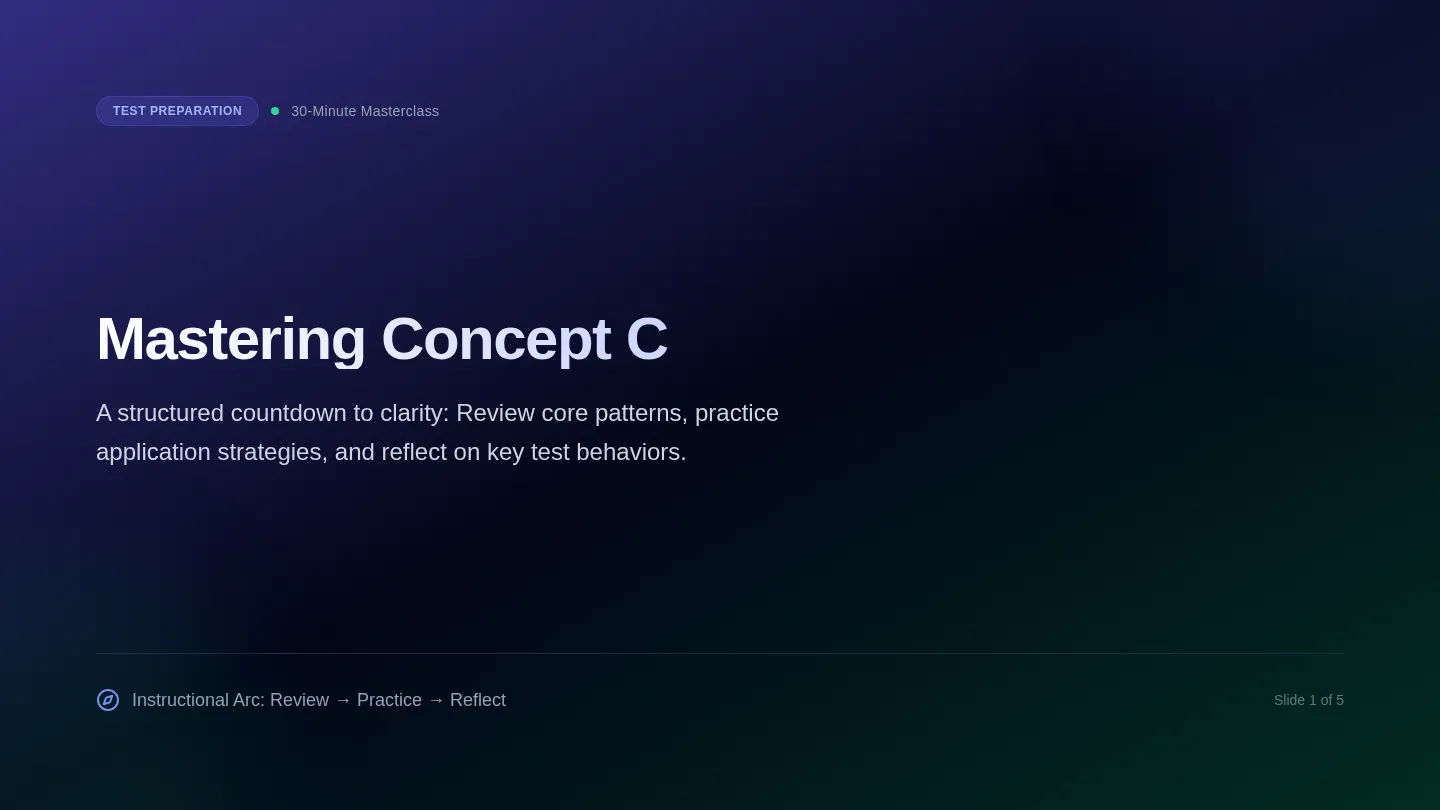
Mastering Concept C
A structured countdown to clarity: Review core patterns, practice application strategies, and reflect on key test behaviors.
Instructional Arc: Review → Practice → Reflect
Slide 1 of 5
Phase 1 of 3
Review: Unlocking Concept C
Time check: 8 mins
What is Concept C?
Concept C rules standard test scenarios. It guides how we analyze relationships, identify critical variables, and eliminate misleading distractors.
The Core Rule
Always isolate the independent element before evaluating adjacent changes.
Key Pillars to Remember
1
Identify structural dependencies immediately.
2
Watch out for common reversal traps in distractor answers.
3
Verify logic using simple, direct numeric or textual substitution.
Focus: Core Diagnostic Principles Slide 2 of 5
Phase 2 of 3
Practice: Put Concept C into Action
Time check: 15 mins
Sample Scenario
Suppose structural variable X relies entirely on the output of Y, but Y is directly constrained by independent system constraints. If system constraints double, how does X react?
Strategic Step 1
Isolate the absolute independent element first. In this hierarchy, what sits at the top?
Strategic Step 2
Map the chain reaction step-by-step. Do not jump straight to variable X's reaction.
Focus: Active Application & Process Mapping Slide 3 of 5
Phase 3 of 3
Reflect: Diagnostic Checklist
Time check: 7 mins
Spotting Pitfalls
Did you catch yourself trying to solve all variables simultaneously instead of working sequentially?
Be Mindful of Chaos
Verification Trap
Did you prove your final solution by substituting a simple mock scenario back into the initial problem constraints?
Verify Every Choice
Time Strategy
Can you confidently execute this diagnostic sequence in under 90 seconds on a high-stakes exam?
Pacing and Speed
Focus: Metacognitive awareness & behavioral agility Slide 4 of 5
Classroom Wrap-Up End of Session
Today's Golden Rule for Concept C
Speed on test day is a byproduct of absolute, structured process clarity. If you systematically isolate relationships, you neutralize traps before they can ever confuse you.