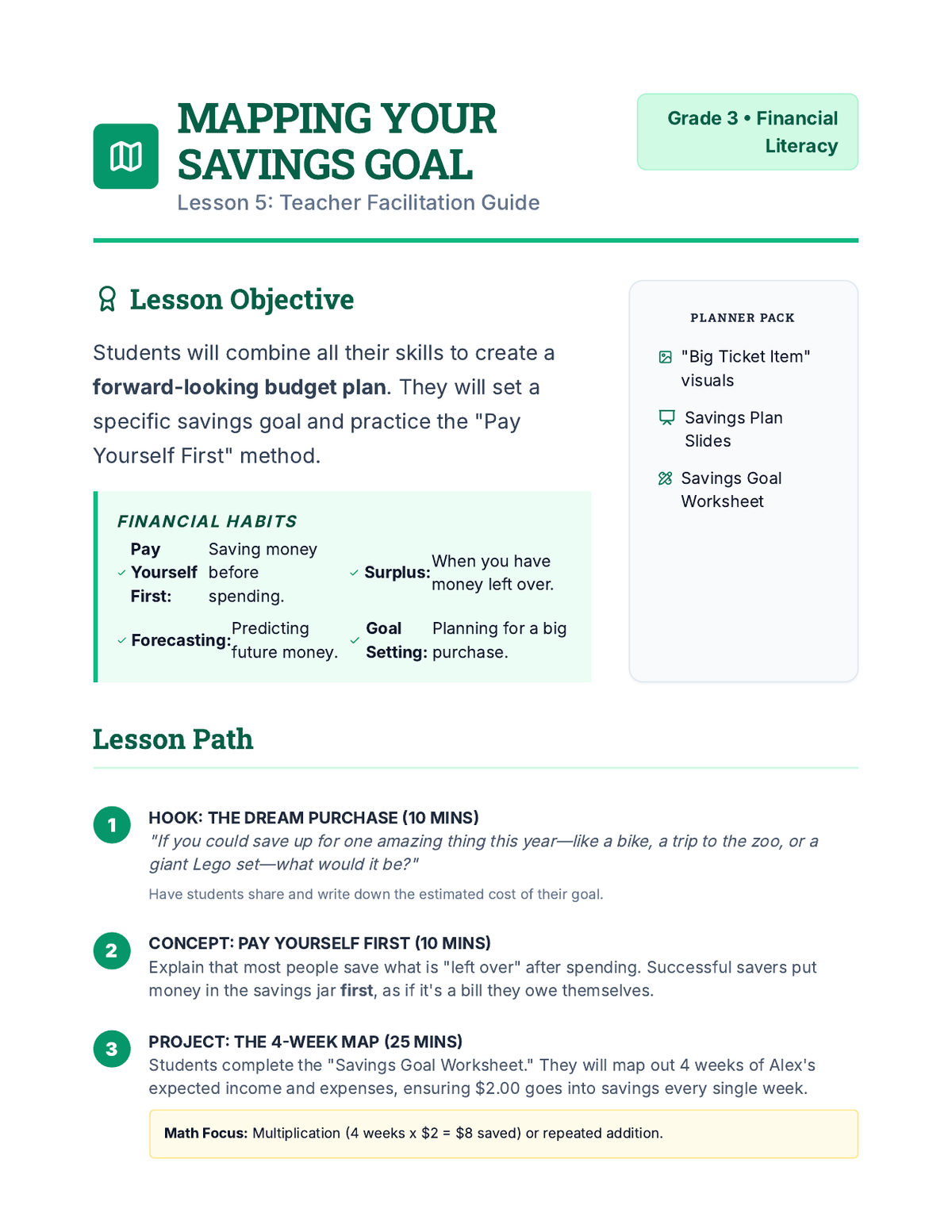
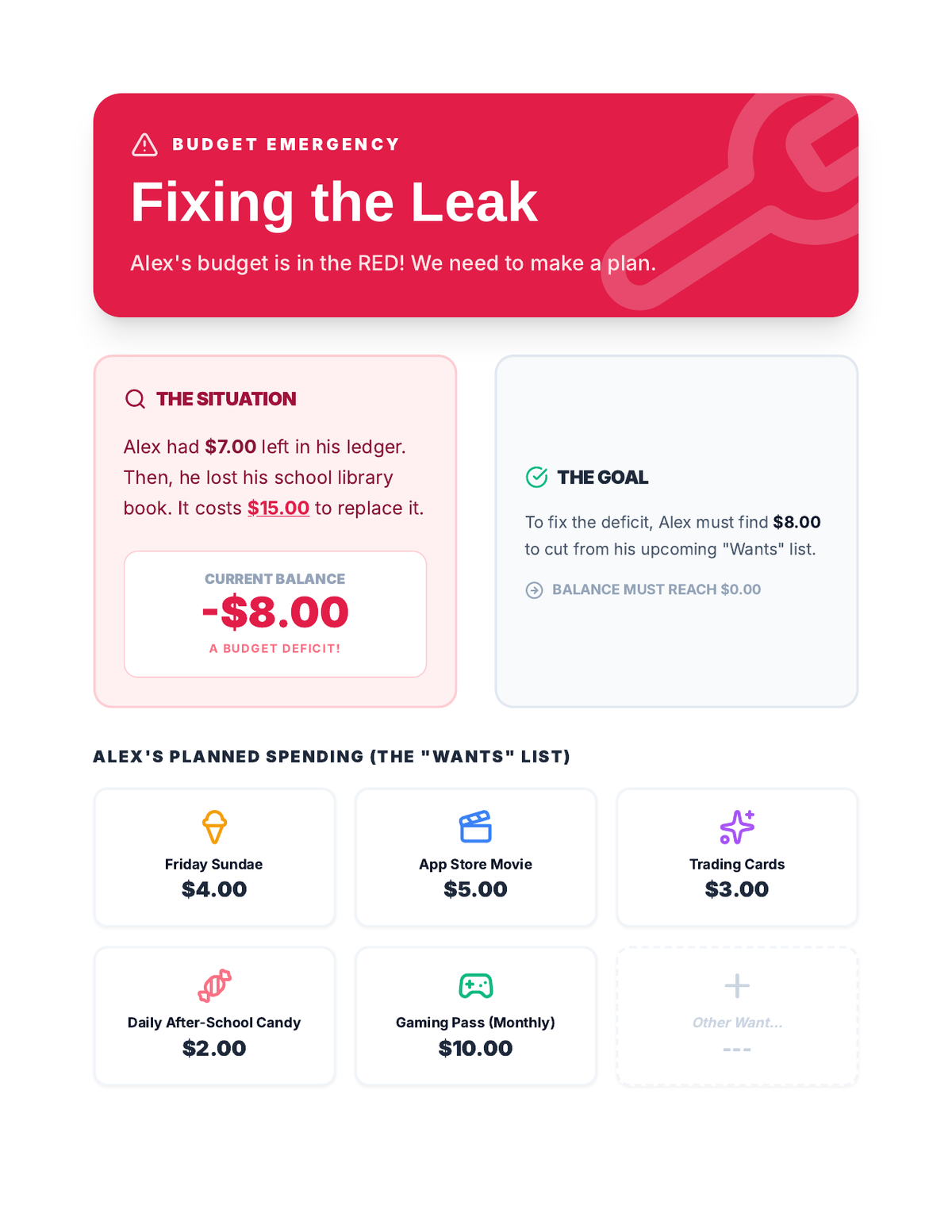
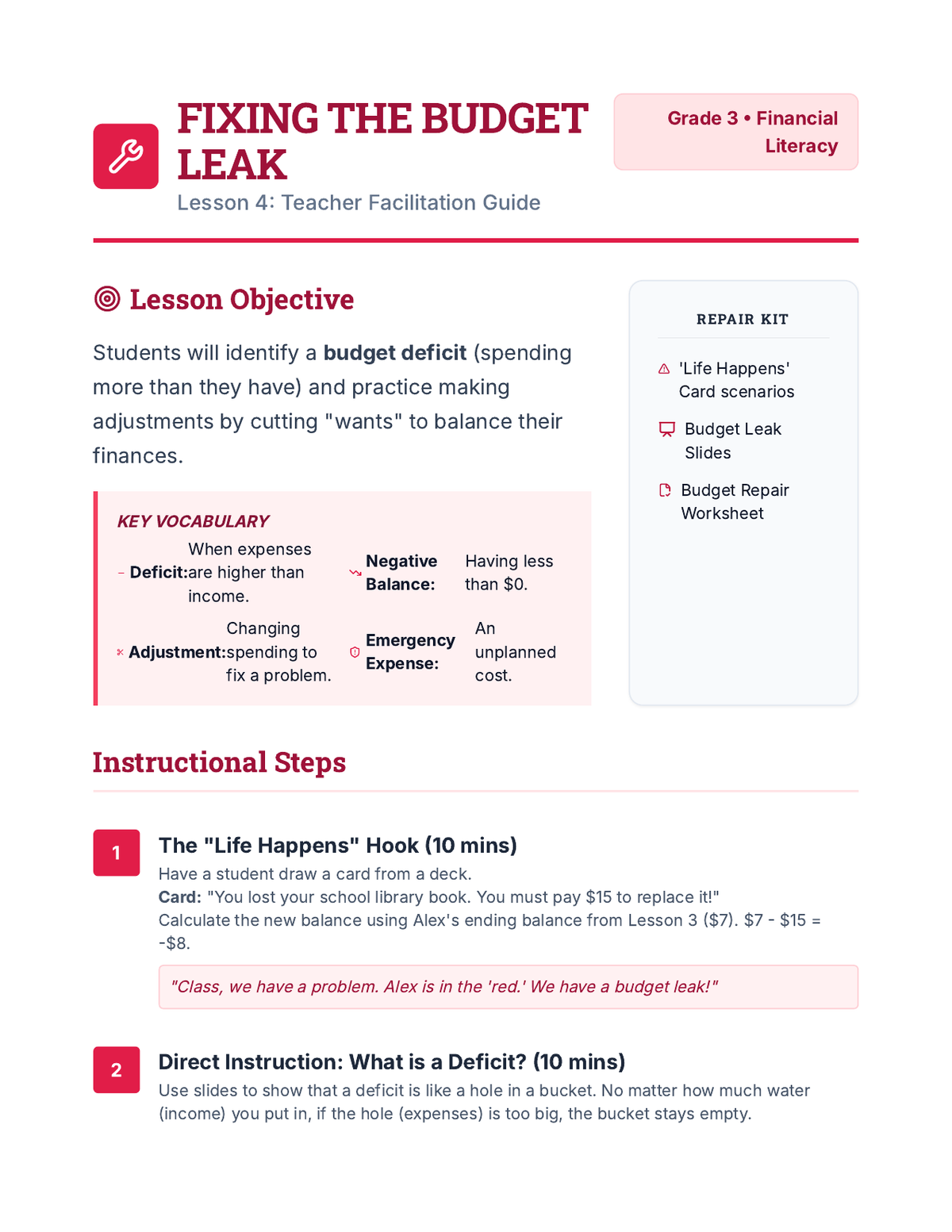
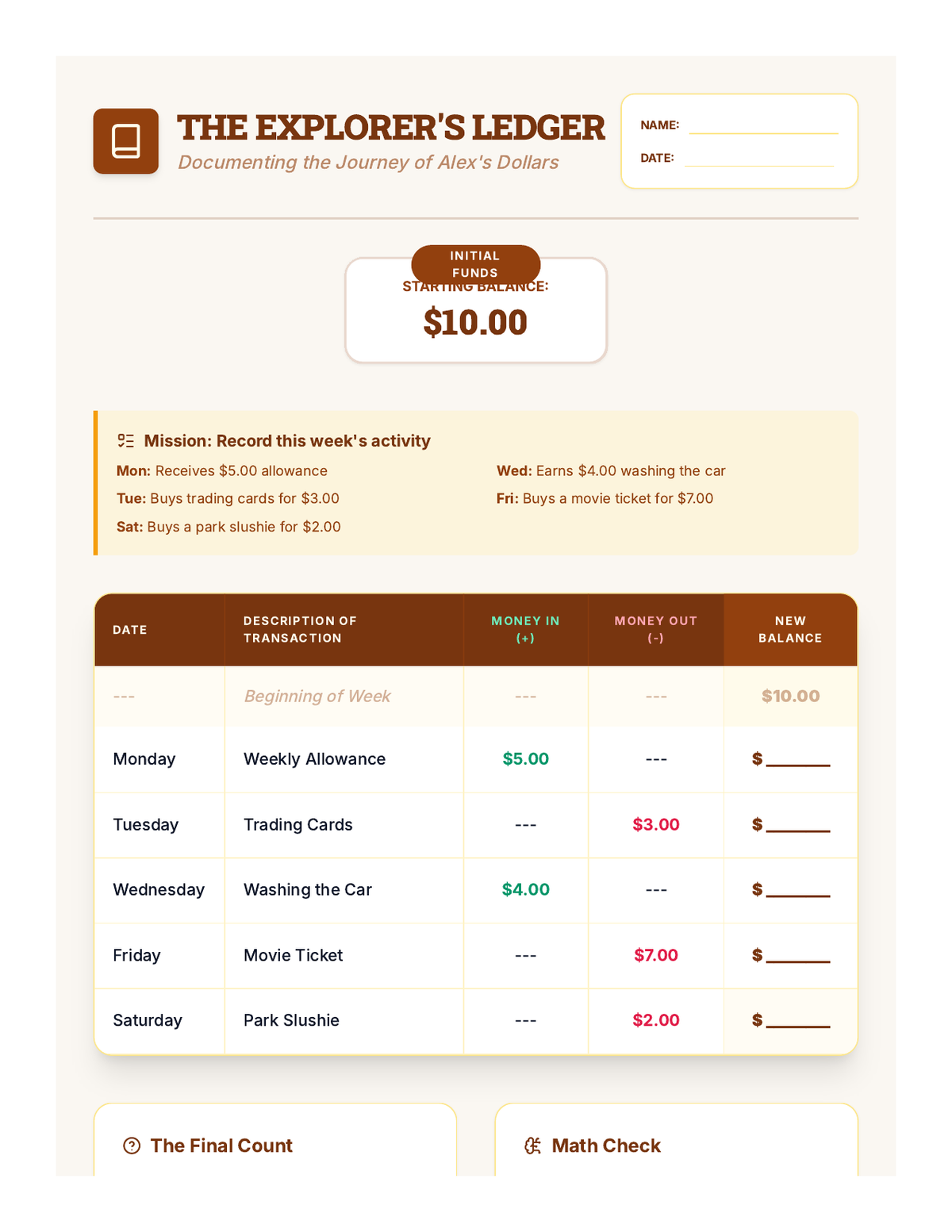
An answer key for the Money Flow Sorting Worksheet to help teachers quickly grade and discuss the sorting activity.
Introductory worksheet for fractions including shading area models, identifying points on number lines, and solving a simple word problem.
1/16
Final facilitation guide for Session 6. Provides instructions for synthesizing the 6-week program, helping students select their best tools, and planning for long-term maintenance of skills.
1/13
Visual presentation for Session 5, focusing on assertive communication (I-statements) and the concept of healthy boundaries in relationships.
Introductory slides for the first lesson on personal cash flow, covering income, expenses, and the difference between fixed and variable costs.
Instructional slides for Lesson 3 covering time management, opportunity cost, and the "Big Rocks" theory of prioritization.
Teacher-facing facilitation guide for Session 5. Includes guidance on modeling assertive communication and navigating cultural differences in communication styles.
A visual worksheet for Kindergarteners to identify musical moods by coloring emoji faces and associating colors with sounds.
Instructions for a kinesthetic activity where students match their movement intensity to musical dynamics using animal metaphors.
Informative reading passage about the Djembe drum, its cultural origins, construction, and the three primary sounds it produces, followed by comprehension questions.
Slide deck for Lesson 2, introducing the character 'Casey' and setting the stage for the month-long financial simulation.
An introductory worksheet for 4th graders to identify and name fractions using visual models (circles, rectangles, and grids). Includes shading exercises and a critical thinking prompt.
A base schedule board for students to organize their daily routine cards, featuring five numbered slots and check-off circles.
Culminating slide deck for Session 6, summarizing the key skills from the intervention and guiding students through the creation of their personalized 'Resilience Toolkit.'
Engaging slide deck for Kindergarteners exploring music and emotions, covering major/minor tones and energy levels.
Visual presentation for Session 3, focusing on distress tolerance techniques for high-intensity situations using the TIPP skills framework.
Teacher-facing facilitation guide for Session 3. Focuses on teaching TIPP skills for crisis regulation and helping students identify environmental supports (like cold water access) within the school.
A student planning sheet for Session 3. It introduces the TIPP skills (Temperature, Intense Exercise, Paced Breathing, Paired Muscle Relaxation) and helps students create a personalized 'Emergency Brake' plan for high-intensity emotional moments.
A culminating student worksheet that synthesizes all skills learned throughout the 6-week intervention into a single, comprehensive 'Resilience Toolkit' for future reference.
A set of printable routine icons to be used with the Daily Roadmap Board, including requested activities like sensory breaks and morning meetings.
A 2-page student worksheet for the first lesson in the Side Hustle sequence. It helps students audit the gig economy, conduct a personal skills inventory, and brainstorm viable business ideas.