Income and Expenses Teacher Guide
Income & Expenses Trail
Lesson 1: Teacher Facilitation Guide
Grade 3 • Financial Literacy
Lesson Objective
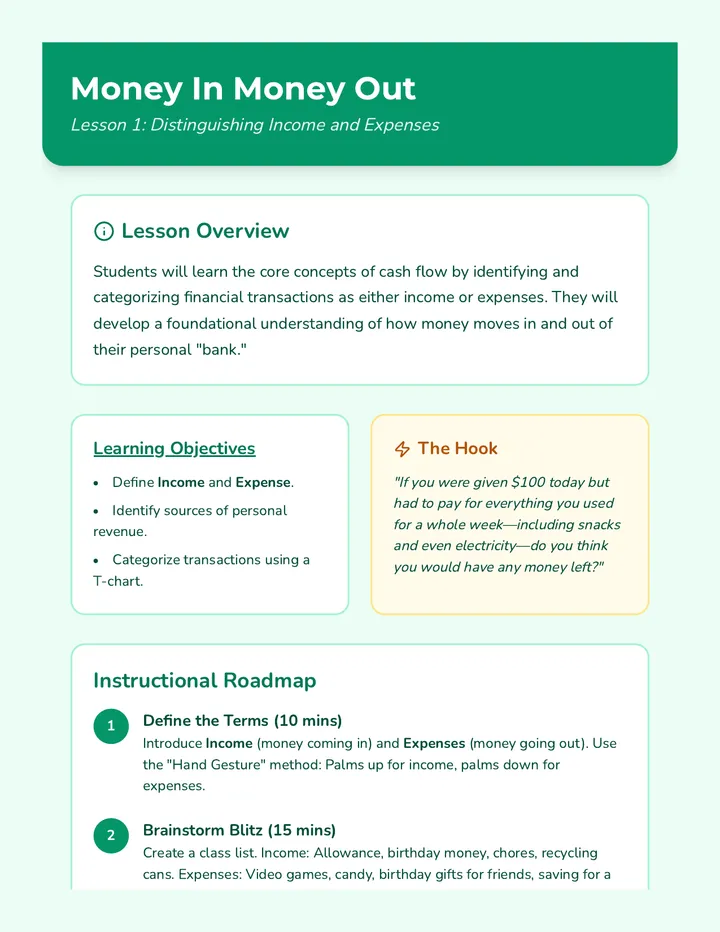
Students will define income and expenses and demonstrate their understanding by categorizing various financial scenarios as "money in" or "money out."
Key Vocabulary
- Income: Money received (Money In)
- Expense: Money spent (Money Out)
- Cash Flow: Movement of money
- Balance: Total money currently held
Materials Needed
- Clear Jar + Tokens/Coins
- Income & Expenses Slides
- Money Flow Sorting Worksheet
- Scissors & Glue
Instructional Steps
1
The Hook: The Growing Jar (10 mins)
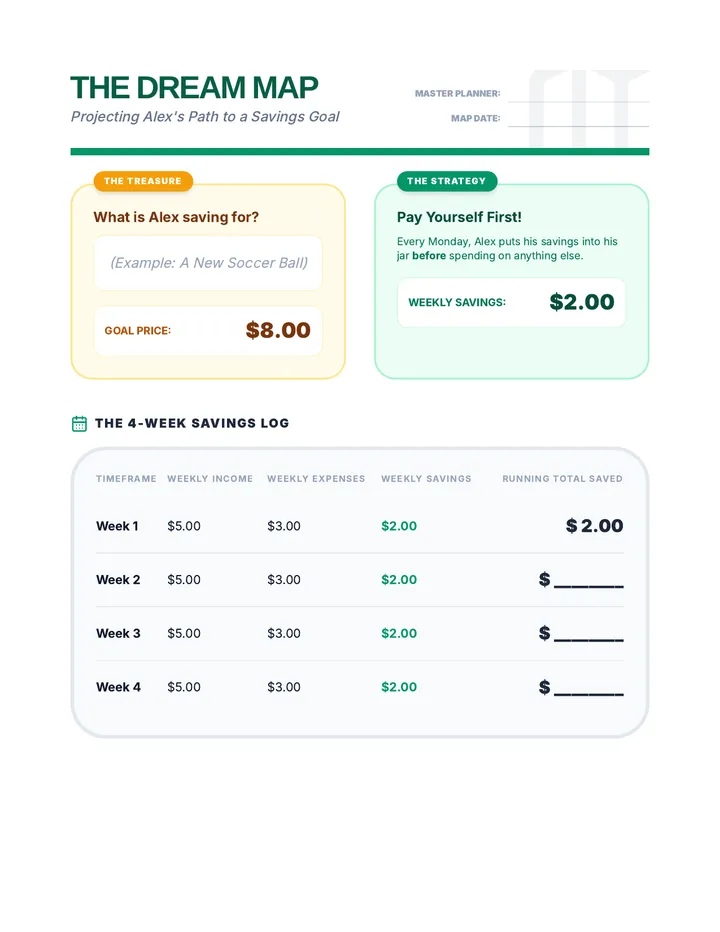
Present a clear jar labeled "Alex's Account." Use plastic tokens or real coins.
"Class, imagine this jar is where Alex keeps his money. I'm going to read a story. Every time Alex gets money, we add a token. Every time he buys something, we take one out."
- "Alex gets $5 for his birthday." (Add token)
- "Alex buys an ice cream cone for $2." (Remove token)
- "Alex finds a dollar on the sidewalk." (Add token)
2
Direct Instruction: Defining Terms (15 mins)
Use the Slide Deck to define Income and Expenses. Connect "Money In" with the plus sign and "Money Out" with the minus sign.
Income Examples:
Allowance, gifts, yard work, selling old toys.
Expense Examples:
Snacks, movie tickets, library fines, donations.
3
Guided Practice: Sorting Scenarios (15 mins)
Distribute the Sorting Activity. Read each scenario together before allowing students to cut and paste. Discuss: "Is this making the jar fuller or emptier?"
4
Wrap Up: The Exit Question (5 mins)
Ask: "If you want to have MORE money in your jar at the end of the week, should you have more income or more expenses?"
Support
Provide pre-sorted icons for students to simply paste rather than categorizing first. Use a color-coded T-chart (Green for Income, Red for Expenses).
Extension
Have students write their own scenario cards for a partner to sort, including amounts to practice addition/subtraction.