Mountain Masters Slides
Grade 4 Science • Life Adaptations
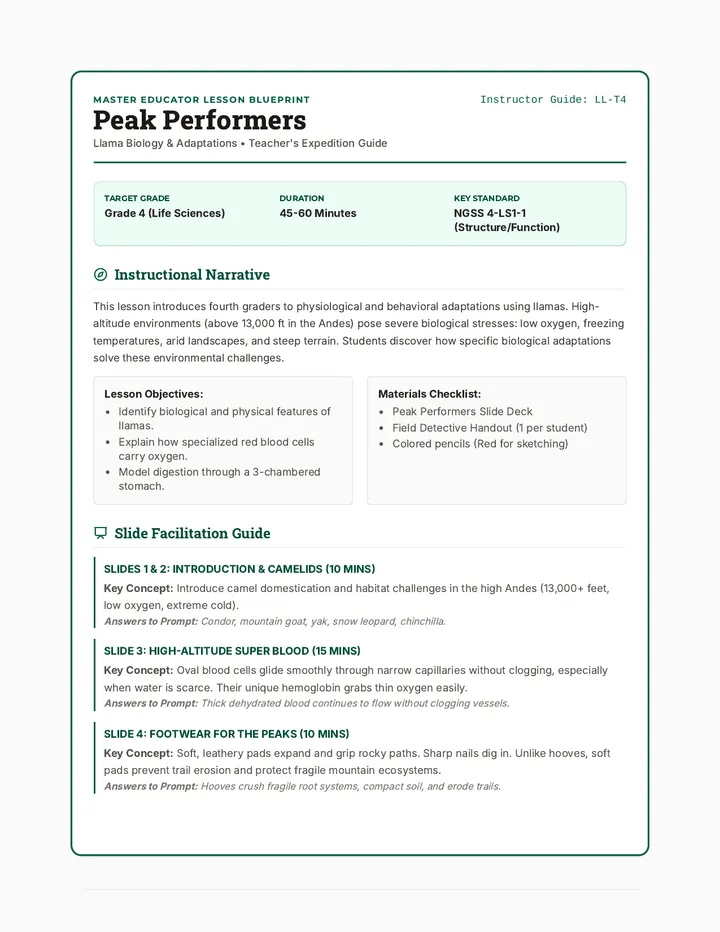
Mountain Masters
How Llamas Conquer the Extreme Andes
Explorer Series Structure & Function
Let's Explore!
The Alpine Survival Challenge
The Andes Mountains reach over 13,000 feet high. Survival here requires specialized equipment for humans, but llamas live here comfortably.
Habitat Profile:
Very low oxygen, biting freezing winds, slippery rock ledges, and extremely tough wild grasses.
Biting Cold
Winds can freeze standard animal skin instantly.
Thin Air
40% less oxygen in every single breath.
How does a llama's body solve these extreme problems?
Super Feet for Steep Slopes
Adaptation #1
Soft Padded Soles
Unlike horses or goats with hard, rigid hooves, a llama has a two-toed foot with a leathery pad on the bottom.
These pads expand and conform to rocky terrain, behaving like built-in, high-traction climbing shoes.
Grip & Protect
- Amazing Grip: Allows them to sprint up vertical rock cliffs.
- Soil Protection: Soft pads do not tear up fragile alpine plants, preserving their food source!
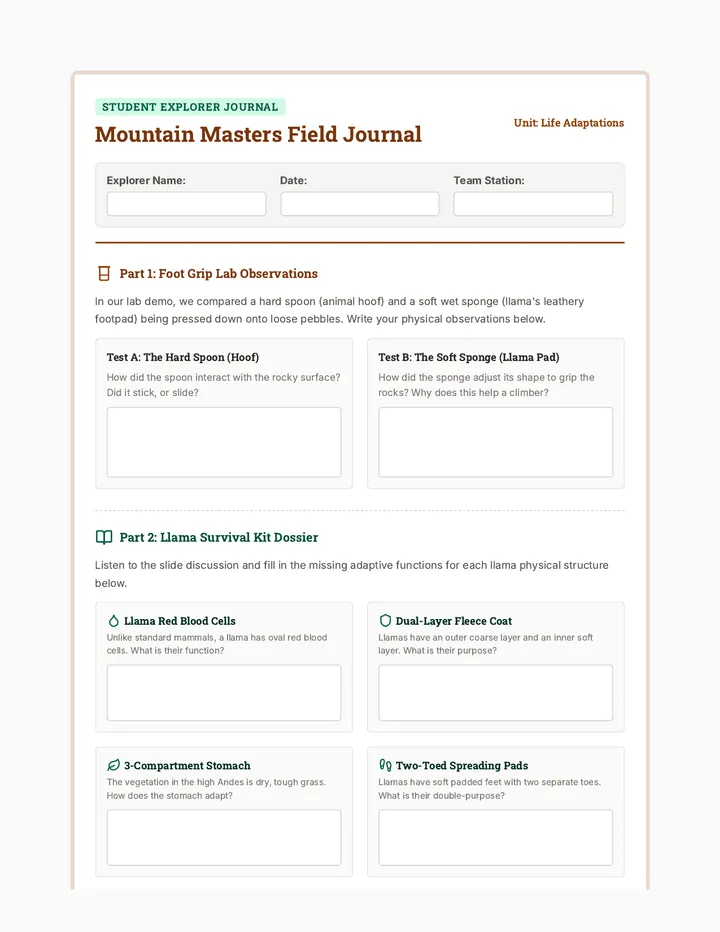
Demonstration: The Sponge vs. Spoon grip test in your log!
Mountain Masters • 4th Grade Science
High-Octane Blood Biology
Adaptation #2
Oval Red Blood Cells
Most mammals have round red blood cells. Llamas have unique oval-shaped blood cells.
Oval cells flow more smoothly through narrow blood vessels even when dehydrated, delivering oxygen with incredible efficiency.
Llamas also produce much more hemoglobin (oxygen-binding protein) than standard mammals.
Conquering Thin Air
Because their blood can trap and move so much oxygen, llamas do not get altitude sickness or tire out at 14,000 feet.
"Llamas can absorb up to 3 times more oxygen per breath than a domestic horse!"
Mountain Masters • 4th Grade Science
Fleece Coat & Iron Stomach
Adaptation #3 & #4
3. Three-Chambered Stomach
Mountain grass (Ichu) is stiff and woody. Llama stomachs ferment this dry food in three separate compartments, extracting maximum water and nutrients.
4. Double-Layer Fleece
Llamas have a coarse outer coat that repels mountain rain and wind, and a fine inner coat that insulates them from freezing alpine nights.
A complete survival kit: warm coat, iron gut, high-altitude blood, rock-gripping feet!
Camelid Family Cousins
Desert Camel
- Humps: Store fat to convert into energy and water.
- Broad Pads: Spread wide so feet don't sink into sandy dunes.
- Eyelashes: Long, double-rows block howling sandstorms.
Adaptation Focus: Fighting heat & sand.
Mountain Llama
- Fleece: Heavy wool traps massive heat against cold air.
- Narrow Pads: Split toe design hugs steep mountain ledges.
- Oval Blood Cells: Transport thin oxygen effortlessly.
Adaptation Focus: Fighting cold & altitude.
Same family tree, completely opposite adaptive structures!