Field Detective Handout
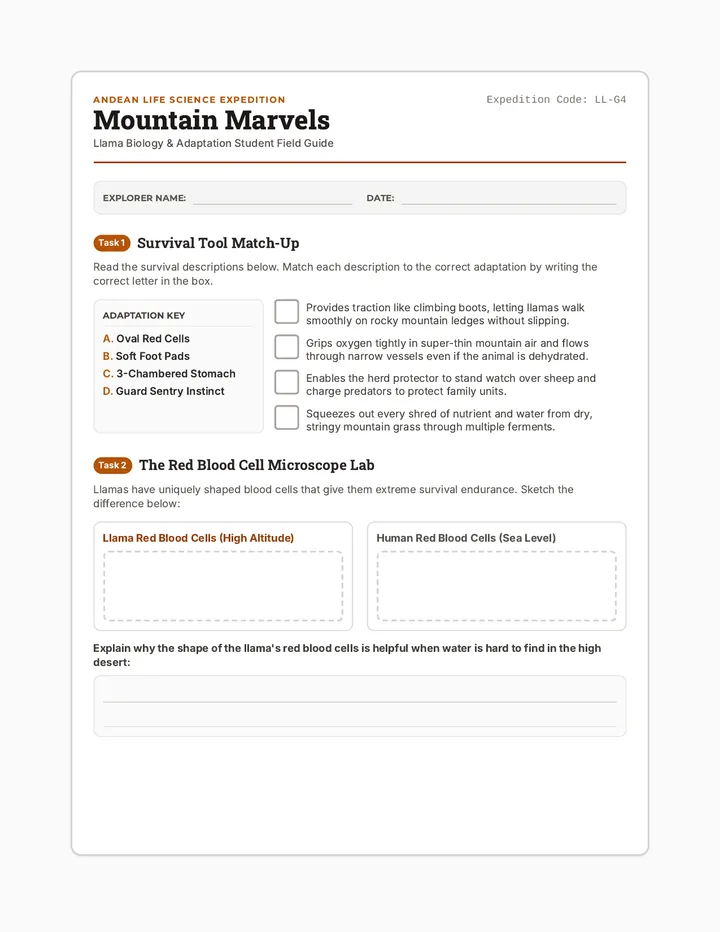
Andean Life Science Expedition
Mountain Marvels
Llama Biology & Adaptation Student Field Guide
Expedition Code: LL-G4
Explorer Name:
Date:
Task 1
Survival Tool Match-Up
Read the survival descriptions below. Match each description to the correct adaptation by writing the correct letter in the box.
Adaptation Key
A. Oval Red Cells
B. Soft Foot Pads
C. 3-Chambered Stomach
D. Guard Sentry Instinct
Provides traction like climbing boots, letting llamas walk smoothly on rocky mountain ledges without slipping.
Grips oxygen tightly in super-thin mountain air and flows through narrow vessels even if the animal is dehydrated.
Enables the herd protector to stand watch over sheep and charge predators to protect family units.
Squeezes out every shred of nutrient and water from dry, stringy mountain grass through multiple ferments.
Task 2
The Red Blood Cell Microscope Lab
Llamas have uniquely shaped blood cells that give them extreme survival endurance. Sketch the difference below:
Llama Red Blood Cells (High Altitude)
Human Red Blood Cells (Sea Level)
Explain why the shape of the llama's red blood cells is helpful when water is hard to find in the high desert:
Part II: Digestive & Social Secrets Page 2 of 2
Task 3
The 3-Chambered Fuel Factory
A llama eats dry mountain grass, but its stomach handles it in an incredible multi-step process. Put these events in order by numbering them 1 to 4.
Cud Chew: The llama regurgitates (brings back up) semi-digested food to chew it again for extra breakdown.
First Stop: Food enters Chambers 1 and 2, where helper bacteria digest tough fibers through fermentation.
Initial Intake: The llama clips mountain grass with its sharp front teeth and swallows it quickly.
Final Digestion: In Chamber 3, strong acids break down the food fully, absorbing remaining nutrients and water.
Task 4
Defense Operations Scenario
Explorer Briefing:
Imagine a rancher uses a "Guard Llama" named Bolt to protect a flock of sheep. One evening, a hungry coyote prowls near the fence. Describe Bolt's biological defense mechanisms.
1. What alarm signal will Bolt use to warn the sheep? What does it sound like?
2. If the coyote gets too close, how will Bolt use spitting and charging to scare it away?
Field Report Completed
Ready for Teacher Review