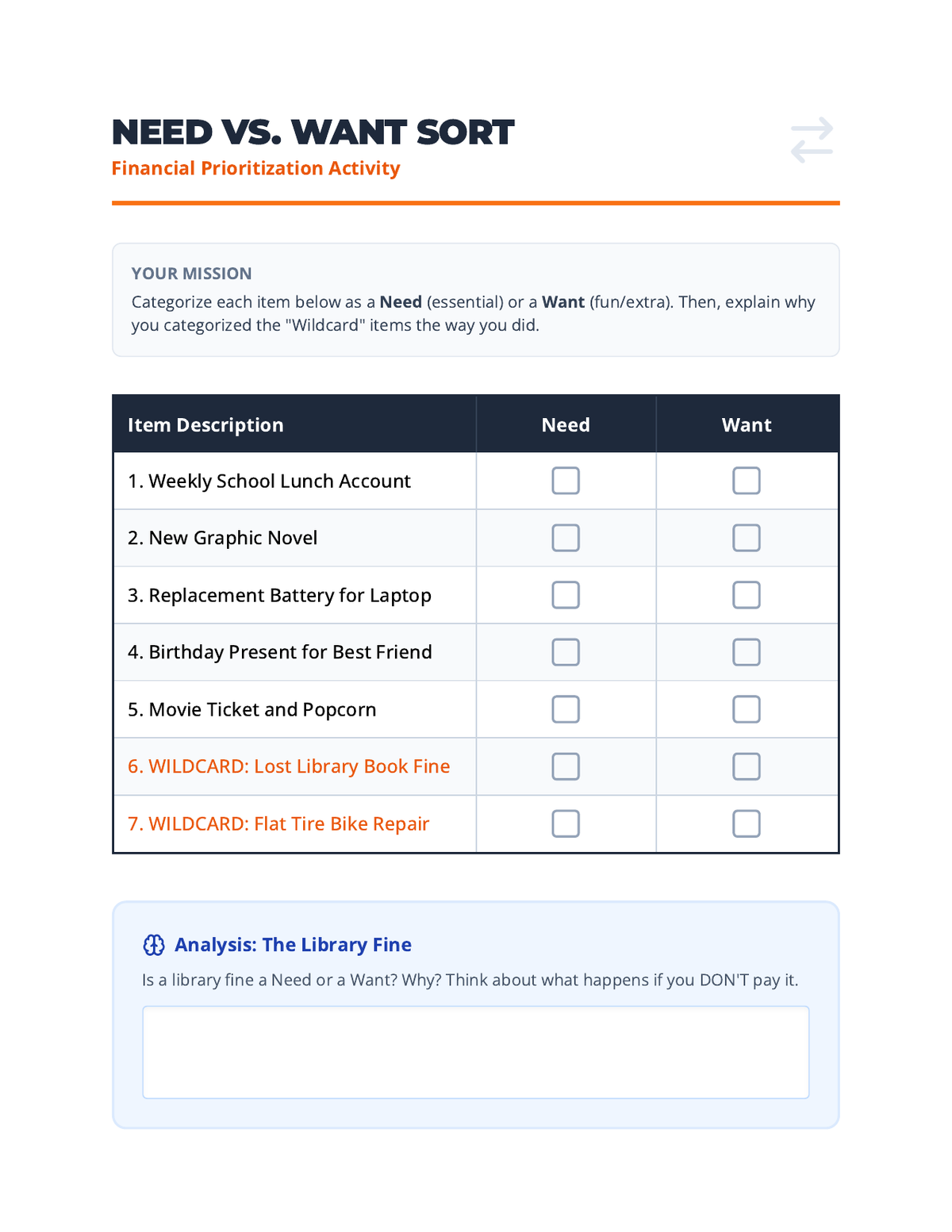
Introductory slides for the first lesson on personal cash flow, covering income, expenses, and the difference between fixed and variable costs.
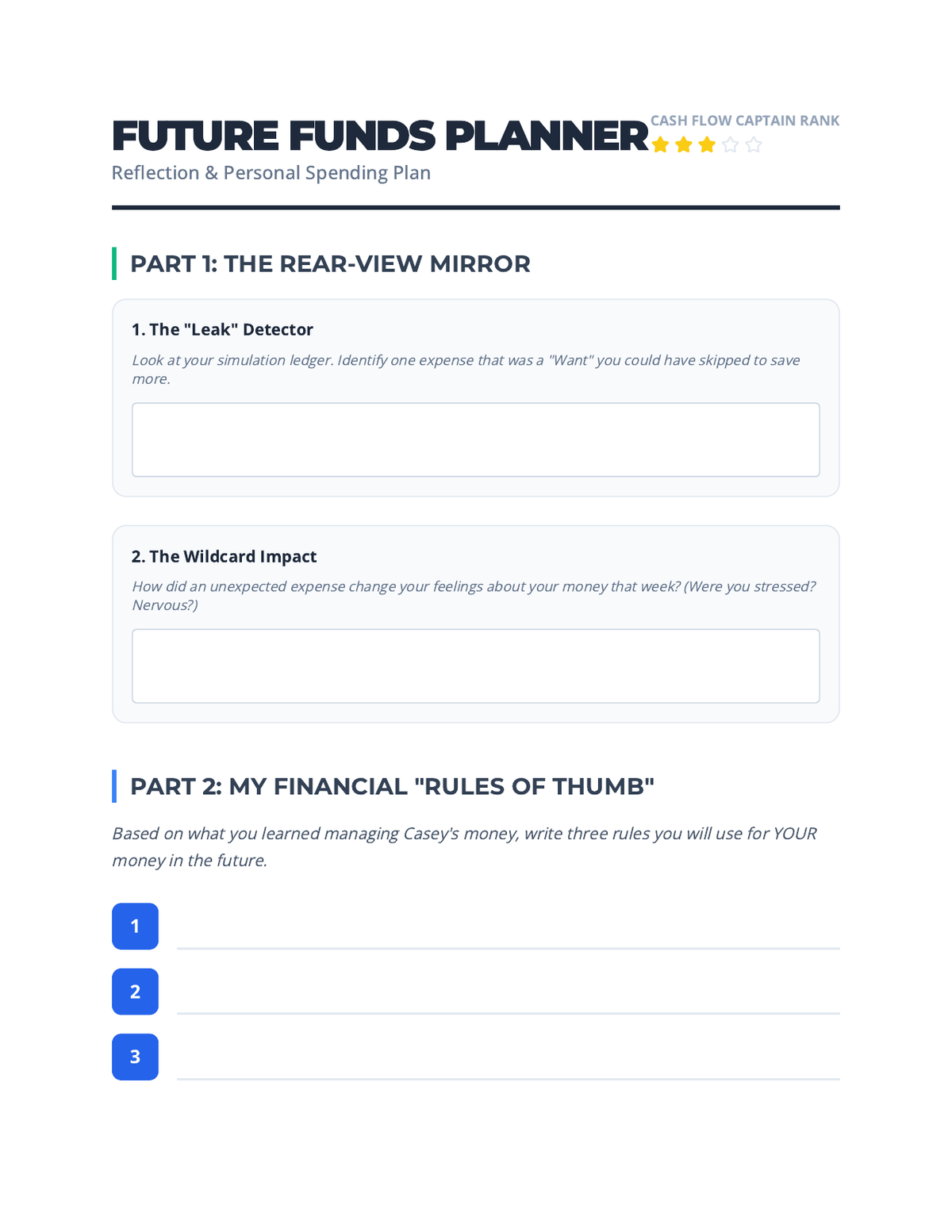
Student reflection and planning worksheet for Lesson 5, allowing students to identify 'spending leaks', set personal financial rules, and draft a balanced monthly budget.
1/16
A base schedule board for students to organize their daily routine cards, featuring five numbered slots and check-off circles.
Cumulative multiple-choice assessment for 4th graders covering fraction vocabulary, unit fractions, and model identification.
Introductory worksheet for fractions including shading area models, identifying points on number lines, and solving a simple word problem.
A ledger recording activity where students fill in transaction details and calculate a running balance based on Charlie's weekly activity.
Engaging slide deck for Kindergarteners exploring music and emotions, covering major/minor tones and energy levels.
Teacher-facing facilitation guide for Session 4. Provides guidance on explaining the Catch-Check-Change method and helping students distinguish between positive thinking and accurate reframing.
1/13
Visual presentation for Session 3, focusing on distress tolerance techniques for high-intensity situations using the TIPP skills framework.
A student worksheet for Session 4, guiding students through the 'Catch-Check-Change' reframing technique to identify and edit negative self-talk.
Introductory slides for the second lesson, teaching students the mechanical skill of logging transactions in a ledger and calculating a running balance.
A comprehensive teacher facilitation guide for the 'Digital Archaeology' lesson, including a 60-minute timeline, discussion prompts, and differentiation strategies.
A set of printable routine icons to be used with the Daily Roadmap Board, including requested activities like sensory breaks and morning meetings.
Teacher-facing facilitation guide for Session 3. Focuses on teaching TIPP skills for crisis regulation and helping students identify environmental supports (like cold water access) within the school.
A teacher-facing guide for Session 1, including learning objectives, a detailed pacing guide, and facilitation tips specifically for Tier 3 mental health interventions.
Slide deck for Lesson 5, focusing on identifying spending habits, understanding 'spending leaks', and establishing future 'Rules of Thumb' for financial success.
Introductory slide deck for Session 1, establishing the 'Inner Compass' theme. It explains the purpose of the intervention and teaches students how to recognize physiological signals of emotions using the 'Emotions as Data' framework.
Instructional slides for Lesson 3 covering time management, opportunity cost, and the "Big Rocks" theory of prioritization.
Engaging slide deck for Kindergarteners about world dances, specifically focusing on the Mexican folk dance "La Raspa".
Culminating slide deck for Session 6, summarizing the key skills from the intervention and guiding students through the creation of their personalized 'Resilience Toolkit.'
A visual worksheet for Kindergarteners to identify musical moods by coloring emoji faces and associating colors with sounds.