A comprehensive lesson designed for 2nd-grade ELL students to master vocabulary and sentence structures related to the four seasons and various weather conditions.
Students practice writing complete sentences while identifying and describing key story elements in their own narrative planning.
A comprehensive 4th-grade lesson introducing students to the world of llamas, covering their habitat, diet, and unique physical characteristics through engaging visuals and a reading comprehension activity.
A comprehensive exploration of the butterfly life cycle, featuring anatomy, metamorphosis comparisons, and dietary habits at each stage.
A comprehensive lesson on llama social behaviors, including herd dynamics, communication methods like humming and spitting, and their roles as protector animals. Students will explore how these camelids interact with each other and their environment.
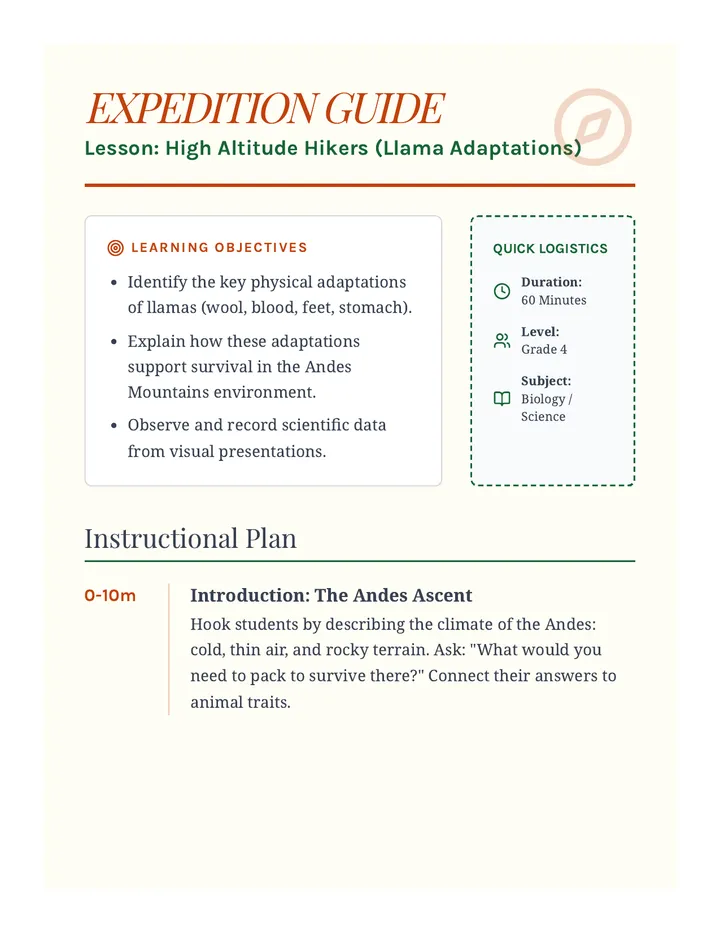
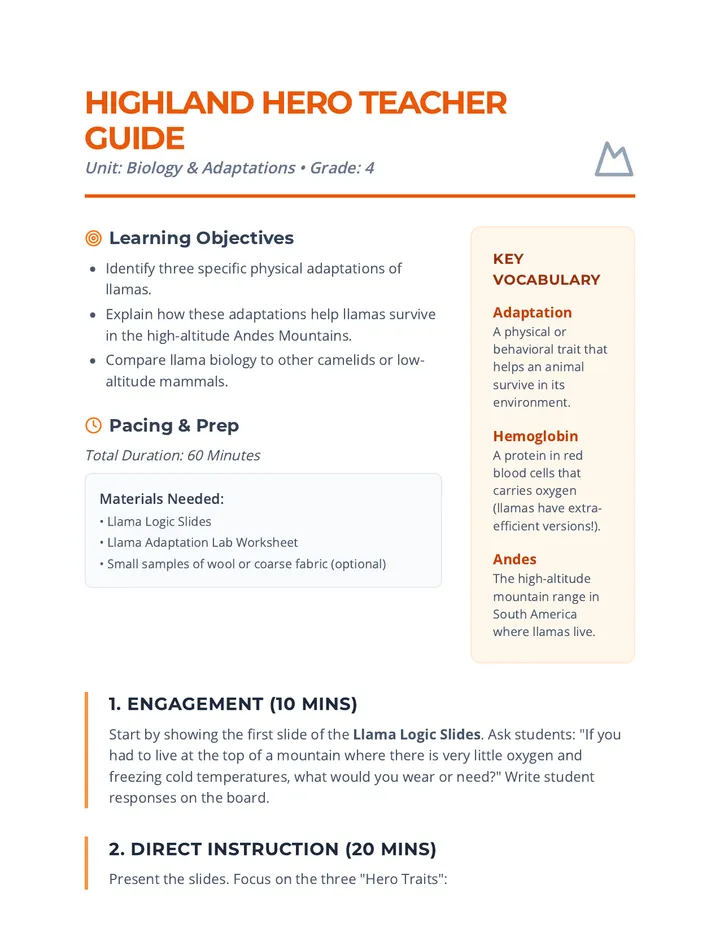
An introductory lesson for 4th graders on llamas, focusing on their unique physical adaptations for survival in the high-altitude Andes Mountains.
A jungle-themed sight word adventure focusing on the first 100 Fry words. This lesson includes visual aids, hands-on practice, and a mini-booklet for early readers.
A fun, engaging lesson exploring the unique biology, history, and personality of llamas. Students will learn about their adaptations to high-altitude environments and their importance to Andean culture.
An engaging exploration of llamas, their South American heritage, and their unique characteristics for 4th-grade students.
An engaging exploration into the world of llamas, covering their South American heritage, unique physical adaptations, and roles in human history. Students will learn to distinguish llamas from their relatives and understand their importance as pack animals.
A lesson exploring the unique characteristics of llamas and how they compare to other camelids and pack animals, focusing on vocabulary and comparative analysis.
A comprehensive lesson on the water cycle, covering evaporation, condensation, precipitation, and collection through visual aids, interactive experiments, and practice.
A fun and engaging introductory lesson for primary students to explore the basics of plant biology, including parts of a plant and what they need to grow.
In this lesson, students will take on the role of 'Flight Engineers' to explore the Engineering Design Process (EDP). They will engage with the iterative stages of Ask, Imagine, Plan, Create, and Improve through a hands-on aerospace challenge.
A fun, animal-themed sight word practice lesson for K-2 students focusing on recognition, tracing, and usage in simple sentences.
In this lesson, students will take on the role of 'Mission Engineers' to explore the Engineering Design Process (EDP). They will learn to identify problems, brainstorm solutions, build prototypes, and iterate on their designs through hands-on challenges.
A reading comprehension lesson where students explore the physical traits, behaviors, and high-altitude habitats of llamas while practicing key literacy skills.
In this lesson, students will take on the role of 'Chief Engineers' to explore the Engineering Design Process (EDP). Through hands-on challenges and collaborative problem-solving, they will learn to define problems, brainstorm solutions, create prototypes, and iterate on their designs.
A hands-on introduction to the Engineering Design Process (EDP), guiding students through the stages of Ask, Imagine, Plan, Create, and Improve through a mini-challenge.
A hands-on introduction to the Engineering Design Process (EDP), guiding students through the Ask, Imagine, Plan, Create, and Improve stages to solve a practical challenge.
A fun and informative lesson where students discover the unique characteristics of llamas and learn how to distinguish them from their alpaca cousins through reading, vocabulary building, and comparative analysis.
A fun and informative lesson on llamas, focusing on their physical characteristics, habitats, and roles in South American culture. Students will practice reading comprehension and identification skills.
A high-energy, hands-on introduction to the Engineering Design Process (EDP) where students take on the role of 'Mission Engineers' to solve a rapid-fire design challenge.
A reading comprehension lesson where students explore the world of llamas and learn to distinguish them from their South American cousins, specifically alpacas and camels.
Students are introduced to the Engineering Design Process (EDP) through a collaborative tower-building challenge, learning the importance of constraints and iteration.
An introductory lesson on the water cycle focusing on the core stages of evaporation, condensation, and precipitation using visual models and hands-on demonstrations.
Explore how water moves across the Earth and how human impact affects water quality and the cycle.
Lesson for studio export and print testing
An introductory lesson exploring the continuous movement of water on Earth, focusing on the key stages of the water cycle.
A 60-minute introductory lesson exploring the physical characteristics, behaviors, and habitats of llamas, designed for 4th-grade students.
The final stage of the EDP where students test their designs, gather data, and iterate for improvement.
Students learn about materials, constraints, and building techniques as they move into the 'Plan' and 'Create' stages.
Focuses on the 'Define' and 'Imagine' stages of the EDP through a real-world problem-solving scenario.
Students are introduced to the five stages of the Engineering Design Process and apply them to a simple 'Paper Tower' challenge.
A high school history and media studies lesson exploring the evolution of digital primary sources, centered on the first-ever YouTube video. Students analyze how user-generated content has shifted from casual archiving to highly produced monetization.
A Kindergarten to 2nd Grade lesson exploring the first YouTube video ever made, focusing on observation skills, animal characteristics, and the evolution of digital content. Students will identify key details about elephants and create their own drawings based on the video's descriptions.
A Kindergarten-2nd Grade lesson where students learn to make simple animal observations by watching the first-ever YouTube video and creating their own 'Zoo Vlog' drawing and description.
A Kindergarten-2nd grade lesson focused on using descriptive adjectives to observe animals, using the historic first YouTube video as a starting point for vocabulary expansion.
A Kindergarten to 2nd-grade lesson on observation and descriptive language using the historic 'Me at the zoo' video. Students will practice using the word 'long' to describe elephant trunks through drawing and writing activities.
This lesson explores the historical significance of the first YouTube video, 'Me at the zoo,' as a primary source document that signaled the shift from gatekeeper-controlled media to user-generated content and the democratization of information. Students engage in a Socratic Seminar to analyze how this low-fidelity 19-second clip fundamentally changed global media consumption and production.
A Kindergarten to 2nd Grade lesson where students practice observation and descriptive language by watching the first-ever YouTube video and drawing an elephant.
A Kindergarten to 2nd-grade lesson where students observe elephants, learn about their trunks, and practice observation skills using the historic 'Me at the zoo' video.
A K-2 lesson focused on observing animals and using descriptive vocabulary, featuring the video 'Me at the zoo'.
A high school Computer Science lesson connecting the history of YouTube's first video to concepts of bandwidth, data compression, and internet infrastructure evolution.