Media Shift Teacher Guide
Teacher Facilitation Guide
Digital Democratization: The Web 2.0 Shift
Grade Level
9-12 (History/SS)
Objective
Students will analyze three distinct primary sources from 2005 to evaluate the cultural and structural shift from Web 1.0 (consumption) to Web 2.0 (participation). Students will specifically explore how the democratization of media tools impacts the creation and archiving of historical narratives.
Standards Alignment
- CCSS.ELA-LITERACY.RH.11-12.1: Cite specific textual evidence to support analysis of primary and secondary sources.
- CCSS.ELA-LITERACY.RH.11-12.7: Integrate and evaluate multiple sources of information presented in diverse formats and media.
Materials Checklist
- Slide Deck
- "Web Revolution" Article
- Analysis Matrix (1 per student)
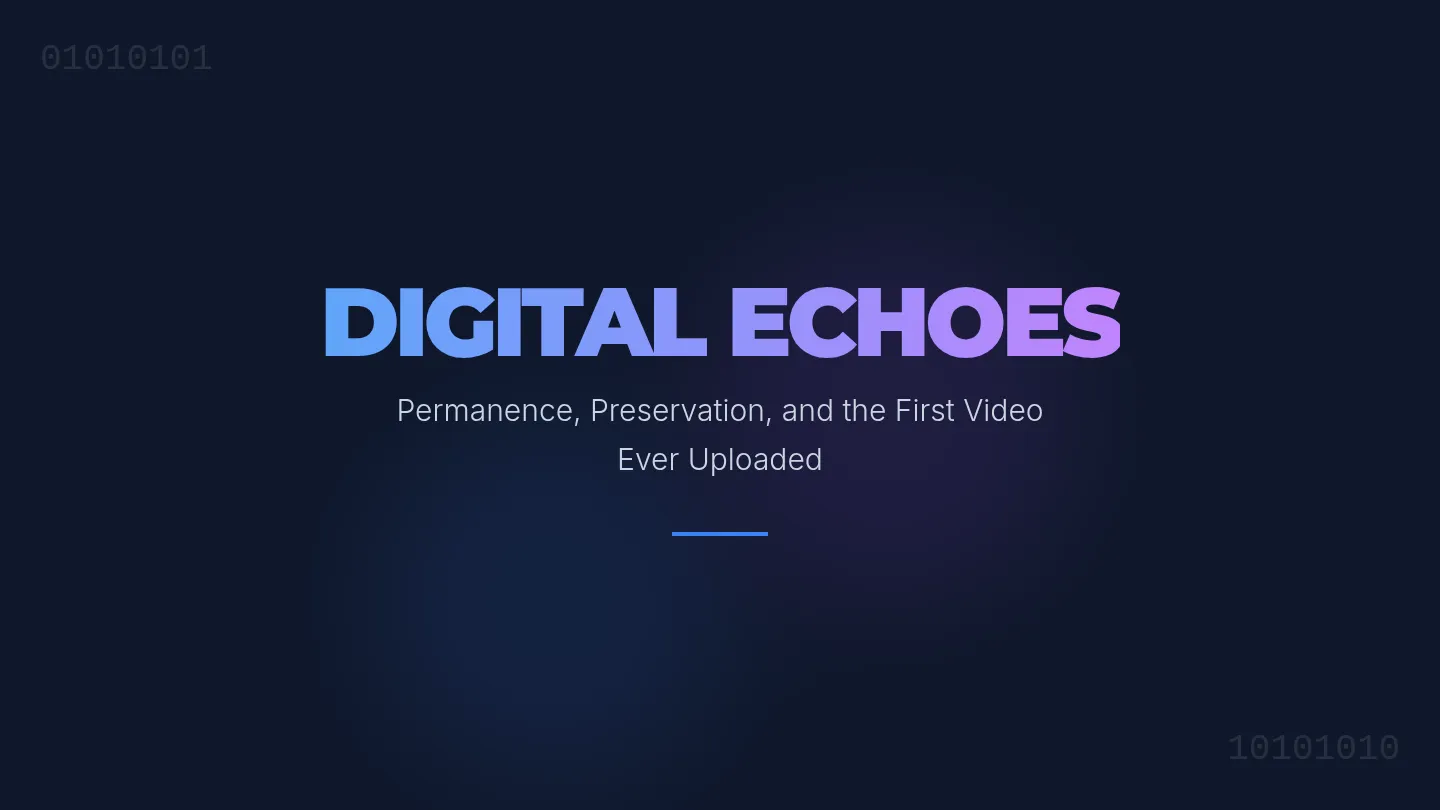
- YouTube: "Me at the zoo"
Instructional Sequence
1. Warm-up: The Definition Shift (5 min)
SLIDES 1-2
Use the slide deck to define Web 1.0 vs. Web 2.0. Ask students: "When was the last time you read something online but couldn't leave a comment or interact with it?"
Key Concept: Web 1.0 = Library (Read-Only). Web 2.0 = Town Square (Read-Write).
2. Artifact Spotlight: "Me at the zoo" (10 min)
SLIDES 3-4
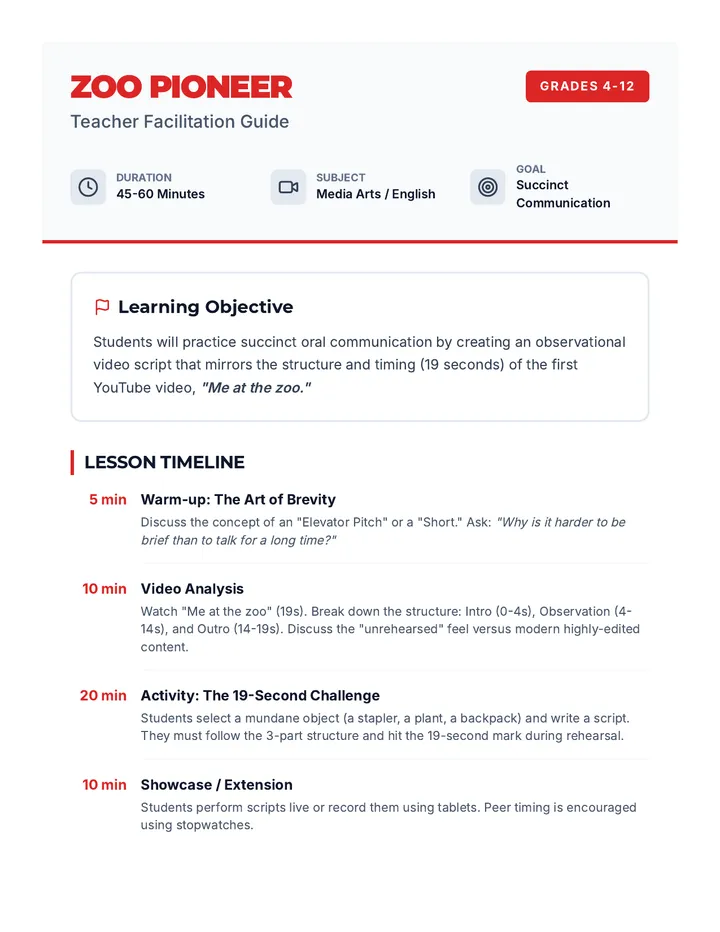
Show the video. It is only 19 seconds. Context for students: This was uploaded by YouTube co-founder Jawed Karim. At the time, there were no "influencers."
Discussion Prompts:
- Why choose elephants? Why is it so mundane (boring)?
- Identify the "Missing Professionalism" (Low res, no edits, no music).
- How does this video challenge the idea of what is "historically significant"?
3. Archive Analysis (20 min)
WORKSHEET + ARTICLE
Distribute the Analysis Matrix and the Web Revolution Article. For "Source B" (TV Clip), describe a typical 2005 local news segment to the class (high production, anchor in a suit, professional camerawork, passive audience).
Look For:
Students noting that the Newspaper has high "barriers to entry" (editors, printing press) while the Video has almost none (webcam, internet).
Bias Check:
Is the Newspaper biased toward "expertise"? Is the Video biased toward "authenticity"?
Closure: The Historian's Dilemma
"In 1940, if you wanted to know what happened in a town, you read the local paper. Today, there are 5,000 TikToks from that town. Is history more accurate now, or just more confusing?"
Challenge students to think about Gatekeeping: Is it better to have one 'expert' editor, or a million 'amateur' eyewitnesses?