A friendly, 5th-grade appropriate intake form for quick mental health check-ins, featuring a mood meter, safety check-in, and space for private thoughts.
A visual presentation to introduce and explain the expectations for each step of the morning routine.
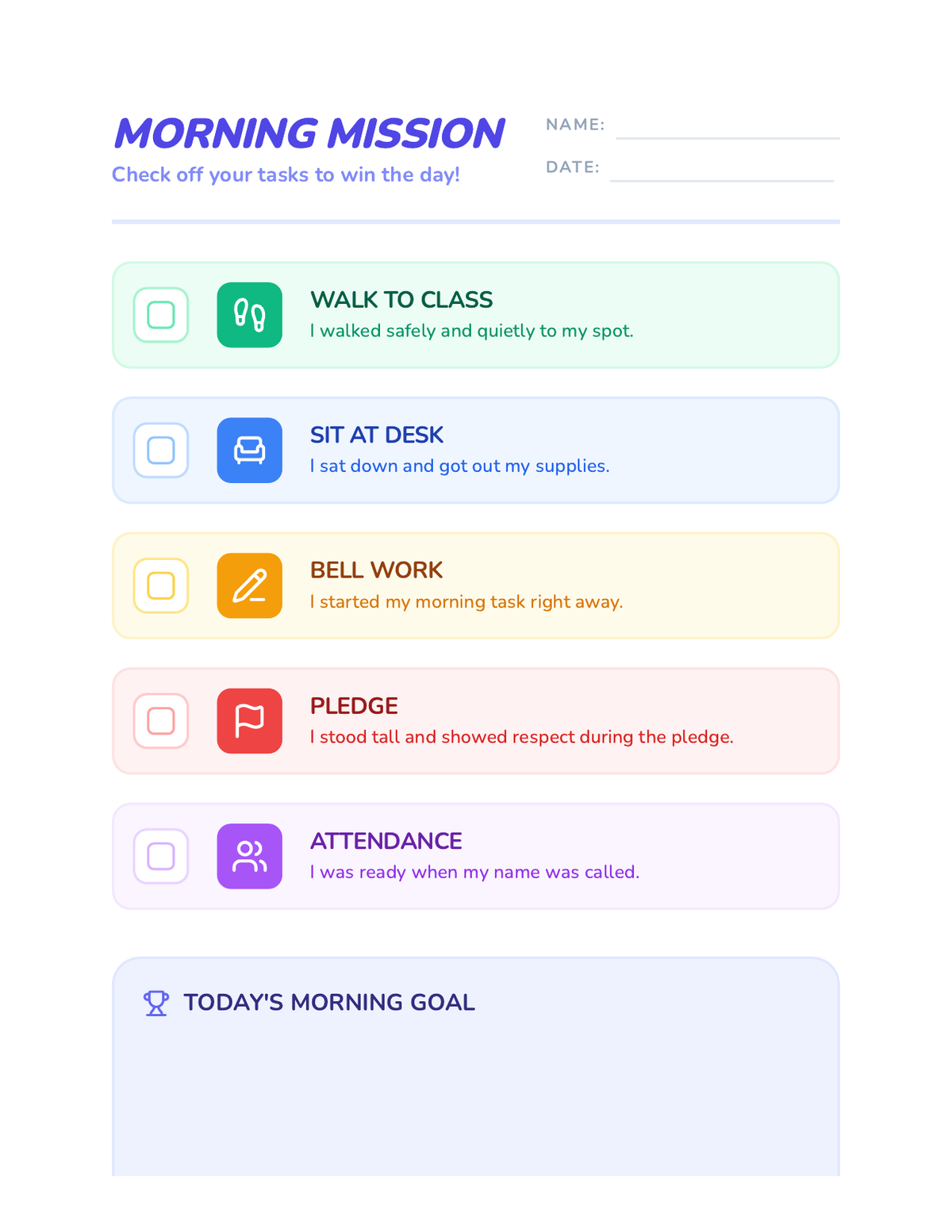
An individual student checklist to help children track their morning routine steps independently.
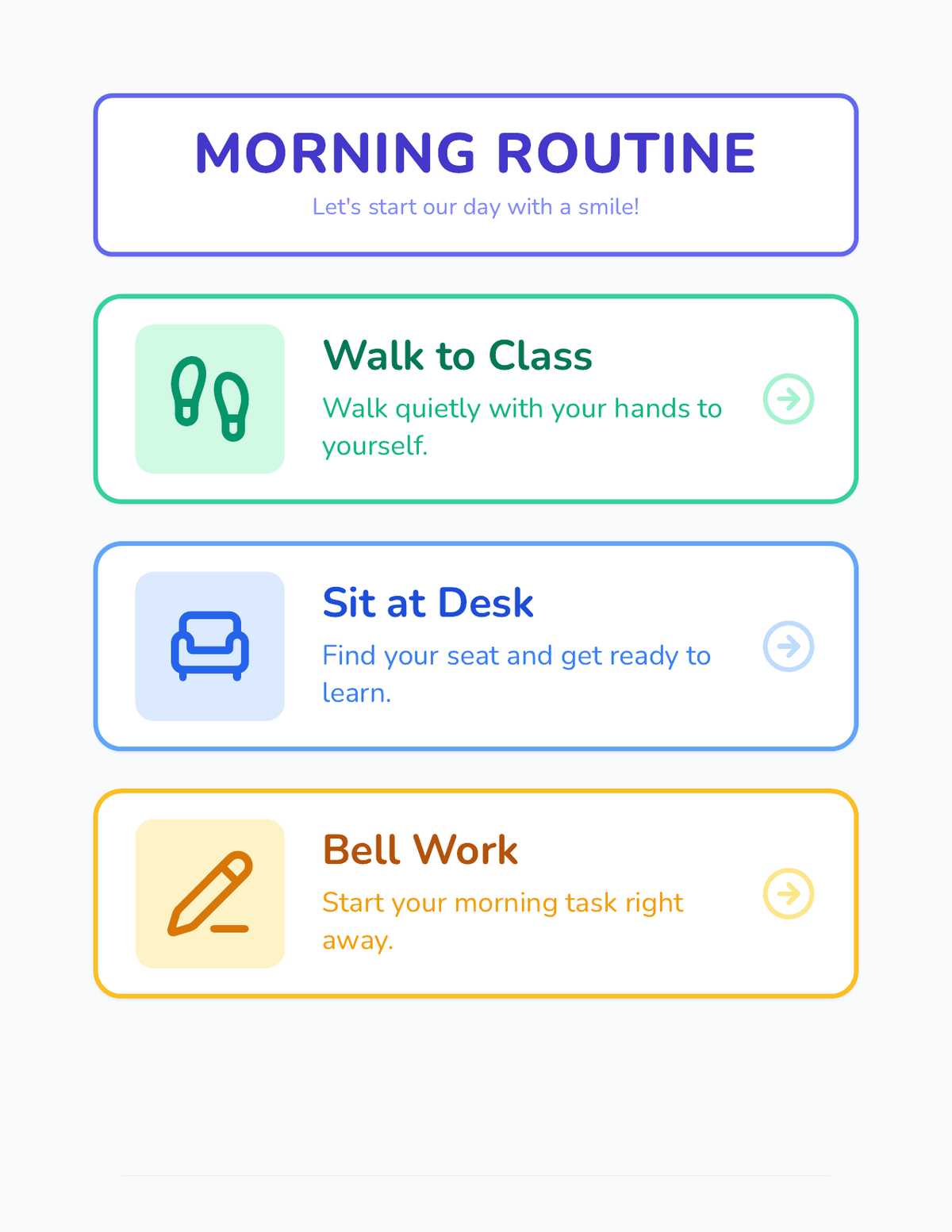
Large, colorful visual cards for a classroom wall chart showing the morning routine steps: Walk to Class, Sit at Desk, Bell Work, Pledge, and Attendance.
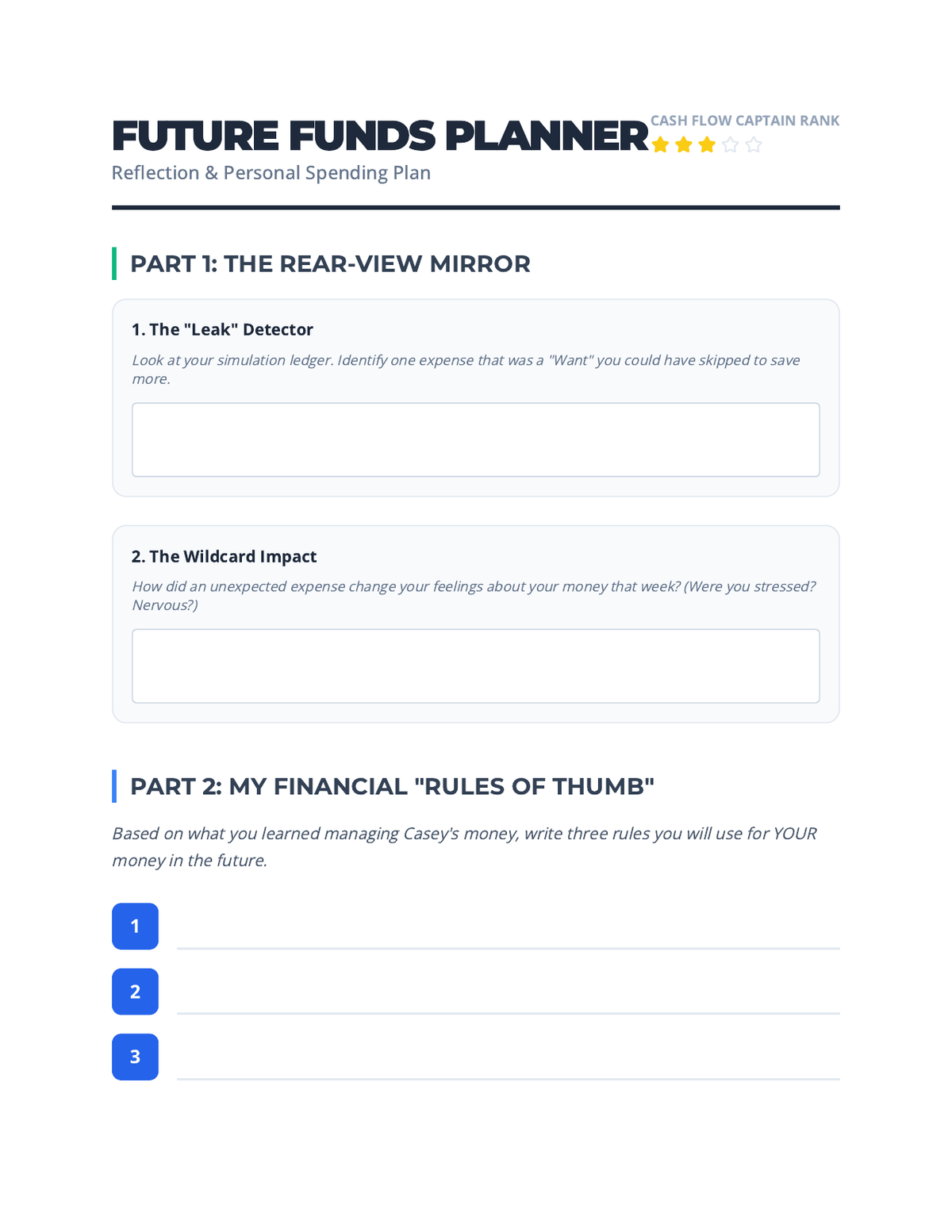
Student reflection and planning worksheet for Lesson 5, allowing students to identify 'spending leaks', set personal financial rules, and draft a balanced monthly budget.
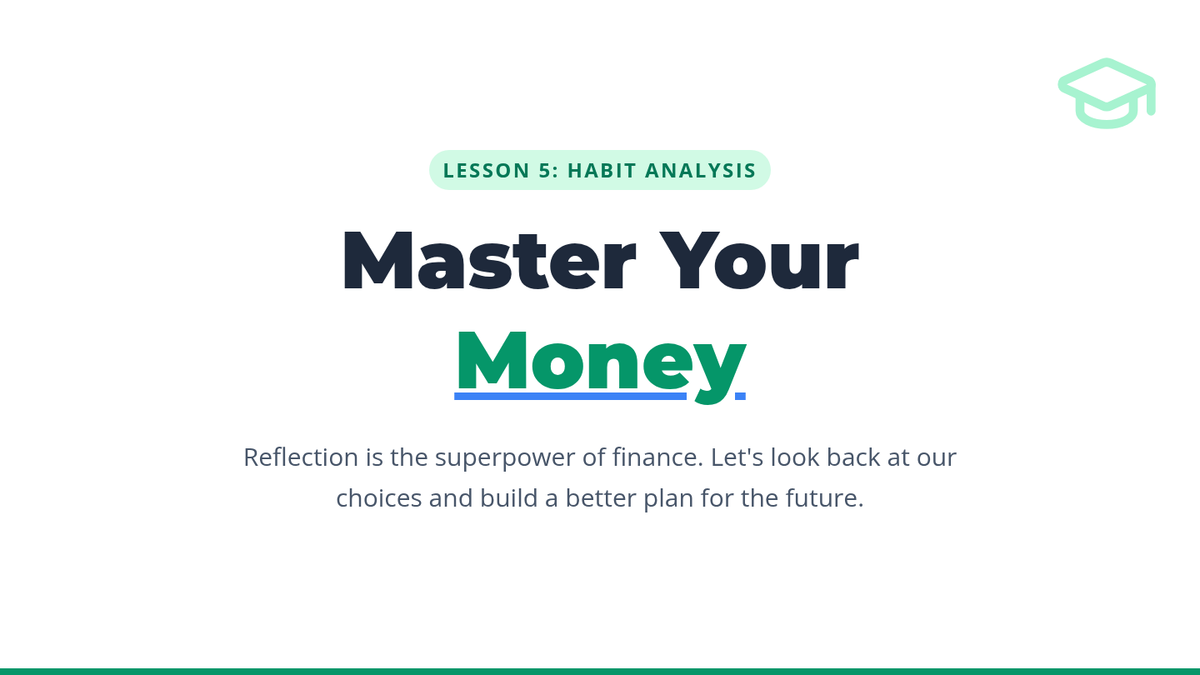
Slide deck for Lesson 5, focusing on identifying spending habits, understanding 'spending leaks', and establishing future 'Rules of Thumb' for financial success.
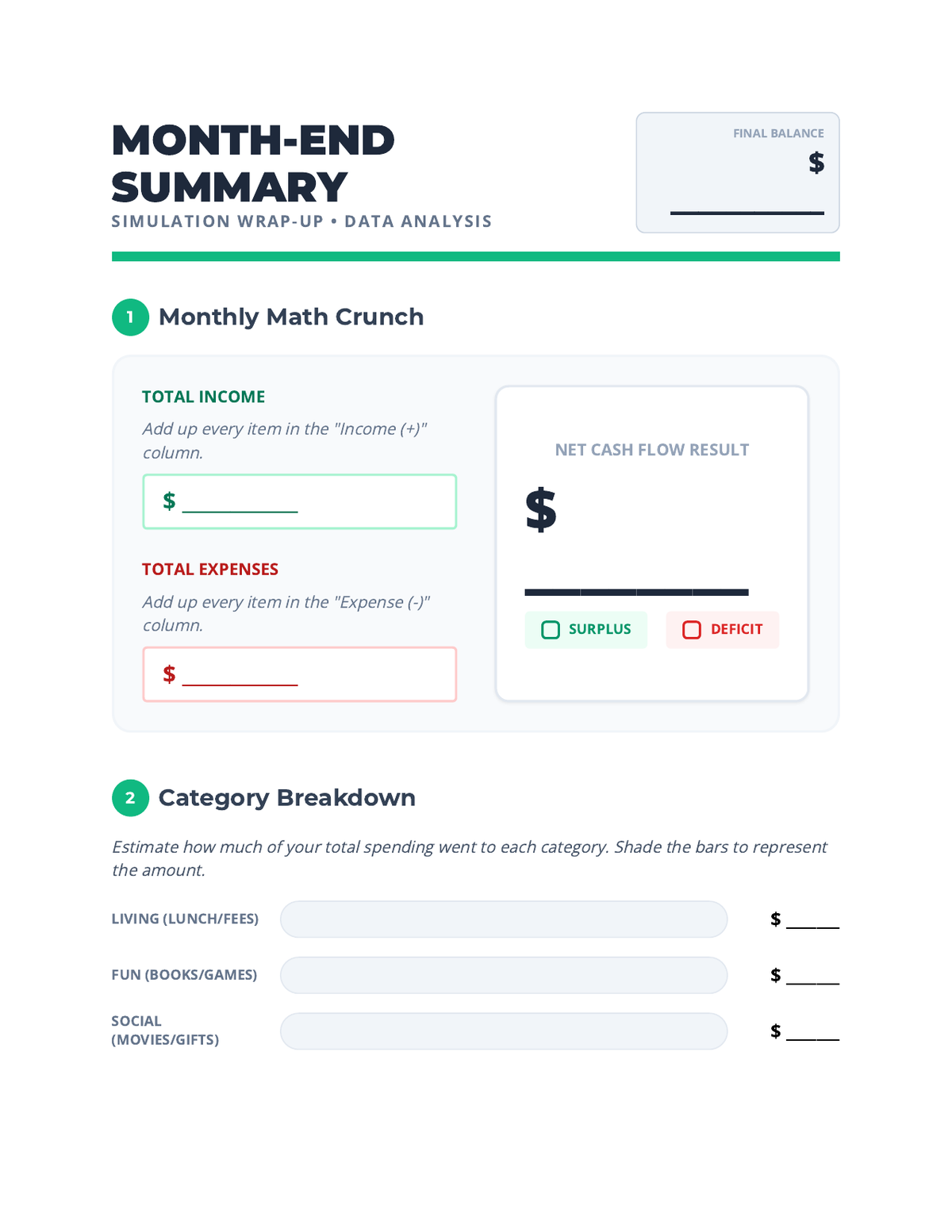
Student worksheet for Lesson 4, used to calculate total income and expenses, determine net cash flow, and visualize spending by category.
Slide deck for Lesson 4, guiding students through the process of calculating monthly totals, identifying surpluses or deficits, and evaluating their success against their savings goal.
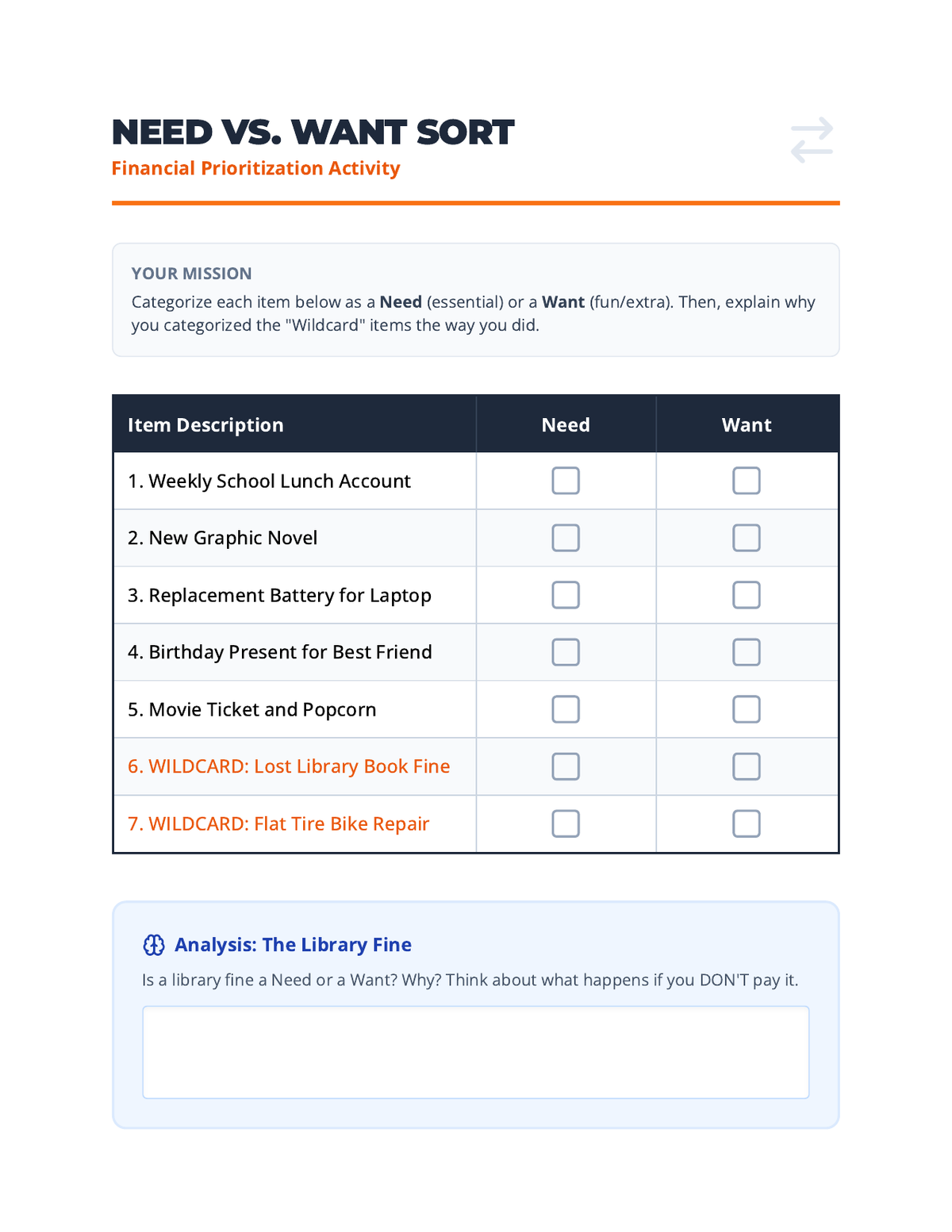
A student worksheet for categorizing expenses as needs or wants, including specific focus on wildcard expenses and their impact on financial planning.
Slide deck for Lesson 3, focusing on the distinction between needs and wants and how unexpected 'wildcard' expenses impact financial plans.
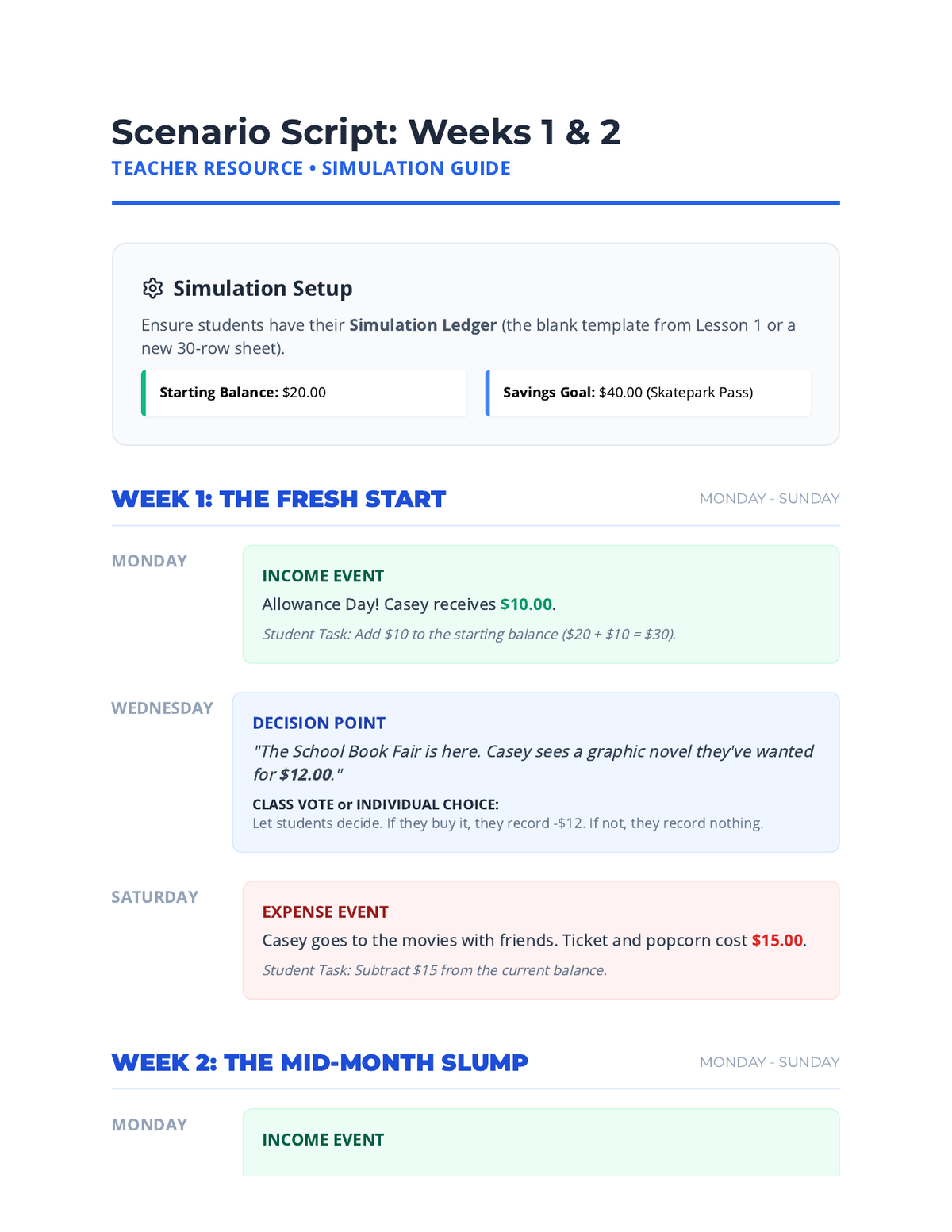
Teacher script for Lesson 2 simulation, providing specific financial scenarios for Weeks 1 and 2 including income, mandatory expenses, and decision points.
Slide deck for Lesson 2, introducing the character 'Casey' and setting the stage for the month-long financial simulation.
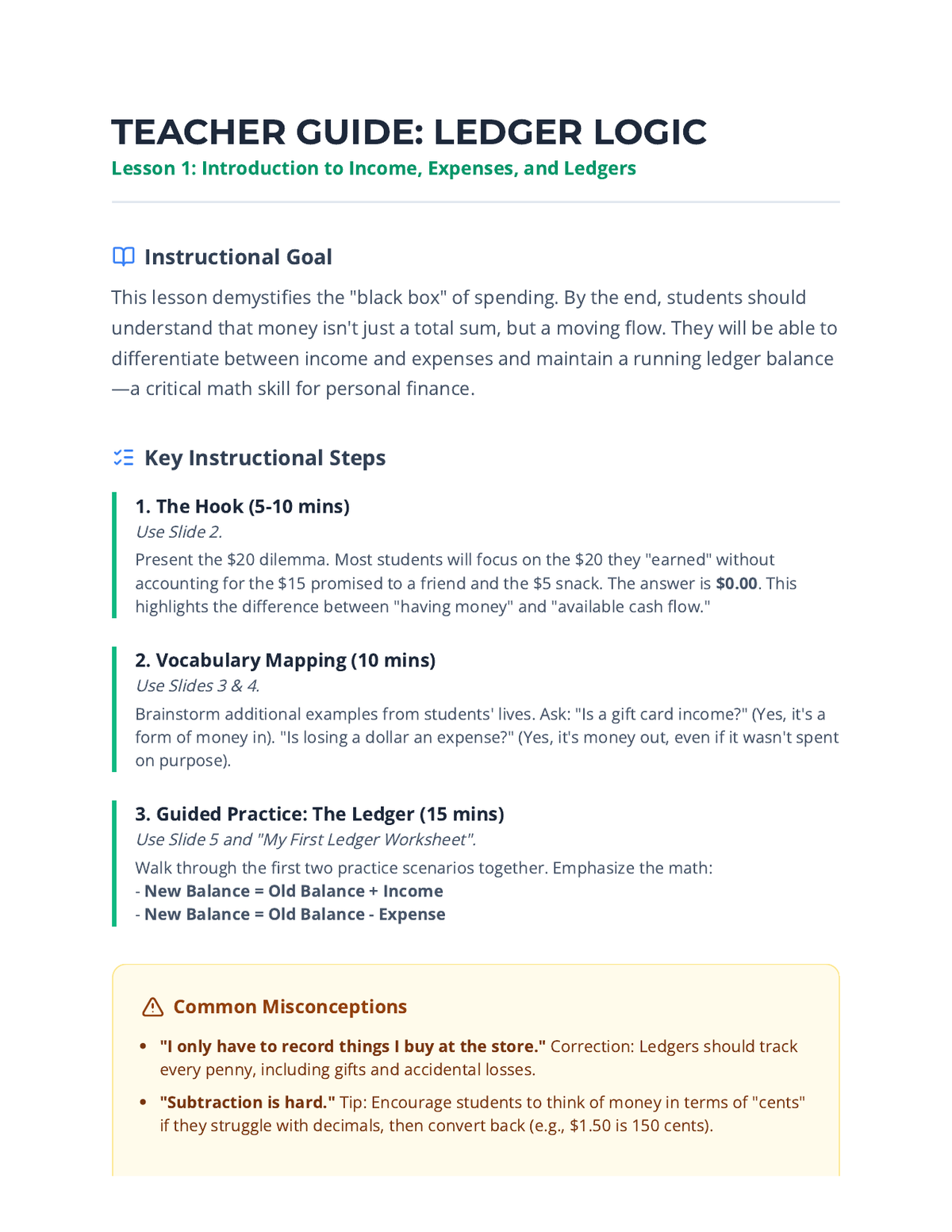
A teacher guide for Lesson 1, providing instructional tips, misconception alerts, and the answer key for the student worksheet.
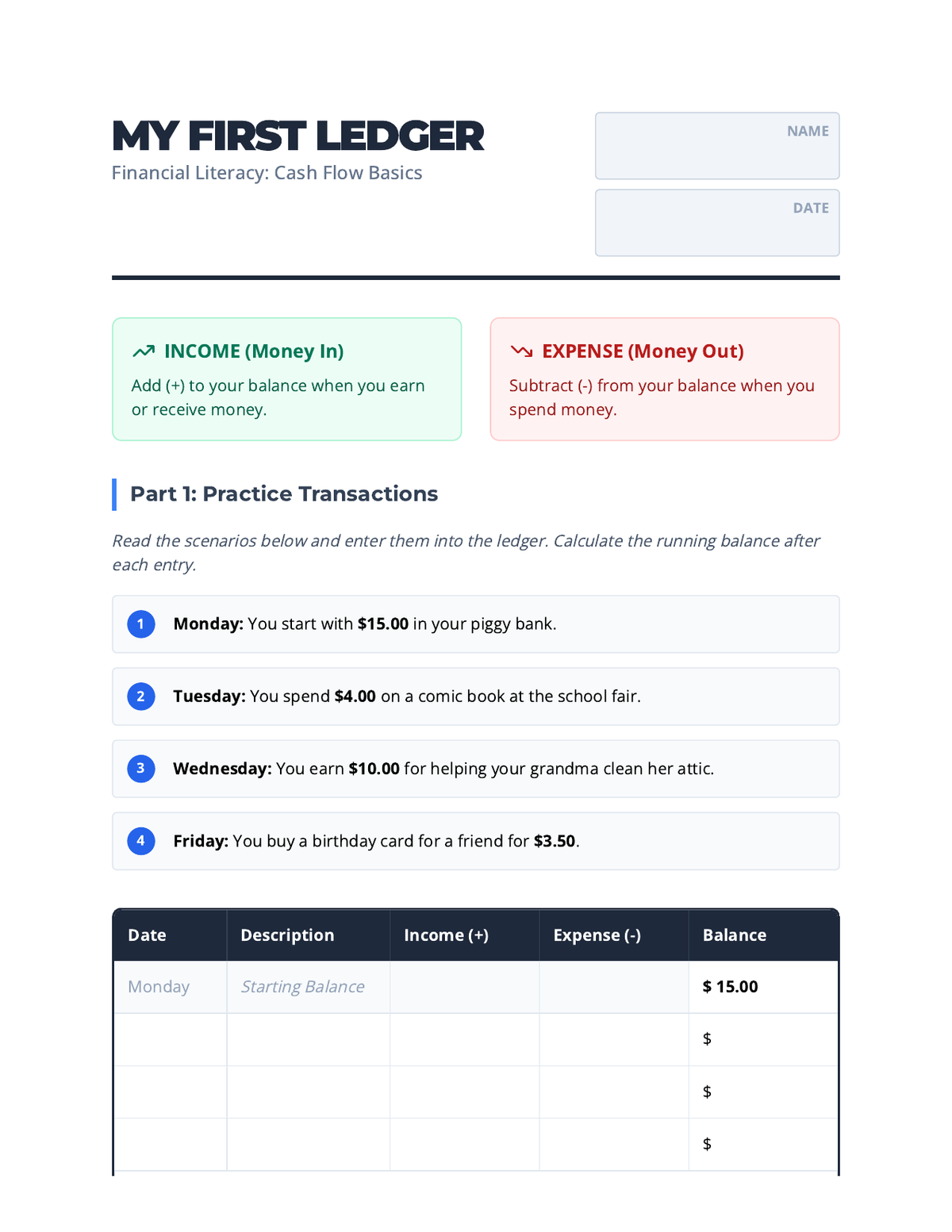
A student worksheet for practicing ledger entries, calculating running balances, and understanding basic financial transactions.
Introductory slide deck for Lesson 1, covering income, expenses, and the purpose of a financial ledger.
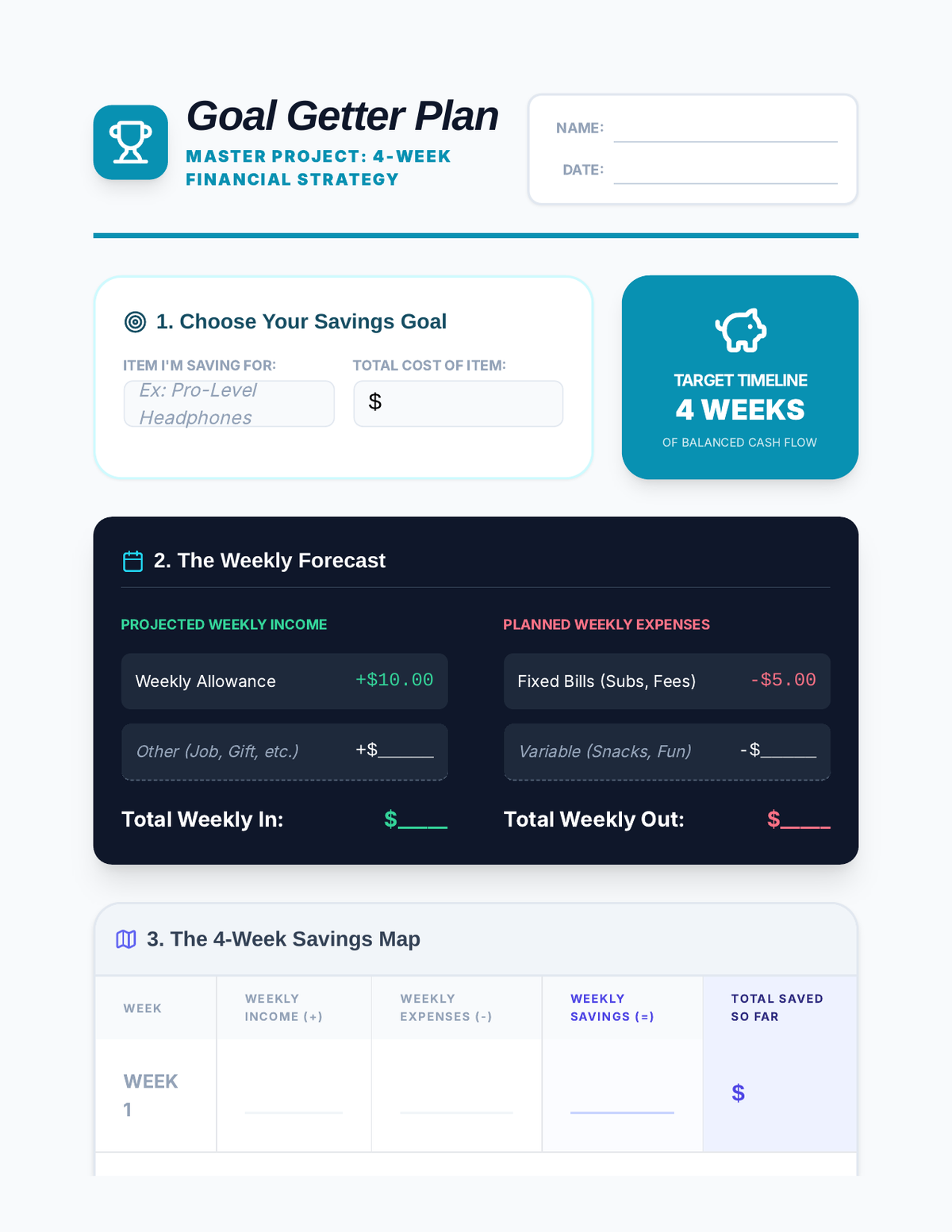
A culminating project worksheet where students create a 4-week cash flow projection to hit a specific savings goal.
Introductory slides for the fifth lesson, teaching students how to synthesize their learning to create a balanced cash flow plan.
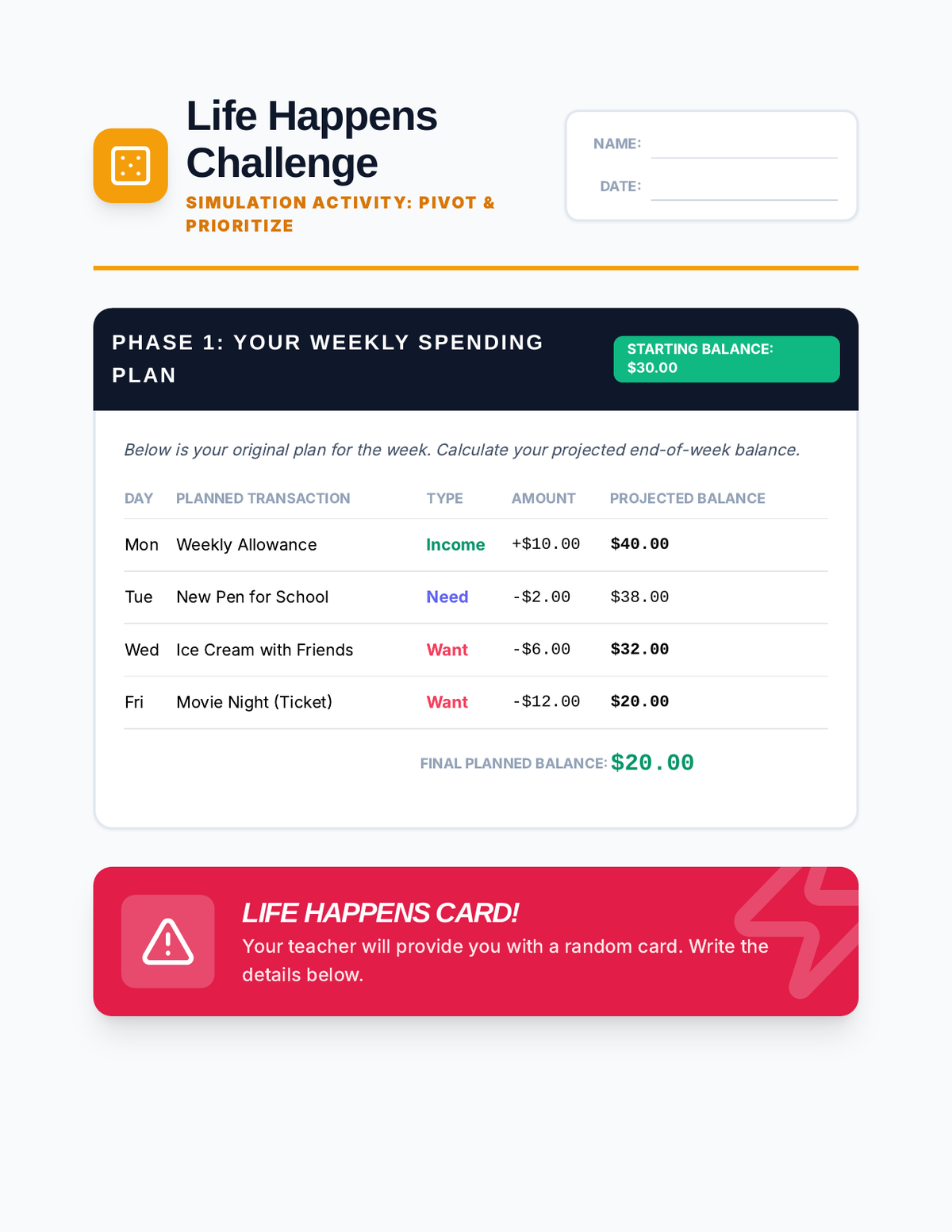
A simulation activity where students receive unexpected 'Life Happens' cards and must adjust their weekly spending plans to maintain a positive balance.
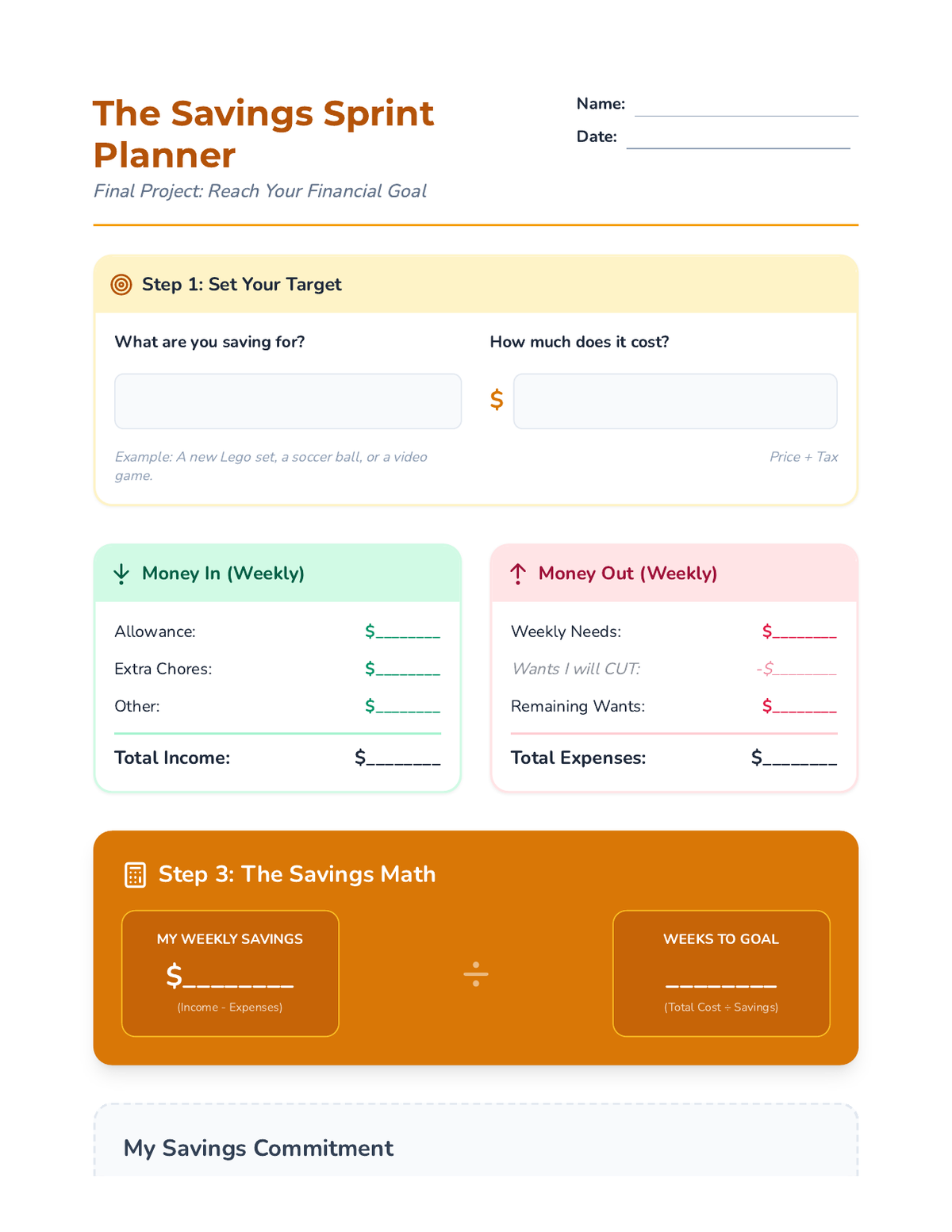
A worksheet for students to plan and track their personal savings goals, calculating weekly savings and time to reach their target.
Introductory slides for the fourth lesson, teaching students how to adjust their spending plans and make trade-offs between needs and wants.
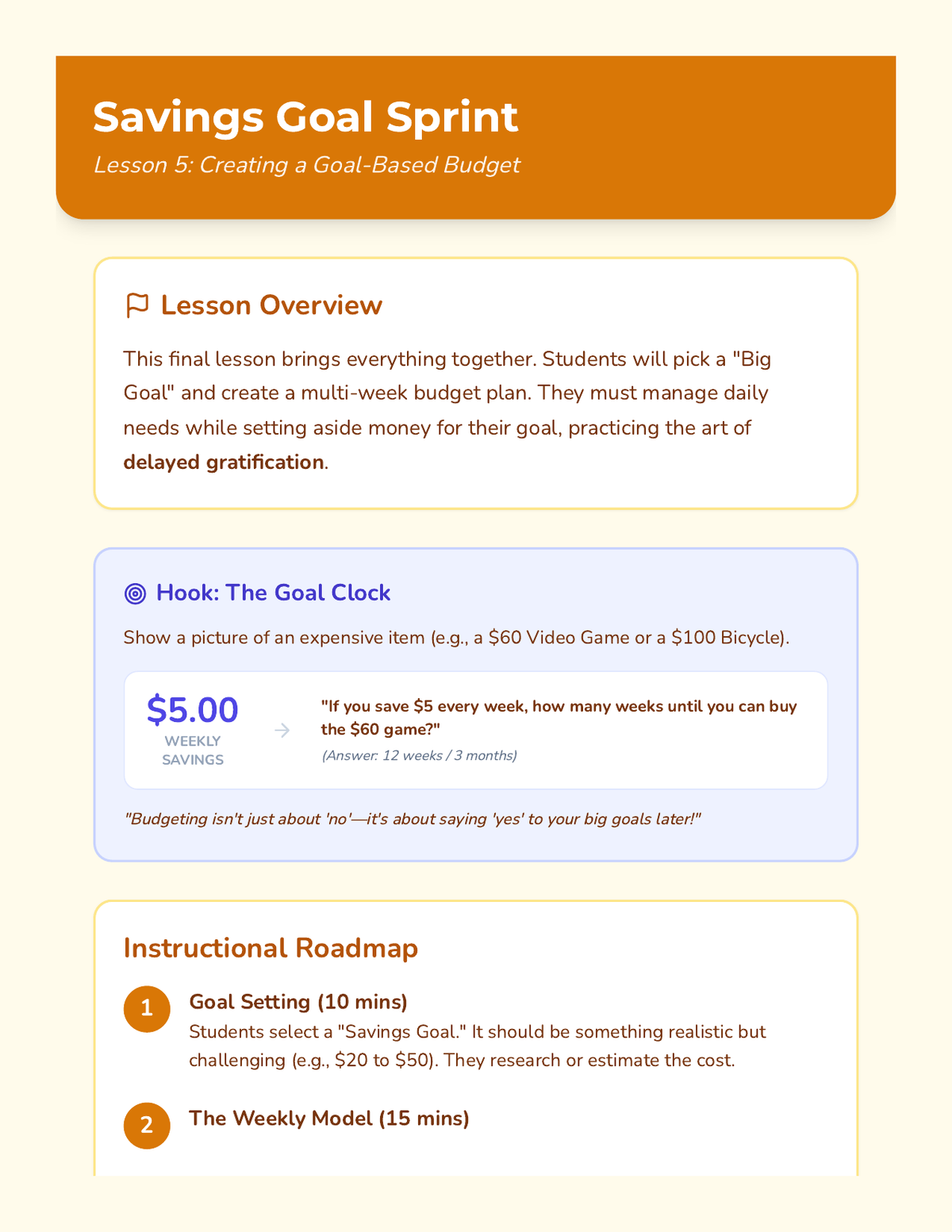
Teacher's guide for Lesson 5, focusing on setting savings goals and creating a long-term budget plan to reach them.
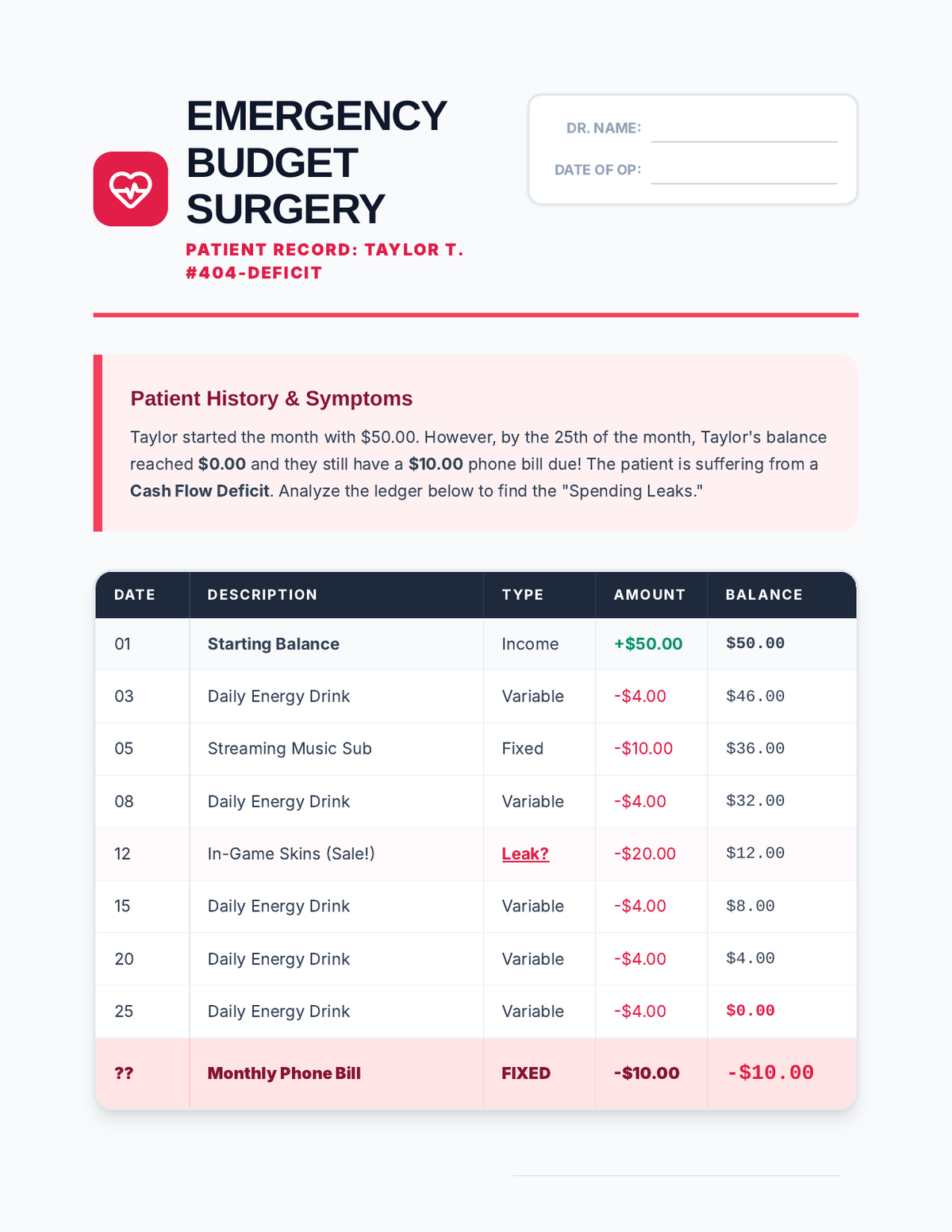
A budget analysis worksheet where students act as doctors to identify spending leaks in Taylor's ledger and recommend a treatment plan to fix a $10 deficit.
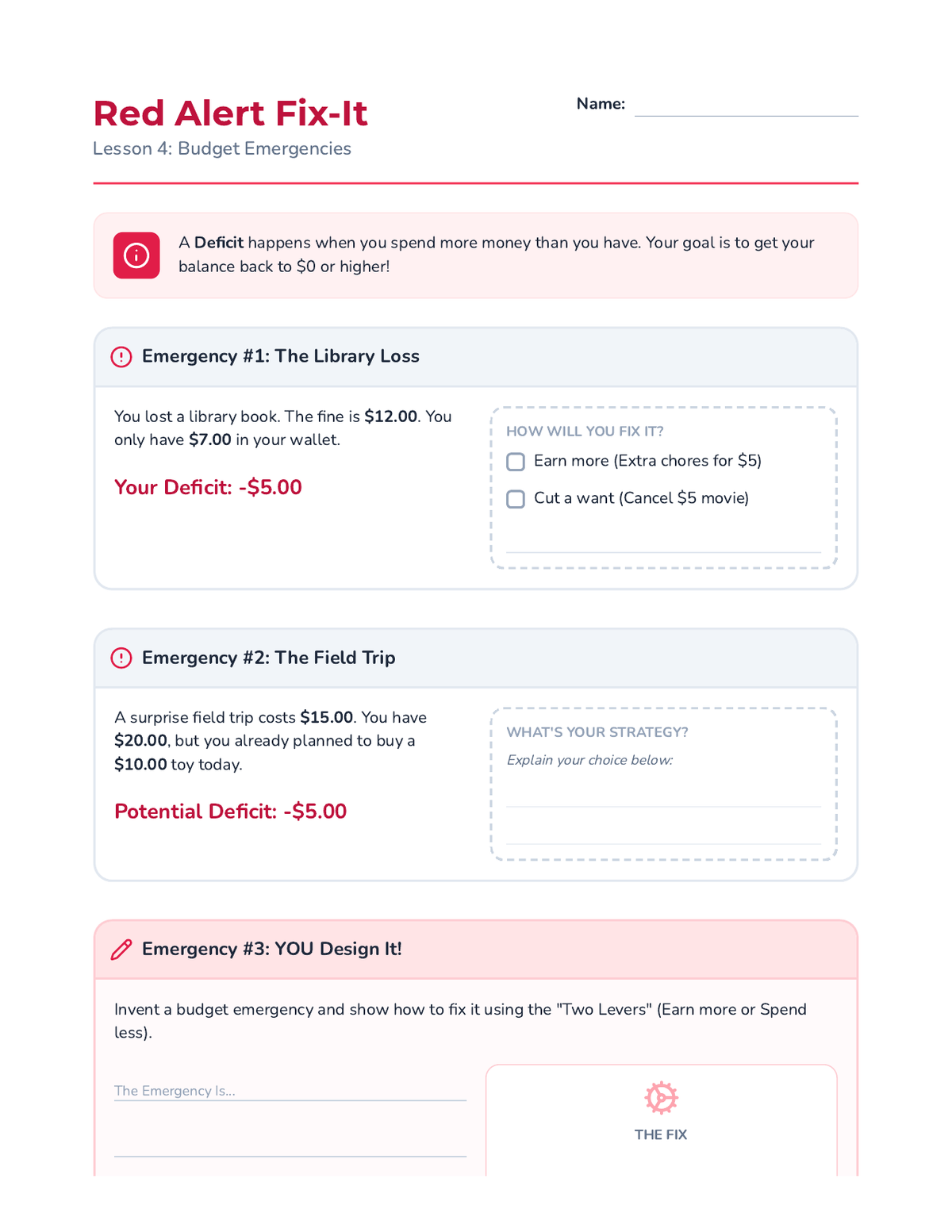
A worksheet where students solve budget deficit scenarios by applying earning or cutting strategies.
Introductory slides for the third lesson, teaching students how to identify financial deficits and spending leaks.
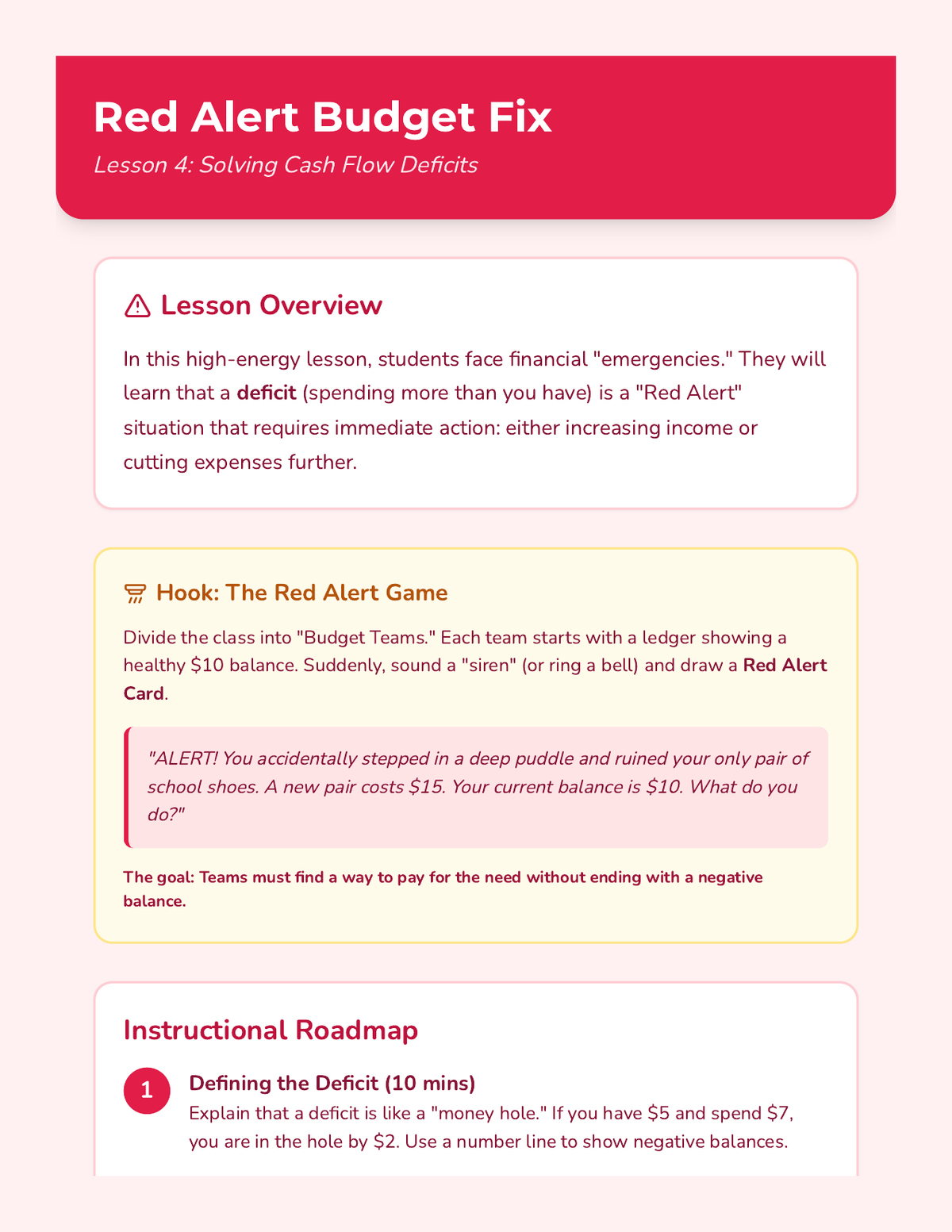
Teacher's guide for Lesson 4, detailing the "Red Alert" game hook and strategies for teaching students how to solve budget deficits.
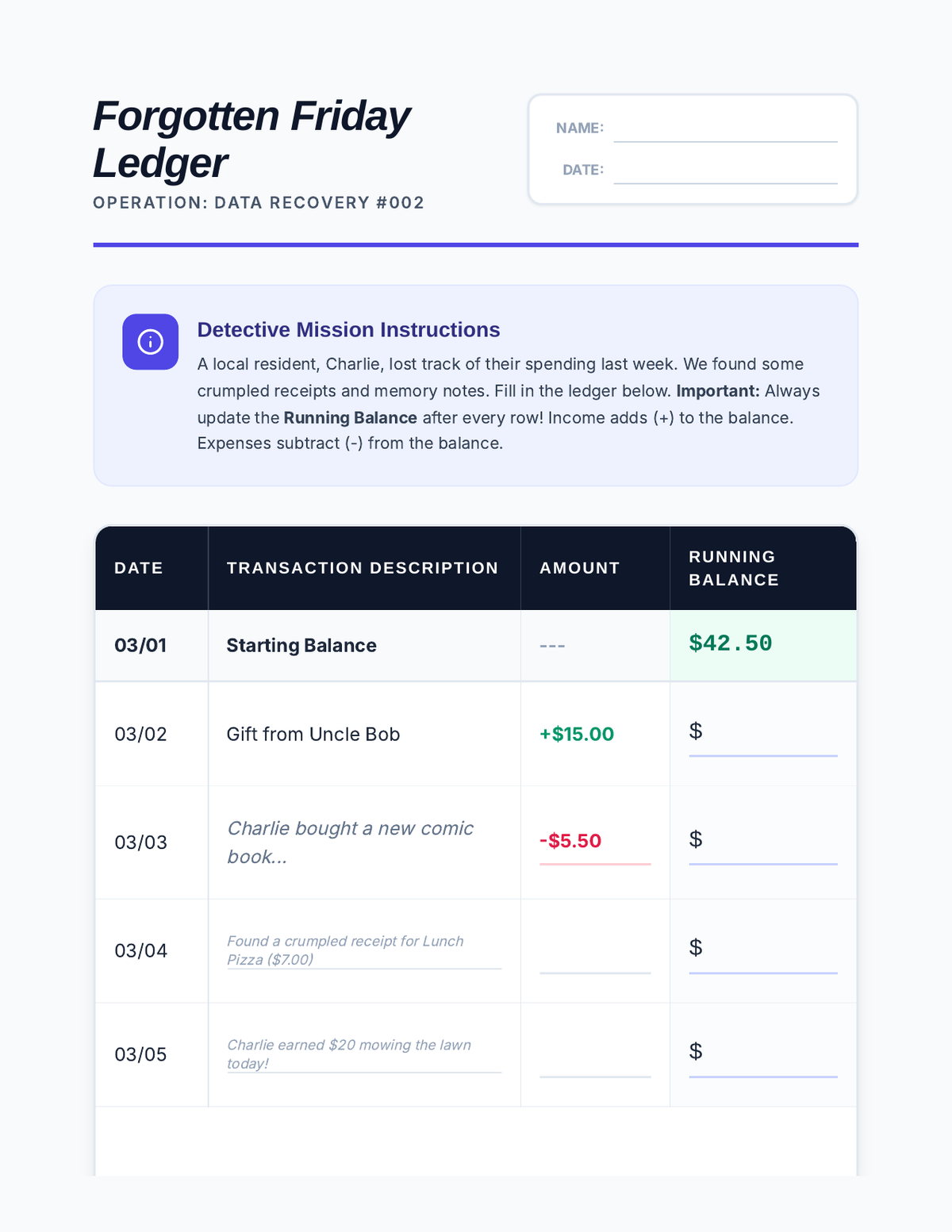
A ledger recording activity where students fill in transaction details and calculate a running balance based on Charlie's weekly activity.
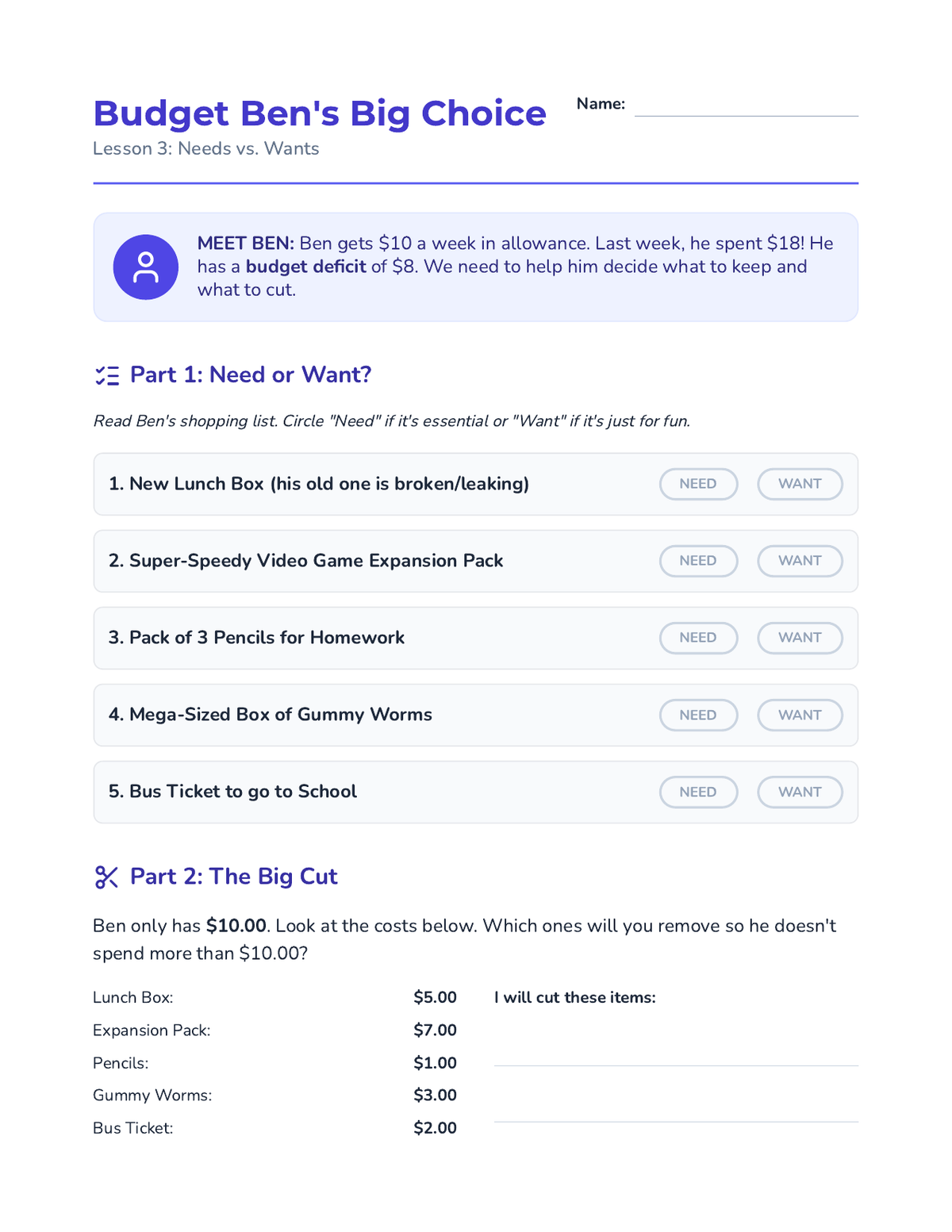
A worksheet for students to practice categorizing expenses as needs or wants and deciding which items to cut from a budget to avoid a deficit.
Introductory slides for the second lesson, teaching students the mechanical skill of logging transactions in a ledger and calculating a running balance.
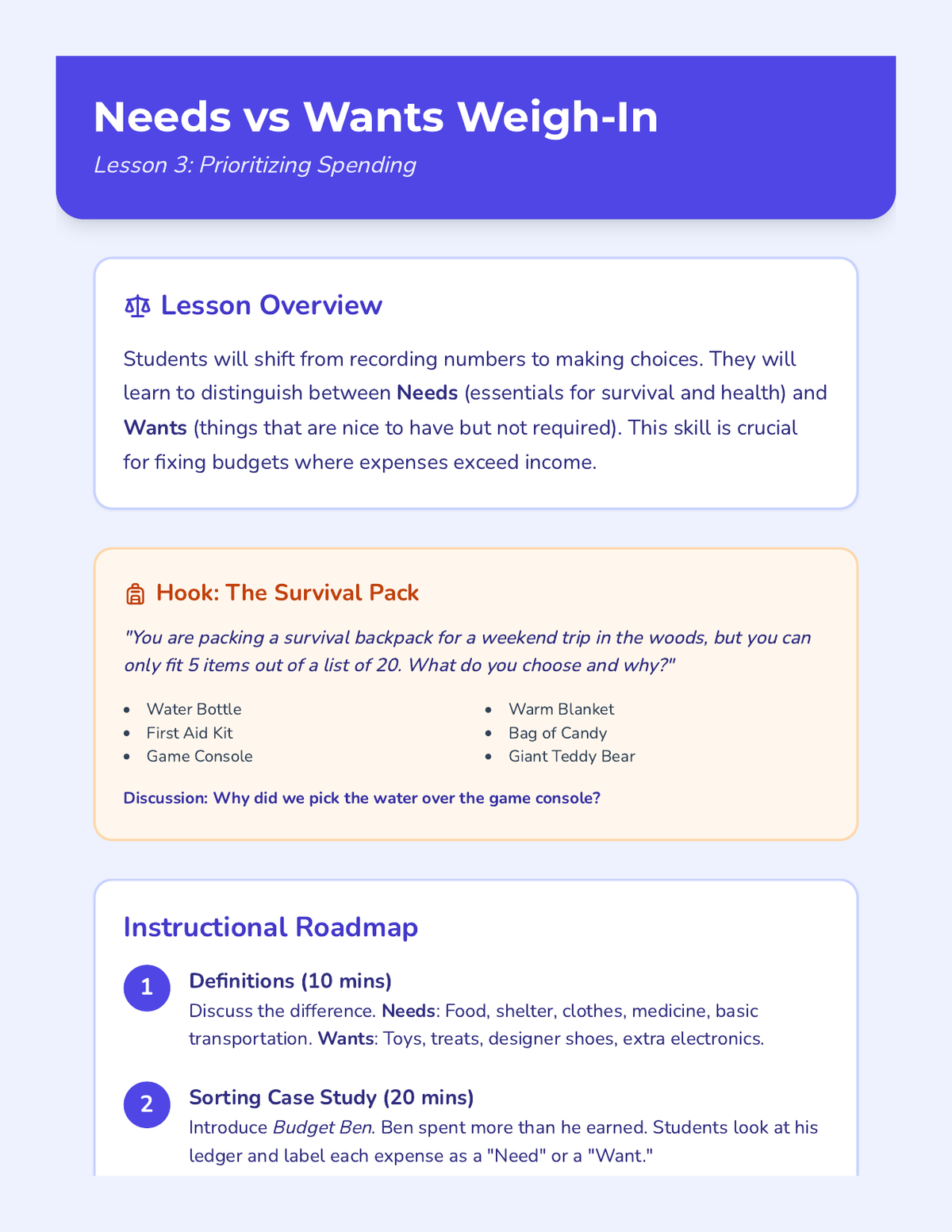
Teacher's guide for Lesson 3, focusing on differentiating needs from wants and strategies for budget prioritization.
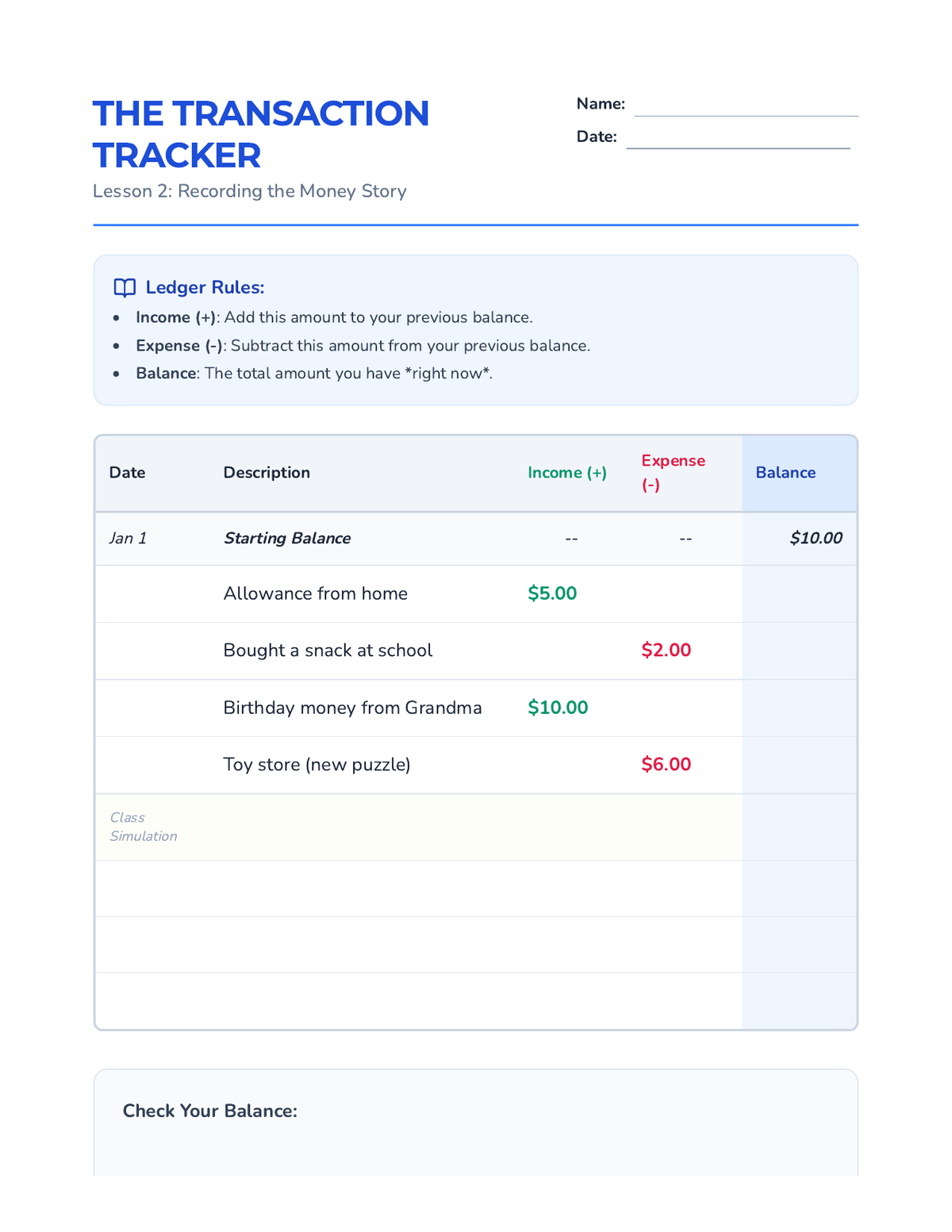
A worksheet for students to practice recording transactions and calculating a running balance in a simplified ledger format.
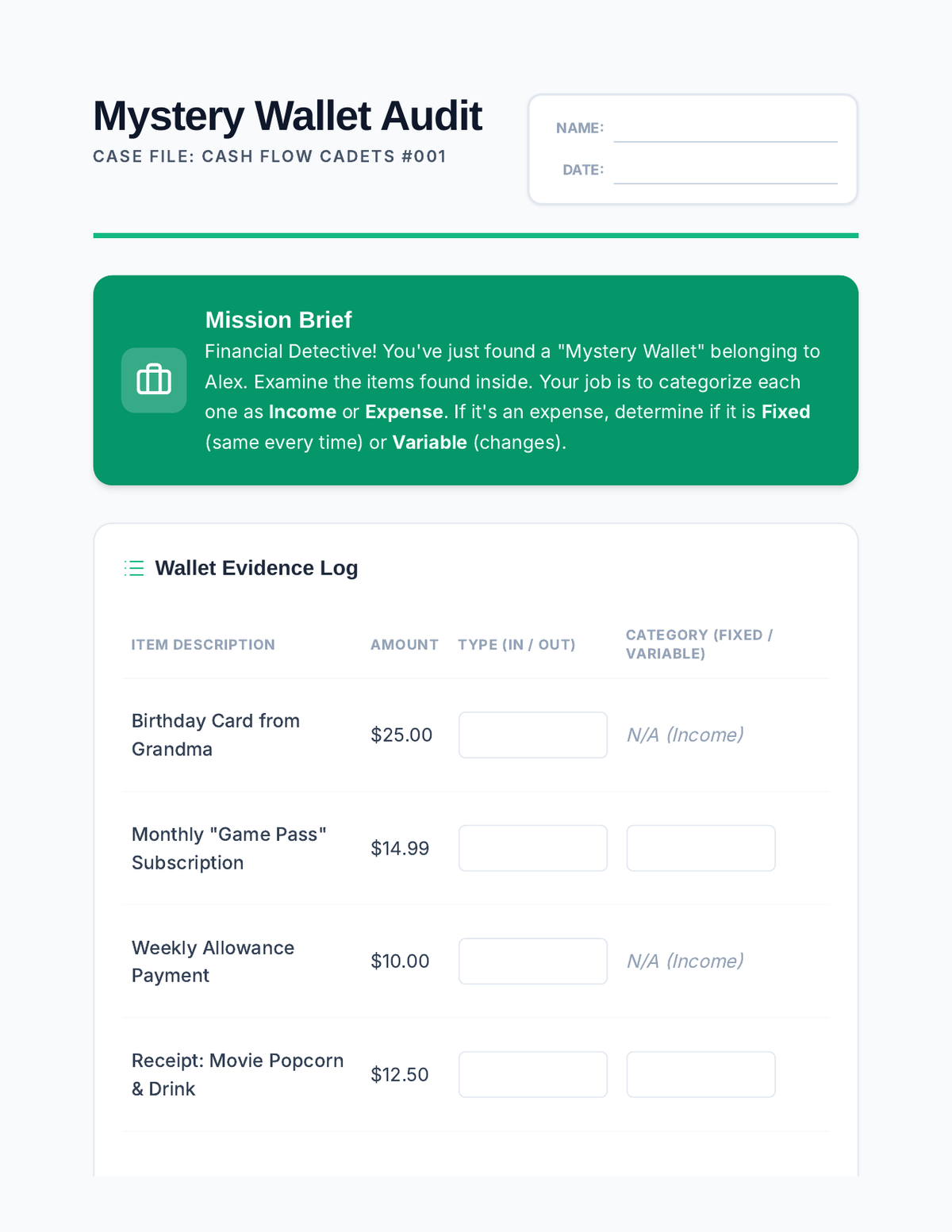
A categorization activity where students examine receipts and earnings to calculate Alex's total cash flow for the week.
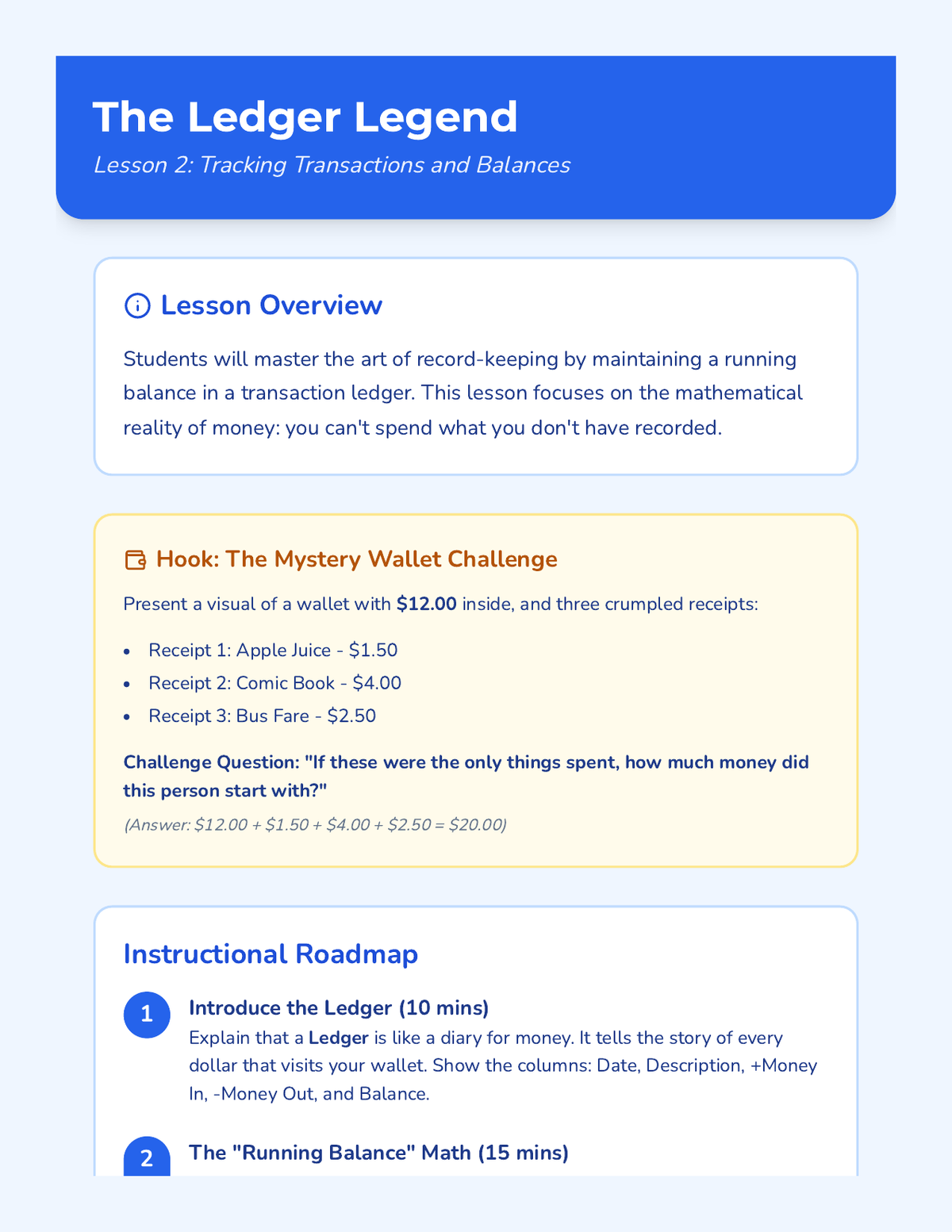
Teacher's guide for Lesson 2, including the Mystery Wallet hook, ledger math instruction, and simulation guidance.
Introductory slides for the first lesson on personal cash flow, covering income, expenses, and the difference between fixed and variable costs.
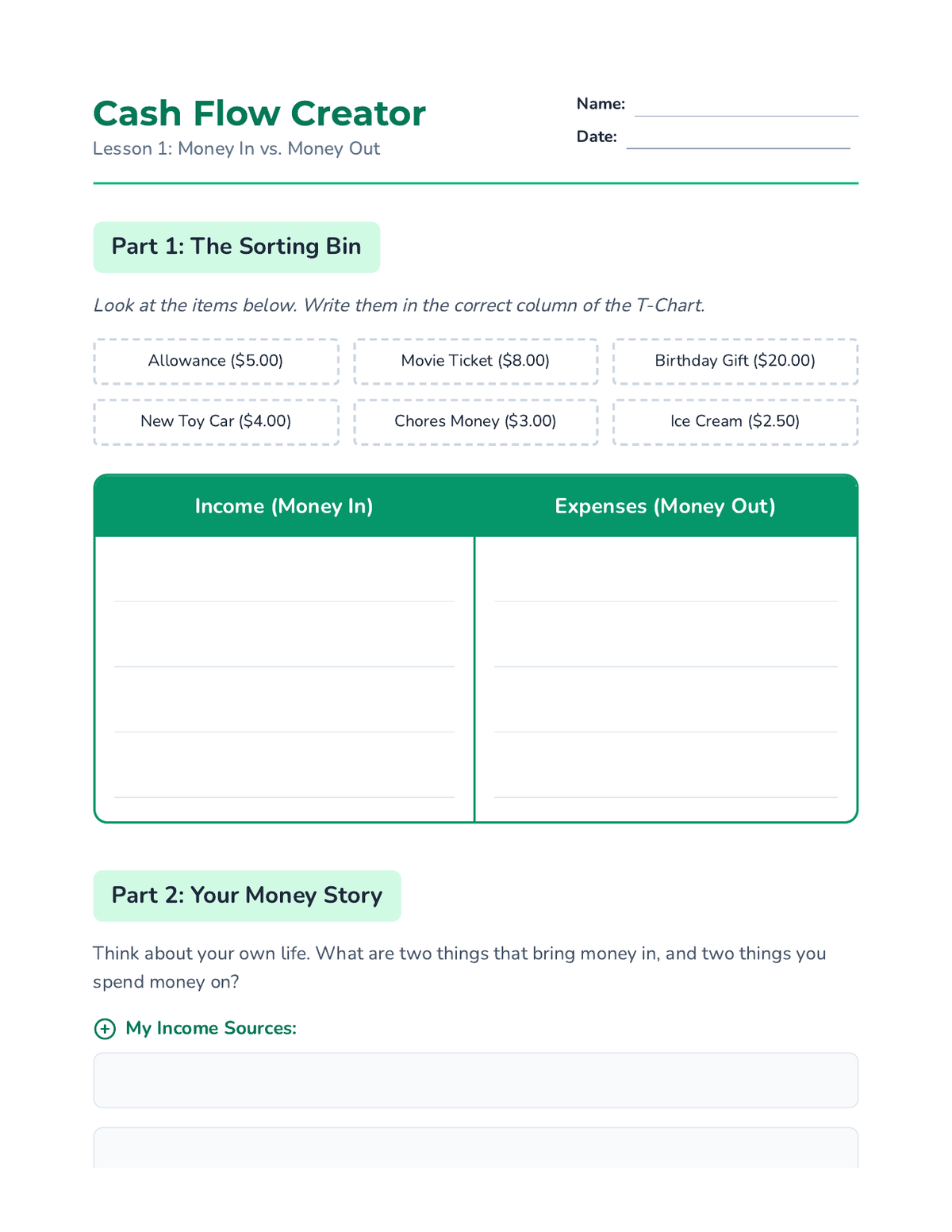
A worksheet for students to categorize income and expenses using a T-chart and brainstorm their own financial scenarios.
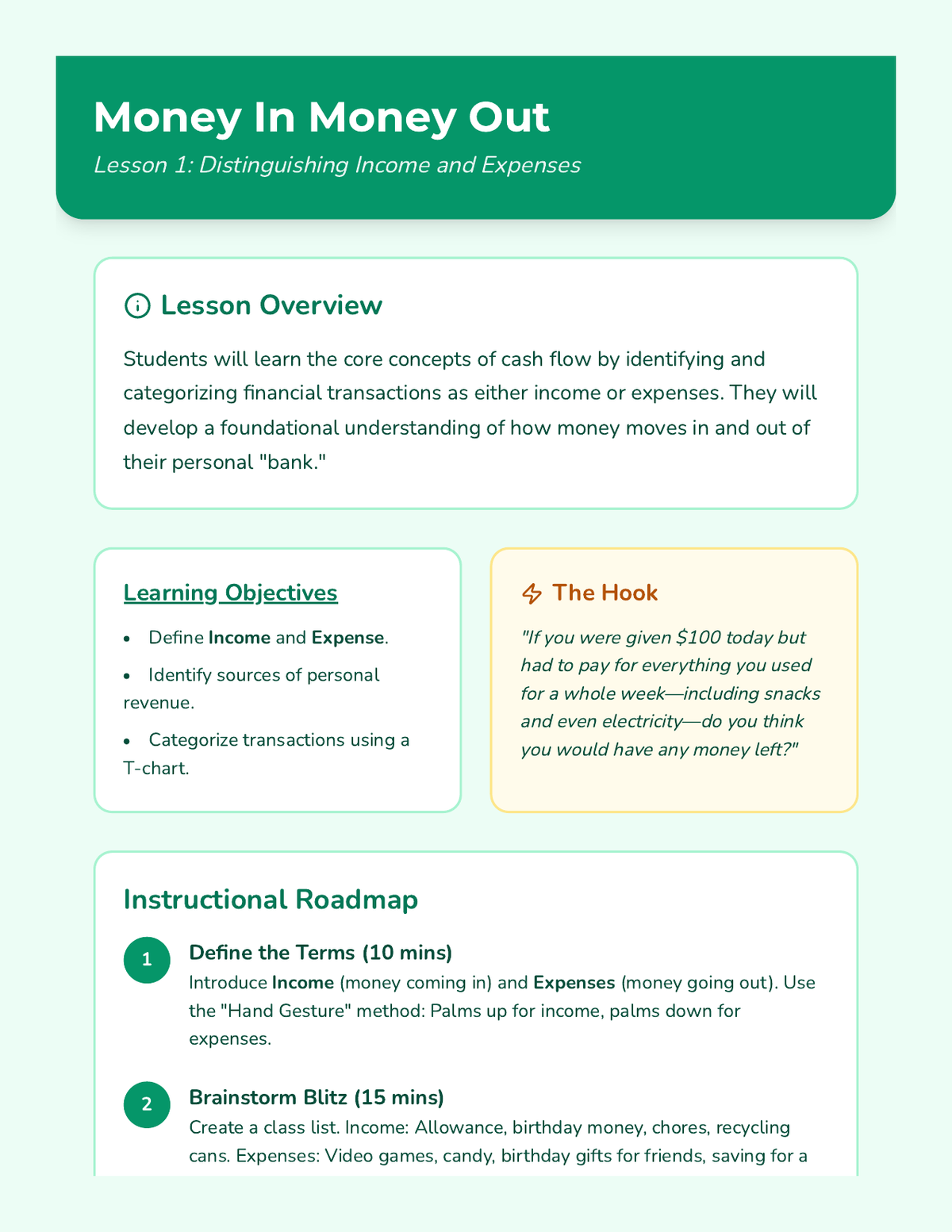
A teacher's guide for Lesson 1, detailing objectives, the "Money In Money Out" hook, instructional steps, and discussion questions.
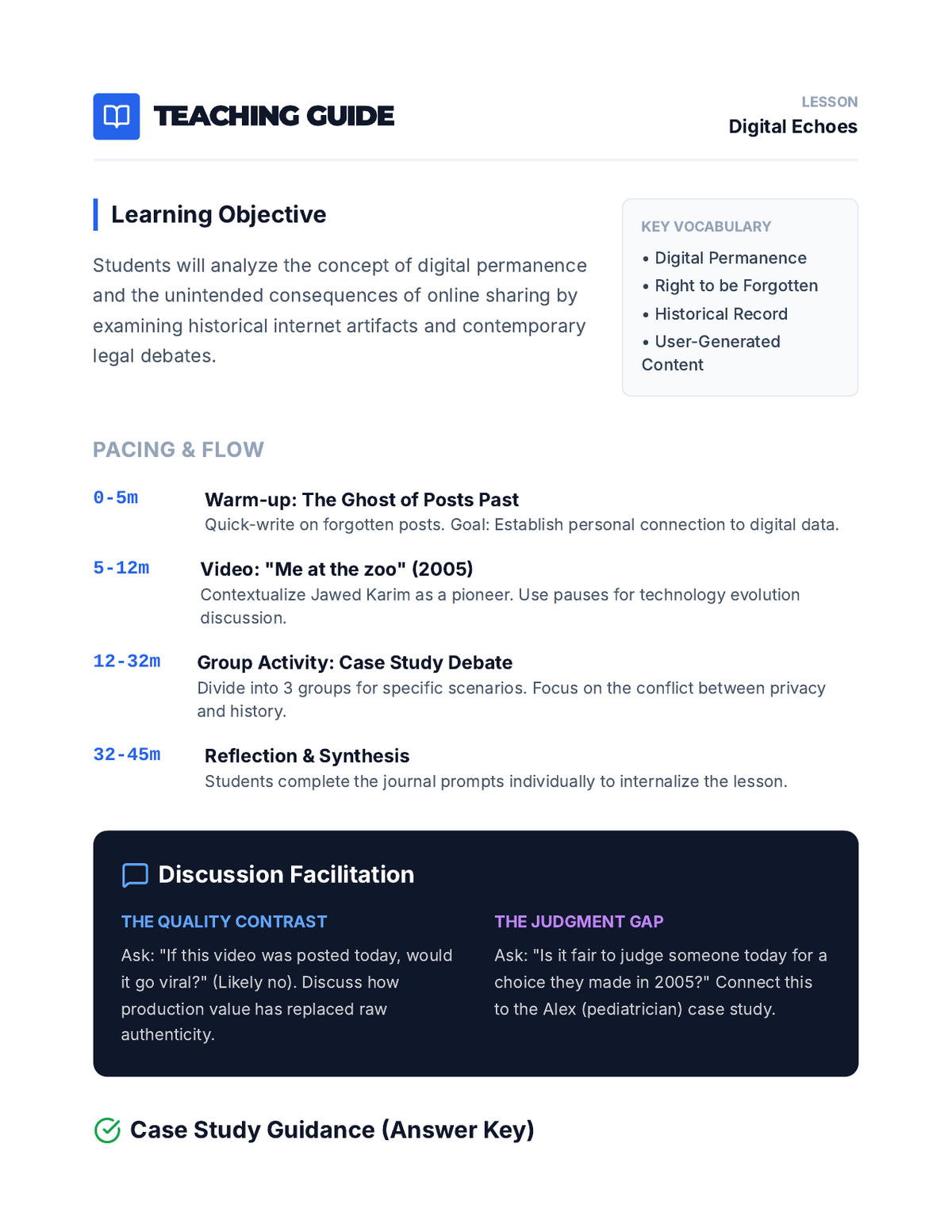
A comprehensive teacher resource providing pacing, discussion anchors, and suggested responses for the 'Digital Echoes' lesson. Includes specific guidance for facilitating the case study debates and differentiation strategies.
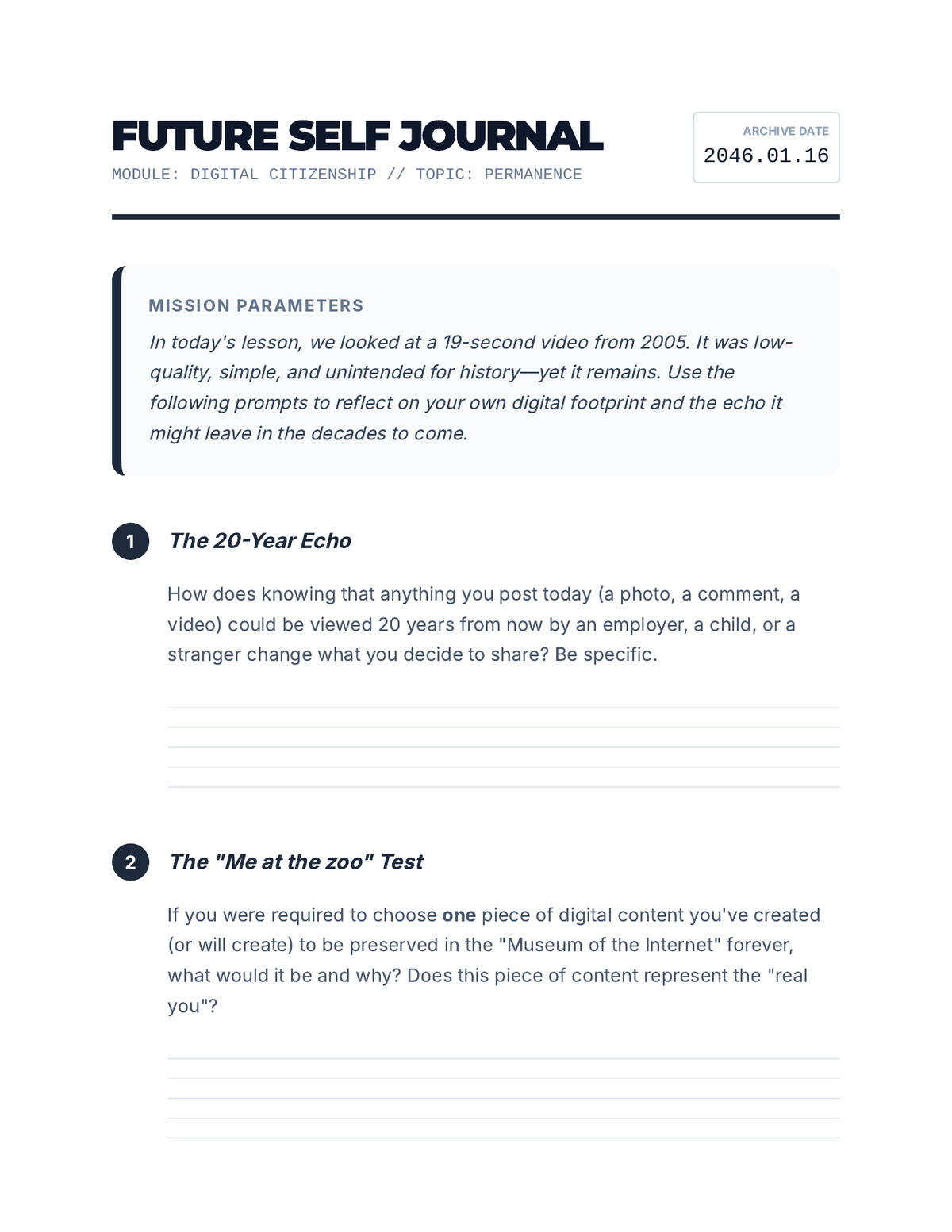
A reflection journal for students to contemplate their personal digital legacy. Features three deep-thinking prompts focused on long-term impact, personal identity, and the ethics of the 'Right to be Forgotten'.
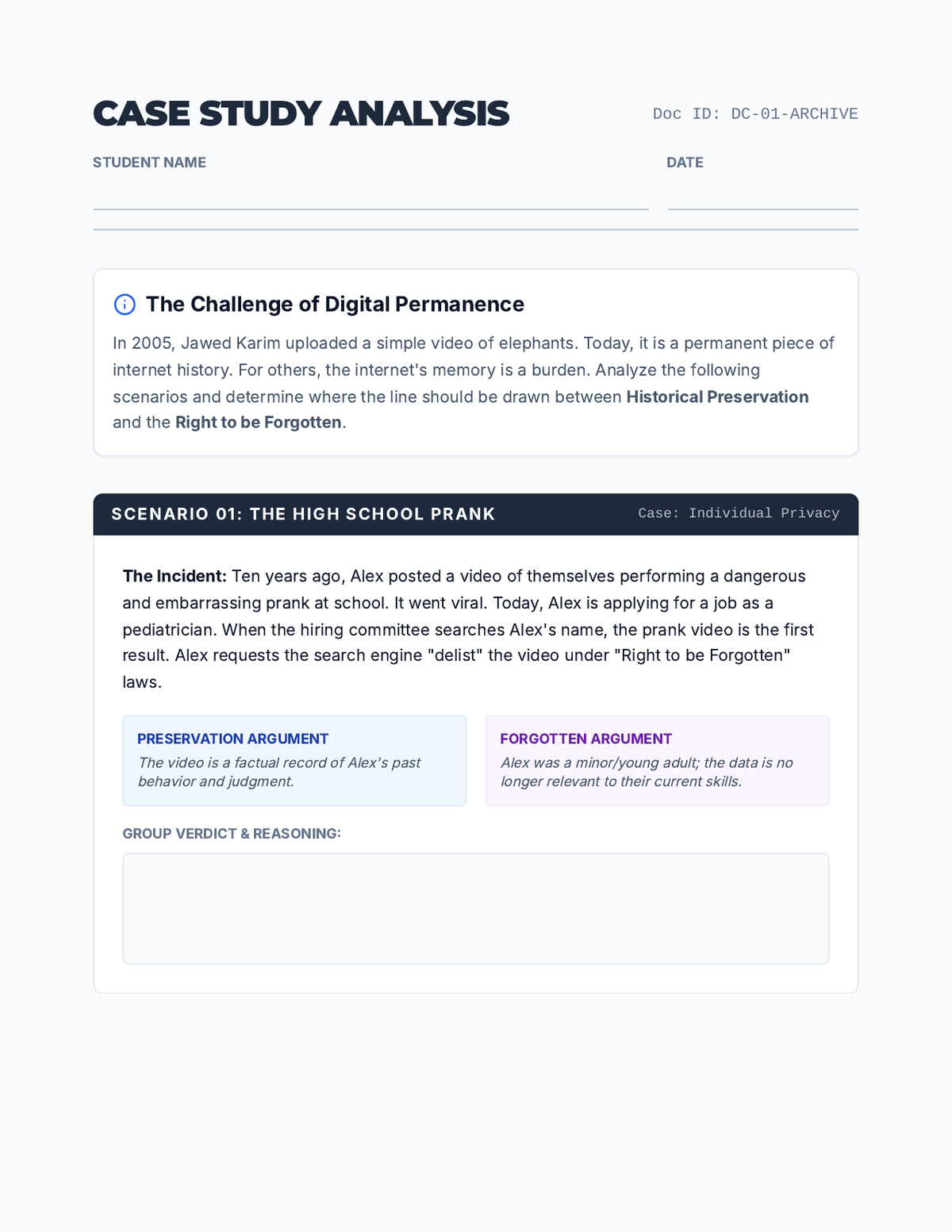
A structured student worksheet featuring three distinct case studies on digital permanence, encouraging debate between individual privacy and historical preservation. Includes space for group verdicts and a summary 'permanence scale' activity.
A sleek, tech-themed slide deck exploring digital permanence using the first YouTube video, 'Me at the zoo', as a primary case study. Features high-contrast visuals, discussion anchors, and a professional 'Digital Archive' aesthetic.
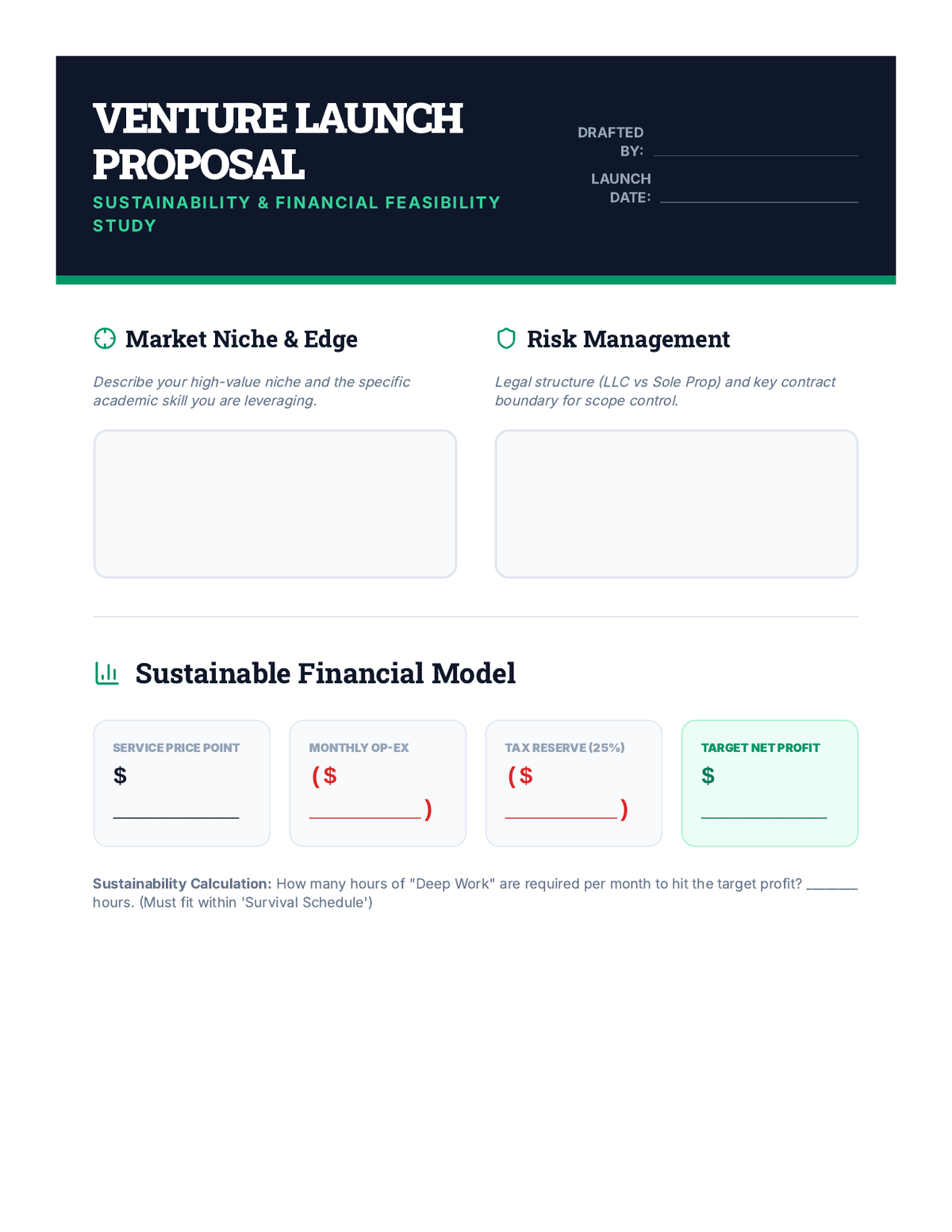
The capstone project template for 'Hustle Logic'. This comprehensive launch proposal requires students to synthesize financial, legal, and operational planning into a 90-day strategy. Includes a peer audit section.
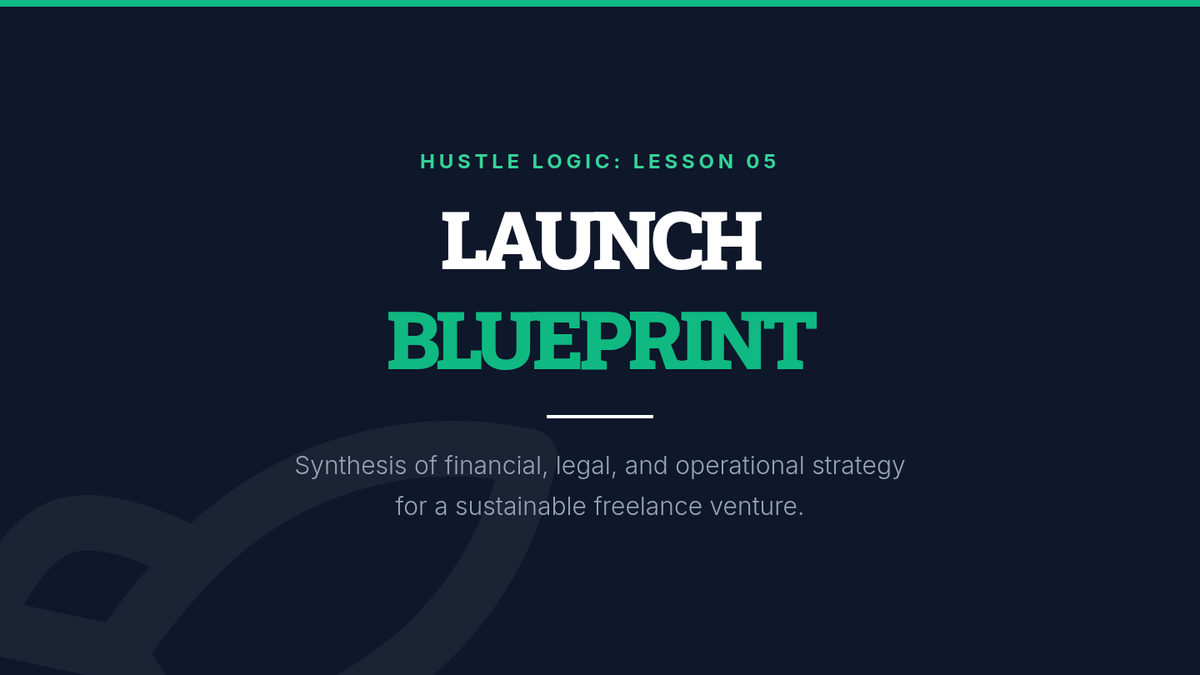
Slide presentation for the final lesson 'Launch Blueprint'. Guides students through synthesizing their learning into a 3-pillar launch strategy (Profit, Risk, Flow) and prepares them for a peer 'Sustainability Audit'.
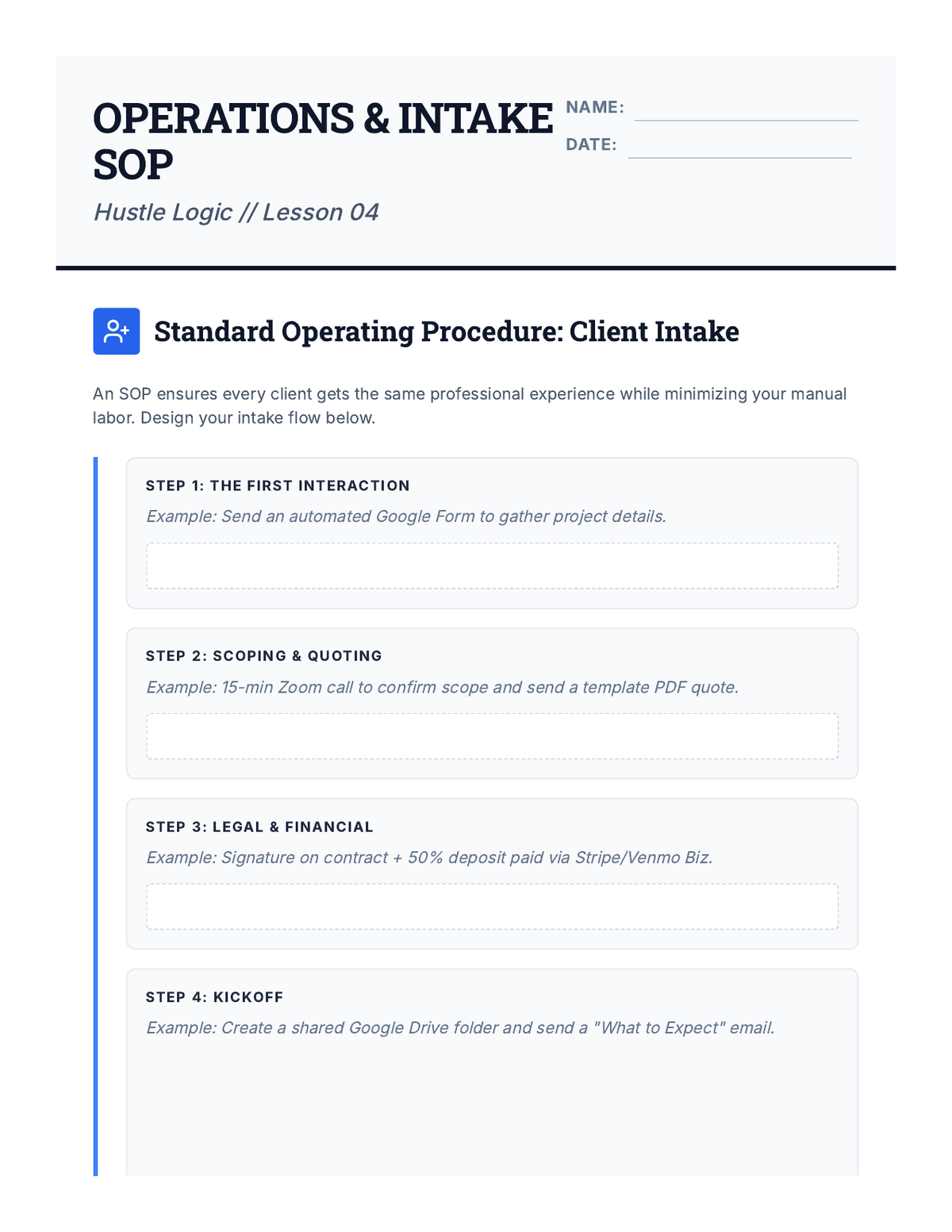
Worksheet for designing a Client Intake SOP and a time-blocked "Survival Schedule" to manage academic and freelance commitments.
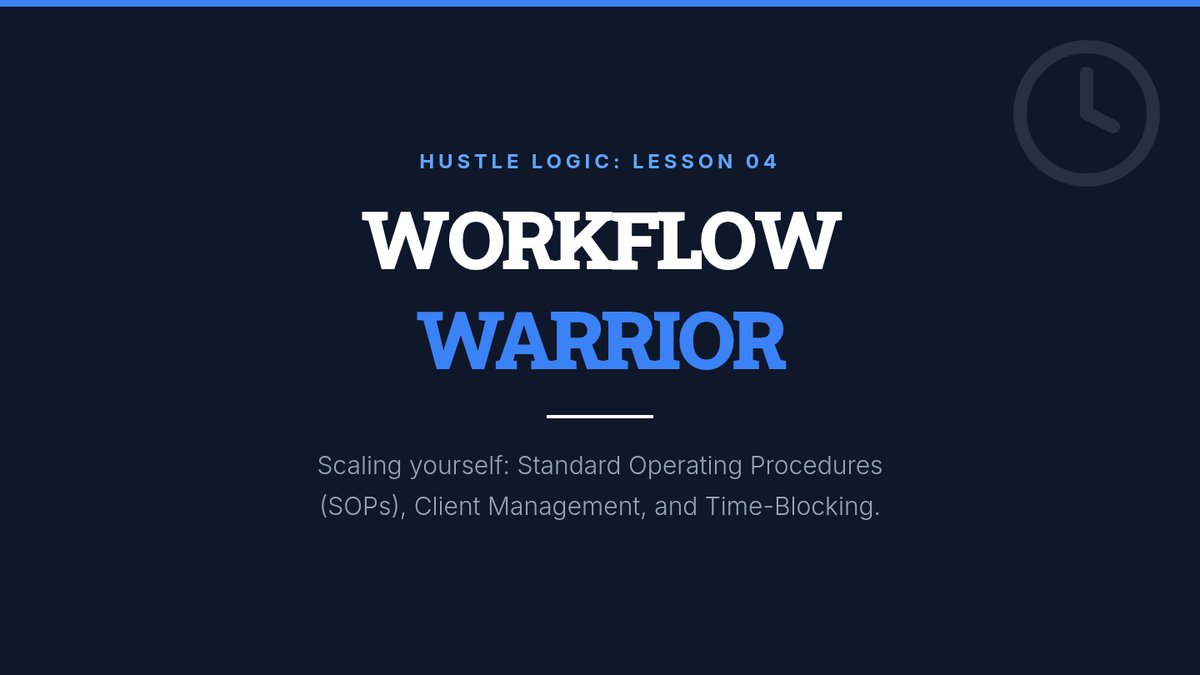
Slide presentation for Lesson 04 focusing on operational efficiency. Covers the importance of SOPs, boundary setting, and time-blocking for student entrepreneurs.
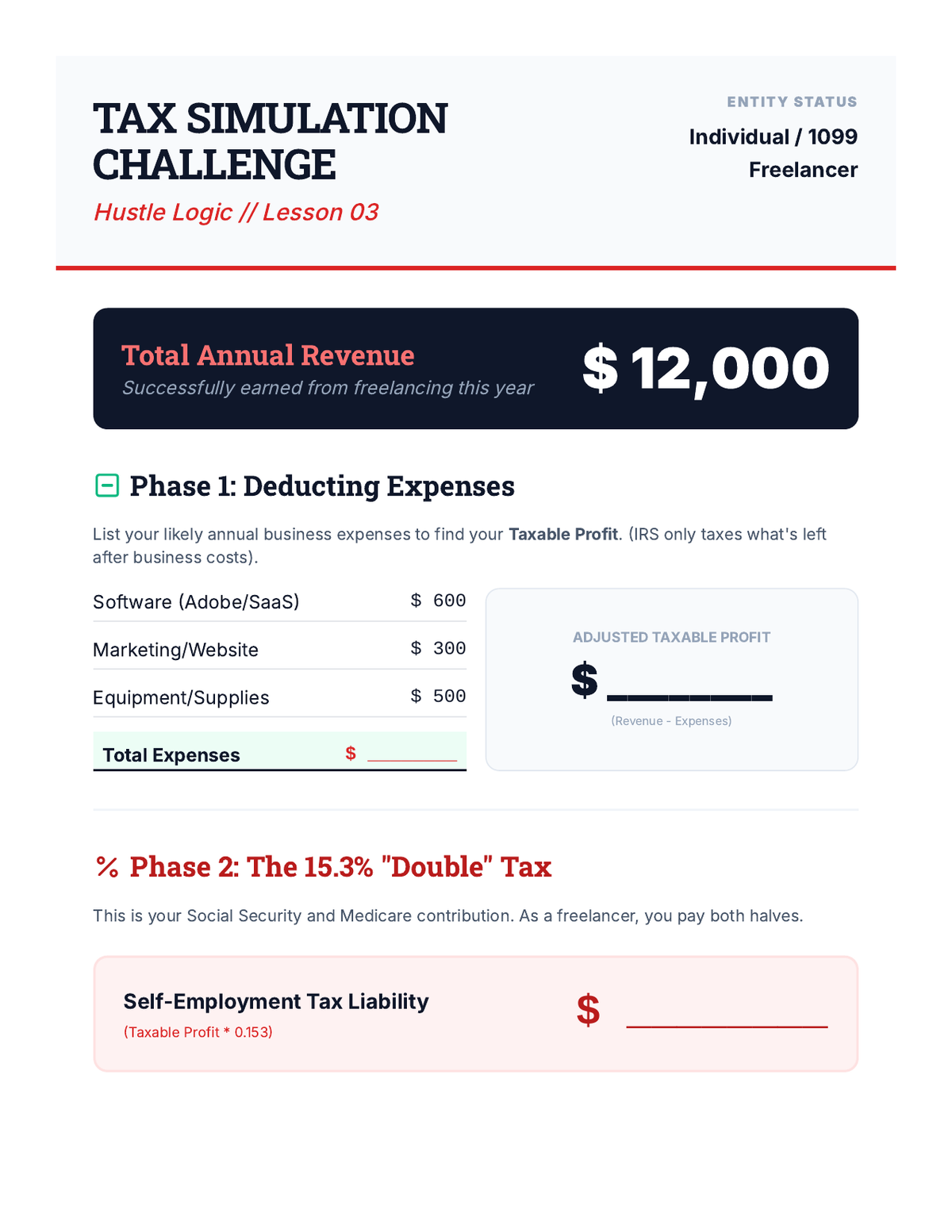
A simulation-based worksheet for calculating the true financial impact of self-employment taxes and business expenses on a $12,000 annual side hustle revenue.
Slide presentation for Lesson 03 on self-employment taxes and legal structures. Covers the 15.3% SE tax, deductions, quarterly payments, and the differences between Sole Proprietorships and LLCs.
Workshop worksheet for Lesson 02. Includes a guided calculation scenario for a social media consultant and a blank template for students to model their own venture's costs and profitability.
Slide presentation for Lesson 02 focused on the financial modeling of side hustles. Teaches students to distinguish between revenue and profit while accounting for hidden costs.
Instructional guide for teachers delivering the 'Market Mindset' lesson, including pacing, discussion prompts, and a case study on niche identification.
Engaging slide presentation for the 'Market Mindset' lesson, covering gig economy differences, internal/external assessment using SWOT, and a market scanning activity.
A professional market analysis and SWOT worksheet for undergraduate students to evaluate potential freelance side hustles. Includes sections for market saturation checks and a comprehensive SWOT grid.
A field-journal-themed student worksheet for recording observations and interpretations during the video analysis and virtual zoo activity.