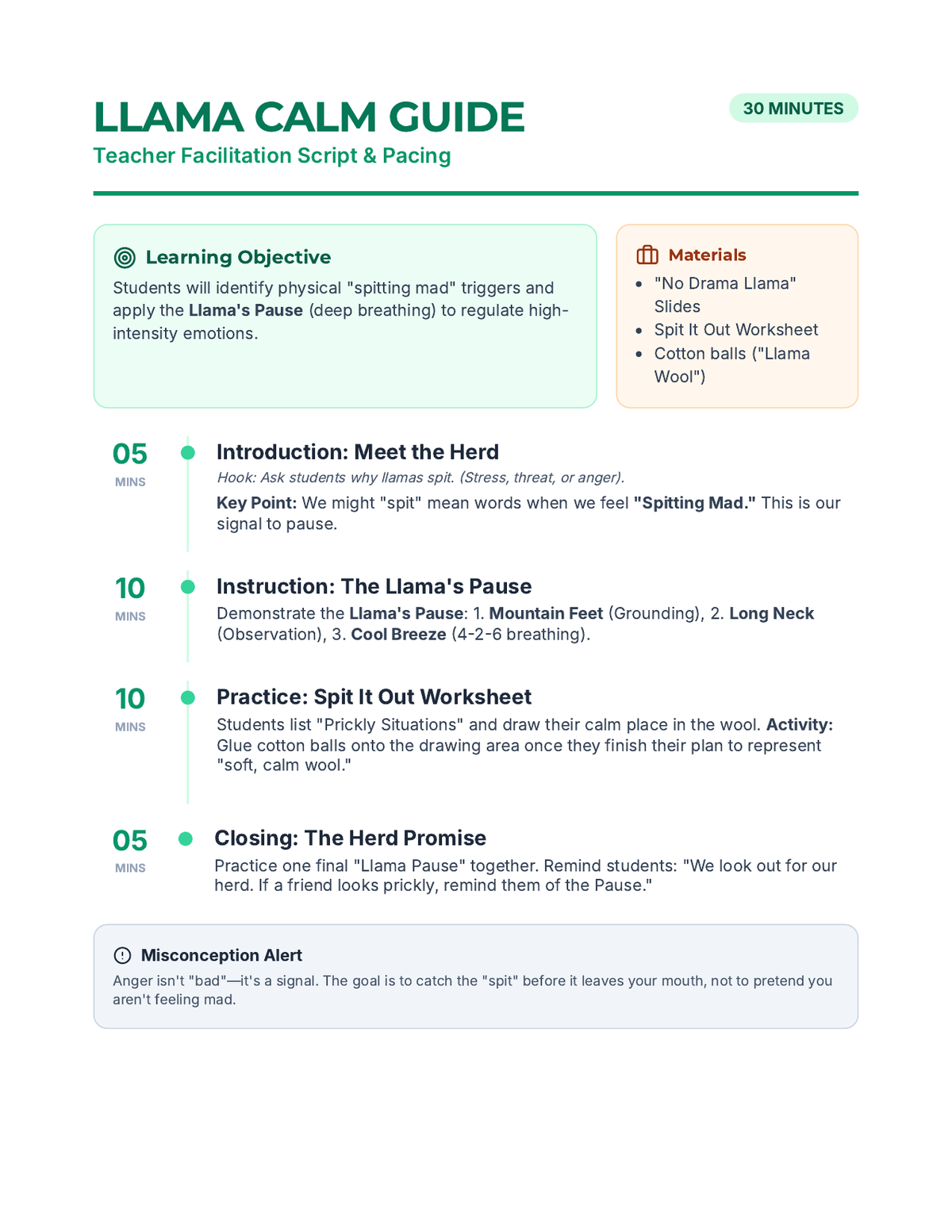
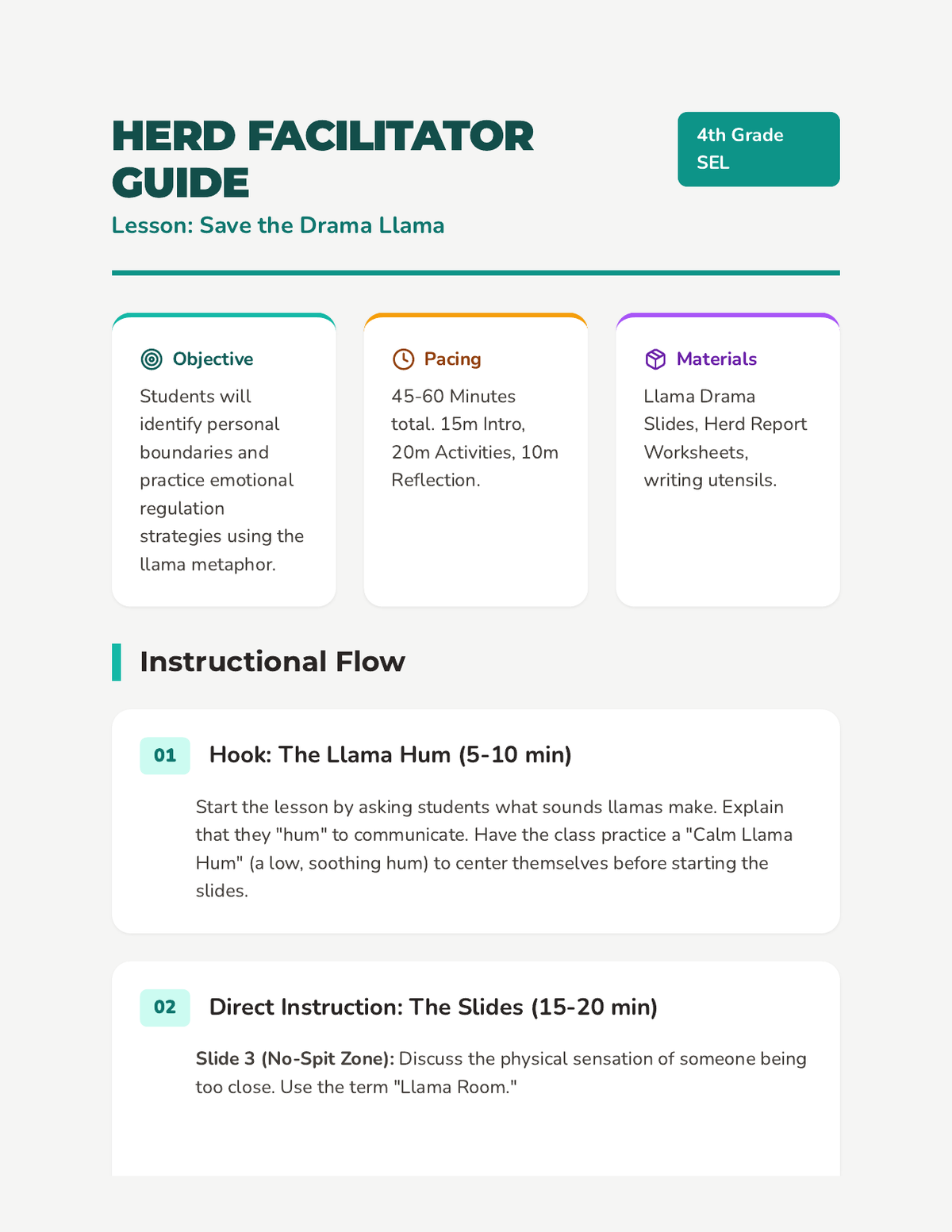
A comprehensive teacher facilitation guide for the Digital Trailblazers lesson, featuring step-by-step instructions, discussion prompts, and vocabulary for elementary students.
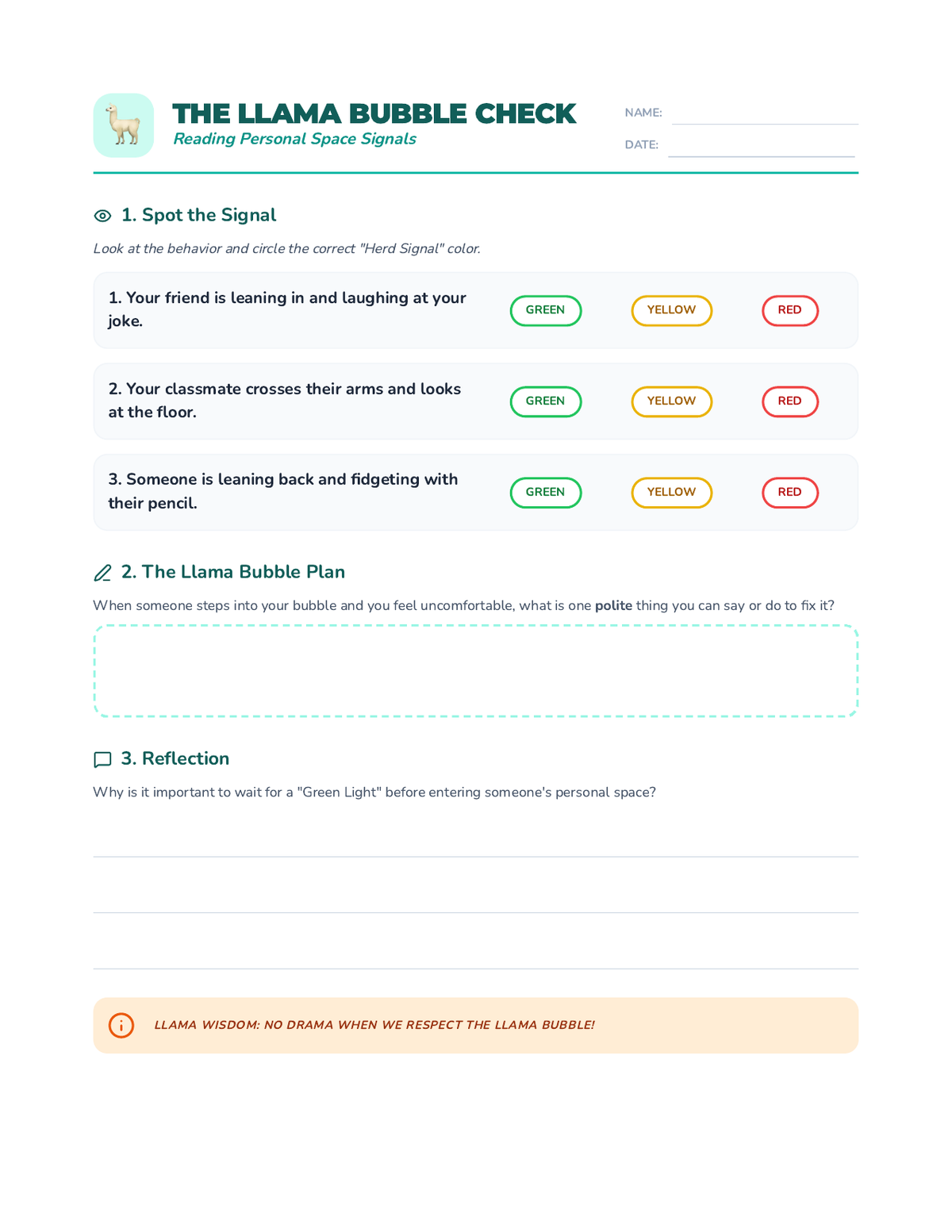
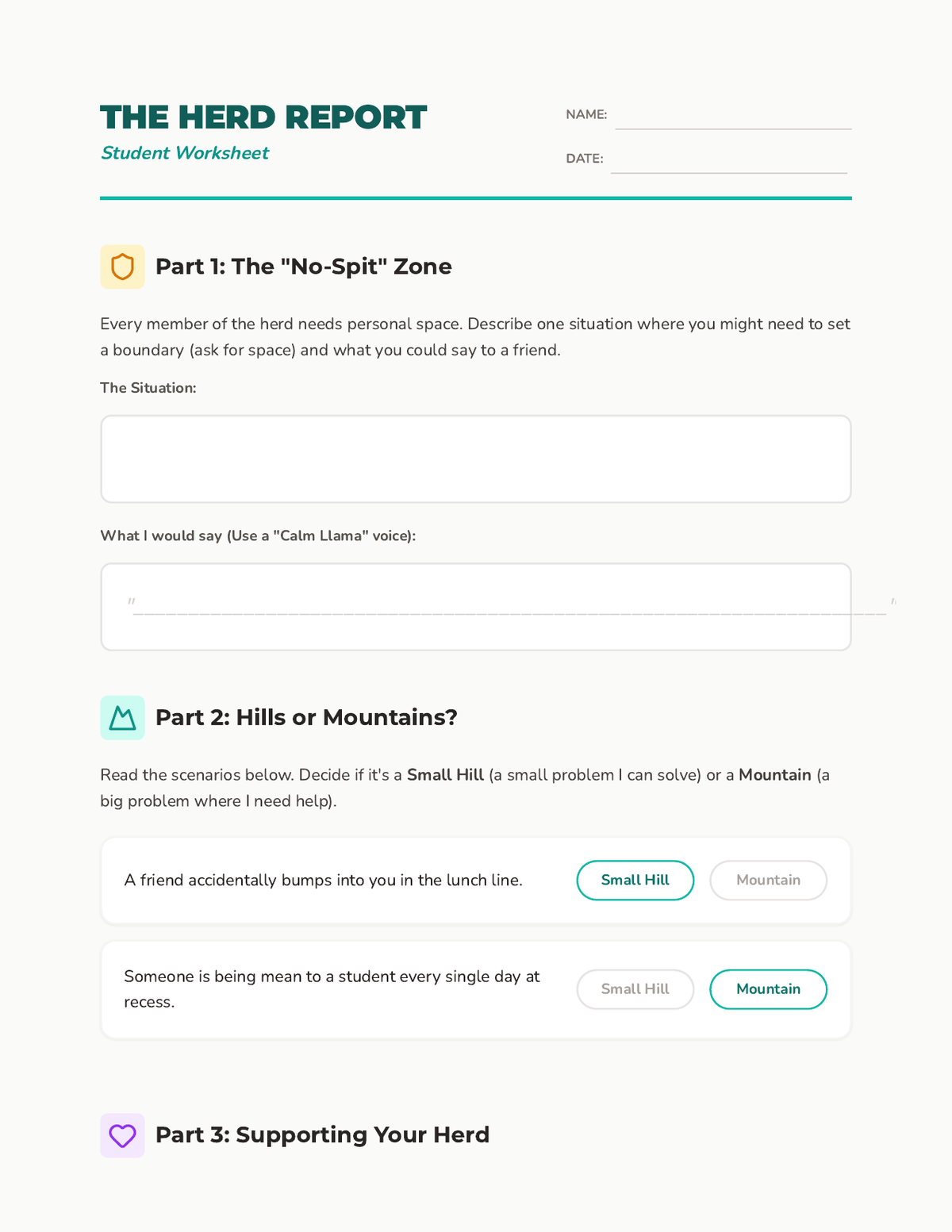
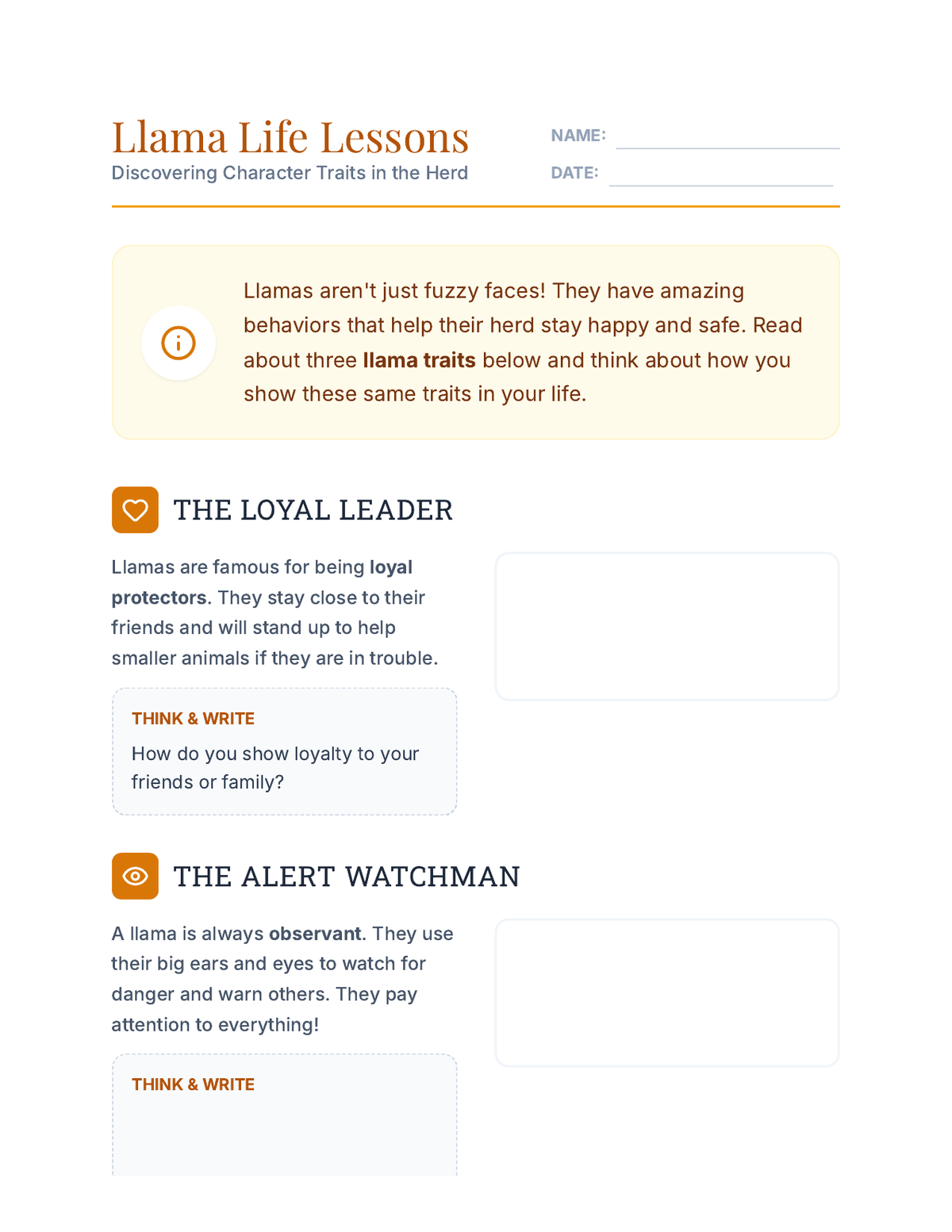
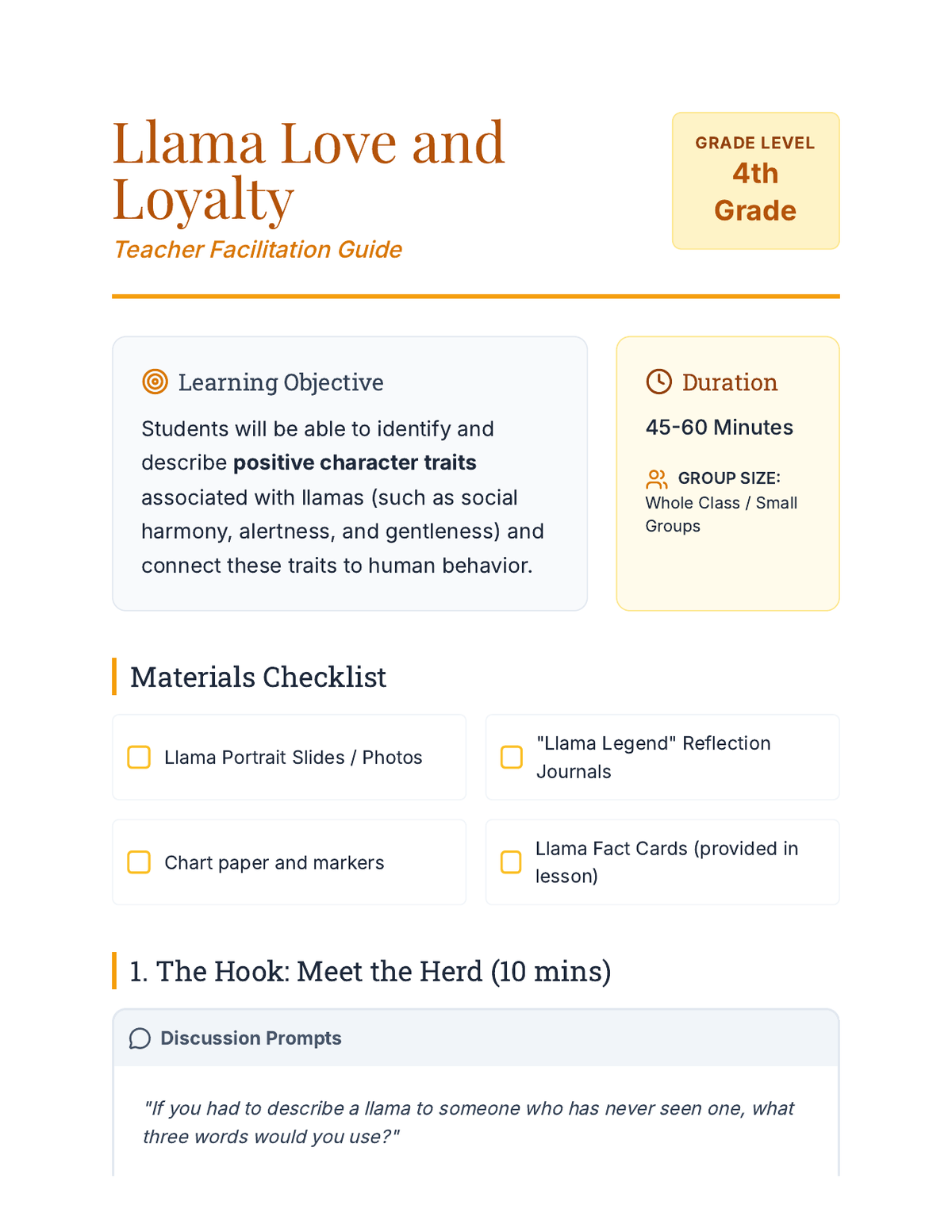
A student reflection worksheet that helps 4th graders connect llama behaviors to positive human character traits like loyalty, alertness, and gentleness.
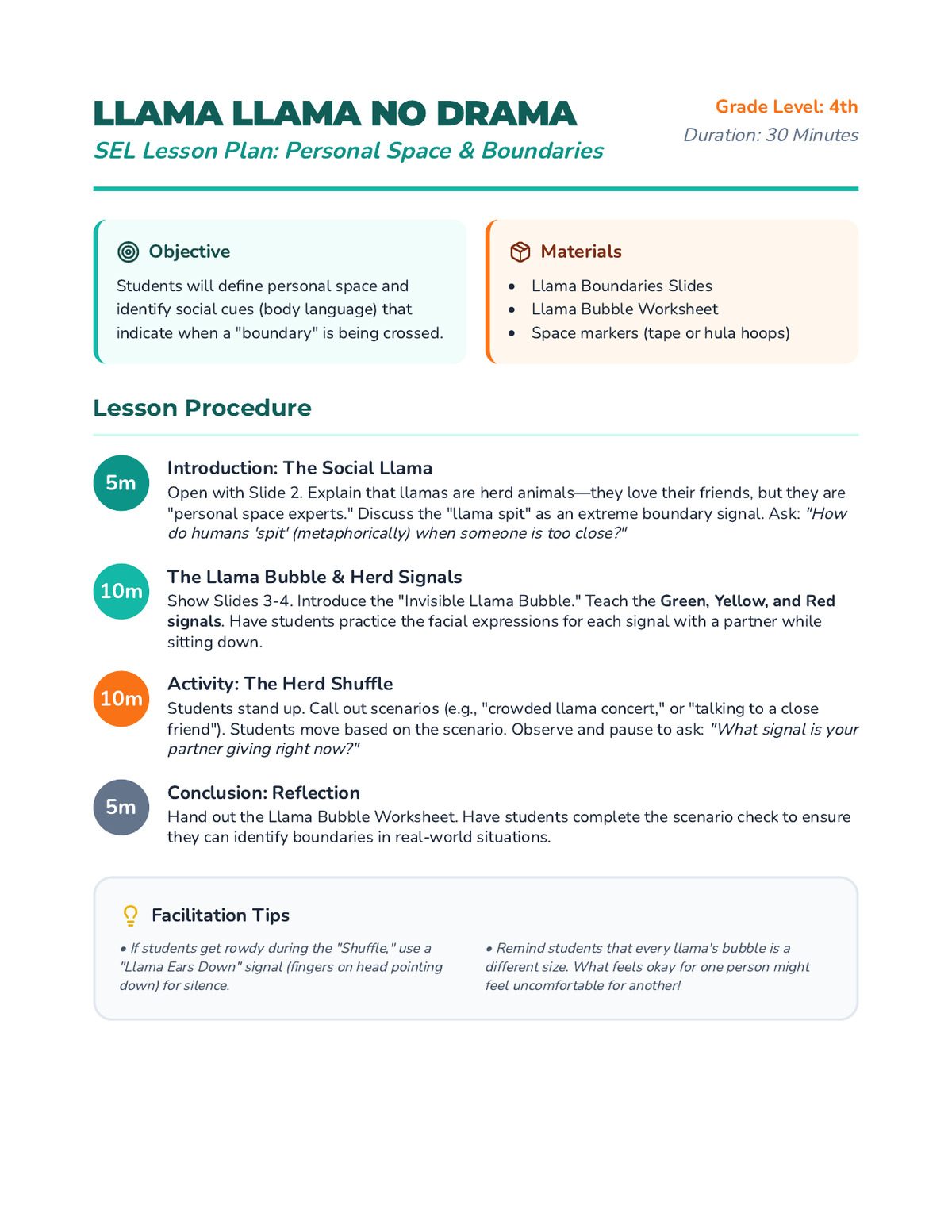
A comprehensive teacher's guide for a 4th-grade lesson on llama character traits, featuring discussion prompts, behavioral facts, and reflection activities.
Student budget planning worksheet for Lesson 5 where they must allocate funds to meet a savings goal while managing essential costs.
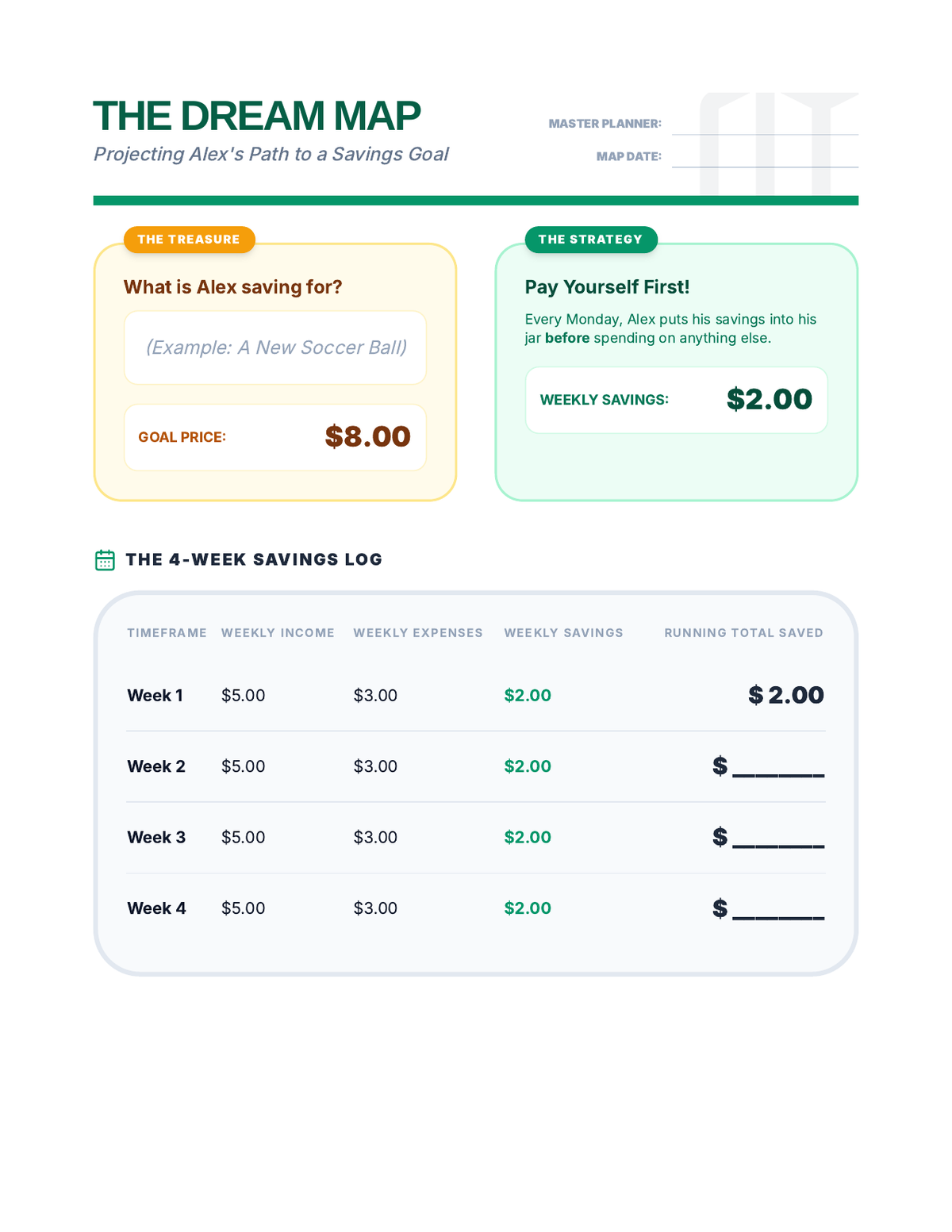
A worksheet for students to create a forward-looking savings plan for a specific goal, applying the "pay yourself first" principle.
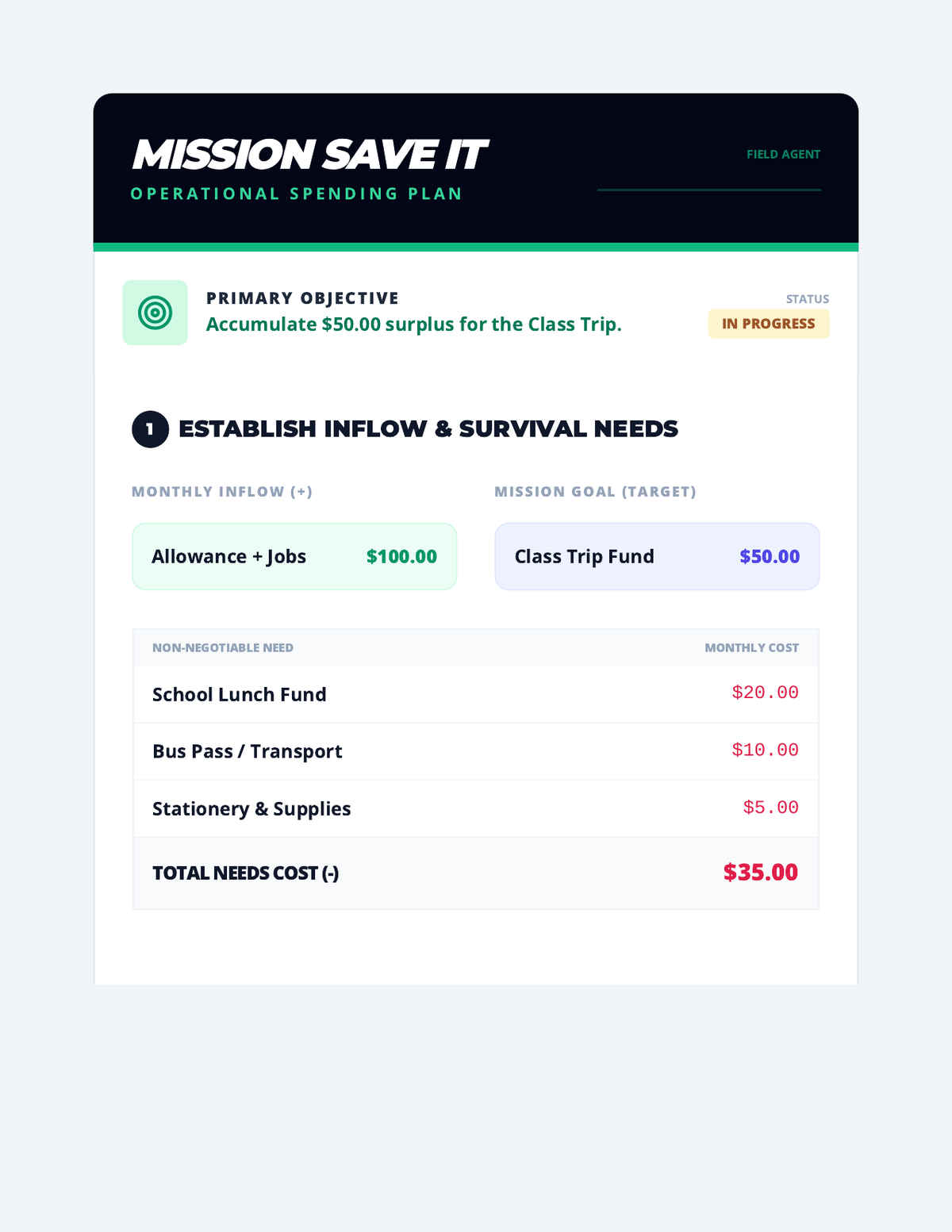
Presentation slides for Lesson 5, illustrating the mission objective, non-negotiable needs, and the math for calculating savings.
A slide deck introducing students to goal setting, the "pay yourself first" principle, and planning for a financial surplus.
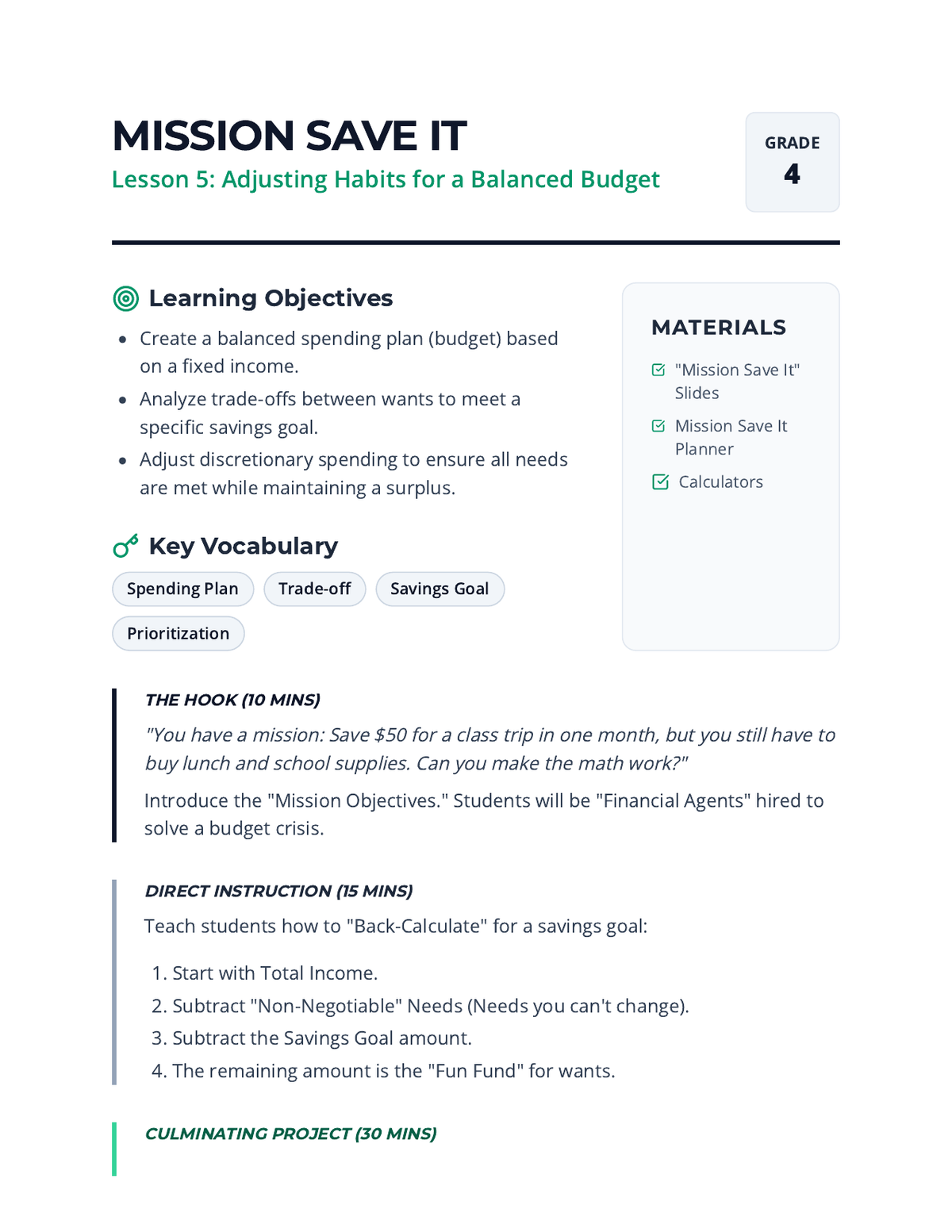
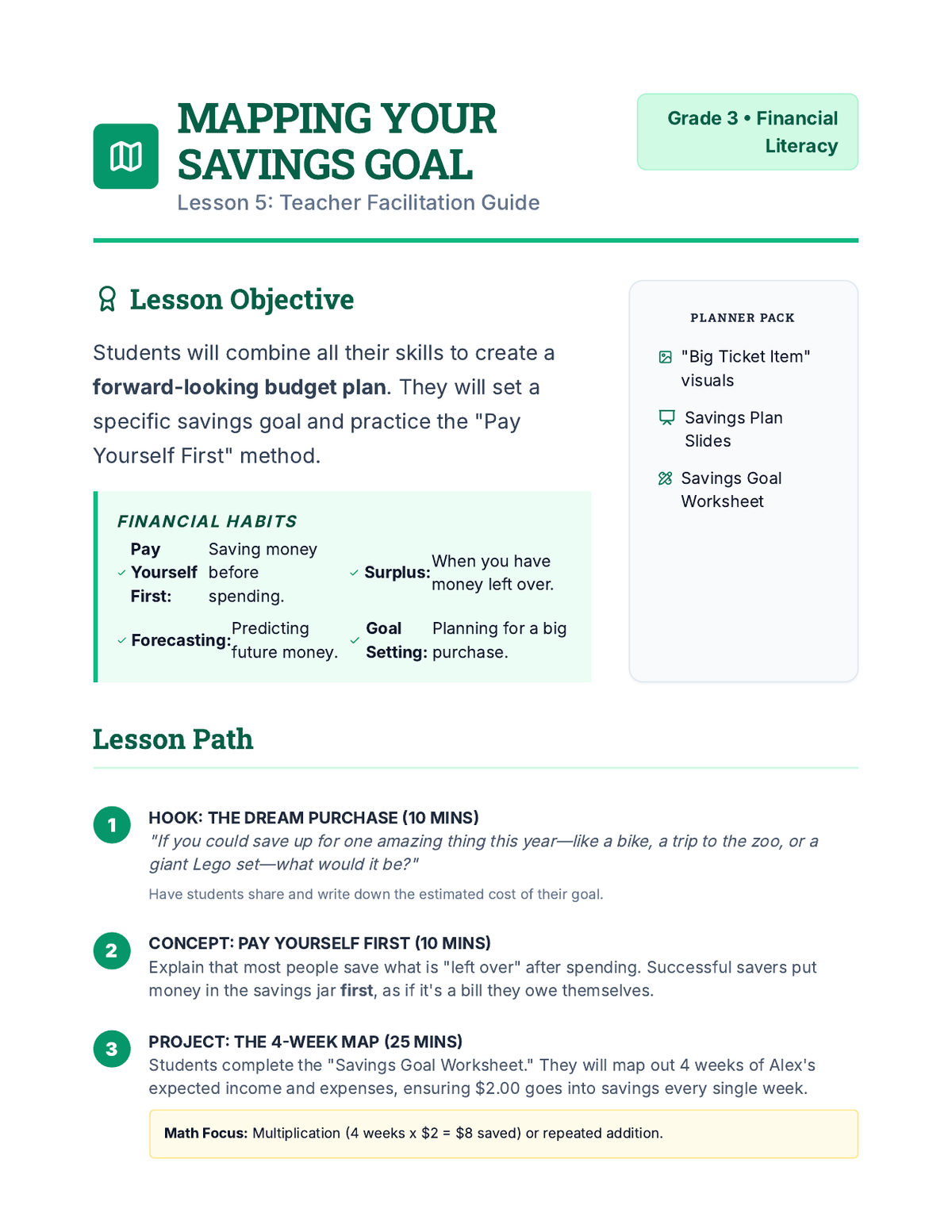
Teacher guide for Lesson 5, detailing instructional steps for teaching budget balancing and trade-offs.
A teacher guide for the final lesson on creating a savings plan, including the "pay yourself first" principle and goal-setting strategies.
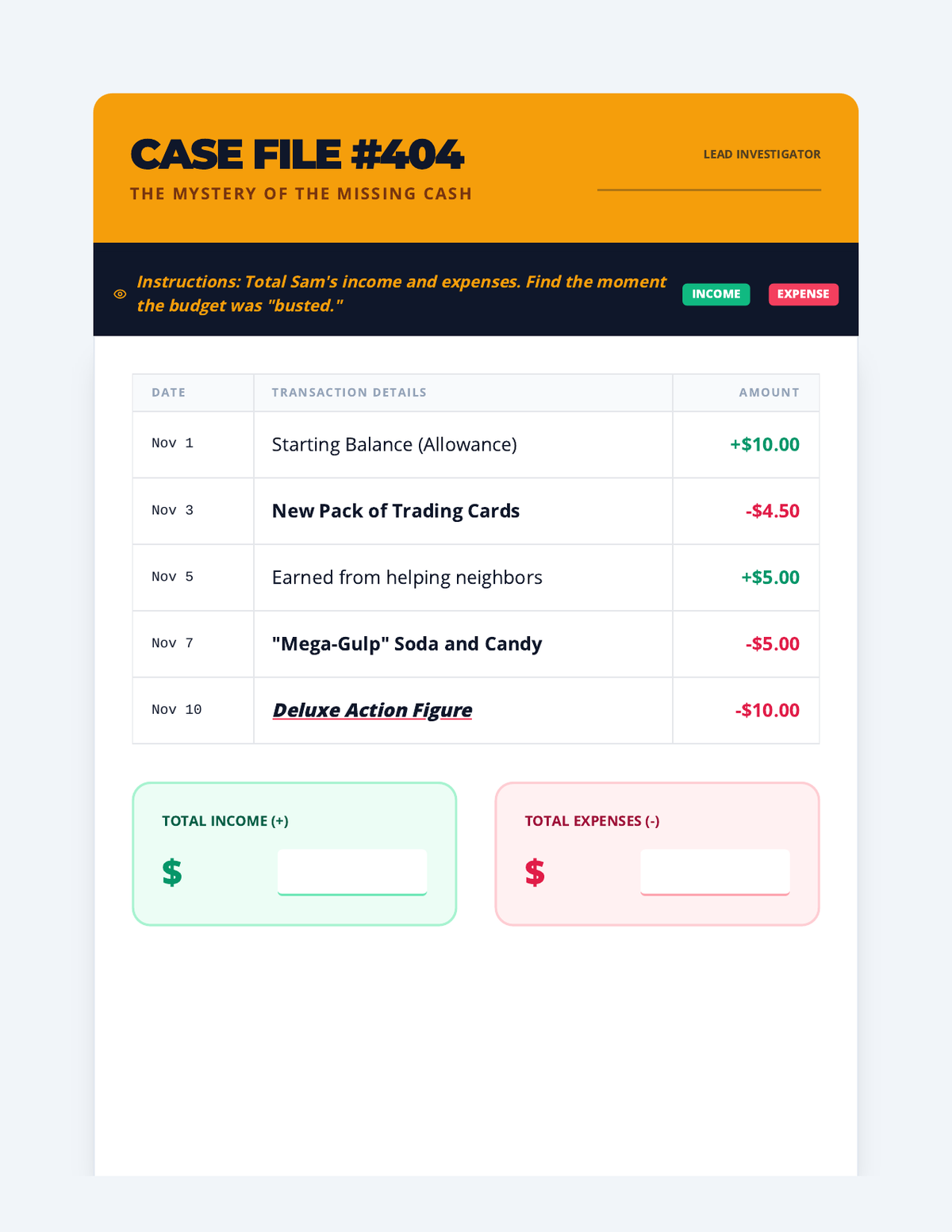
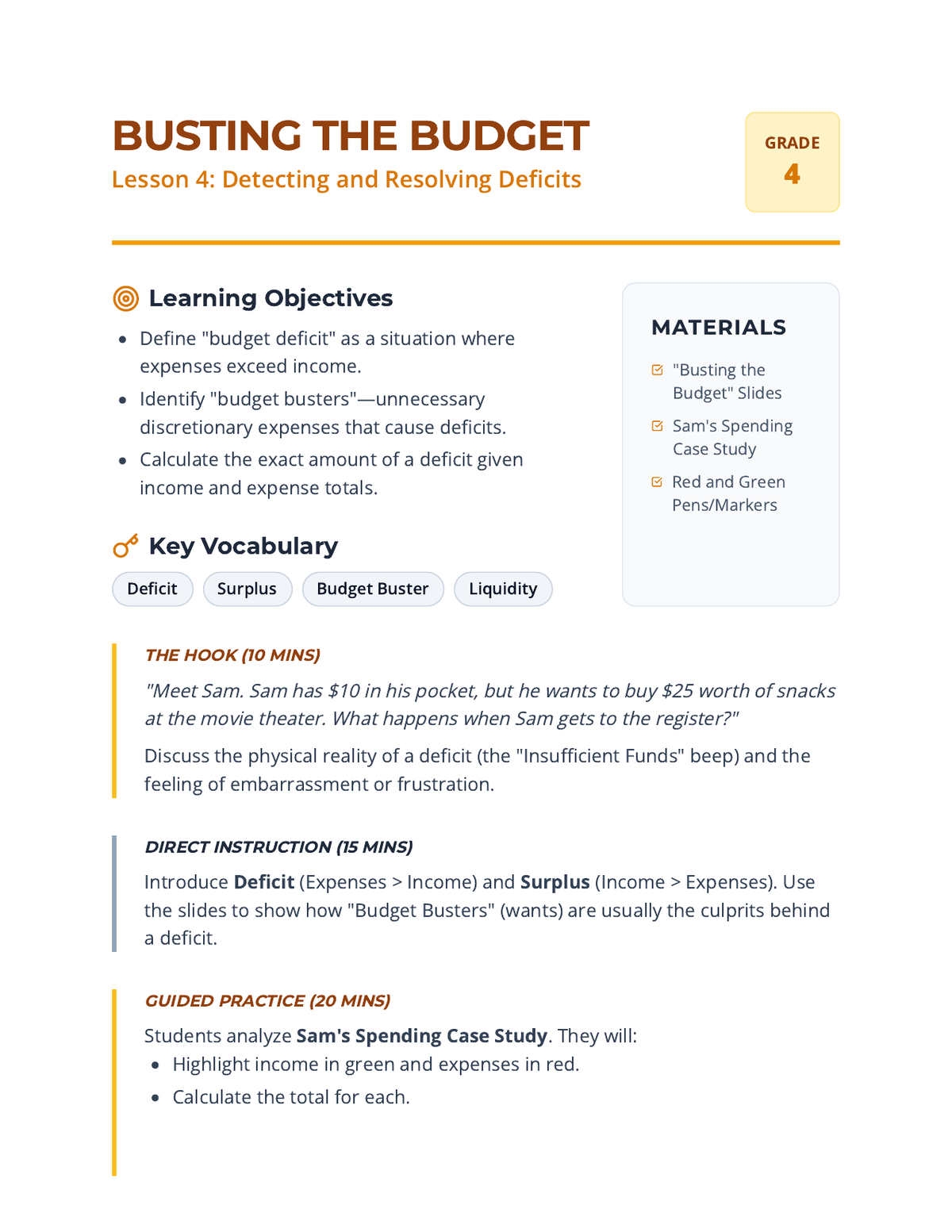
Case study student worksheet for analyzing a budget deficit scenario, calculating totals, and identifying 'budget busters'.
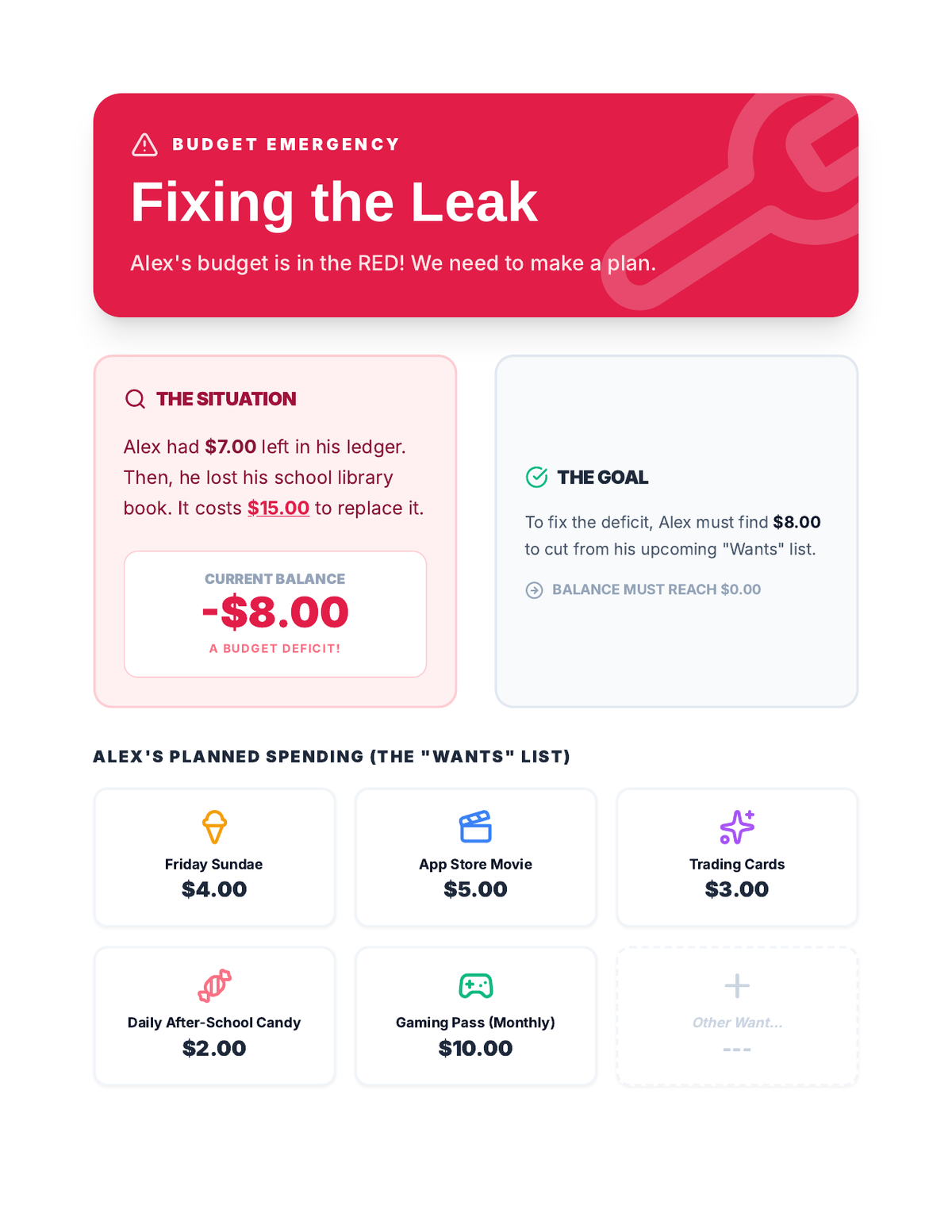
A budget simulation worksheet where students analyze a deficit scenario and make difficult spending cuts to balance their account.
Presentation slides for Lesson 4, illustrating budget deficits, 'budget busters', and the math behind negative cash flow.
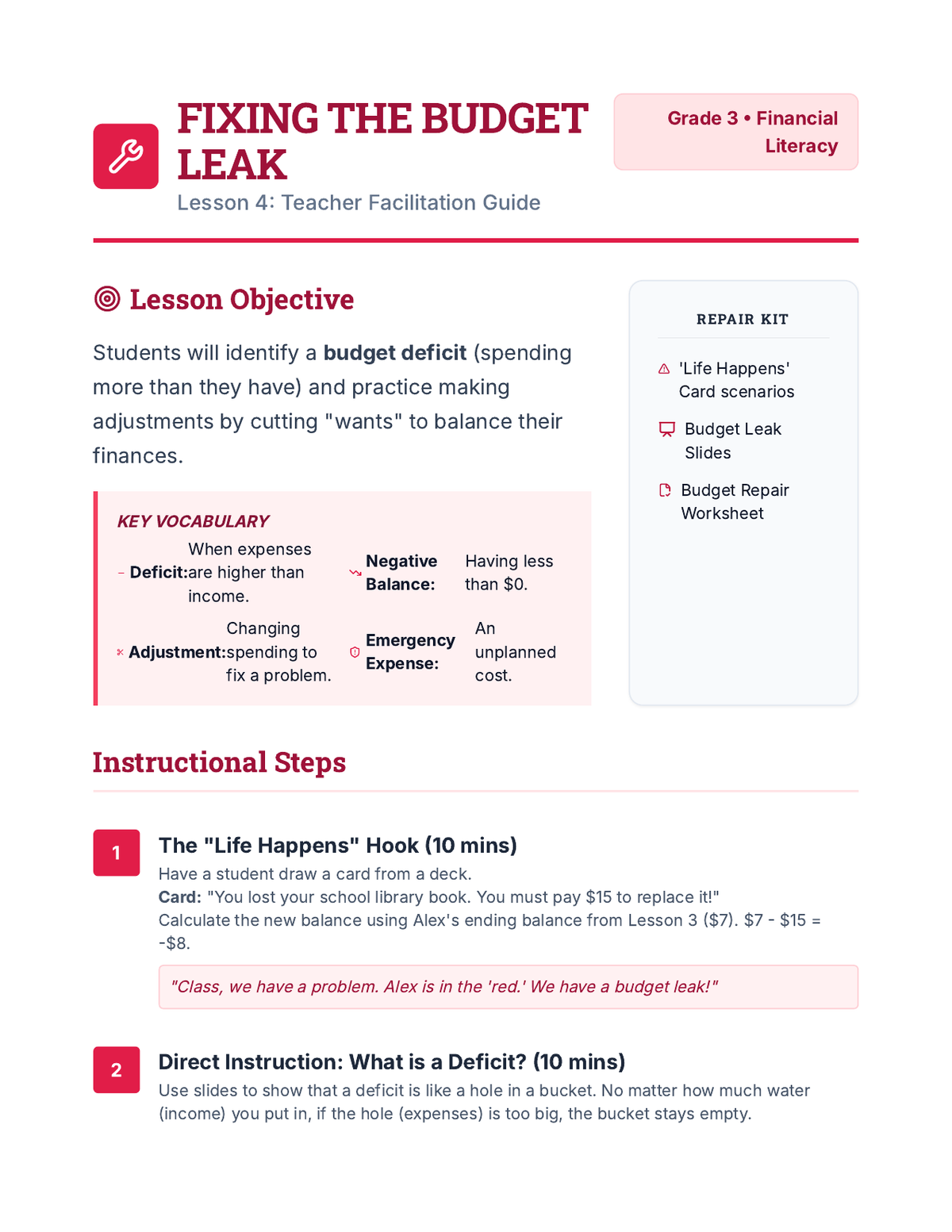
A teacher guide for the lesson on fixing a budget deficit, focusing on identifying "wants" that can be cut to balance a budget.
Teacher guide for Lesson 4, detailing instructional steps for teaching budget deficits and identifying 'budget busters'.
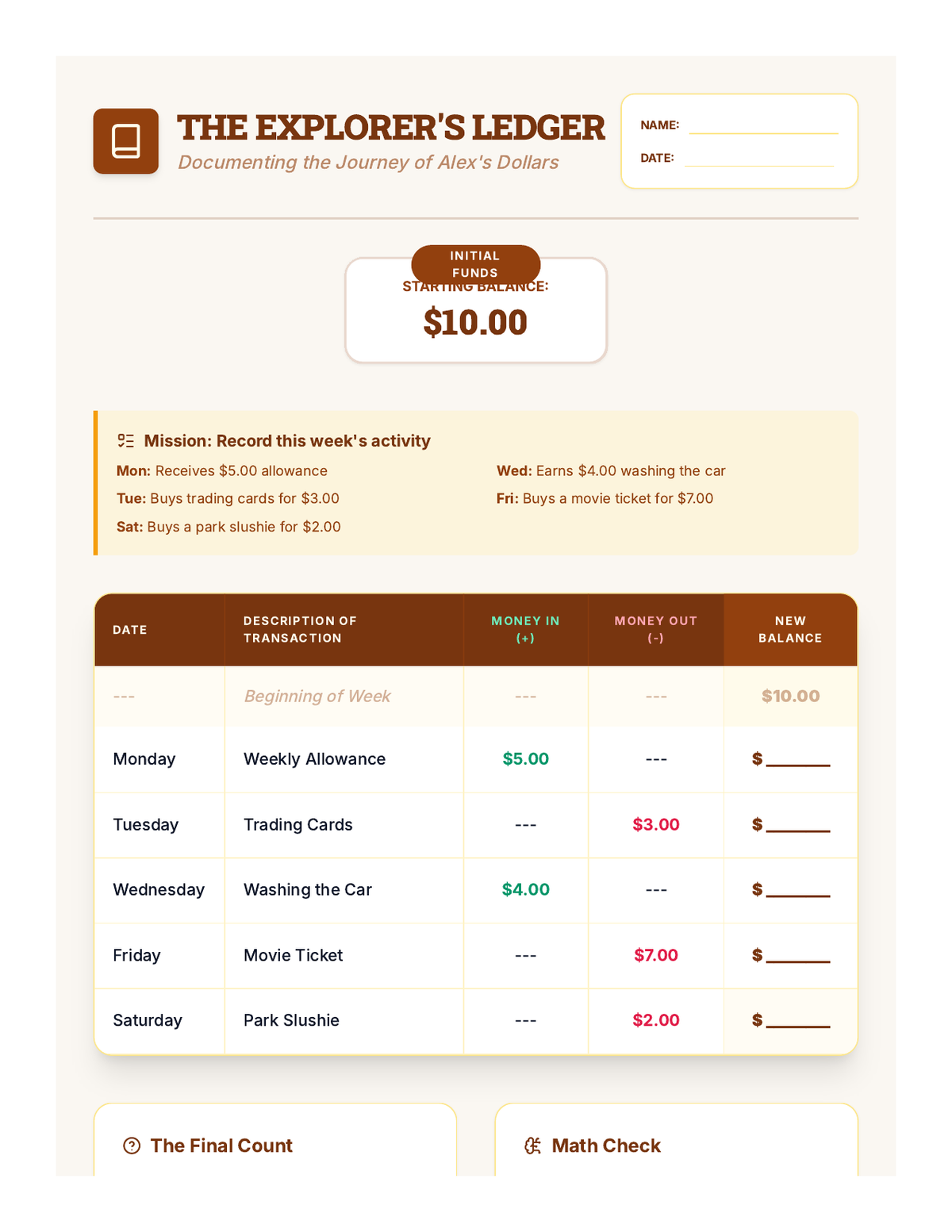
A transaction log worksheet where students practice recording money in and money out to maintain a running balance.
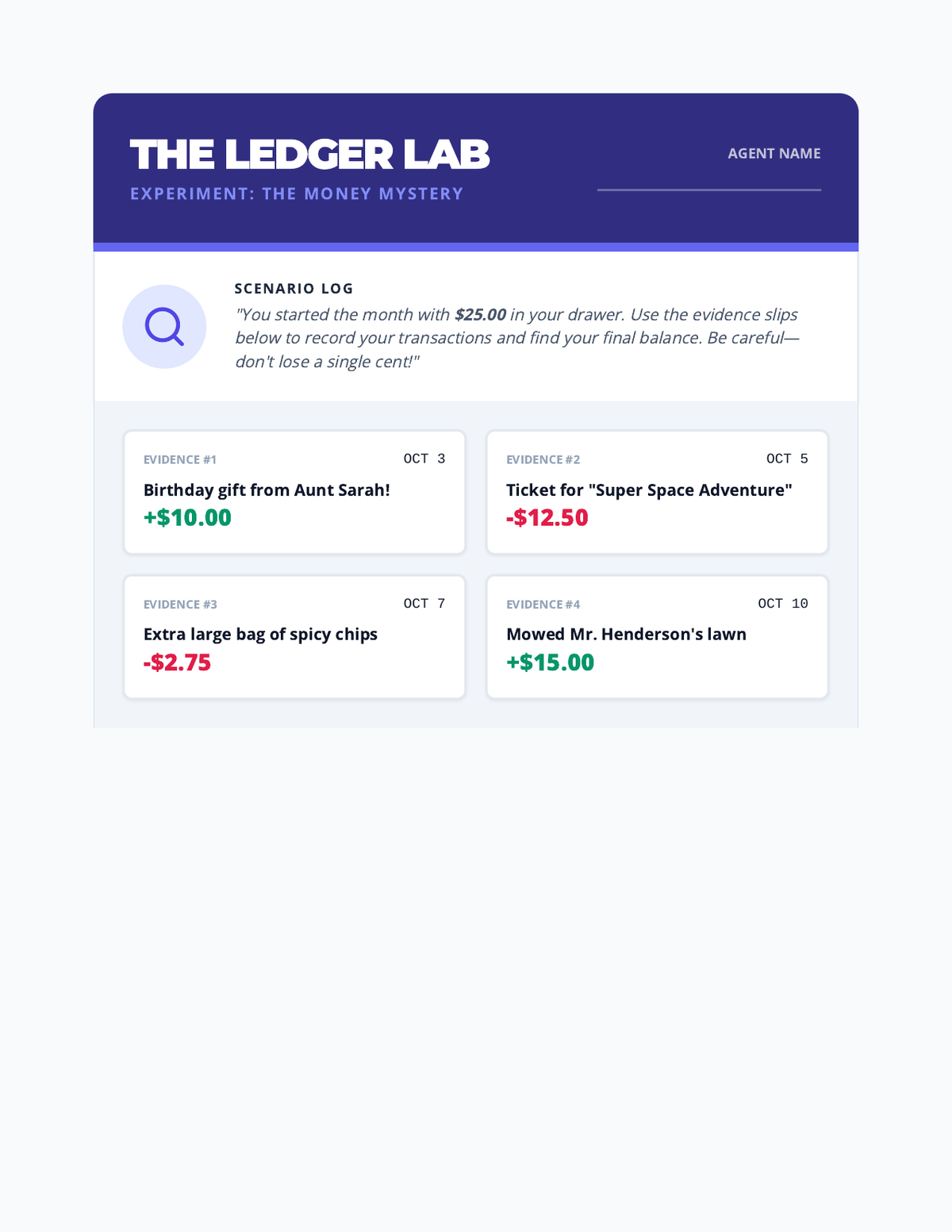
Student practice worksheet for recording transactions in a ledger format, featuring mock evidence slips and a running balance table.
A slide deck introducing students to the layout and mechanics of a financial ledger, including step-by-step balance calculations.
Presentation slides for Lesson 3, teaching the anatomy of a ledger and the mechanics of recording transactions.
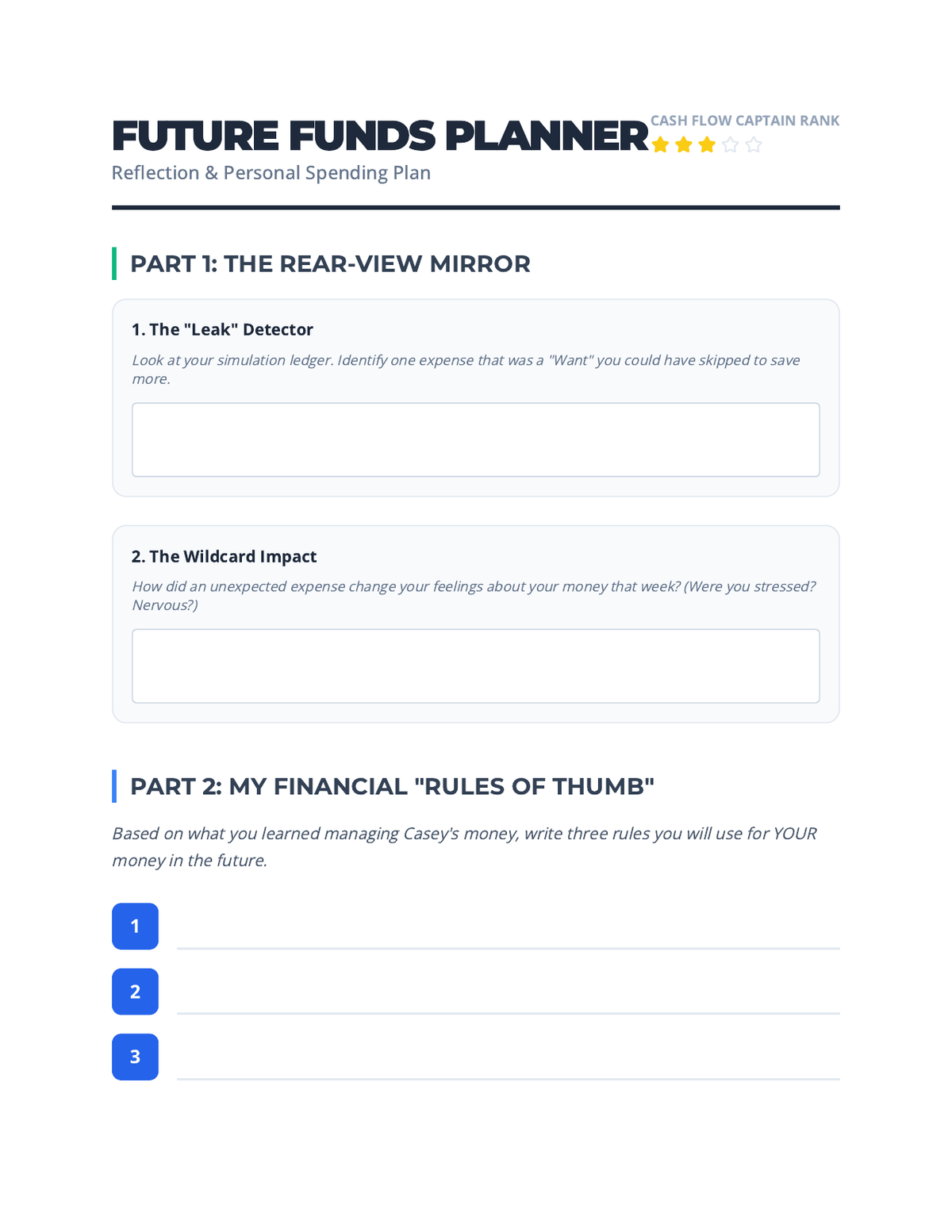
Student reflection and planning worksheet for Lesson 5, allowing students to identify 'spending leaks', set personal financial rules, and draft a balanced monthly budget.
Slide deck for Lesson 5, focusing on identifying spending habits, understanding 'spending leaks', and establishing future 'Rules of Thumb' for financial success.
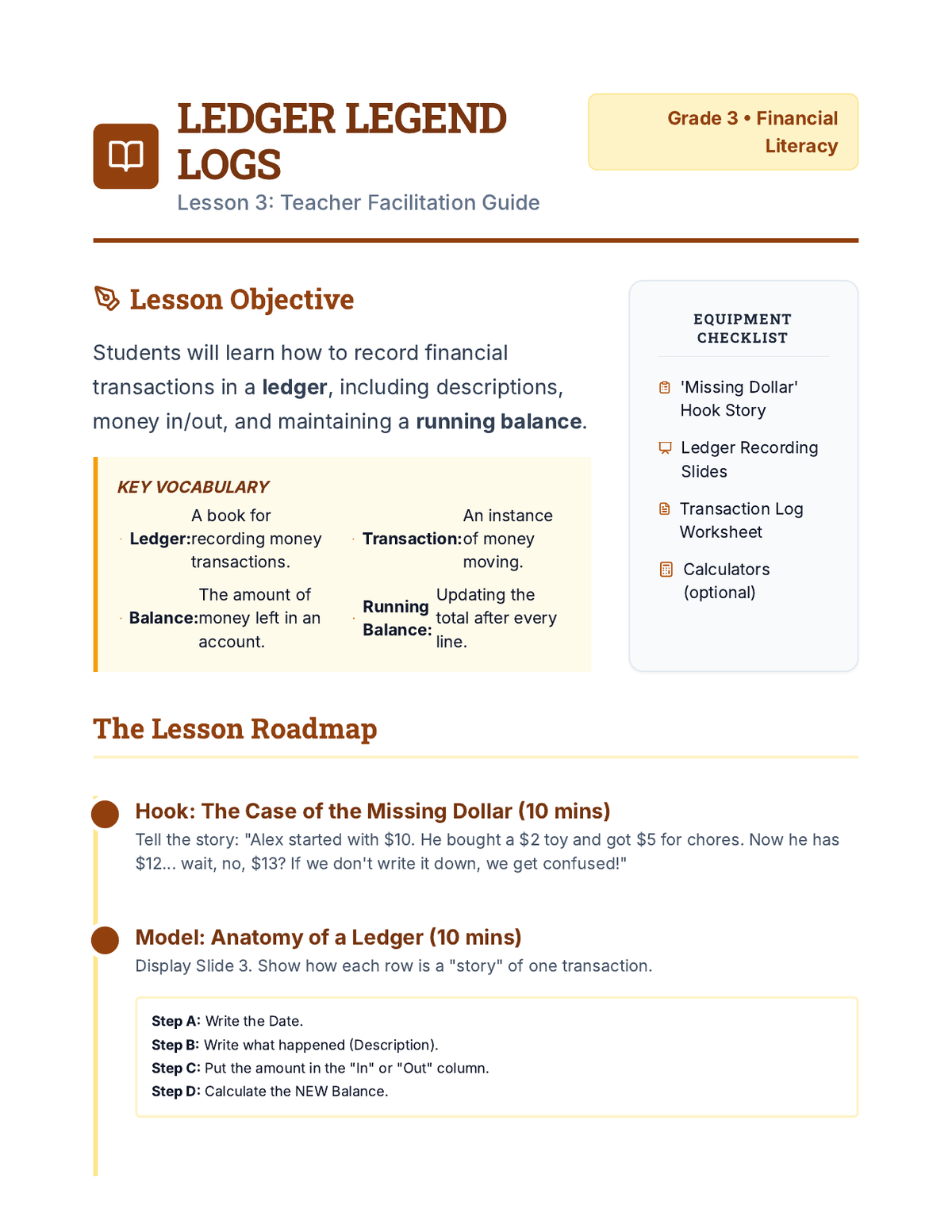
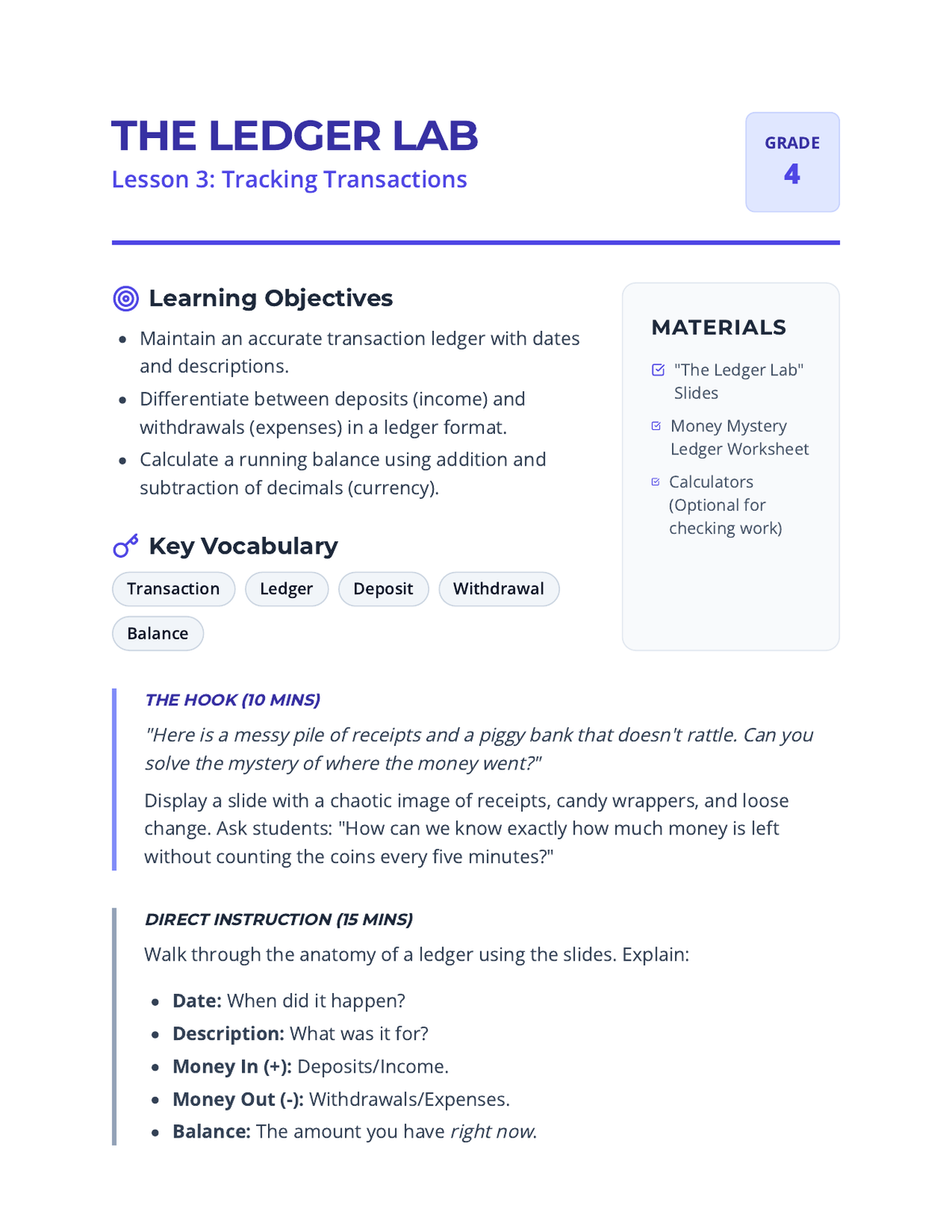
A teacher guide for the lesson on recording transactions in a ledger, focusing on maintaining a running balance and entry accuracy.
Teacher guide for Lesson 3, detailing instructional steps for teaching ledger maintenance and calculating a running balance.
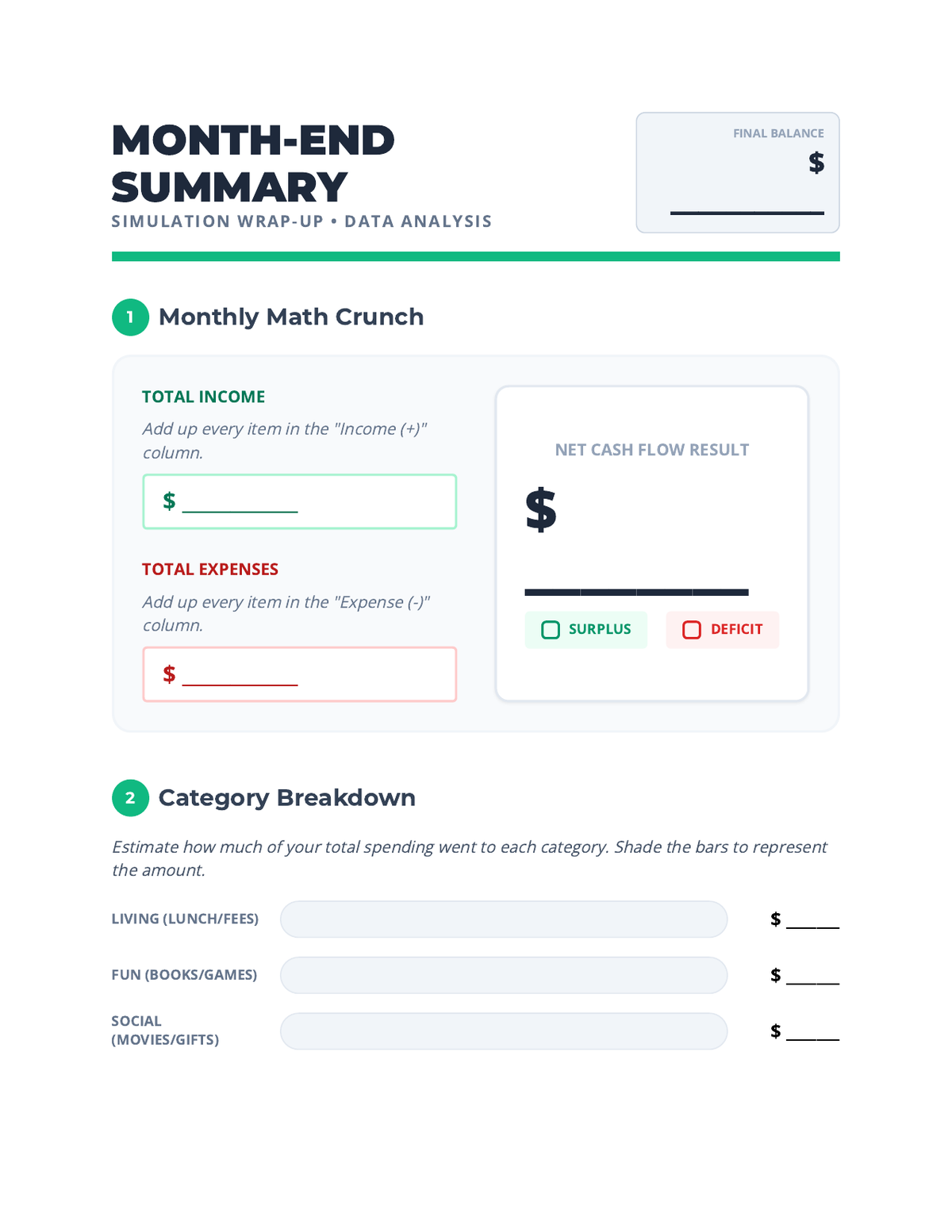
Student worksheet for Lesson 4, used to calculate total income and expenses, determine net cash flow, and visualize spending by category.
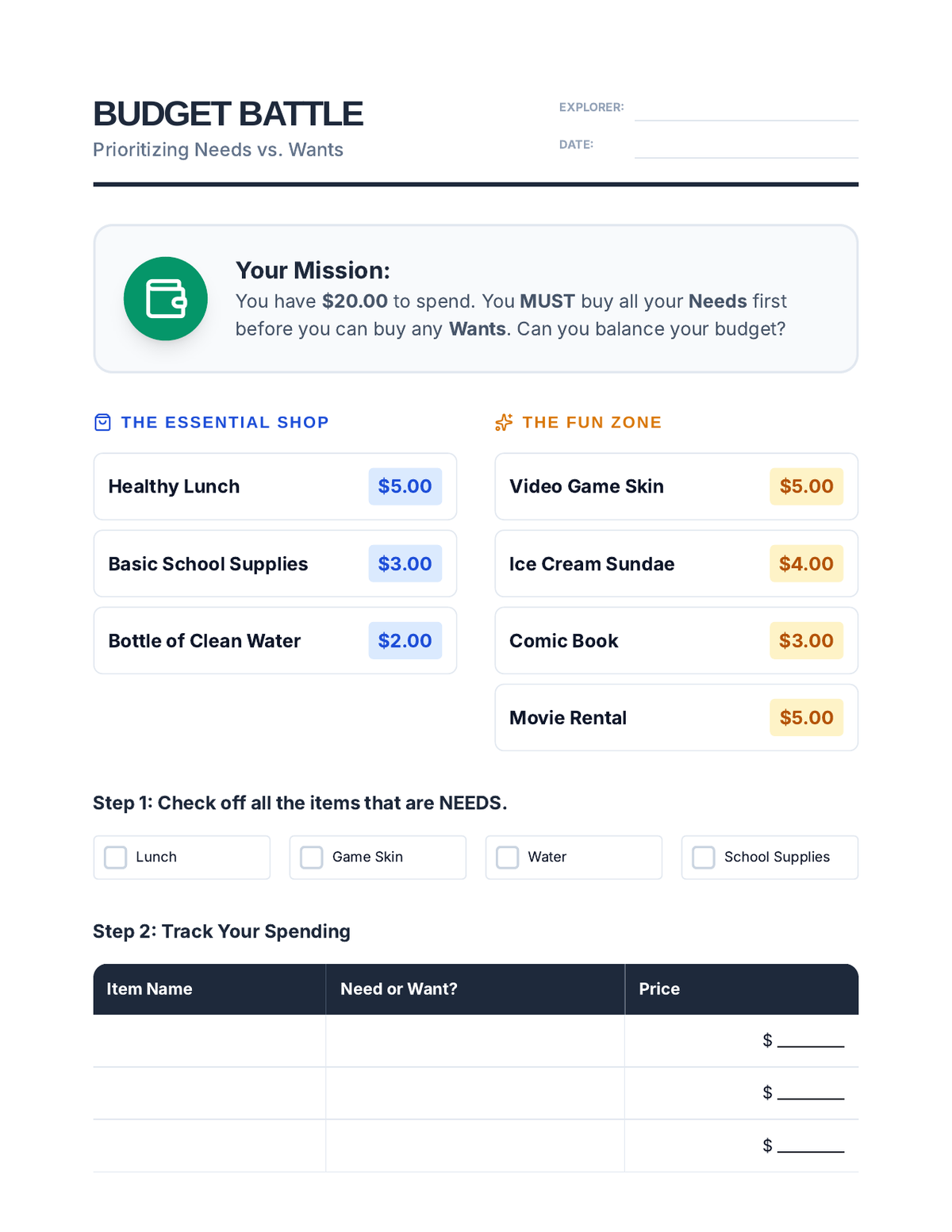
A budget simulation worksheet where students prioritize essential items within a fixed budget.
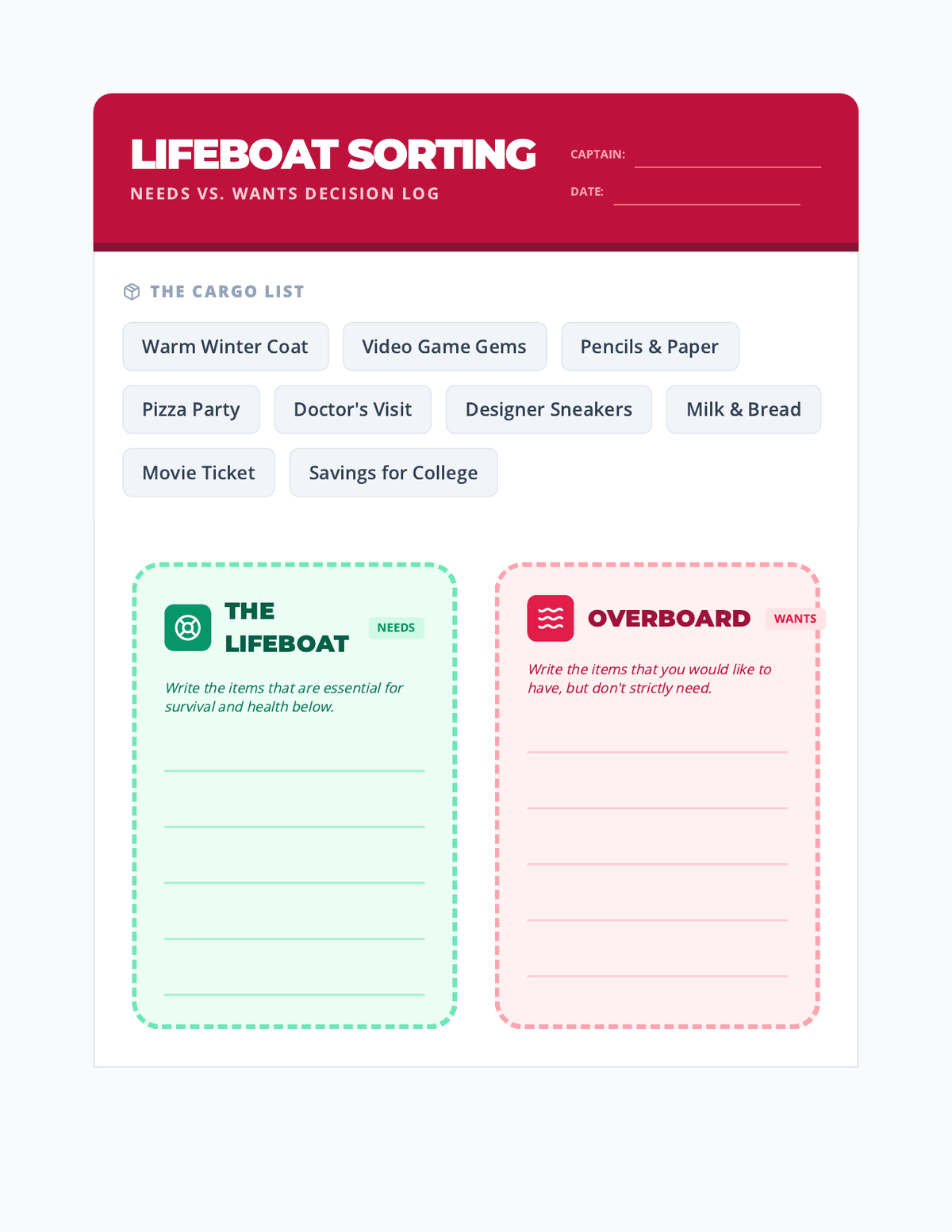
Student worksheet for Lesson 2 featuring a sorting activity for needs and wants and a reflection section on opportunity cost.
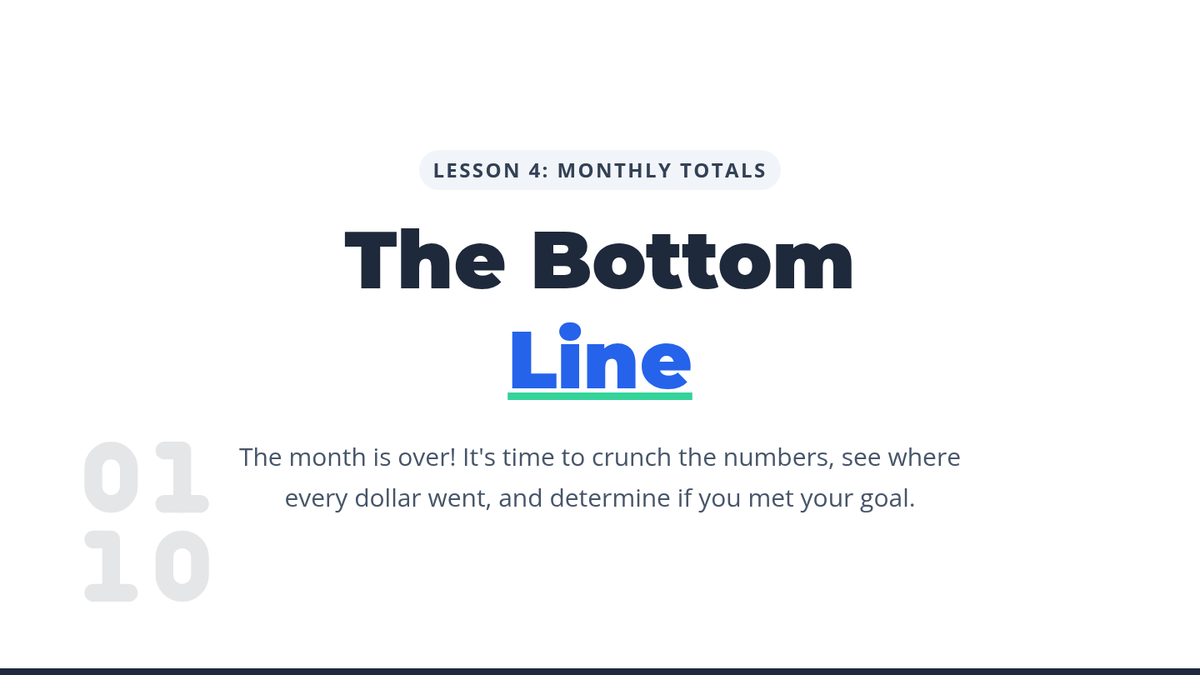
Slide deck for Lesson 4, guiding students through the process of calculating monthly totals, identifying surpluses or deficits, and evaluating their success against their savings goal.
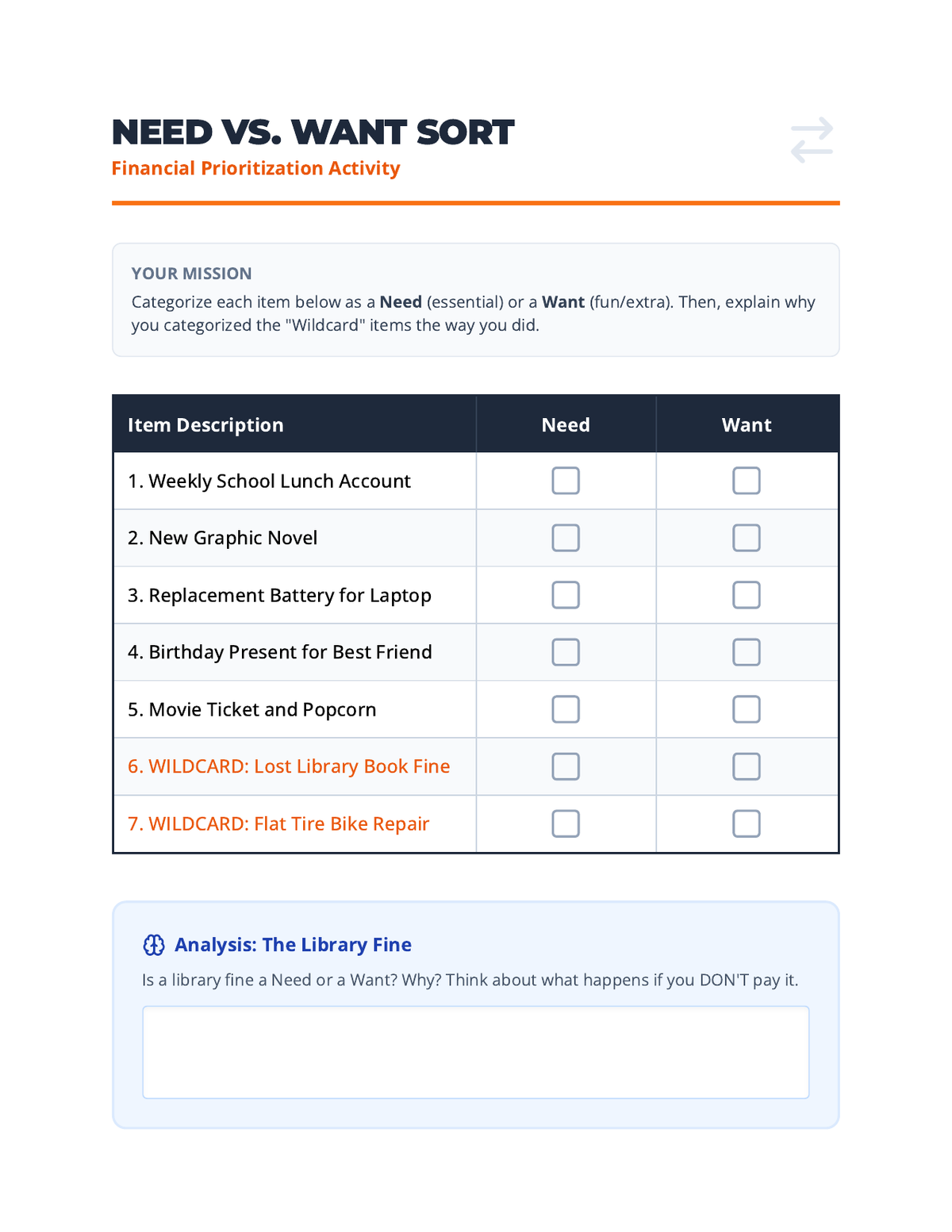
A student worksheet for categorizing expenses as needs or wants, including specific focus on wildcard expenses and their impact on financial planning.
A slide deck for Lesson 2 that visually defines needs and wants and introduces the Budget Battle simulation.
Presentation slides for Lesson 2, illustrating the differences between needs and wants and the concept of opportunity cost.
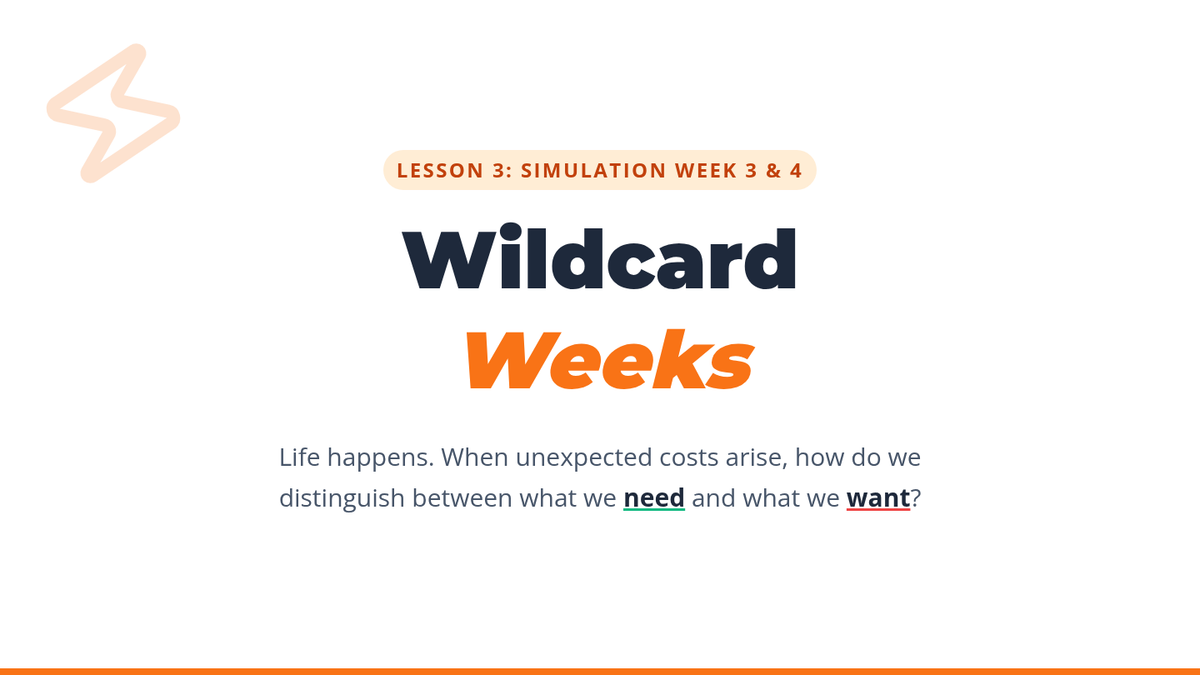
Slide deck for Lesson 3, focusing on the distinction between needs and wants and how unexpected 'wildcard' expenses impact financial plans.
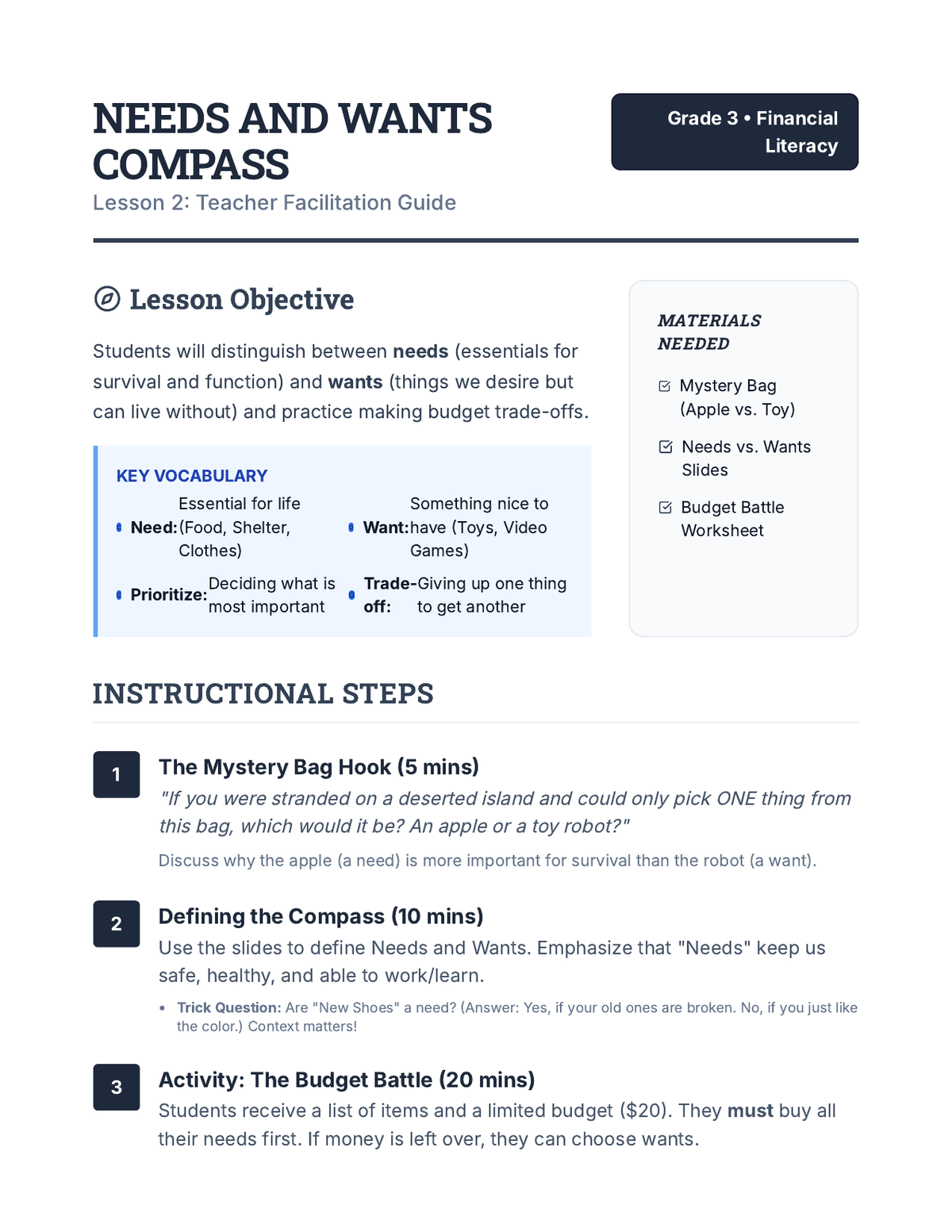
A teacher guide for the lesson on needs versus wants, focusing on prioritization and trade-offs.
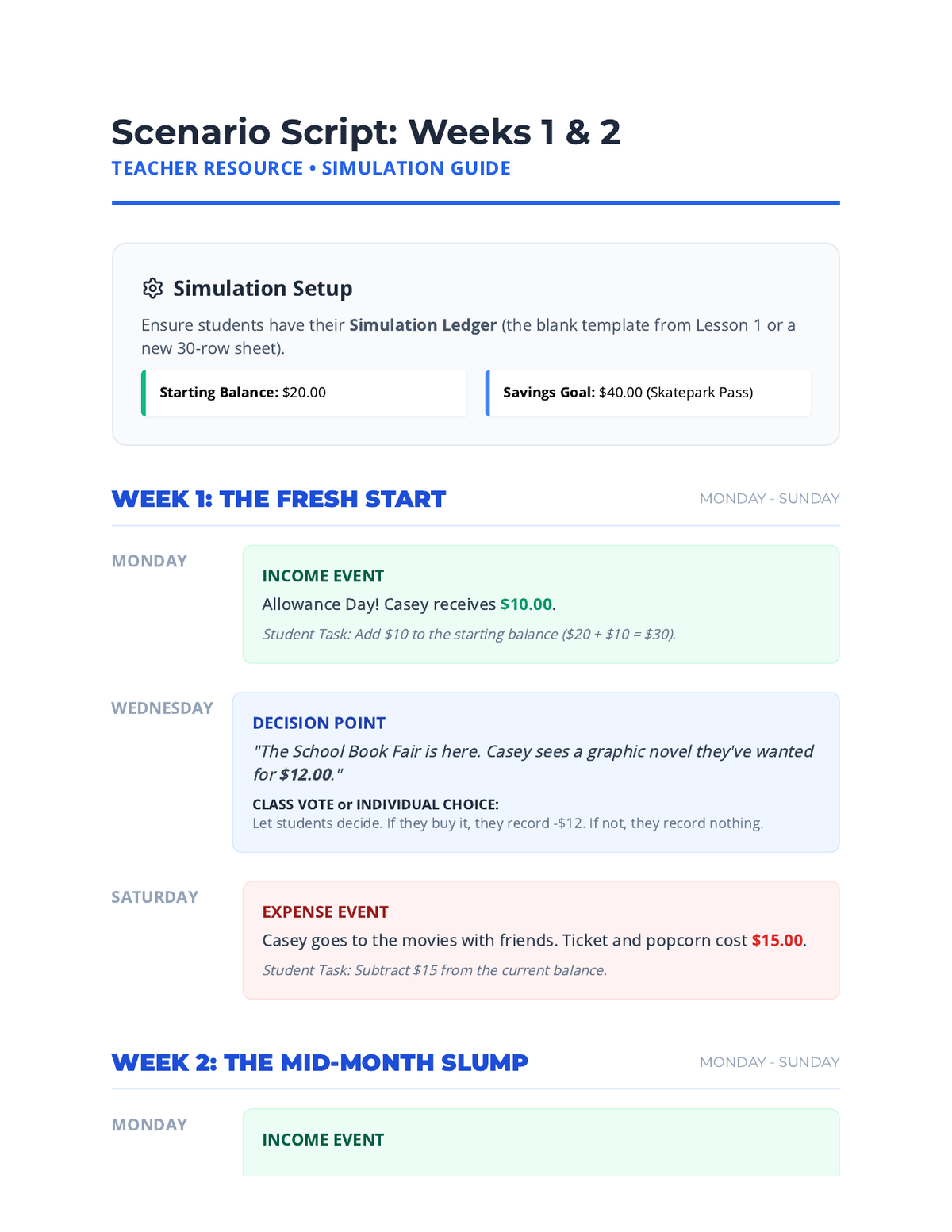
Teacher script for Lesson 2 simulation, providing specific financial scenarios for Weeks 1 and 2 including income, mandatory expenses, and decision points.
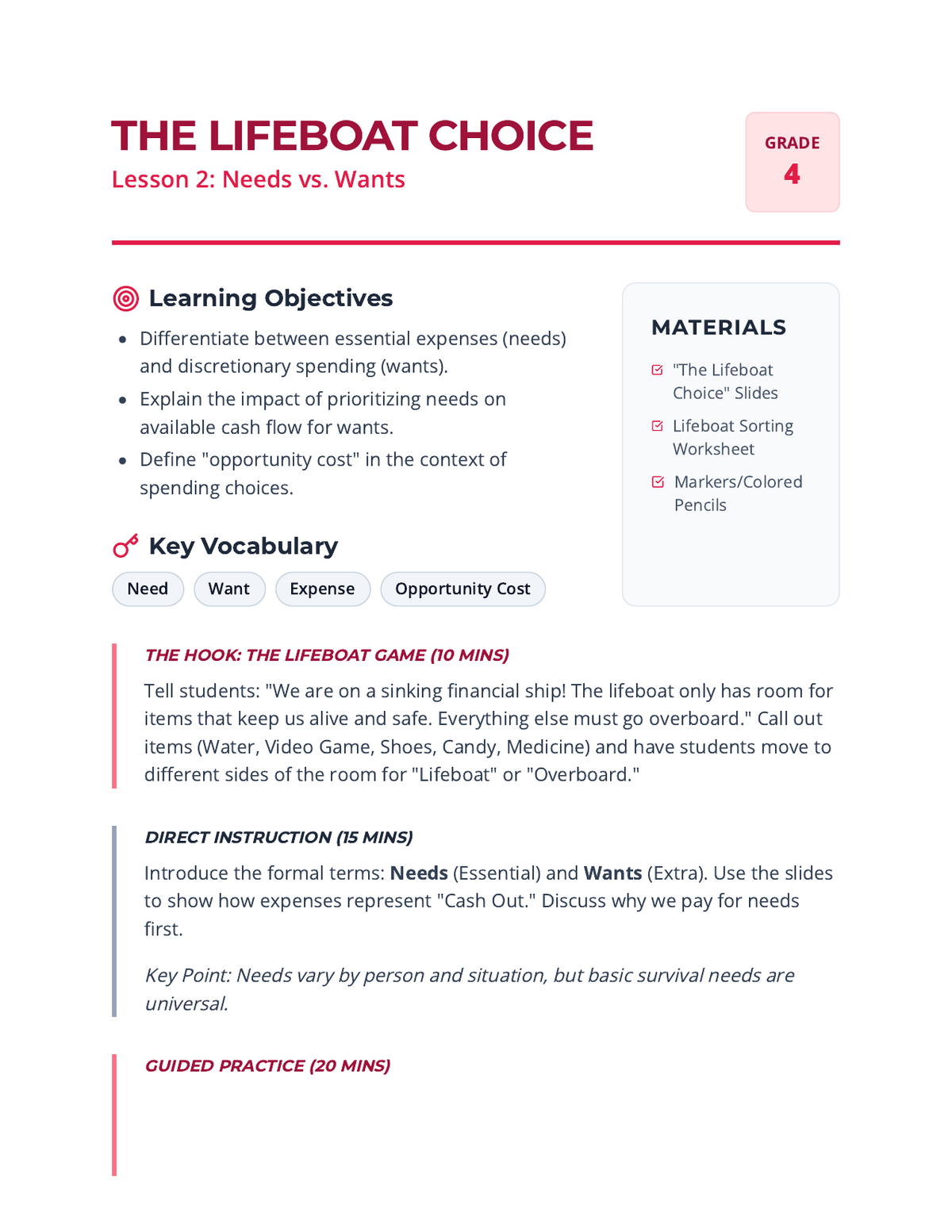
Teacher guide for Lesson 2, providing instructional steps for the 'Lifeboat Choice' game and guidelines for teaching the difference between needs and wants.
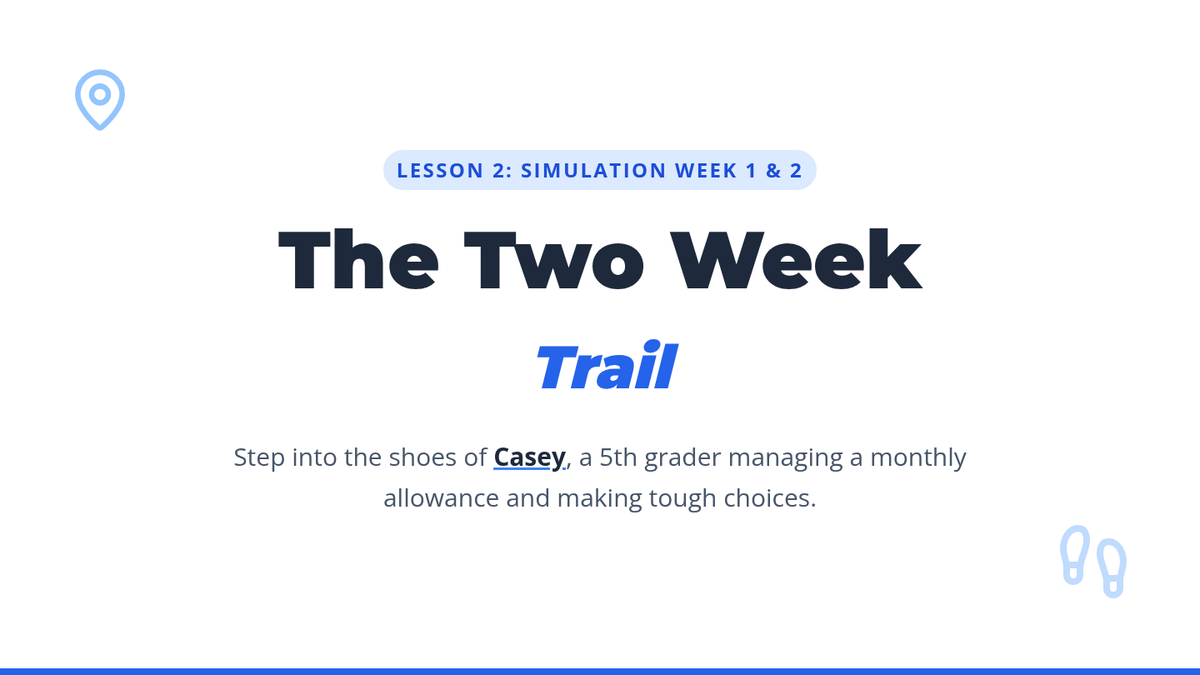
Slide deck for Lesson 2, introducing the character 'Casey' and setting the stage for the month-long financial simulation.
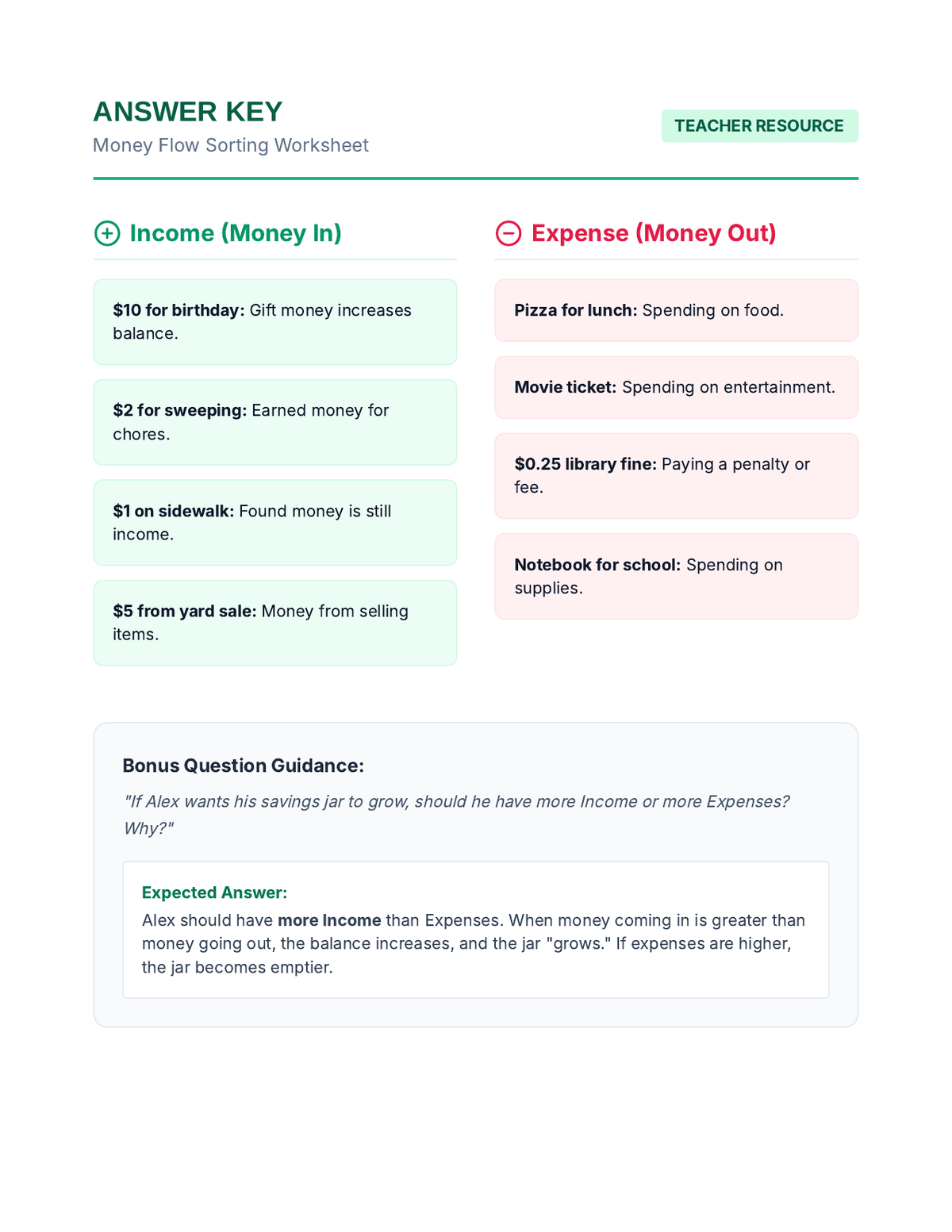
An answer key for the Money Flow Sorting Worksheet to help teachers quickly grade and discuss the sorting activity.
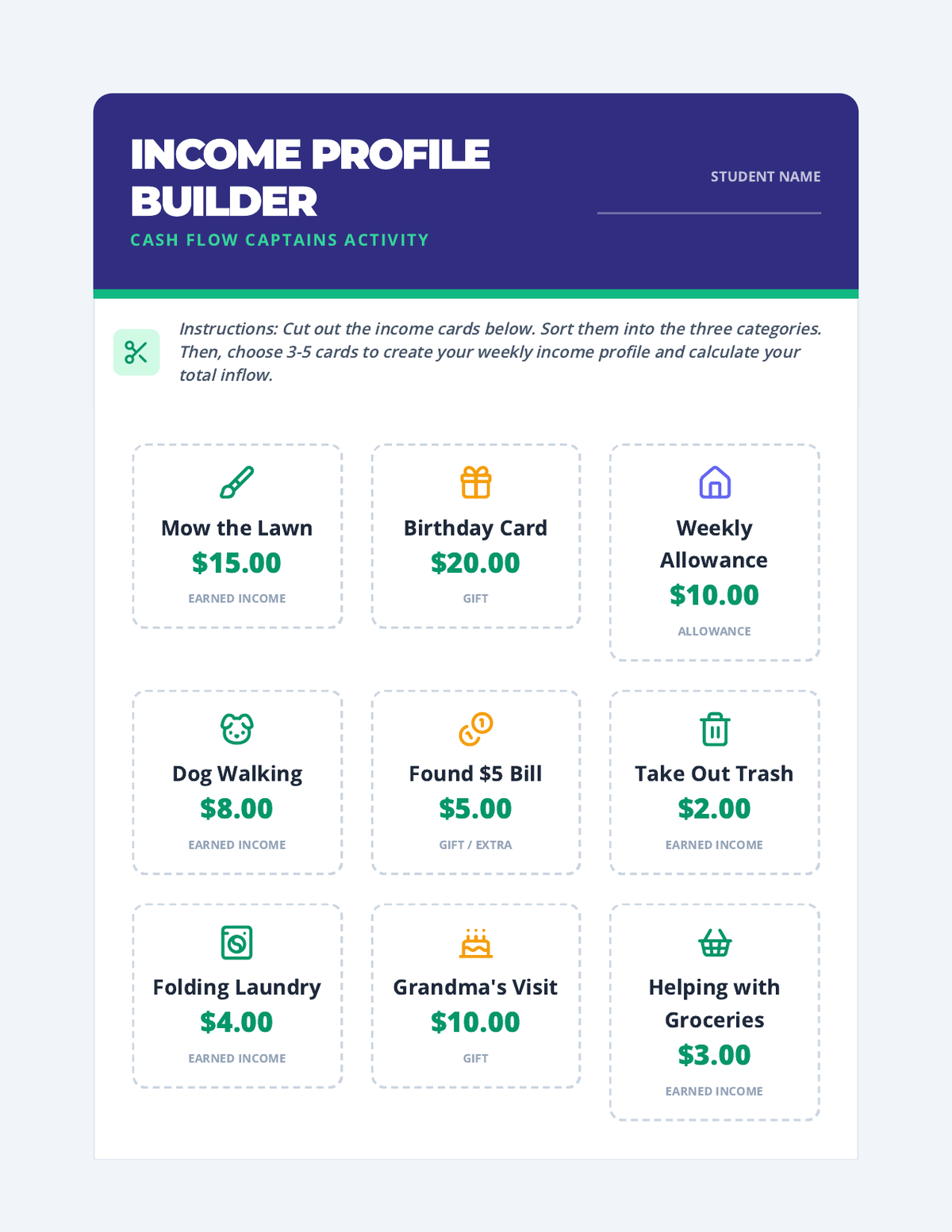
Activity cards for students to cut and sort by income category, with a profile builder section to calculate total weekly inflow.
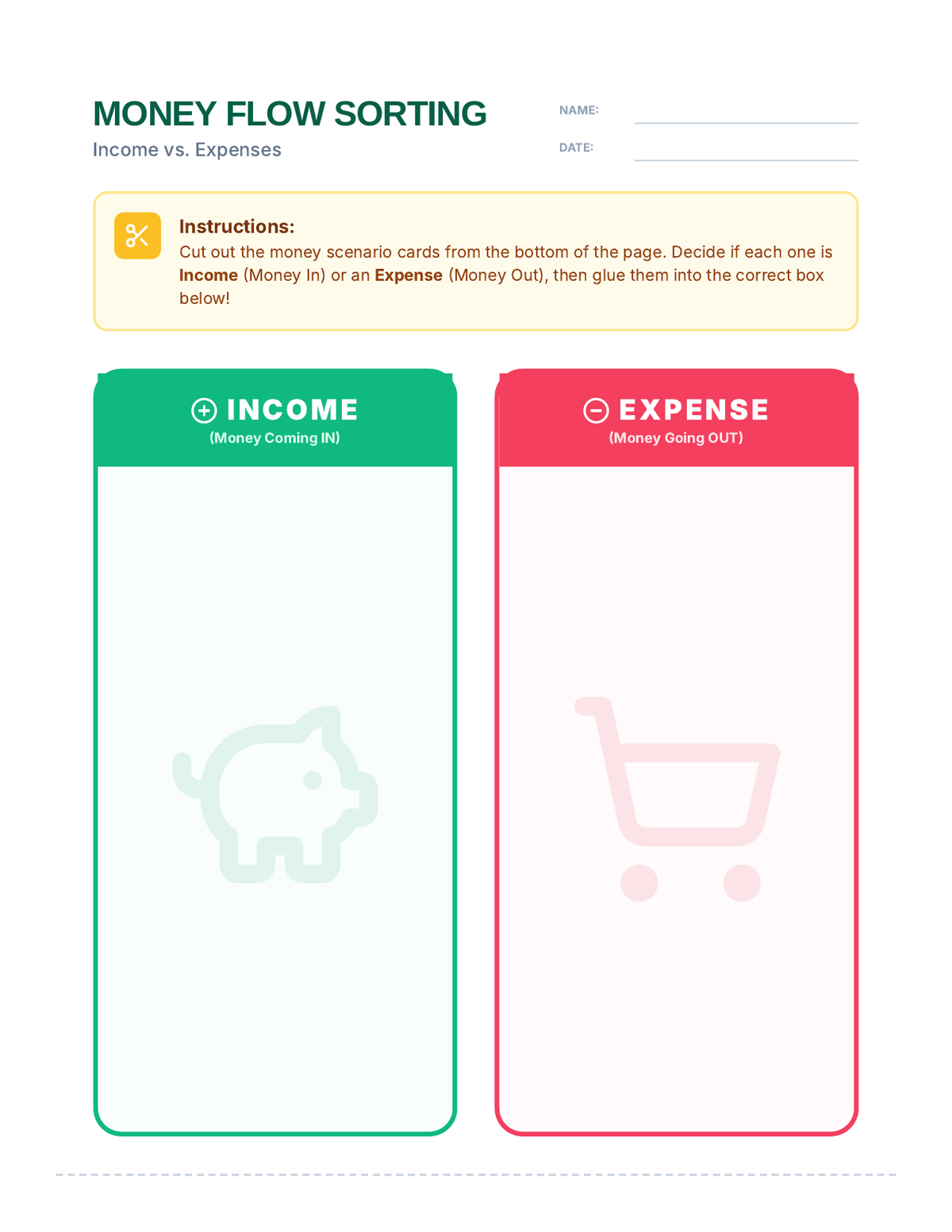
A cut-and-paste sorting activity where students categorize financial scenarios as either income or expenses.
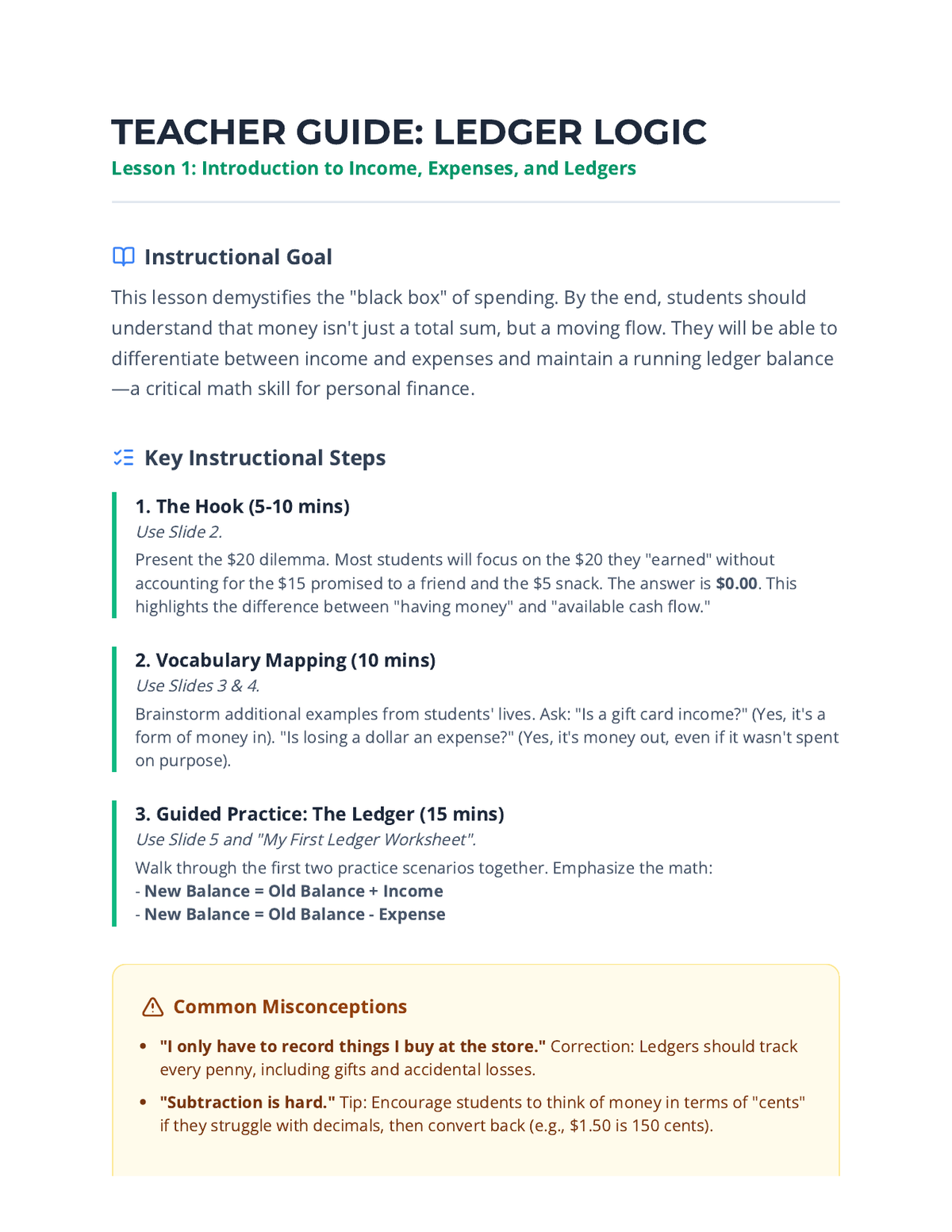
A teacher guide for Lesson 1, providing instructional tips, misconception alerts, and the answer key for the student worksheet.
A student worksheet for practicing ledger entries, calculating running balances, and understanding basic financial transactions.
Introductory slides for Lesson 1 on income sources, defining income and cash inflow with student-friendly examples.
A slide deck introducing the concepts of income (money in) and expenses (money out) with clear definitions and examples.
Introductory slide deck for Lesson 1, covering income, expenses, and the purpose of a financial ledger.
Teacher guide for Lesson 1, detailing learning objectives, vocabulary, instructional steps, and differentiation strategies for teaching income sources.
A teacher guide for the first lesson on distinguishing income from expenses, including hook ideas, vocabulary, and instructional steps.
A culminating project worksheet where students create a 4-week cash flow projection to hit a specific savings goal.
A final reflection worksheet where students evaluate their savings success, analyze their trade-offs, and set goals for future spending.
Final presentation slides for the Savings Success Summit, featuring reflections on trade-offs, mission results, and key financial takeaways.
Introductory slides for the fifth lesson, teaching students how to synthesize their learning to create a balanced cash flow plan.
A worksheet for the mid-month financial review where students calculate their totals, forecast their future balance, and plan spending adjustments.
A simulation activity where students receive unexpected 'Life Happens' cards and must adjust their weekly spending plans to maintain a positive balance.
Slide deck for Lesson 4, teaching students how to monitor their cash flow, identify trends, and forecast their future balance.